
THE FATHER AND THE SON
PART 7 — WHAT DOES “ONE” MEAN?
Understanding John 10 and John 17 Through the Whole Counsel of Elohim
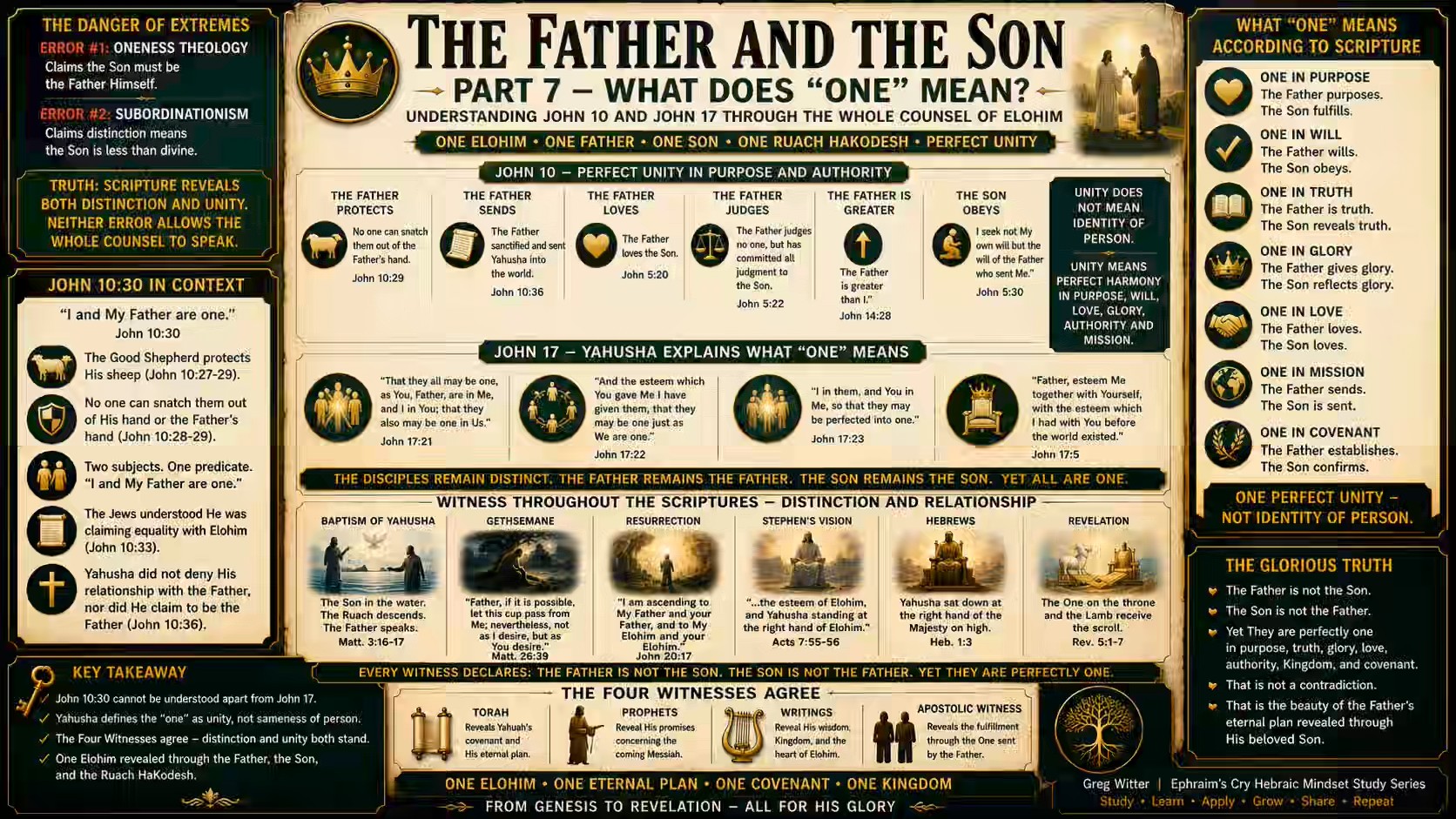
Few statements made by Yahusha have generated more discussion than His declaration, “I and My Father are one” (John 10:30). Entire theological systems have been built upon that single verse. Some conclude that Yahusha was declaring that He and the Father are literally the same person. Others react so strongly against that conclusion that they diminish the unity Yahusha was proclaiming. Both errors arise from isolating one verse instead of allowing the whole counsel of Elohim to define its meaning.
One of the first principles of sound biblical interpretation is that Scripture interprets Scripture. The immediate context must always be considered before drawing doctrinal conclusions. The broader witness of the Scriptures must then be brought alongside it. No single verse should ever be allowed to overturn the testimony of the entire Bible. This is exactly why John 17 is indispensable to understanding John 10. Yahusha Himself defines what He meant by saying, “I and My Father are one.”
The context of John 10 is often overlooked. Yahusha is speaking about the Good Shepherd. He declares that His sheep hear His voice, He knows them, they follow Him, and no one can snatch them out of His hand (John 10:27–28). He then immediately says that no one can snatch them out of His Father’s hand because the Father is greater than all (John 10:29). It is within this context of shared authority, shared protection, and shared purpose that Yahusha declares, “I and My Father are one.”
Notice what the text does not say.
It does not say, “I am the Father.”
It does not say, “The Father became Me.”
It does not say, “We are the same person.”
It says, “I and My Father are one.”
There are two subjects.
“I.”
“My Father.”
Then there is one predicate.
“Are one.”
The statement itself distinguishes the Father and the Son while declaring Their unity.
The Jews immediately attempted to stone Yahusha because they understood that He was making Himself equal with Elohim (John 10:33). Yahusha did not deny His unique relationship with the Father. Neither did He redefine Himself as the Father. Instead, He continued speaking about the One whom the Father had sanctified and sent into the world (John 10:36). Even within the same conversation, the distinction remains.
If John 10 stood alone, some might still debate its meaning.
But John 17 does not allow us to speculate.
On the night before His crucifixion, Yahusha prayed one of the most profound prayers recorded in all of Scripture. In that prayer He explained exactly what He meant by the oneness He shares with the Father.
“That they all may be one, as You, Father, are in Me, and I in You; that they also may be one in Us…” (John 17:21)
Notice the comparison.
The unity of believers is to reflect the unity between the Father and the Son.
Yahusha continues,
“And the glory which You gave Me I have given them, that they may be one just as We are one.” (John 17:22)
Then again,
“I in them, and You in Me, so that they may be perfected into one.” (John 17:23)
Here Yahusha becomes His own interpreter.
The same word “one” used in John 10 is now explained in John 17.
Now ask the obvious question.
If the Father and the Son are one person because of John 10:30, then what does Yahusha mean when He prays that every disciple will become one exactly as They are one?
Do believers become the Father?
Do believers become the Son?
Do millions of disciples somehow merge into one individual?
Of course not.
No believer has ever understood John 17 that way.
Why?
Because the text itself defines the oneness.
It is unity.
Perfect unity.
Not identity of person.
Yahusha is praying that His disciples would become united in truth, united in purpose, united in love, united in obedience, united in mission, and united in covenant, just as He and the Father are perfectly united.
The disciples remain distinct persons.
The Father remains the Father.
The Son remains the Son.
Yet all are one.
John 17 therefore becomes one of the strongest passages refuting the claim that oneness requires one person.
Yahusha Himself defines the nature of that unity.
This understanding also harmonizes with the rest of Scripture.
Throughout the Gospel of John, Yahusha continually distinguishes Himself from the Father.
“The Father loves the Son…” (John 3:35)
“The Father judges no one, but has committed all judgment to the Son.” (John 5:22)
“I seek not My own will but the will of the Father who sent Me.” (John 5:30)
“My teaching is not Mine, but His who sent Me.” (John 7:16)
“I honor My Father…” (John 8:49)
“The Father who sent Me is with Me.” (John 8:29)
“I go to the Father.” (John 14:12)
“The Father is greater than I.” (John 14:28)
These statements are not isolated.
They are repeated throughout Yahusha’s ministry.
They reveal genuine relationship.
Not role-playing.
Not changing manifestations.
Not conversations with Himself.
Relationship.
John 17 also contains another profound truth often overlooked.
Yahusha prays,
“Father, esteem Me together with Yourself, with the esteem which I had with You before the world existed.” (John 17:5)
Later He says,
“…for You loved Me before the foundation of the world.” (John 17:24)
Before creation…
The Father loved the Son.
The Son shared glory with the Father.
This is not language of one person pretending to converse with Himself.
It is the revelation of an eternal relationship that existed before the world began.
The more we allow Scripture to interpret Scripture, the clearer the picture becomes.
The Father sends.
The Son is sent.
The Father loves.
The Son loves.
The Father glorifies.
The Son glorifies.
The Father gives.
The Son receives.
The Father speaks.
The Son obeys.
The Father exalts.
The Son is exalted.
The Father remains the Father.
The Son remains the Son.
Yet They are perfectly one.
This is the beauty of biblical revelation.
Scripture never forces us to choose between unity and distinction.
It reveals both.
The error of Oneness theology is that it confuses unity with identity of person.
The error of those who deny the Son’s divine glory is that they confuse distinction with separation.
The Scriptures teach neither.
Instead, they reveal one Elohim working in perfect harmony through the Father, the Son, and the Ruach HaKodesh according to the eternal plan established before the foundation of the world.
John 10 cannot be understood apart from John 17.
John 17 cannot be separated from the rest of Scripture.
The Four Witnesses agree.
The Father is not the Son.
The Son is not the Father.
Yet They are perfectly one in purpose, truth, glory, love, authority, Kingdom, and covenant.
That is not a contradiction.
That is the testimony of the whole counsel of Elohim.
Greg Witter | Ephraim’s Cry Hebraic Mindset Study Series
Study • Learn • Apply • Grow • Share • Repeat
#EphraimsCry #GregWitter #HebraicMindset #HebraicMindsetStudySeries #FatherAndSon #John10 #John17 #OneElohim
#WholeCounselOfElohim #ScriptureInterpretsScripture #Torah #Prophets #Writings #ApostolicWitness #KingdomOfElohim
#GospelOfTheKingdom #TruthMatters #Discernment #Covenant #UnityWithoutConfusion #IdentityAndRelationship #BibleStudy
#KingdomPreparation #StudyLearnApplyGrowShareRepeat
