
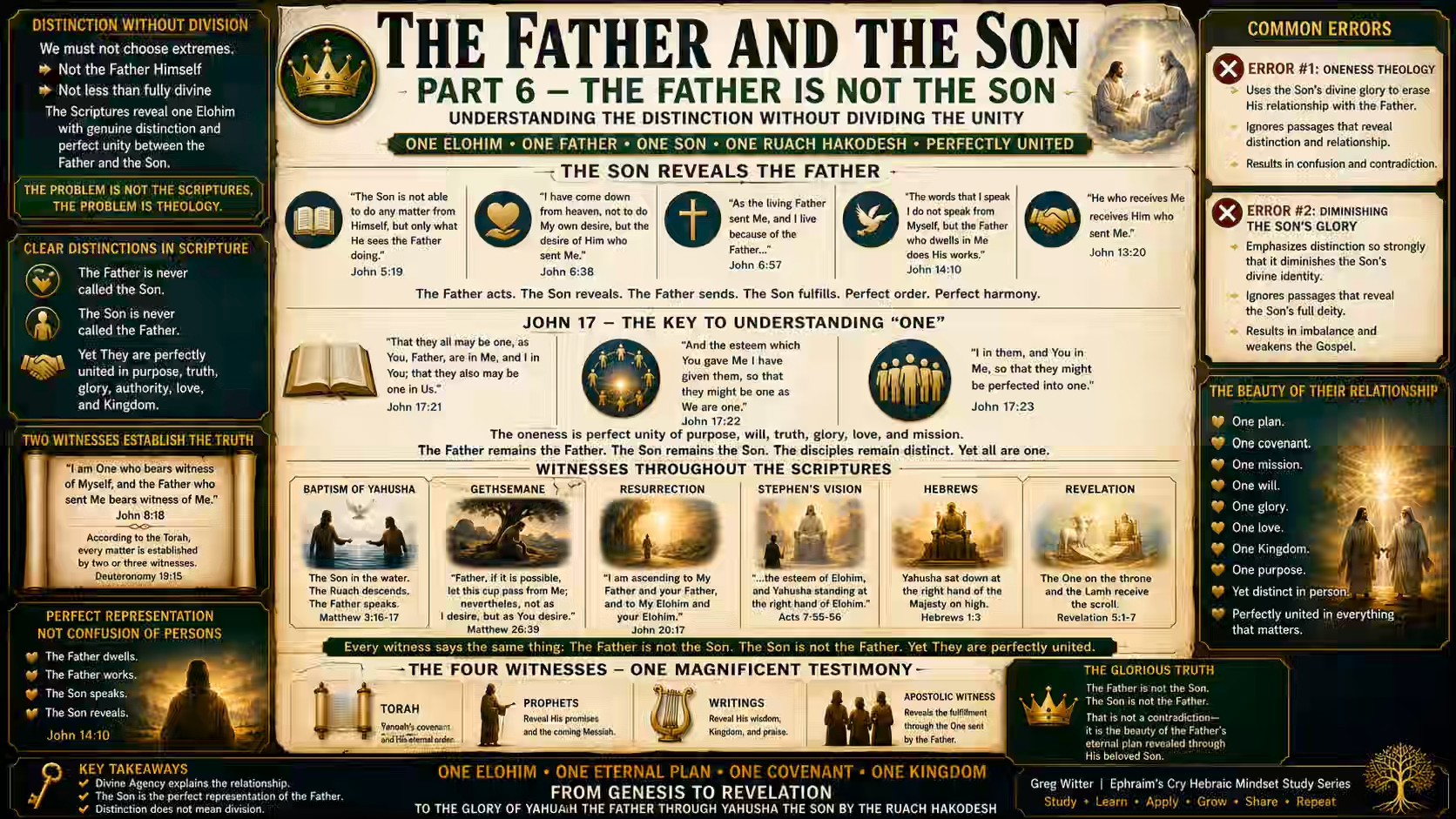
THE FATHER AND THE SON
PART 6 — THE FATHER IS NOT THE SON
Understanding the Distinction Without Dividing the Unity
One of the greatest errors in the discussion concerning the Father and the Son is the assumption that we must choose between distinction and unity. One theological system insists that if Yahusha is truly divine, then He must literally be the Father Himself. Another insists that if the Father and the Son are distinct, then the Son must somehow be less than fully divine. The Scriptures teach neither position. Instead, they consistently reveal one Elohim while maintaining the genuine distinction and relationship between the Father and the Son.
This distinction is not hidden in a few isolated passages. It is woven throughout the entire biblical record. The Father is never called the Son. The Son is never called the Father. Yet They are perfectly united in purpose, truth, glory, authority, love, and Kingdom. The problem is not with the Scriptures. The problem is with theological systems that refuse to allow every witness to speak.
Perhaps nowhere is this relationship more clearly seen than in the Gospel of John. Yahusha repeatedly distinguishes Himself from the Father while simultaneously revealing perfect unity with Him.
In John 5, after healing the lame man on the Sabbath, Yahusha declares,
“The Son is not able to do any matter from Himself, but only what He sees the Father doing. For whatever He does, the Son likewise also does.” (John 5:19)
Notice the relationship.
The Father acts.
The Son perfectly reveals the Father’s actions.
The Father shows.
The Son accomplishes.
The Father loves the Son and shows Him all that He Himself is doing (John 5:20).
This is not the language of one person pretending to have a relationship with Himself.
It is the language of genuine relationship.
Yahusha continues,
“For as the Father raises the dead and makes alive, so also the Son makes alive whom He wishes.” (John 5:21)
The Father judges no one, but has committed all judgment to the Son (John 5:22).
Again we see perfect order.
The Father entrusts.
The Son carries out.
The Father sends.
The Son fulfills.
The relationship remains intact.
John 8 continues this same testimony.
“I know where I came from and where I am going… I am One who bears witness of Myself, and the Father who sent Me bears witness of Me.” (John 8:14–18)
According to the Torah, every matter is established by two or three witnesses (Deuteronomy 19:15).
If the Father and the Son are literally the same person, then Yahusha’s appeal to two witnesses becomes meaningless.
He specifically distinguishes His own testimony from that of the Father.
The Father is one witness.
The Son is another witness.
Together They establish the truth.
Again Yahusha declares,
“I do nothing from Myself, but as My Father taught Me, these words I speak.” (John 8:28)
“He who sent Me is with Me. The Father has not left Me alone.” (John 8:29)
These are not isolated expressions.
They are repeated throughout His ministry because they reveal the relationship that exists between the Father and the Son.
John 14 is perhaps one of the most misunderstood chapters in the entire discussion.
Philip asks,
“Master, show us the Father, and it is enough for us.”
Yahusha replies,
“He who has seen Me has seen the Father.” (John 14:9)
Many stop reading at that statement.
The context does not.
Yahusha immediately explains what He means.
“Do you not believe that I am in the Father, and the Father in Me? The words that I speak to you I do not speak from Myself, but the Father who dwells in Me does His works.” (John 14:10)
Again…
The Father dwells.
The Father works.
The Son speaks.
The Son reveals.
This is perfect representation.
Not confusion of persons.
The climax of this discussion comes in John 17.
This chapter alone destroys the claim that “one” means one person.
Yahusha prays,
“That they all may be one, as You, Father, are in Me, and I in You; that they also may be one in Us.” (John 17:21)
He continues,
“And the esteem which You gave Me I have given them, so that they might be one as We are one.” (John 17:22)
Then He says,
“I in them, and You in Me, so that they might be perfected into one.” (John 17:23)
This is Yahusha’s own explanation of His earlier statement,
“I and My Father are one.” (John 10:30)
The obvious question must now be asked.
If “I and My Father are one” means that the Father and the Son are literally one person, then what does Yahusha mean when He prays that every believer will become one exactly as They are one?
Do believers become the Father?
Do believers become the Son?
Do millions of believers somehow merge into one person?
Of course not.
No one believes that because the text itself will not allow it.
Yahusha’s own prayer becomes the greatest refutation of the Oneness doctrine because He defines His own words.
The oneness He describes is perfect unity of purpose.
Perfect unity of will.
Perfect unity of truth.
Perfect unity of glory.
Perfect unity of love.
Perfect unity of mission.
Perfect covenant relationship.
The disciples remain distinct persons while becoming one.
Likewise, the Father remains the Father.
The Son remains the Son.
Yet They are perfectly one.
John 17 becomes the greatest internal commentary on John 10.
Yahusha Himself tells us what He meant.
The Scriptures continue presenting this relationship throughout the remaining Apostolic Witness.
At the baptism of Yahusha, the Son stands in the Jordan.
The Ruach HaKodesh descends like a dove.
The Father’s voice speaks from heaven:
“This is My beloved Son, in whom I delight.” (Matthew 3:16–17)
All three are present simultaneously.
Nothing in the passage suggests one person merely changing manifestations.
Instead, the event beautifully reveals the harmony of the Father, the Son, and the Ruach HaKodesh in the inauguration of Messiah’s earthly ministry.
The same pattern appears at Gethsemane.
Yahusha prays,
“Father, if it is possible, let this cup pass from Me; nevertheless, not as I desire, but as You desire.” (Matthew 26:39)
If the Father and the Son are the same person, whose will is being submitted?
Who is praying?
Who is listening?
Who answers?
The relationship is genuine because the Scriptures consistently reveal it as genuine.
Following the resurrection, Yahusha says,
“I am ascending to My Father and your Father, and to My Elohim and your Elohim.” (John 20:17)
Stephen later sees,
“…the esteem of Elohim, and Yahusha standing at the right hand of Elohim.” (Acts 7:55–56)
Hebrews declares that Yahusha sat down at the right hand of the Majesty on high (Hebrews 1:3).
Revelation shows the One seated upon the throne and the Lamb approaching to receive the scroll (Revelation 5:1–7).
Every witness says the same thing.
The Father is not the Son.
The Son is not the Father.
Yet They are perfectly united.
The error of Oneness theology is not that it exalts Yahusha too highly.
Scripture itself exalts Him above every name.
The error is that it refuses to let all of Scripture speak.
It takes passages revealing Yahusha’s divine glory and uses them to erase the equally clear passages revealing His relationship with the Father.
The opposite error does the reverse.
It emphasizes distinction so strongly that it diminishes the Son’s glory and divine identity.
Both errors arise because one group of Scriptures is allowed to silence another.
The Four Witnesses never do that.
They reveal one magnificent testimony.
One Elohim.
One Father.
One Son.
One Ruach HaKodesh.
Perfect unity.
Perfect relationship.
Perfect harmony.
Perfect redemption.
The Father is not the Son.
The Son is not the Father.
That is not a contradiction.
It is the beauty of the Father’s eternal plan revealed through His beloved Son.
Greg Witter | Ephraim’s Cry Hebraic Mindset Study Series
Study • Learn • Apply • Grow • Share • Repeat
#EphraimsCry #GregWitter #HebraicMindset #HebraicMindsetStudySeries #FatherAndSon #John17 #John10 #John14
#John8 #John5 #Matthew3 #Gethsemane #Acts7 #Hebrews1 #Revelation5 #WholeCounselOfElohim #Torah #Prophets
#Writings #ApostolicWitness #OneElohim #ScriptureInterpretsScripture #KingdomOfElohim #GospelOfTheKingdom
#TruthMatters #Discernment #StudyLearnApplyGrowShareRepeat
