
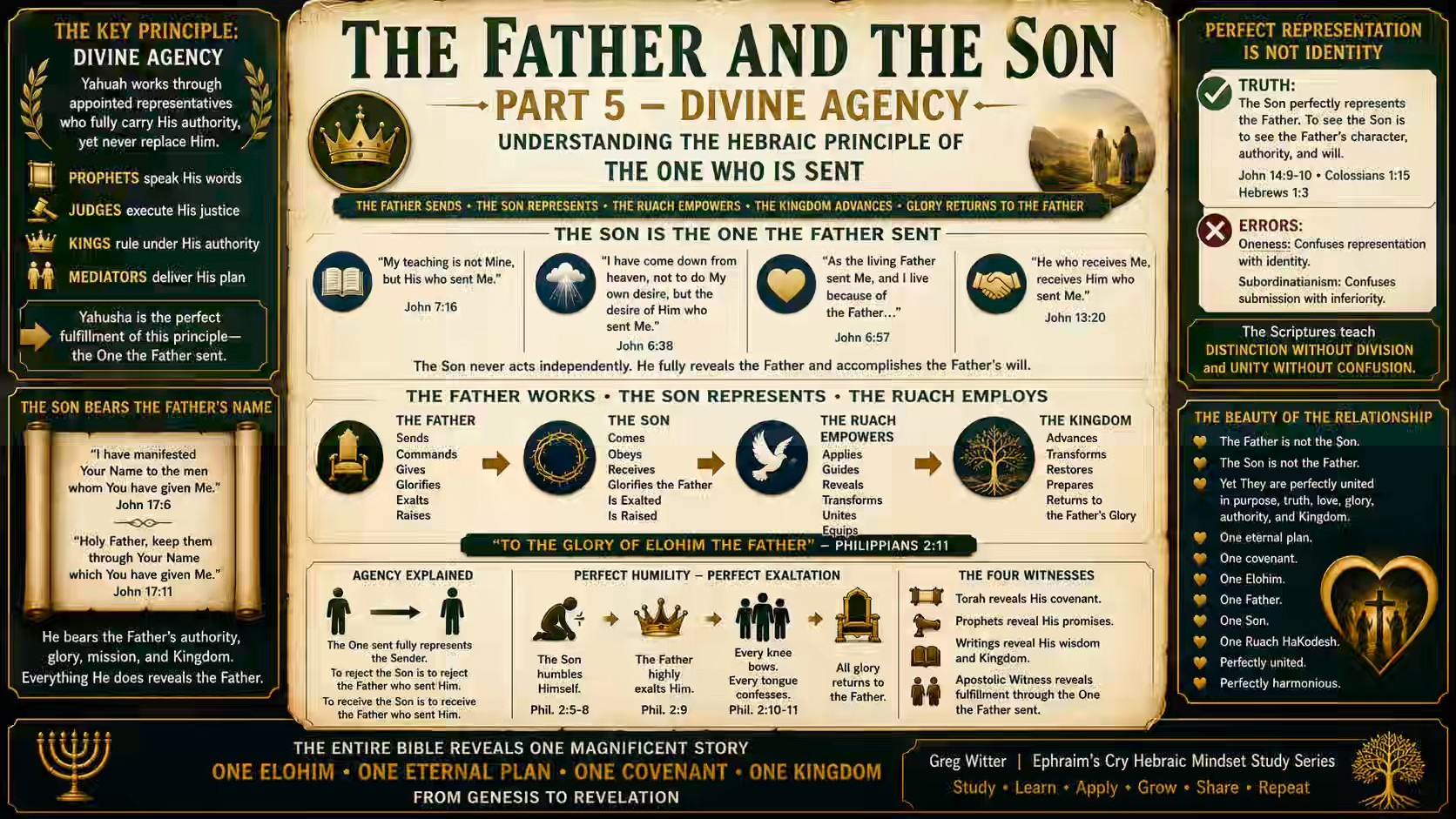
THE FATHER AND THE SON
PART 5 — DIVINE AGENCY
Understanding the Hebraic Principle of the One Who Is Sent
One of the greatest keys to understanding the relationship between the Father and the Son is a biblical principle that has largely been lost in modern theology: divine agency. Many of the passages that have divided believers for centuries become remarkably clear once this Hebraic principle is understood. Without it, people often find themselves forced into one of two extremes. Either they conclude that Yahusha must be the Father because He speaks and acts with the Father’s authority, or they conclude that because He is sent by the Father He must therefore be something less than fully divine. Both conclusions fail to recognize how the Scriptures consistently present the One whom the Father sent.
Throughout the Scriptures, Yahuah repeatedly works through appointed representatives. He speaks through prophets. He judges through judges. He reigns through kings. He delivers through mediators. These individuals never replace Yahuah, nor do they diminish His authority. Rather, they function as His appointed representatives, carrying His authority into the situations to which they are sent. This pattern reaches its perfect fulfillment in Yahusha the Messiah.
The Scriptures repeatedly emphasize that Yahusha is the One whom the Father sent. This is not a minor theme hidden within a few verses. It is one of the defining characteristics of His entire ministry.
“My teaching is not Mine, but His who sent Me.” (John 7:16)
“I have come down from heaven, not to do My own desire, but the desire of Him who sent Me.” (John 6:38)
“As the living Father sent Me, and I live because of the Father…” (John 6:57)
“He who receives Me receives Him who sent Me.” (John 13:20)
Again and again, Yahusha directs attention back to the Father. His purpose is never to draw people away from the Father but to reveal Him perfectly.
This is precisely where many misunderstand the biblical witness. They hear Yahusha speaking with absolute authority, forgiving sins, commanding nature, raising the dead, judging mankind, and receiving worship, and they assume there can be only one explanation: either He must literally be the Father Himself, or He must somehow be competing with the Father for authority.
The Scriptures teach neither.
The Father never loses His authority by sending the Son.
The Son never acts independently of the Father.
Instead, the Son perfectly reveals the Father because He perfectly represents the Father.
This principle is seen repeatedly throughout John’s Gospel.
“The words that I speak to you I do not speak from Myself, but the Father who dwells in Me does His works.” (John 14:10)
Notice the relationship.
The Father is working.
The Son is speaking.
The Father is acting through the Son.
The Son is perfectly revealing the Father.
The relationship is one of complete harmony, not competition.
This also explains one of Yahusha’s most misunderstood statements.
“He who has seen Me has seen the Father.” (John 14:9)
Many stop reading at that sentence and conclude that Yahusha must literally be the Father.
But Yahusha immediately explains what He means.
“Do you not believe that I am in the Father, and the Father in Me? The words that I speak I do not speak from Myself…” (John 14:10)
The context defines the statement.
Seeing Yahusha is seeing the Father because Yahusha perfectly reveals the Father’s character, authority, glory, and will.
He is the visible image of the invisible Elohim.
Paul explains this beautifully.
“He is the image of the invisible Elohim…” (Colossians 1:15)
The writer of Hebrews says,
“He is the brightness of His glory and the exact representation of His being…” (Hebrews 1:3)
An image reveals what cannot otherwise be seen.
A representation perfectly reflects the original.
Neither statement eliminates the distinction between the One revealed and the One revealing.
Rather, they establish the perfect relationship between them.
Agency also explains why Yahusha bears the Father’s Name.
In John 17 Yahusha prays,
“I have manifested Your Name to the men whom You have given Me…” (John 17:6)
Later He says,
“Holy Father, keep them through Your Name which You have given Me…” (John 17:11)
The Son bears the Father’s Name because He comes as the Father’s perfect representative.
He bears the Father’s authority.
He bears the Father’s glory.
He bears the Father’s mission.
He bears the Father’s Kingdom.
Everything He does reveals the Father.
Everything He says reveals the Father.
Everything He accomplishes fulfills the Father’s eternal purpose.
This principle becomes even clearer when we examine Yahusha’s works.
The Father sends.
The Son accomplishes.
The Father commands.
The Son obeys.
The Father gives.
The Son receives.
The Father glorifies.
The Son glorifies the Father.
The Father exalts.
The Son is exalted.
The Father raises.
The Son is raised.
This is not inequality.
It is divine order.
It is covenant order.
It is Kingdom order.
One of the greatest errors of Oneness theology is confusing perfect representation with identity of person.
The other great error is confusing submission with inferiority.
The Scriptures teach neither.
Perfect representation does not erase distinction.
Perfect submission does not diminish glory.
Yahusha’s obedience demonstrates His perfection.
His submission demonstrates His righteousness.
His faithfulness reveals the Father’s heart.
Philippians 2 beautifully illustrates this order.
The Son humbles Himself.
The Father highly exalts Him.
Every knee bows before Yahusha.
Every tongue confesses Yahusha Messiah as Master.
Why?
“To the glory of Elohim the Father.”
The Son’s exaltation magnifies the Father.
The Father’s plan magnifies the Son.
There is no competition.
There is no confusion.
There is only perfect covenant harmony.
This same principle appears throughout the Four Witnesses.
Torah reveals Yahuah’s covenant.
The Prophets reveal His promises.
The Writings reveal His wisdom and Kingdom.
The Apostolic Witness reveals the fulfillment of that covenant through the One whom the Father sent.
The entire Bible moves in one direction.
The Father purposes.
The Son accomplishes.
The Ruach HaKodesh empowers.
The Kingdom advances.
Everything returns to the glory of the Father.
When we understand divine agency from a Hebraic mindset, many of the arguments that have divided believers begin to disappear.
The Scriptures no longer appear contradictory.
Instead, they reveal one magnificent story.
One Elohim.
One eternal plan.
One covenant.
One Kingdom.
One Father.
One Son.
One Ruach HaKodesh.
Perfectly united.
Perfectly harmonious.
Perfectly revealing the wisdom, love, and glory of Elohim from Genesis to Revelation.
Greg Witter | Ephraim’s Cry Hebraic Mindset Study Series
Study • Learn • Apply • Grow • Share • Repeat
#EphraimsCry #GregWitter #HebraicMindset #HebraicMindsetStudySeries #FatherAndSon #DivineAgency #Shaliach
#Yahuah #Yahusha #WholeCounselOfElohim #Torah #Prophets #Writings #ApostolicWitness #John14 #John17
#Colossians1 #Hebrews1 #Philippians2 #KingdomOfElohim #GospelOfTheKingdom #ScriptureInterpretsScripture
#Covenant
