
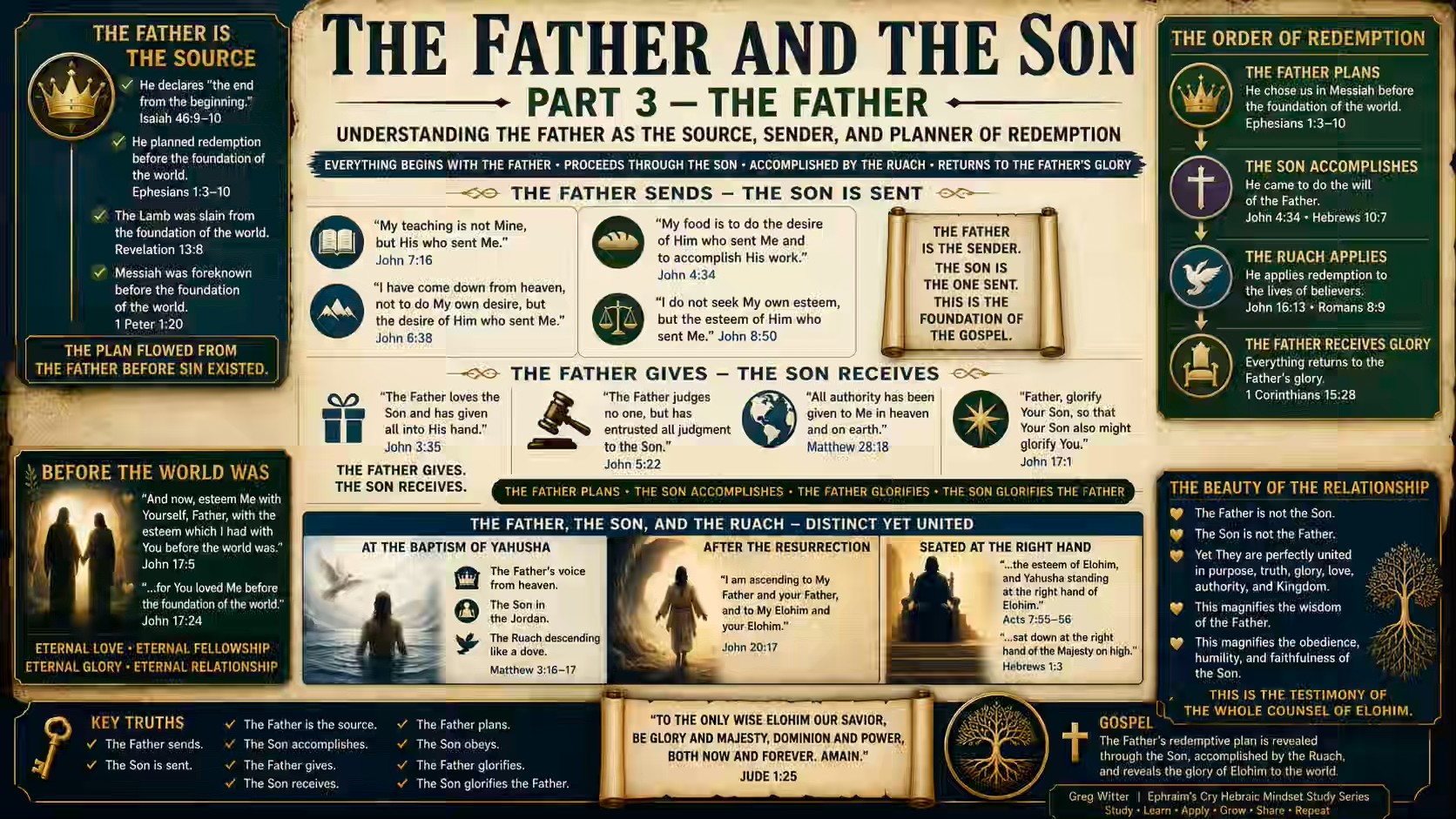
THE FATHER AND THE SON
PART 3 — THE FATHER
Understanding the Father as the Source, Sender, and Planner of Redemption
From the opening verses of Genesis to the closing chapters of Revelation, the Scriptures consistently reveal the Father as the source of His redemptive plan. He is never portrayed as reacting to events or adjusting His purposes. He declares “the end from the beginning” (Isaiah 46:9–10), revealing that redemption was not an emergency plan but the unfolding of His eternal purpose. Everything begins with the Father, proceeds through the Son, is accomplished by the Ruach HaKodesh, and ultimately returns to the Father’s glory.
One of the greatest problems in modern theology is that the Father is often overlooked. Entire discussions become centered upon proving who Yahusha is while giving little attention to the One whom Yahusha came to reveal. Yet Yahusha Himself repeatedly directed attention to His Father. His mission was never to replace the Father but to reveal Him.
Yahusha said, “No one has seen Elohim at any time. The only brought-forth Son, who is in the bosom of the Father, He has declared Him” (John 1:18). His purpose was revelation. The Son came to make the Fatherknown.
Throughout His earthly ministry, Yahusha consistently spoke of the Father as Someone distinct from Himself.
“My teaching is not Mine, but His who sent Me.” (John 7:16)
“I have come down from heaven, not to do My own desire, but the desire of Him who sent Me.” (John 6:38)
“My food is to do the desire of Him who sent Me and to accomplish His work.” (John 4:34)
“I do not seek My own esteem, but the esteem of Him who sent Me.” (John 8:50)
These are not isolated statements. They reveal the consistent relationship between the Father and the Son throughout the Apostolic Witness.
The Father is consistently presented as the Sender.
The Son is consistently presented as the One sent.
This distinction is not a contradiction.
It is the very foundation of the Gospel of the Kingdom.
John repeatedly emphasizes this relationship. The phrase “the One who sent Me,” or its equivalent, appears throughout Yahusha’s ministry. It is one of His most repeated descriptions of the Father. The Father sends because the Father is the source of the mission. The Son comes because the Son perfectly accomplishes the Father’s will.
This pattern did not begin in Matthew.
It began before the foundation of the world.
Peter tells us that Messiah was foreknown before the foundation of the world (1 Peter 1:20). Revelation speaks of the Lamb slain from the foundation of the world (Revelation 13:8). Paul writes that the Father chose us in Messiah before the foundation of the world (Ephesians 1:3–10).
The Father planned redemption before man ever sinned.
The Son came to accomplish what the Father had purposed.
The Ruach HaKodesh applies that redemption to the lives of believers.
The entire plan flows from the Father.
Yahusha repeatedly acknowledged this order.
“The Father loves the Son and has given all into His hand.” (John 3:35)
“All authority has been given to Me in heaven and on earth.” (Matthew 28:18)
Notice the language carefully.
Authority was given.
The Father is the Giver.
The Son is the Receiver.
This does not diminish the Son.
It reveals the order established by the Father Himself.
Likewise, Yahusha says,
“The Father judges no one, but has entrusted all judgment to the Son.” (John 5:22)
Again, the Father entrusts.
The Son executes.
The Father plans.
The Son accomplishes.
The Father sends.
The Son comes.
The Father glorifies.
The Son glorifies the Father.
This beautiful harmony is seen throughout the Scriptures.
John 17 becomes one of the clearest examples.
“Father, the hour has come. Glorify Your Son, so that Your Son also might glorify You.” (John 17:1)
Notice the mutual glorification.
The Father glorifies the Son.
The Son glorifies the Father.
Neither seeks independent glory.
Everything flows toward the Father’s ultimate purpose.
Yahusha continues,
“I have brought You esteem on the earth, having accomplished the work You have given Me that I should do.” (John 17:4)
Again, the Father gives.
The Son accomplishes.
The relationship is genuine.
It is covenantal.
It is loving.
It is perfect.
This relationship existed before the incarnation.
“And now, esteem Me with Yourself, Father, with the esteem which I had with You before the world was.” (John 17:5)
Notice carefully what Yahusha says.
He speaks of shared glory with the Father before creation.
He speaks of fellowship before creation.
Later He says,
“…for You loved Me before the foundation of the world.” (John 17:24)
This is not language of one person pretending to speak with Himself.
It reveals genuine love.
Genuine fellowship.
Genuine relationship.
The Father loved the Son before the foundation of the world.
The Son loved the Father.
This relationship is part of the eternal revelation of Elohim.
Perhaps nowhere is the distinction between the Father and the Son more visible than at Yahusha’s baptism.
Yahusha stands in the Jordan.
The Ruach HaKodesh descends like a dove.
The Father’s voice comes from heaven:
“This is My beloved Son, in whom I delight.” (Matthew 3:16–17)
All three are present simultaneously.
The Father is not standing in the water.
The Son is not speaking from heaven.
The Ruach is not either the Father’s voice or the Son standing in the river.
The Scriptures simply present the event exactly as it occurred.
The same pattern continues after the resurrection.
Yahusha says,
“I am ascending to My Father and your Father, and to My Elohim and your Elohim.” (John 20:17)
Stephen sees,
“…the esteem of Elohim, and Yahusha standing at the right hand of Elohim.” (Acts 7:55–56)
Hebrews declares,
“…when He had made purification of sins, sat down at the right hand of the Majesty on high.” (Hebrews 1:3)
These passages are not difficult unless we first adopt a theological system that cannot accommodate them.
The Scriptures consistently reveal the Father as the One who sends.
The Son as the One who is sent.
The Father as the Planner.
The Son as the Accomplisher.
The Father as the Giver.
The Son as the Receiver.
The Father as the One who exalts.
The Son as the One exalted.
None of this diminishes Yahusha.
It magnifies the wisdom of the Father’s redemptive plan.
It also magnifies the humility, obedience, and perfect faithfulness of the Son, who came not to do His own will but the will of the Father who sent Him.
The Father is not the Son.
The Son is not the Father.
Yet They are perfectly united in purpose, truth, glory, love, authority, and Kingdom.
That is the consistent testimony of the whole counsel of Elohim.
Greg Witter | Ephraim’s Cry Hebraic Mindset Study Series
Study • Learn • Apply • Grow • Share • Repeat
#EphraimsCry #GregWitter #HebraicMindset #HebraicMindsetStudySeries #FatherAndSon #Yahuah #Yahusha
#WholeCounselOfElohim #KingdomOfElohim #GospelOfTheKingdom #Torah #Prophets #Writings #ApostolicWitness
#John17 #John20 #Matthew3 #Acts7 #Hebrews1 #Covenant #ScriptureInterpretsScripture #TruthMatters #BibleStudy
#Discernment #KingdomPreparation #StudyLearnApplyGrowShareRepeat
