
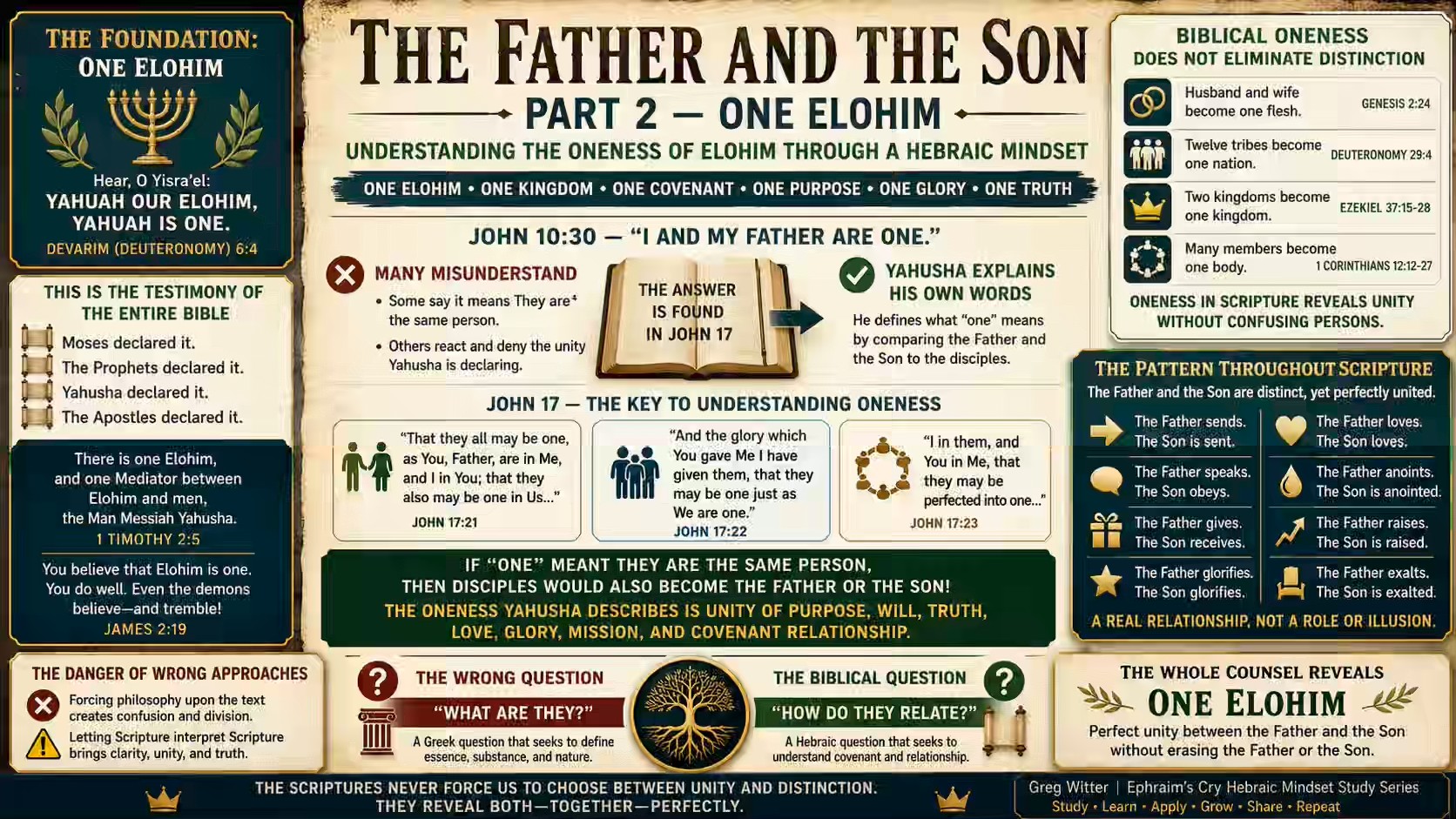
THE FATHER AND THE SON
PART 2 — ONE ELOHIM
Understanding the Oneness of Elohim Through a Hebraic Mindset
One of the greatest mistakes made in this discussion is assuming that everyone means the same thing when they use the word “one.” Entire doctrines have been built upon that assumption without first asking how the Scriptures themselves define oneness. Before we can understand the relationship between the Father and the Son, we must first understand what the Bible means when it declares that Elohim is one.
Every believer who accepts the Scriptures agrees that there is only one Elohim. This is not merely an Apostolic doctrine or a Torah doctrine. It is the testimony of the entire Bible. Moses declared it. The Prophets declared it. Yahusha declared it. The Apostles declared it. There has never been more than one true Elohim, nor will there ever be.
The foundational declaration of Yisra’el’s faith is found in Devarim (Deuteronomy) 6:4:
“Hear, O Yisra’el: Yahuah our Elohim, Yahuah is one.”
This declaration, commonly called the Shema, became the confession of every faithful Israelite. Yahusha Himself affirmed it when He was asked which commandment was the greatest. He answered by quoting the Shema before giving any other commandment (Mark 12:28–30). Paul affirmed the same truth when he wrote, “There is one Elohim, and one Mediator between Elohim and men, the Man Messiah Yahusha” (1 Timothy 2:5). James likewise declared, “You believe that Elohim is one. You do well. Even the demons believe—and tremble!” (James 2:19).
There is no disagreement that there is only one Elohim.
The disagreement begins when people define the word “one” according to philosophy instead of allowing Scripture to define it.
One of the greatest errors in theology is reading later philosophical definitions back into the biblical text. The Hebrew Scriptures do not begin by asking abstract questions about essence, substance, or metaphysical categories. They reveal Elohim through covenant, relationship, authority, purpose, revelation, and action. The Hebraic mindset is practical before it is philosophical. It asks, “What has Elohim revealed?” not, “What system can we construct?”
Throughout the Scriptures, oneness is repeatedly expressed as unity, harmony, agreement, covenant relationship, and shared purpose. Husband and wife become one flesh (Genesis 2:24), yet they remain two distinct persons. The twelve tribes become one nation, yet they remain twelve tribes. The divided kingdoms of Judah and Israel are prophesied to become one kingdom again under one Shepherd (Ezekiel 37:15–28), yet Judah does not become Ephraim, nor does Ephraim become Judah. The body of Messiah is called one body (1 Corinthians 12:12–27), yet it consists of many members with different gifts and functions. Scripture repeatedly demonstrates that biblical oneness does not require the elimination of distinction.
This becomes critically important when we come to Yahusha’s own words.
In John 10:30 Yahusha declared, “I and My Father are one.”
That single statement has generated centuries of debate because many stop reading after verse 30. Some immediately conclude that Yahusha must be saying He and the Father are literally the same person. Others react so strongly against that conclusion that they diminish the unity Yahusha is declaring. Both errors fail to continue reading the Scriptures.
The answer is found only a few chapters later.
In John 17 Yahusha explains exactly what He meant.
As He prays to the Father, He says:
“That they all may be one, as You, Father, are in Me, and I in You; that they also may be one in Us…” (John 17:21).
He continues:
“And the glory which You gave Me I have given them, that they may be one just as We are one.” (John 17:22).
Then He says:
“I in them, and You in Me, that they may be perfected into one…” (John 17:23).
These verses become one of the greatest interpretive keys in all of Scripture because Yahusha defines His own words.
He does not leave us guessing what He meant by saying, “I and My Father are one.”
He explains it Himself.
Now ask the obvious question.
If “I and My Father are one” means that the Father and the Son are literally the same person, then what does Yahusha mean when He prays that every believer will become one exactly as They are one?
Do believers become the Father?
Do believers become the Son?
Do millions of disciples somehow merge into one person?
Of course not.
No one believes that because the text itself will not allow it.
Yahusha’s own prayer interprets His earlier statement.
The oneness He describes is perfect unity of purpose, perfect unity of will, perfect unity of truth, perfect unity of love, perfect unity of glory, perfect unity of mission, and perfect covenant relationship.
The disciples remain distinct persons while becoming one in Messiah.
Likewise, the Father remains the Father.
The Son remains the Son.
Yet They are perfectly one.
John 17 destroys the assumption that oneness requires identity of person.
At the same time, it destroys the opposite error that distinction destroys unity.
The Scriptures teach neither.
The Father and the Son are perfectly united without becoming the same person.
This pattern appears throughout the Scriptures.
The Father sends.
The Son is sent.
The Father speaks.
The Son obeys.
The Father gives.
The Son receives.
The Father glorifies.
The Son glorifies.
The Father loves.
The Son loves.
The Father anoints.
The Son is anointed.
The Father raises.
The Son is raised.
The Father exalts.
The Son is exalted.
These relationships are real.
They are not dramatic illustrations.
They are not temporary roles.
They are not conversations with Himself.
They reveal genuine covenant relationship.
This is precisely why John 17 becomes one of the greatest challenges to the Oneness position. If the Father and the Son are simply one person appearing in different modes, then Yahusha’s prayer loses its plain meaning. The Father is no longer truly loving the Son. The Son is no longer truly praying to the Father. The Father is no longer truly sending the Son. The Son is no longer truly obeying the Father. The relationship revealed throughout the Scriptures becomes a series of self-directed actions rather than the genuine relationship consistently presented from beginning to end.
The modern debate often asks the wrong question.
It asks, “What are They?”
The Scriptures ask, “How do They relate?”
That is the Hebraic question.
Throughout the Bible, Elohim reveals Himself through covenant relationships. Father and Son. King and Servant. Bridegroom and Bride. Shepherd and Sheep. Master and Disciple. The relationship itself reveals the message. The relationship is not incidental; it is central to the revelation.
The Father is not pretending to love the Son.
The Son is not pretending to pray.
The Father is not pretending to send.
The Son is not pretending to obey.
The relationship is genuine because the Scriptures present it as genuine.
This does not diminish the Son.
It magnifies Him.
Nor does it diminish the Father.
It magnifies the Father’s wisdom, love, and redemptive purpose revealed through His Son.
The Scriptures never ask us to choose between unity and distinction.
They reveal both.
One Elohim.
One Kingdom.
One Covenant.
One purpose.
One glory.
One truth.
One mission.
One perfect unity between the Father and the Son without confusing the Father with the Son or the Son with the Father.
That is the testimony of the whole counsel of Elohim.
Greg Witter | Ephraim’s Cry Hebraic Mindset Study Series
Study • Learn • Apply • Grow • Share • Repeat
#EphraimsCry #GregWitter #HebraicMindset #HebraicMindsetStudySeries #FatherAndSon #OneElohim #TheShema
#John17 #John10 #WholeCounselOfElohim #ScriptureInterpretsScripture #KingdomOfElohim #GospelOfTheKingdom
#Torah #Prophets #Writings #ApostolicWitness #Covenant #BiblicalTheology #IdentityAndRelationship
#UnityWithoutConfusion #TruthMatters #BibleStudy #Discernment #KingdomPreparation #StudyLearnApplyGrowShareRepeat
