
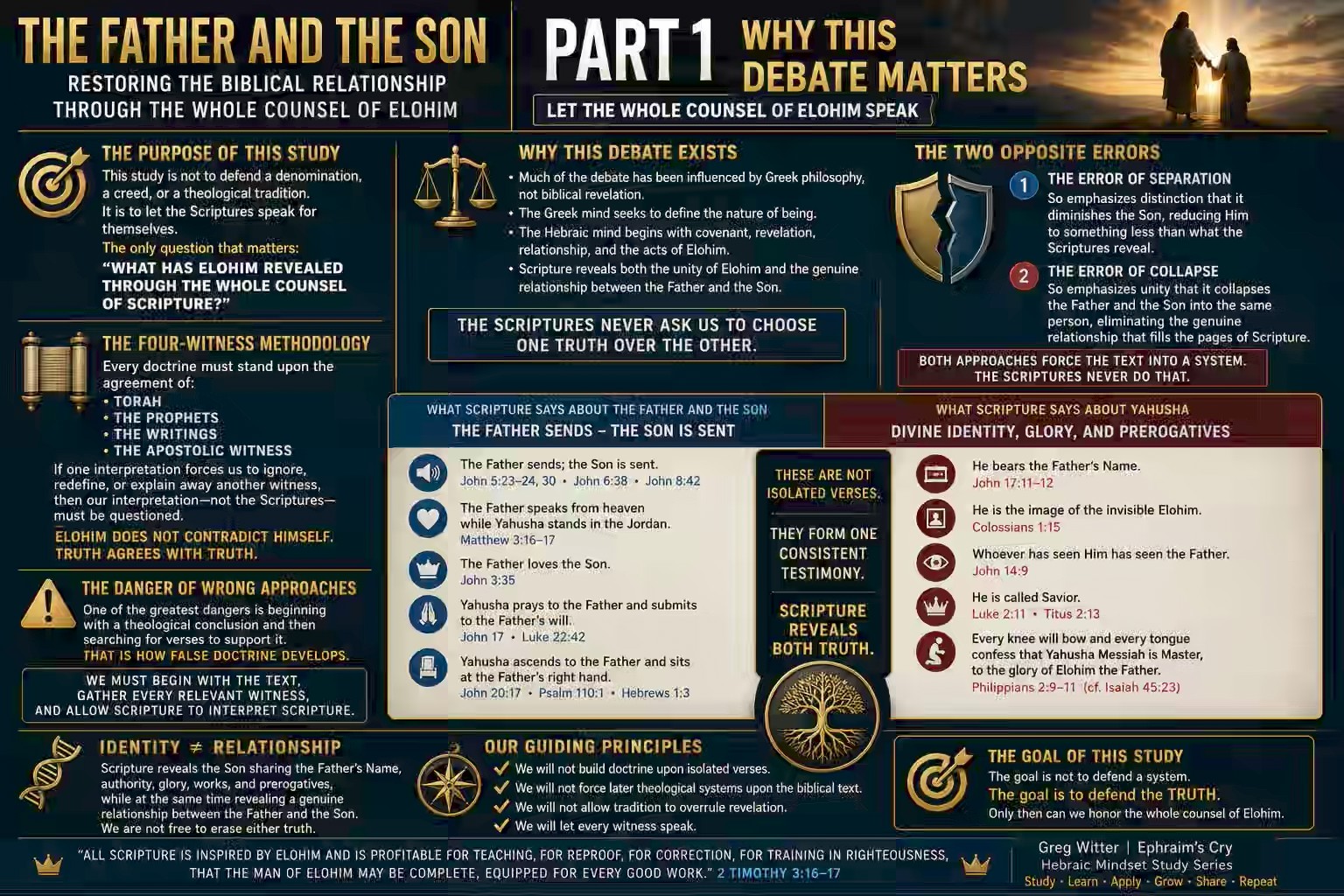
THE FATHER AND THE SON
PART 1 — WHY THIS DEBATE MATTERS
Restoring the Biblical Relationship Through the Whole Counsel of Elohim
The relationship between the Father and the Son is one of the most discussed, debated, and misunderstood subjects in all of Scripture. Entire theological systems have been built upon a handful of verses while ignoring dozens of others. As a result, believers often find themselves choosing between opposing doctrines instead of allowing the whole counsel of Elohim to speak.
The purpose of this study is not to defend a denomination, a creed, or a theological tradition. It is not to argue for Oneness, Trinitarianism, Arianism, or any other man-made system. The purpose of this study is much simpler and much more important: to let the Scriptures speak for themselves.
That must always be our starting point.
The question is not, “What does my denomination teach?” The question is not, “What did the church fathers conclude?” The question is not, “What philosophy best explains the relationship between the Father and the Son?” The only question that matters is this:
What has Elohim revealed through the whole counsel of Scripture?
Every doctrine must stand upon the agreement of Torah, the Prophets, the Writings, and the Apostolic Witness. If one interpretation forces us to ignore, redefine, or explain away another witness, then our interpretation—not the Scriptures—must be questioned. Elohim does not contradict Himself. Truth agrees with truth.
One of the greatest dangers in biblical interpretation is beginning with a theological conclusion and then searching for verses to support it. That is how false doctrine develops. Instead, we must begin with the text, gather every relevant witness, and allow Scripture to interpret Scripture.
This debate has often been approached through a Greek mindset instead of a Hebraic one. The Greek mind seeks to define the nature of being through philosophical categories. The Hebraic mind begins with covenant, revelation, relationship, and the historical acts of Elohim. Scripture was not written to satisfy philosophical curiosity. It was written to reveal Elohim, His covenant, His Kingdom, and His redemptive plan.
When we approach the Scriptures from a Hebraic mindset, we discover something remarkable. The Bible consistently reveals both the unity of Elohim and the genuine relationship between the Father and the Son. It never asks us to choose one truth over the other.
Unfortunately, two opposite errors have dominated much of this discussion.
One error so emphasizes distinction that it diminishes the Son, reducing Him to something less than what the Scriptures reveal. The other so emphasizes unity that it collapses the Father and the Son into the same person, eliminating the genuine relationship that fills the pages of Scripture.
Both approaches create problems because both force the text into a system.
The Scriptures never do that.
The Scriptures consistently reveal the Father as the One who sends, and Yahusha as the One who is sent (John 5:23–24, 30; John 6:38; John 8:42). They reveal the Father speaking from heaven while Yahusha stands in the Jordan River (Matthew 3:16–17). They reveal the Father loving the Son (John 3:35), glorifying the Son (John 17:1–5), and giving all authority into the Son’s hands (Matthew 28:18). They reveal Yahusha praying to the Father (John 17), submitting to the Father’s will (Luke 22:42), ascending to the Father (John 20:17), and sitting at the Father’s right hand (Psalm 110:1; Hebrews 1:3).
These are not isolated verses. They form one consistent testimony.
At the same time, the Scriptures reveal extraordinary truths concerning Yahusha. He bears the Father’s Name (John 17:11–12). He is the image of the invisible Elohim (Colossians 1:15). He is the exact representation of His being (Hebrews 1:3). Whoever has seen Him has seen the Father (John 14:9). Isaiah declares that Yahuah alone is Savior (Isaiah 43:11), yet Yahusha is repeatedly called Savior (Luke 2:11; Titus 2:13). Yahuah declares Himself to be the First and the Last (Isaiah 44:6), yet Yahusha declares, “I am the First and the Last” (Revelation 1:17; 22:13). Isaiah 45 declares that every knee shall bow to Yahuah, and Philippians 2 applies that very passage to Yahusha, declaring that every knee will bow and every tongue confess that Yahusha Messiah is Master, to the glory of Elohim the Father (Philippians 2:9–11).
Do these passages contradict one another?
Absolutely not.
The contradiction exists only when we attempt to force one group of passages to silence another.
The whole counsel of Elohim refuses to allow that.
One of the greatest mistakes made in this discussion is confusing identity with relationship. Those are not the same thing. Scripture reveals the Son bearing the Father’s Name, authority, glory, works, and divine prerogatives, while at the same time revealing a genuine relationship between the Father and the Son. We are not free to erase either truth simply because one theological system finds it difficult to reconcile.
As this study progresses, we will not begin with assumptions. We will begin with the text. We will examine every major passage within its context. We will compare witness with witness. We will allow Torah to agree with the Prophets, the Prophets with the Writings, the Writings with the Apostolic Witness, and the Apostolic Witness with everything that came before it.
We will not build doctrine upon isolated verses.
We will not force later theological systems upon the biblical text.
We will not allow tradition to overrule revelation.
Instead, we will let every witness speak.
Only then can we arrive at a conclusion that honors the whole counsel of Elohim.
Because the goal of this study is not to defend a system.
The goal is to defend the truth.
Greg Witter | Ephraim’s Cry Hebraic Mindset Study Series
Study • Learn • Apply • Grow • Share • Repeat
#EphraimsCry #GregWitter #HebraicMindset #HebraicMindsetStudySeries #WholeCounselOfElohim #FatherAndSon
#OneElohim #KingdomOfElohim #GospelOfTheKingdom #Torah #Prophets #Writings #ApostolicWitness
#ScriptureInterpretsScripture #BiblicalTheology #Covenant #CovenantRelationship #KingdomTruth #Discernment
#RestoringBiblicalTruth #BibleStudy #TeachTheTruth #KingdomPreparation #FaithfulRemnant #TruthMatters
#StudyLearnApplyGrowShareRepeat
