
Understanding Justification, Sanctification, and Glorification Through the Whole Counsel of Elohim
Lesson 5
THE COMPLETE COVENANT JOURNEY
Bringing It All Together
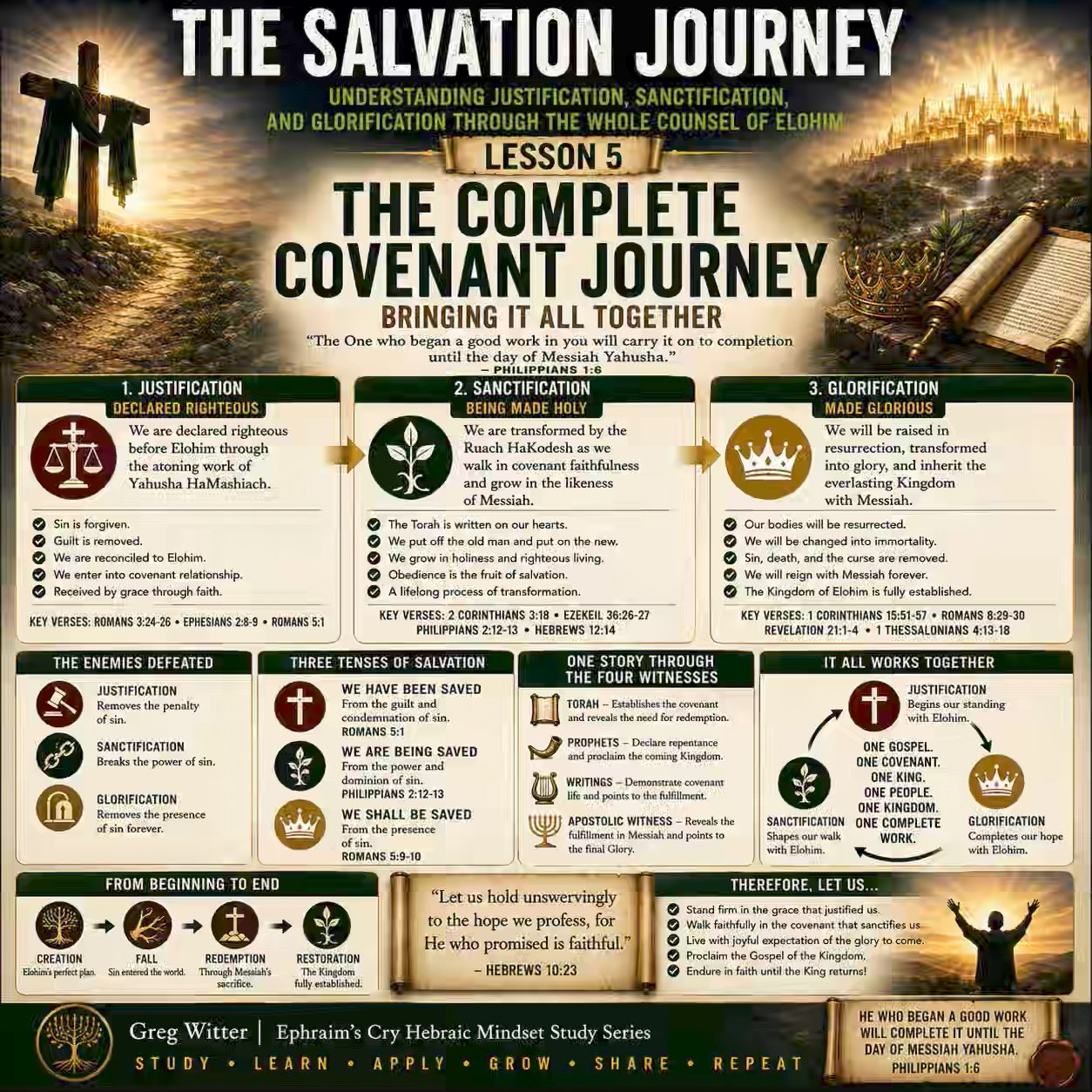
Throughout this series we have examined the three great stages of salvation: justification, sanctification, and glorification. Each lesson has built upon the one before it, revealing that salvation is not a collection of disconnected doctrines but one continuous covenant work of 𐤄𐤅𐤄𐤉 (Yahuah). When viewed together through the Torah, the Prophets, the Writings, and the Apostolic Witness, these truths reveal the magnificent plan of redemption that has been unfolding since the foundation of the world.
Many theological systems isolate one part of salvation while neglecting the others. Some preach justification but rarely speak of sanctification. Others emphasize holy living while forgetting that salvation begins with grace through faith. Still others focus almost entirely upon the future hope of resurrection while overlooking the covenant life that prepares the believer for that day. Scripture never separates these truths. It presents them as one complete work from beginning to end.
Justification is the beginning of the covenant journey. Through the atoning work of 𐤏𐤔𐤅𐤄𐤉 (Yahusha), the guilty sinner is declared righteous before Elohim. Sin is forgiven. Reconciliation is established. The believer enters covenant relationship, not through personal merit or works of righteousness, but through the grace of Elohim received by faith. Justification answers the question, “How can a sinner stand before a holy Elohim?” The answer is found entirely in the finished work of Messiah.
Sanctification follows justification. Having been brought into covenant relationship, the believer begins the lifelong process of transformation. The Ruach HaKodesh writes the Torah upon the heart, renews the mind, strengthens the inner man, and produces the fruit of righteousness. Day by day the disciple learns to walk in faithful obedience, not to earn salvation, but because salvation has already been freely given. Sanctification demonstrates that redemption is alive within the believer and that the covenant is producing its intended fruit.
Glorification completes what justification began and sanctification has been preparing. At the return of the King, the dead in Messiah will be raised, the living will be transformed, mortality will put on immortality, and corruption will put on incorruption. Every covenant promise will reach its fulfillment. Death will be swallowed up in victory. The Kingdom of Elohim will be fully established, and the redeemed will dwell forever in the presence of their King.
These three stages correspond beautifully to the three great enemies of mankind. Justification removes the penalty of sin. Sanctification progressively breaks the power of sin. Glorification forever removes the presence of sin. Only the complete work of Elohim accomplishes all three.
The covenant story itself follows this same pattern. Israel was redeemed from Egypt through the blood of the Passover lamb. They were then brought into covenant at Sinai, where they learned to walk as a holy nation. Finally, they journeyed toward the Promised Land, the inheritance prepared for them. This historical pattern points prophetically to the believer’s own journey. We are redeemed through the blood of Messiah, transformed through covenant faithfulness, and journey toward the inheritance of the coming Kingdom.
The Tabernacle also illustrates this progression. The bronze altar speaks of sacrifice and justification. The laver speaks of cleansing and continual sanctification. The Most Holy Place points toward perfect fellowship with Elohim, ultimately fulfilled in glorification when His dwelling is fully among His people. The feasts likewise proclaim this unfolding plan. Passover reveals redemption, the counting toward Shavuot reflects covenant formation and spiritual growth, and the fall appointments point toward the return of the King, the resurrection, judgment, and the establishment of the Kingdom.
The Scriptures consistently speak of salvation in three tenses because salvation itself unfolds through these three stages. We have been saved from the guilt and condemnation of sin. We are being saved from its dominion through the transforming work of the Ruach HaKodesh. We shall be saved from its very presence when Messiah returns in glory. Each statement is true because each describes a different aspect of the same covenant journey.
This understanding also protects us from serious doctrinal error. Justification without sanctification produces lawlessness by treating grace as permission to continue in sin. Sanctification without justification produces legalism by attempting to earn what only grace can provide. Glorification without the covenant journey produces false expectations by focusing only upon future promises while neglecting present faithfulness. The whole counsel of Elohim preserves the balance by holding these truths together.
Faith and obedience must never be placed in opposition. We are not saved by works, but neither are we saved unto a life without works. Faith receives the gift of salvation. Obedience demonstrates that the gift has transformed the heart. James declares that faith without works is dead, while Paul teaches that we are created in Messiah for good works that Elohim prepared beforehand. The Apostolic Witness speaks with one voice because both apostles understood the covenant from the same foundation.
The Gospel of the Kingdom has always been greater than the forgiveness of sins. It calls men and women to repentance, reconciles them to Elohim through Messiah, transforms them into faithful disciples, and prepares them to inherit the everlasting Kingdom. This has been the consistent testimony of the Torah, proclaimed by the Prophets, lived throughout the Writings, and fulfilled in the Apostolic Witness.
As followers of 𐤏𐤔𐤅𐤄𐤉 (Yahusha), we therefore live between redemption and resurrection. We look back with gratitude to the sacrifice that justified us. We walk daily in covenant faithfulness as the Ruach HaKodesh sanctifies us. We look forward with unwavering hope to the return of the King, the resurrection of the righteous, and the glory that shall be revealed.
The salvation journey is not merely about reaching the end. It is about becoming the people Elohim has called us to be along the way. Every trial refines us. Every act of obedience shapes us. Every lesson from the Scriptures matures us. Every victory over temptation prepares us. Every step of faithful endurance moves us closer to the day when faith becomes sight.
The work that 𐤄𐤅𐤄𐤉 began in us will not remain unfinished. The One who called us is faithful. The One who justified us continues to sanctify us. The One who sanctifies us will also glorify us. From the first call to repentance until the final resurrection, salvation belongs to 𐤄𐤅𐤄𐤉 alone.
May we therefore stand firm in the grace that justified us, walk faithfully in the covenant that sanctifies us, and live with joyful expectation of the glory that awaits us. Let us endure in faith, pursue holiness, proclaim the Gospel of the Kingdom, and eagerly await the appearing of our great King, knowing that every promise of 𐤄𐤅𐤄𐤉 will be fulfilled exactly as He has spoken.
This is the complete covenant journey.
One Gospel.
One Covenant.
One King.
One People.
One Kingdom.
One Complete Work.
Greg Witter | Ephraim’s Cry
Hebraic Mindset Study Series
Study • Learn • Apply • Grow • Share • Repeat
#TheSalvationJourney#Justification#Sanctification#Glorification#CompleteCovenantJourney#GospelOfTheKingdom
#WholeCounselOfElohim#HebraicMindset#Torah#Prophets#Writings#ApostolicWitness#Faith#Obedience#Endurance
#Resurrection#KingdomOfElohim#Messiah#EphraimsCry#BibleStudy
