
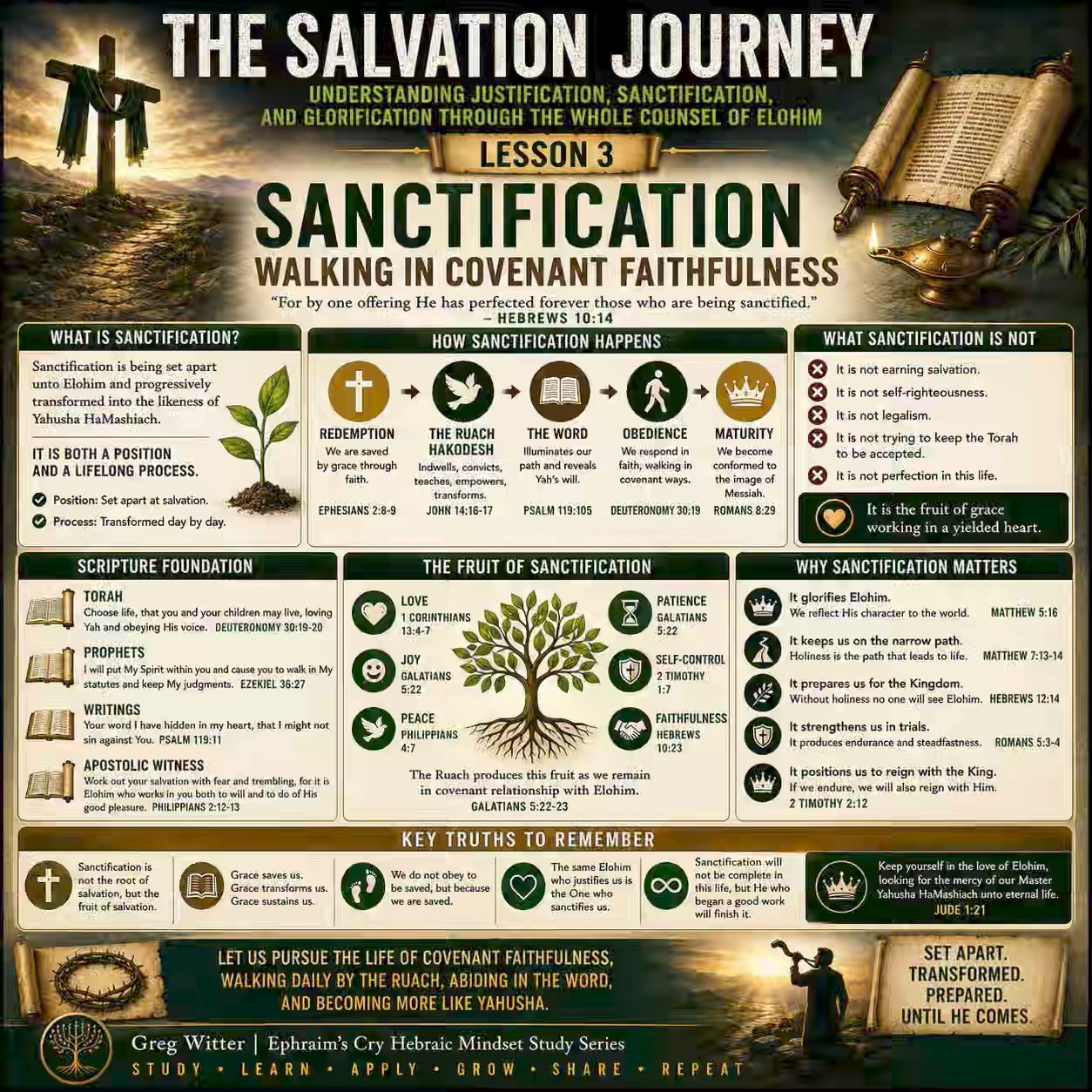
THE SALVATION JOURNEY
Understanding Justification, Sanctification, and Glorification Through the Whole Counsel of Elohim
Lesson 3
SANCTIFICATION
Walking in Covenant Faithfulness
Justification answers the question, “How can a guilty sinner be declared righteous before a holy Elohim?” Sanctification answers the next question, “Now that I have been redeemed, how should I live?” These two truths must never be confused, nor should they ever be separated. Justification establishes our covenant relationship with 𐤄𐤅𐤄𐤉 (Yahuah). Sanctification is the lifelong process of growing within that covenant relationship. One establishes our standing before Elohim; the other transforms our daily walk with Him.
Many believers have been taught that obedience belongs to the “Old Testament” while grace belongs to the “New Testament.” Scripture teaches no such division. Grace has always been the means by which Elohim restores His people, and obedience has always been the proper response of those who belong to Him. Noah found grace in the eyes of 𐤄𐤅𐤄𐤉. Abraham believed Elohim, and it was counted to him as righteousness, yet Abraham also obeyed His voice, kept His charge, His commandments, His statutes, and His Torah (Genesis 26:5). Grace and obedience have never been enemies. They are covenant companions.
Sanctification simply means being set apart unto Elohim and progressively transformed into His likeness. The word describes both a position and a process. At the moment of redemption, the believer is set apart as belonging to Elohim. From that moment forward, the Ruach HaKodesh begins the lifelong work of conforming that believer to the image of 𐤏𐤔𐤅𐤄𐤉 (Yahusha). Sanctification is therefore not a single event but a continual work that continues until the resurrection.
The purpose of sanctification is not merely moral improvement. It is covenant transformation. Elohim is restoring His image within His people. Sin distorted that image in the Garden. Redemption begins restoring it. Sanctification continues that restoration day by day as the believer learns to think, speak, live, love, serve, and obey according to the character of Elohim.
This has always been the promise of the Renewed Covenant. Through the prophet Jeremiah, 𐤄𐤅𐤄𐤉 declared that He would write His Torah upon the hearts of His people. Ezekiel expands this promise by declaring that Elohim would give His people a new heart, place His Spirit within them, and cause them to walk in His statutes and carefully observe His judgments. The covenant did not change; the location of the Torah changed. Instead of remaining external upon tablets of stone alone, it would also become internal within transformed hearts.
For this reason, sanctification can never be separated from obedience. Obedience does not earn salvation, but salvation produces obedience. A heart that has truly been transformed desires to walk in the ways of the King. Yahusha Himself declared, “If you love Me, keep My commandments.” Love is not measured by emotion alone but by covenant faithfulness. The Apostle John repeats this truth when he writes that the love of Elohim is demonstrated by keeping His commandments, and that His commandments are not burdensome.
The Apostle Paul is often misunderstood on this subject. Some claim Paul taught that obedience no longer matters because believers are under grace. Paul teaches precisely the opposite. After declaring that believers are justified by grace through faith, he immediately asks, “Shall we continue in sin that grace may abound?” His answer is emphatic: “Certainly not!” If sin is the transgression of Torah, then grace cannot be permission to continue violating Torah. Grace delivers us from the dominion of sin so that we may become servants of righteousness.
Sanctification is the evidence that justification is genuine. James addresses those who claimed to possess faith while living unchanged lives. He demonstrates that genuine faith always produces visible fruit. Abraham believed Elohim long before offering Isaac upon the altar, yet his obedience demonstrated the maturity and completeness of his faith. Faith and works do not compete with one another. True faith naturally produces faithful obedience.
This pattern is seen throughout the entire Scriptures. Israel was redeemed from Egypt by grace before receiving the covenant instructions at Sinai. Their obedience did not produce their redemption; it flowed from their redemption. In the same way, believers are redeemed through Messiah before being called to walk worthy of that calling. Covenant obedience is not the root of salvation. It is the fruit of salvation.
Sanctification affects every area of life. It transforms how we worship, how we speak, how we treat our families, how we conduct business, how we handle conflict, how we use our resources, how we study the Scriptures, and how we serve others. There is no area of life outside the authority of the King. The Kingdom is not merely a future destination; it is a present reality that shapes the daily conduct of every disciple.
This transformation does not occur through human determination alone. It is accomplished through the work of the Ruach HaKodesh. The Spirit convicts of sin, illuminates the Scriptures, strengthens the believer, produces spiritual fruit, renews the mind, and empowers covenant faithfulness. Yet the believer is not passive in this process. Scripture repeatedly commands us to pursue holiness, discipline ourselves for godliness, put off the old man, put on the new man, walk by the Spirit, resist temptation, and endure faithfully. Sanctification is therefore a cooperative work in which Elohim supplies the power and the believer responds in faithful submission.
The fruit of sanctification becomes increasingly evident over time. Pride gives way to humility. Anger yields to patience. Selfishness is replaced by servant-hearted love. Fear is overcome by trust. Worldliness is exchanged for holiness. The disciple becomes increasingly conformed to the image of Messiah. This transformation may not always be rapid, but it is real. Spiritual maturity is measured not merely by knowledge but by Christlike character.
Sanctification also prepares the believer for future glorification. Every act of faithful obedience, every trial endured, every temptation resisted, every lesson learned, and every step of growth is part of Elohim’s preparation of His people for the coming Kingdom. The present life is the training ground for the eternal Kingdom. As sons and daughters mature under the discipline of their Father, they are being prepared to reign with the King.
The writer of Hebrews reminds us that without holiness no one will see the Master. This is not because holiness earns salvation, but because holiness is the inevitable evidence of a life transformed by the grace of Elohim. The same grace that justifies also sanctifies. The same Messiah who forgives also transforms. The same Spirit who indwells also empowers.
Sanctification is therefore not an optional second step for especially devoted believers. It is the normal life of every genuine disciple. Every follower of Messiah is called to grow, mature, persevere, and become increasingly like the One who redeemed them. The covenant journey does not end at justification. It continues every day as Elohim shapes His people into a holy nation, a royal priesthood, and a people for His own possession.
The work of sanctification will not be complete in this present age. There will always be growth yet to experience, lessons yet to learn, and areas yet to surrender. But the believer rests in the faithfulness of 𐤄𐤅𐤄𐤉, knowing that He who began a good work will bring it to completion in the day of 𐤏𐤔𐤅𐤄𐤉 HaMashiach. Sanctification is the daily evidence that the covenant is alive within the heart, preparing the redeemed for the day when faith becomes sight and transformation gives way to glorification.
Greg Witter | Ephraim’s Cry
Hebraic Mindset Study Series
Study • Learn • Apply • Grow • Share • Repeat
#TheSalvationJourney#Sanctification#Holiness#CovenantFaithfulness#GospelOfTheKingdom#WholeCounselOfElohim
#HebraicMindset#Torah#RuachHaKodesh#Discipleship#Obedience#Transformation#KingdomPreparation#Endurance
#Faith#EphraimsCry#BibleStudy#WalkWorthy#SetApart#KingdomLiving
