
THE SALVATION JOURNEY
Understanding Justification, Sanctification, and Glorification Through the Whole Counsel of Elohim
Lesson 2
JUSTIFICATION
Declared Righteous Before Elohim
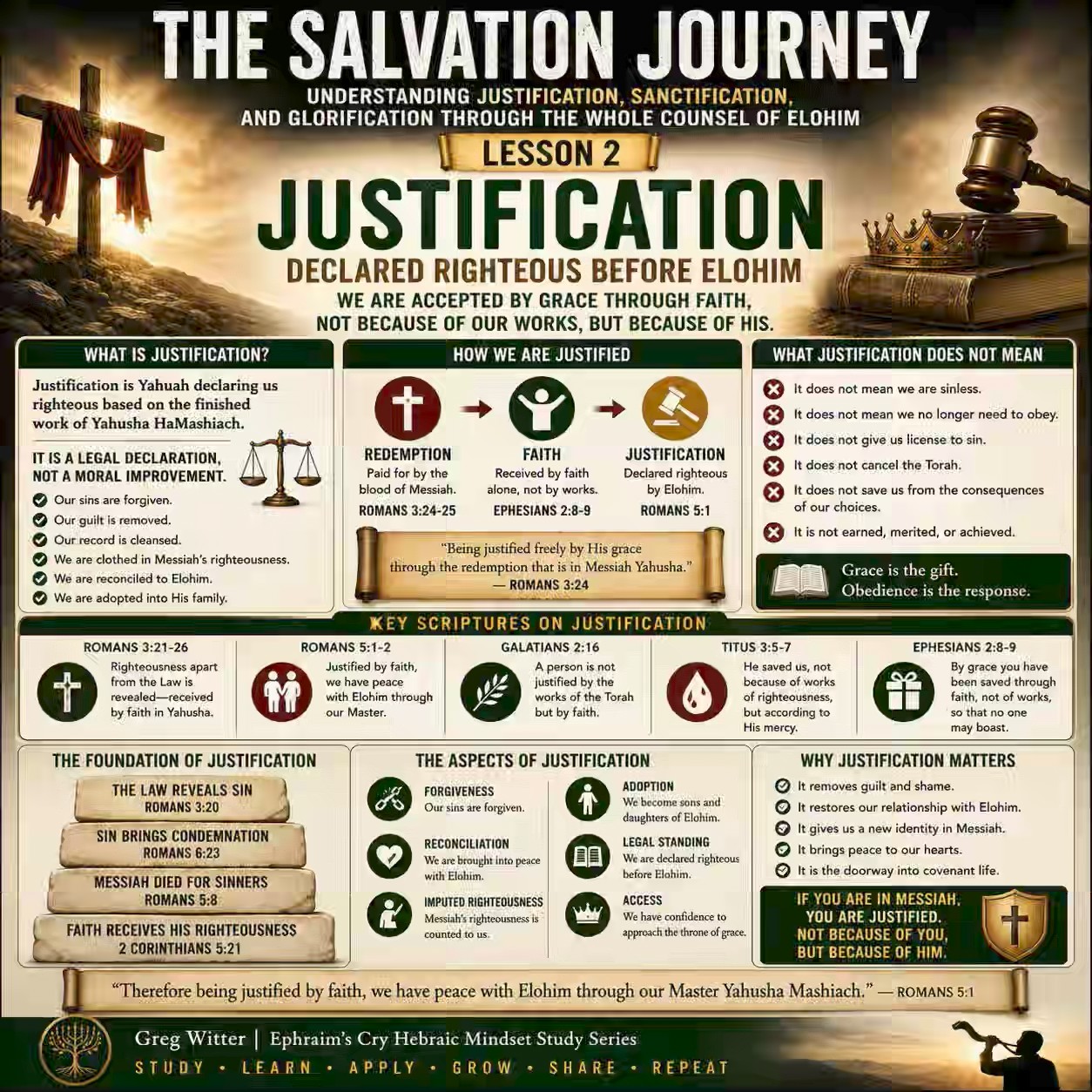
One of the most misunderstood words in all of Scripture is justification. Entire theological systems have been built upon incomplete definitions, isolated verses, and false distinctions that separate grace from obedience, faith from covenant, and redemption from transformation. When justification is removed from the whole counsel of Elohim, it inevitably produces either legalism or lawlessness. Yet when understood within the covenant framework established throughout the Scriptures, justification becomes the glorious doorway through which every repentant sinner enters into covenant relationship with 𐤄𐤅𐤄𐤉 (Yahuah).
Justification answers one of humanity’s greatest questions: How can a guilty sinner stand righteous before a perfectly holy Elohim? Ever since Adam and Chavah rebelled in the Garden, mankind has stood under the sentence of death. Sin fractured fellowship with the Creator, introduced corruption into creation, and placed every descendant of Adam under the curse of death. The problem is not merely that mankind commits sins; the problem is that mankind has become sinful by nature, unable to remove his own guilt or restore himself to covenant fellowship with Elohim.
The Torah reveals this reality from its opening pages. Adam and Chavah attempted to cover their shame with fig leaves, but their own efforts were insufficient. Only after 𐤄𐤅𐤄𐤉 provided garments through the death of an innocent substitute was their nakedness covered. From the very beginning, redemption came through the provision of Elohim, not through the efforts of man. This pattern continues throughout the Scriptures. Abel’s acceptable offering, Noah’s sacrifices after the Flood, Abraham offering Isaac, the Passover lamb, the Levitical sacrifices, and the Day of Atonement all testify that forgiveness requires the provision established by Elohim Himself.
The sacrificial system never existed because animal blood possessed the power to remove sin permanently. Rather, it pointed forward to the perfect sacrifice that would one day be offered through 𐤏𐤔𐤅𐤄𐤉 (Yahusha) HaMashiach. Every sacrifice declared the seriousness of sin, the holiness of Elohim, and the necessity of substitution. Sin always brings death. Either the guilty die under judgment, or an acceptable substitute bears the penalty on their behalf. This principle is woven throughout the Torah and finds its ultimate fulfillment in Messiah.
Justification, therefore, is a legal declaration made by Elohim. It is not the gradual improvement of a sinner, nor is it the declaration that sin never occurred. It is the righteous Judge declaring that the penalty demanded by His justice has been fully satisfied through the atoning work of His Son. The believer does not become justified because he has earned righteousness. He is justified because the righteousness of Messiah is credited to him through faith.
This truth is beautifully illustrated in the life of Abraham. Long before the giving of the covenant at Sinai, Abraham believed 𐤄𐤅𐤄𐤉, and it was counted to him as righteousness. His faith was not mere intellectual agreement. His faith trusted Elohim so completely that it produced faithful obedience throughout his life. When Elohim called him to leave his homeland, he obeyed. When Elohim promised descendants beyond number, he believed. When Elohim commanded him to offer Isaac, he demonstrated unwavering trust. Abraham was not justified because he obeyed; he obeyed because he believed. His obedience revealed the reality of his faith.
Paul appeals to Abraham to demonstrate that justification has always been by grace through faith. James appeals to Abraham to demonstrate that genuine faith is never barren. Paul answers how a sinner enters covenant relationship with Elohim. James explains how genuine covenant faith is demonstrated before men. The two apostles stand in complete agreement. Paul opposes salvation earned through works. James opposes a dead faith that produces no works. Together they reveal that living faith always bears the fruit of covenant faithfulness.
Many have attempted to use justification as proof that obedience is unnecessary. Nothing could be further from the truth. Justification removes the penalty of sin; it does not redefine sin. Scripture continues to define sin as transgression of the Torah. The grace that justifies also begins transforming the believer into one who delights in the instructions of Elohim. Justification does not abolish the covenant. It restores the repentant sinner into covenant relationship where faithful obedience becomes the joyful response of a redeemed heart.
This is precisely why Paul asks in Romans 6, “Shall we continue in sin that grace may abound?” His answer is immediate and emphatic: “Certainly not!” The believer who has been united with Messiah has died to the old life. He is no longer the slave of sin but has become the servant of righteousness. Grace is not permission to continue in rebellion. Grace is the undeserved favor of Elohim that rescues the guilty and empowers them to walk in newness of life.
The Prophets anticipated this very reality. Jeremiah proclaimed that the Renewed Covenant would involve the Torah being written upon the heart. Ezekiel declared that Elohim would give His people a new heart, place His Spirit within them, and cause them to walk in His statutes. Neither prophet described the abolition of the Torah. Both described the transformation of the people. The problem had never been the covenant. The problem had always been the sinful heart of man.
Justification also brings reconciliation. Humanity was separated from Elohim by sin, but through Messiah peace has been established. The hostility created by rebellion has been removed. Those who were once enemies are invited into covenant fellowship as sons and daughters of Elohim. This is not merely a legal transaction. It is the restoration of relationship. The Judge becomes our Father because the penalty has been satisfied through the Son.
The Scriptures also describe this work as redemption. In the ancient world, redemption referred to purchasing the freedom of one who had become enslaved. Humanity became enslaved to sin and death through rebellion, but Messiah paid the redemption price through His own blood. We were not purchased with silver or gold but with the precious blood of the spotless Lamb. Redemption declares that our freedom was costly. Justification declares that the debt has been paid in full.
Because justification is entirely the work of Elohim, there is no room for boasting. No amount of religious performance, moral improvement, charitable giving, or personal discipline can erase guilt before a perfectly holy Judge. Every human being stands equally dependent upon His mercy. The ground at the foot of the stake is level. Every believer enters the covenant by the same grace, through the same Messiah, according to the same promise.
Yet the grace that justifies never leaves the believer unchanged. Justification is the doorway, not the destination. The one declared righteous now begins the lifelong journey of sanctification. The verdict of the courtroom becomes the foundation for transformation in daily life. We are not transformed in order to become justified; we are justified so that transformation may begin.
This is why the Gospel cannot be reduced to forgiveness alone. Forgiveness without transformation would leave mankind exactly where it began. Elohim’s purpose has always been greater. He is restoring a people who bear His image, reflect His holiness, love His ways, and prepare for the coming Kingdom. Justification begins that restoration by removing guilt and restoring covenant relationship. Sanctification continues that restoration by conforming the believer to the image of Messiah. Glorification completes that restoration in the resurrection when death is finally swallowed up in victory.
When justification is understood through the Torah, the Prophets, the Writings, and the Apostolic Witness, the harmony of Scripture becomes unmistakable. The Torah reveals mankind’s guilt and the necessity of atonement. The Prophets proclaim the promise of a Redeemer and a renewed heart. The Writings celebrate the mercy and righteousness of Elohim while anticipating complete redemption. The Apostolic Witness proclaims that these promises find their fulfillment in 𐤏𐤔𐤅𐤄𐤉 HaMashiach. Four Witnesses. One covenant. One Gospel. One righteous Judge. One perfect Redeemer.
Justification is therefore not the end of salvation but its beginning. It is the gracious declaration of Elohim that the repentant sinner has been forgiven, redeemed, reconciled, and welcomed into covenant relationship through the finished work of Messiah. From that moment forward, the believer is called to walk faithfully with the One who has declared him righteous, looking forward to the day when the work begun by grace will be completed in glory.
Greg Witter | Ephraim’s Cry
Hebraic Mindset Study Series
Study • Learn • Apply • Grow • Share • Repeat
#TheSalvationJourney#Justification#GospelOfTheKingdom#WholeCounselOfElohim#HebraicMindset#Covenant
#Torah#Prophets#Writings#ApostolicWitness#Grace#Faith#Redemption#Atonement#Messiah#KingdomPreparation
#EphraimsCry#BibleStudy
