
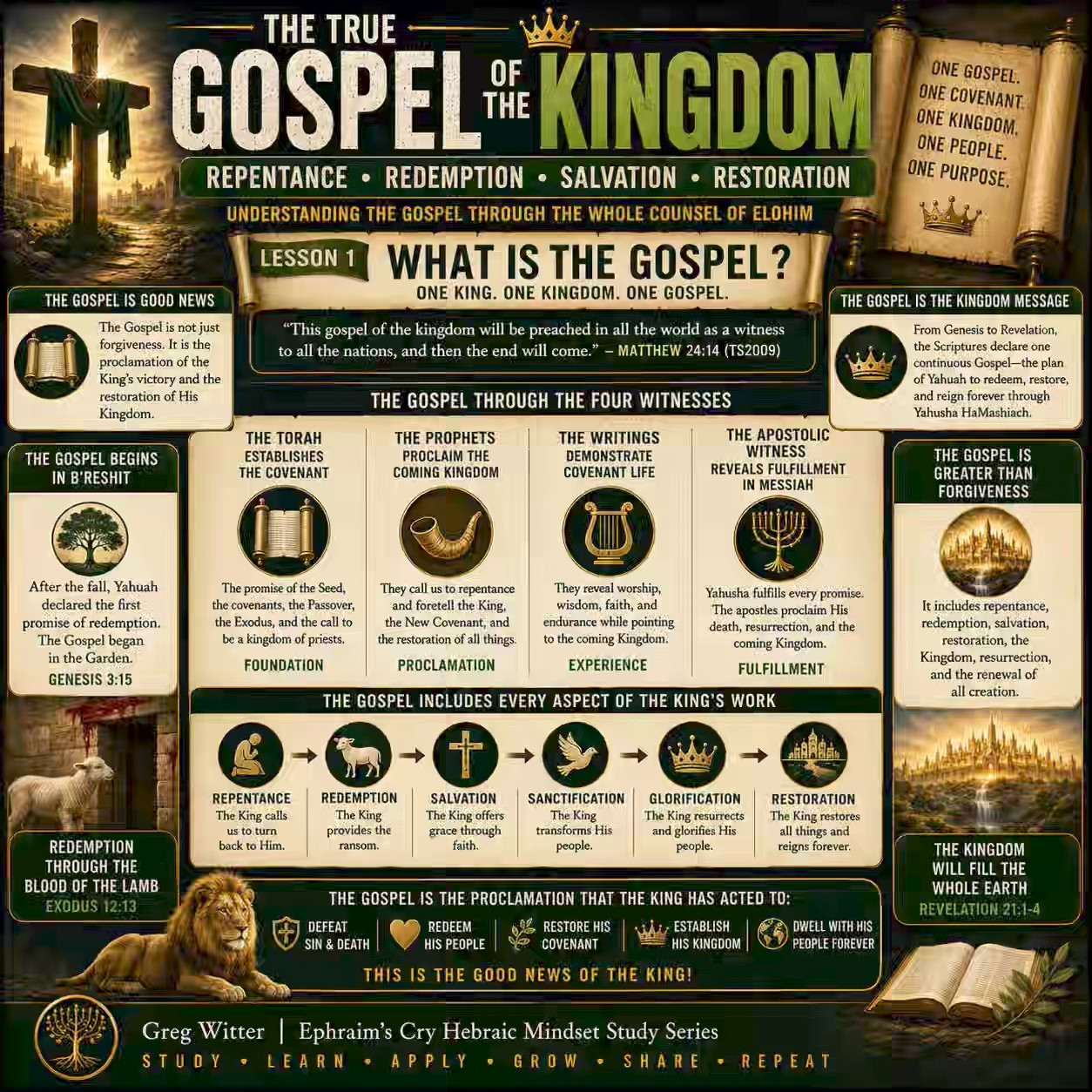
THE TRUE GOSPEL OF THE KINGDOM
Repentance • Redemption • Salvation • Restoration
Understanding the Gospel Through the Whole Counsel of Elohim
Lesson 1
WHAT IS THE GOSPEL?
One King. One Kingdom. One Gospel.
The word “gospel” is one of the most familiar words in Scripture, yet it is also one of the most misunderstood. Ask ten believers to define the Gospel, and many will answer, “Jesus died for my sins so I can go to heaven.” While that statement contains an important truth, it does not present the Gospel in its fullness. It is a summary of one aspect of the Gospel, not the complete message proclaimed throughout the Scriptures.
The Gospel did not begin in Matthew. It did not begin with the birth of 𐤏𐤔𐤅𐤄𐤉 (Yahusha). It did not begin at the cross, nor did it begin with the Apostle Paul. The Gospel begins in B’reshit (Genesis) because the Gospel is the unfolding revelation of the Kingdom of 𐤄𐤅𐤄𐤉 (Yahuah) and His plan to redeem and restore His creation. From the first promise of the coming Seed in Genesis 3:15 until the New Jerusalem descends in Revelation 21 and 22, the Scriptures proclaim one continuous Gospel.
The word “gospel” simply means “good news.” The obvious question is, “Good news about what?” The answer given by the Scriptures is remarkably consistent. The good news is that the King has acted to redeem His people, restore His covenant, defeat sin and death, establish His Kingdom, and dwell forever among a redeemed people. The Gospel is therefore not merely about individual forgiveness. It is the proclamation of the King’s victory and the restoration of His Kingdom.
This Kingdom message is woven throughout the Torah. When mankind rebelled in the Garden, sin, death, separation, and the curse entered creation. Yet in the midst of judgment, 𐤄𐤅𐤄𐤉 declared His first promise of redemption. The Seed of the woman would crush the head of the serpent. That promise became the foundation upon which every covenant, sacrifice, prophecy, and act of redemption would rest. The Gospel was already being proclaimed long before Bethlehem.
The covenant with Abraham further revealed the Gospel. Through Abraham’s seed, all the families of the earth would be blessed. This was never merely the promise of one nation becoming prosperous. It was the promise that through the coming Messiah, the blessings of the Kingdom would ultimately extend to all nations as Elohim gathered a covenant people for His Name.
The Exodus likewise proclaims the Gospel. Israel was not simply rescued from slavery. They were redeemed by the blood of the Passover lamb, delivered by the mighty hand of Elohim, brought into covenant relationship, and called to become a kingdom of priests and a holy nation. Redemption always had a purpose beyond deliverance. Deliverance led to covenant. Covenant prepared the people for inheritance. The Exodus became the great pattern of redemption repeated throughout the Scriptures.
The prophets continued proclaiming this same Gospel. Isaiah announced the coming King whose government would have no end. Jeremiah proclaimed the Renewed Covenant in which the Torah would be written upon the heart. Ezekiel foretold the giving of a new heart and the indwelling of the Spirit. Daniel saw the Son of Man receiving an everlasting Kingdom that would never pass away. Zechariah declared that 𐤄𐤅𐤄𐤉 would become King over all the earth. The prophets did not preach a different message. They proclaimed the coming Kingdom and the restoration of the covenant people.
When 𐤏𐤔𐤅𐤄𐤉 began His public ministry, His first recorded proclamation was, “Repent, for the Kingdom of Heaven is at hand.” His message was not merely, “Believe that I will die.” His message was the arrival of the Kingdom. Everywhere He traveled, He preached the Gospel of the Kingdom, healed the sick, cast out demons, and demonstrated the authority of the King over every enemy. His miracles were signs that the Kingdom had broken into the present age.
The disciples proclaimed the same Gospel. Before the death and resurrection of Messiah, they were already preaching the Gospel of the Kingdom. After His resurrection, they continued proclaiming that same Kingdom, now with the added understanding that the King had accomplished redemption through His death and resurrection. The cross did not replace the Kingdom message; it made the restoration of the Kingdom possible.
The Apostle Paul also preached the Kingdom. Although many remember Paul for his teaching on justification by faith, the book of Acts repeatedly states that he proclaimed the Kingdom of Elohim. His letters explain how redemption is accomplished through Messiah and how Jew and Gentile alike are brought into the covenant promises through faith. Paul’s Gospel was not different from that of Yahusha. It was the same Gospel of the Kingdom explained in greater detail.
The Gospel therefore includes every aspect of the redemptive work of Elohim. It begins with repentance because the King calls His people to turn back to Him. It continues through redemption because the King Himself provides the ransom. It brings salvation by grace through faith because no one can save himself. It restores covenant relationship through the work of the Ruach HaKodesh. It transforms lives through sanctification. It culminates in resurrection, glorification, and the everlasting Kingdom. Every part belongs to the Gospel because every part belongs to the King’s work.
Reducing the Gospel to forgiveness alone produces an incomplete message. Forgiveness is essential, but forgiveness is not the destination. Redemption leads to restoration. Restoration prepares a holy people. That holy people inherit the Kingdom. The Gospel therefore answers far more than the question, “How can I be forgiven?” It answers, “How is 𐤄𐤅𐤄𐤉 restoring His Kingdom, His covenant, His people, and ultimately all creation?”
The Gospel also reveals the character of the King. His justice confronts sin. His mercy provides redemption. His grace offers salvation. His holiness transforms His people. His faithfulness guarantees the fulfillment of every covenant promise. The Gospel is the revelation of who the King is and what the King is accomplishing in history.
This is why the Gospel must always be understood through the Four Witnesses of Scripture. The Torah establishes the covenant foundation. The Prophets proclaim the coming Kingdom and call the people to repentance. The Writings demonstrate covenant life through worship, wisdom, suffering, and faithful endurance. The Apostolic Witness reveals the fulfillment of these promises through 𐤏𐤔𐤅𐤄𐤉 while pointing forward to His glorious return. Together they proclaim one Gospel with one message from beginning to end.
The Gospel of the Kingdom is therefore not a message about escaping the earth. It is the proclamation that the King is restoring what was lost. It is the announcement that the Kingdom has come near through Messiah and will one day fill the entire earth. It is the declaration that sin, death, and the curse will not have the final word. It is the promise that the King will return, the dead will be raised, creation will be renewed, and the covenant people will dwell forever with 𐤄𐤅𐤄𐤉 in His everlasting Kingdom.
Everything that follows in this series grows out of this one foundation. Repentance is the response to the King’s call. Redemption is the King’s provision for His people. Salvation is His gracious gift received through faith. Restoration is His ultimate purpose for His covenant people and His creation. Together they proclaim the true Gospel of the Kingdom—the same Gospel promised in the Torah, proclaimed by the Prophets, lived throughout the Writings, fulfilled through 𐤏𐤔𐤅𐤄𐤉 HaMashiach, and awaiting its glorious consummation at His return.
Greg Witter | Ephraim’s Cry
Hebraic Mindset Study Series
Study • Learn • Apply • Grow • Share • Repeat
#TheTrueGospelOfTheKingdom#GospelOfTheKingdom#OneGospel#OneKing#OneKingdom#WholeCounselOfElohim
#HebraicMindset#Torah#Prophets#Writings#ApostolicWitness#Repentance#Redemption#Salvation#Restoration
#KingdomOfElohim#Messiah#BibleStudy#EphraimsCry#KingdomPreparation
