
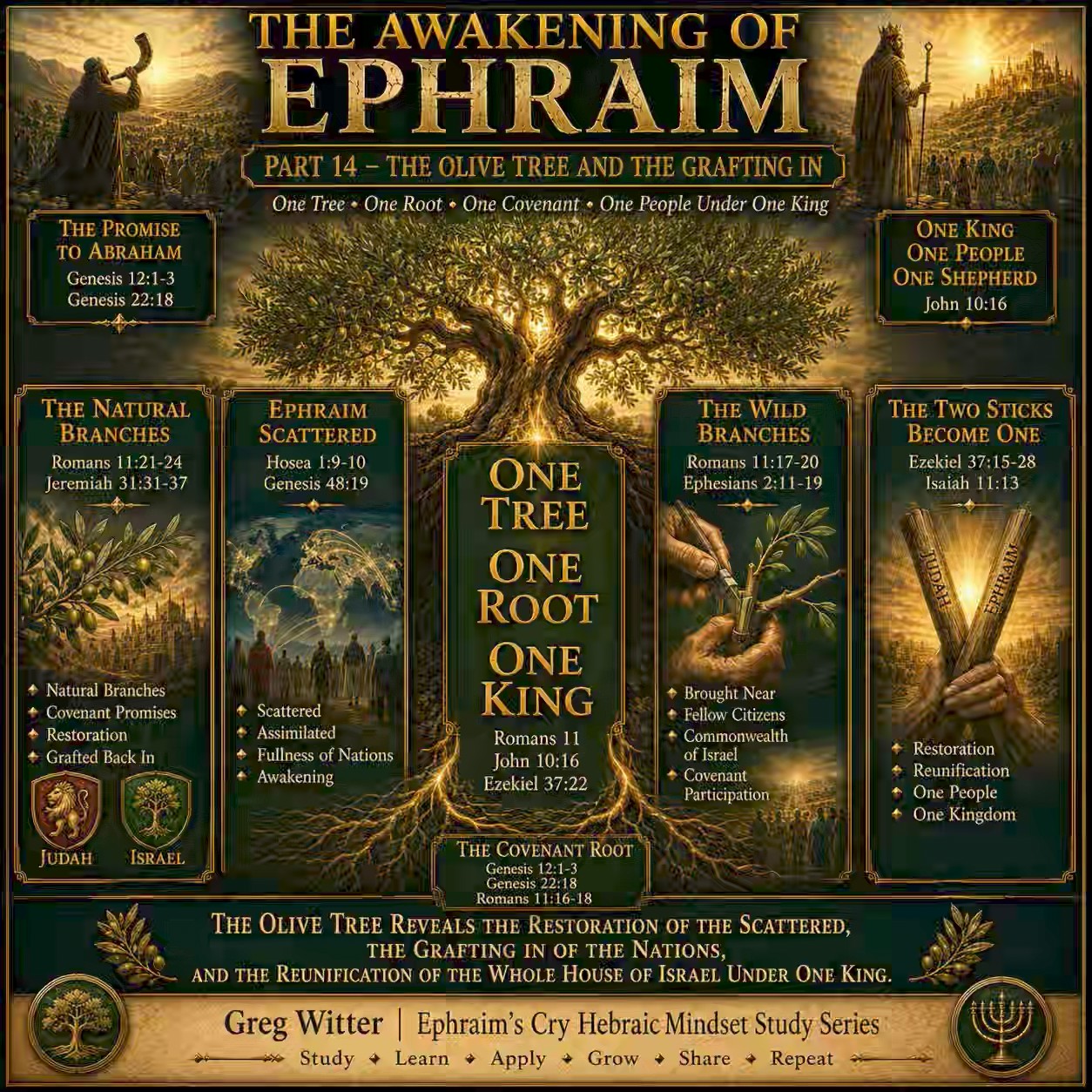
THE AWAKENING OF EPHRAIM
PART 14 — THE OLIVE TREE AND THE GRAFTING IN
One Tree, One Root, One Covenant, One People Under One King
One of the most misunderstood teachings in all of Scripture is Paul’s teaching regarding the olive tree in Romans 11.
Entire systems of theology have been built upon assumptions that Paul never taught.
Entire denominations have developed doctrines that Paul never stated.
Entire generations have been taught to read Romans 11 through the lens of replacement theology, church theology, and inherited traditions rather than through the lens of Torah, the Prophets, the Writings, and the whole counsel of Elohim.
Yet when Paul’s words are allowed to speak for themselves, and when Romans 11 is examined through the Four Witnesses, an entirely different picture emerges.
Paul is not describing the replacement of Israel.
Paul is not describing the creation of a new people.
Paul is not describing a separate Gentile church replacing covenant Israel.
Paul is describing restoration.
Paul is describing reunification.
Paul is describing grafting.
Paul is describing the fulfillment of promises made centuries before he ever wrote Romans.
This is why this teaching belongs directly after the prophecy of the Two Sticks.
Because Romans 11 explains how the reunification process occurs.
It explains how the scattered return.
It explains how those who were far off are brought near.
It explains how the promises made to Abraham continue forward into the restoration story.
The first thing Paul establishes is the existence of a single olive tree.
Not two trees.
Not one Jewish tree and one Christian tree.
Not one Israel tree and one church tree.
One tree.
One covenant tree.
One root.
One source of life.
One source of nourishment.
One source of covenant blessing.
This is critically important.
If there is only one tree, then everyone who belongs to Yahuah ultimately belongs to the same covenant structure.
The tree did not begin in Romans.
The tree did not begin at Pentecost.
The tree did not begin at the resurrection.
The tree reaches all the way back to Abraham.
The root reaches all the way back to the promises.
The root reaches all the way back to the covenant.
The root reaches all the way back to the foundation established by Yahuah Himself.
Yahuah promised Abraham that through his seed all nations of the earth would be blessed (Genesis 12:3; 22:18).
The restoration story was therefore never an afterthought.
It was never Plan B.
It was never a reaction to failure.
It was embedded in the covenant promises from the very beginning.
Paul says the root is holy.
The branches derive their life from the root.
The branches do not support the root.
The root supports the branches.
This immediately destroys one of the greatest errors in modern theology.
The church does not support Israel.
The church does not replace Israel.
The church does not become a new root.
The root remains unchanged.
The promises remain unchanged.
The covenant foundation remains unchanged.
The tree remains unchanged.
What changes are the branches.
Some branches remain.
Some branches are broken off.
Some branches are grafted in.
But the tree remains the same.
Paul then introduces one of the most important concepts in the entire restoration story.
Natural branches.
And wild branches.
The natural branches belong naturally to the tree.
The wild branches do not.
Yet the wild branches are grafted in.
Notice carefully what Paul does not say.
He does not say the wild branches become a new tree.
He does not say the wild branches replace the tree.
He does not say the wild branches inherit a separate covenant.
He does not say the wild branches create a new religion.
He says they are grafted into the existing tree.
Into the existing covenant structure.
Into the existing promises.
Into the existing inheritance.
Into the existing commonwealth.
This language should immediately remind us of Ephesians 2.
Paul says those who were once strangers to the covenants of promise have now been brought near.
Brought near to what?
The covenants.
The promises.
The commonwealth of Israel.
Not a new commonwealth.
Not a replacement commonwealth.
The commonwealth of Israel.
This is why the awakening of Ephraim is so important.
Because many people have been taught that Israel and the church are permanently separate entities.
Paul teaches the opposite.
Paul teaches one olive tree.
One root.
One covenant structure.
One people.
One inheritance.
One King.
This becomes even more significant when we examine Genesis 48.
Jacob places his hands upon Ephraim and Manasseh.
Though Manasseh was the firstborn, Jacob deliberately places the greater blessing upon Ephraim.
Then he declares that Ephraim shall become a multitude of nations.
The Hebrew phrase points toward a fullness of nations.
A company of nations.
A multitude among the nations.
This becomes important because centuries later Paul speaks of the fullness of the Gentiles in Romans 11:25.
Paul is not inventing a new concept.
He is drawing from prophetic themes already embedded within the Hebrew Scriptures.
He is drawing upon the story of Ephraim.
He is drawing upon the scattering among the nations.
He is drawing upon the promises of restoration.
The olive tree therefore becomes more than an illustration.
It becomes a prophetic picture.
A picture of regathering.
A picture of restoration.
A picture of covenant reunification.
A picture of the promises given to Abraham, Isaac, Jacob, Ephraim, and Israel moving toward fulfillment.
The story becomes even more interesting when we remember what happened to the Northern Kingdom.
The House of Israel was scattered.
The House of Israel became as the nations.
The House of Israel assimilated among the Gentiles.
The House of Israel lost its identity among the Gentiles.
The House of Israel became indistinguishable from the Gentiles.
Yet the prophets repeatedly promised restoration.
The prophets repeatedly promised regathering.
The prophets repeatedly promised that those who had become “not My people” would once again become “My people.”
Paul knew these prophecies.
Paul quotes these prophecies.
Paul understood these prophecies.
Paul was not inventing a new theology.
Paul was explaining the fulfillment of ancient prophecy.
This is why Romans 9, 10, and 11 must always be read together.
The restoration story is being unfolded.
The gathering story is being unfolded.
The covenant story is being unfolded.
The olive tree becomes the picture of restoration.
The natural branches that were broken off are not lost forever.
Paul explicitly says they can be grafted back into their own tree.
Think about that statement.
Their own tree.
Not someone else’s tree.
Not a replacement tree.
Their own tree.
That is restoration language.
That is Ezekiel language.
That is Hosea language.
That is Jeremiah language.
That is covenant language.
That is reunification language.
Paul is describing exactly what the prophets promised.
The scattered returning.
The broken being restored.
The divided becoming one.
The covenant people being regathered.
The two sticks becoming one in the hand of Yahuah.
This is where Ephesians 2 becomes critically important.
Paul says those who were once far off have been brought near.
Those who were strangers become fellow citizens.
Those who were outside become members of the household.
Those who lacked citizenship are brought into citizenship.
Notice what Paul does not say.
He does not say a new nation has been created.
He does not say Israel has been replaced.
He does not say the covenants have been abolished.
He says those who were far off have been brought near.
Near to the covenants.
Near to the promises.
Near to the commonwealth of Israel.
This is why Ephesians 2 and Romans 11 belong together.
One explains the citizenship.
The other explains the grafting.
Together they reveal restoration.
Together they reveal reunification.
Together they reveal covenant continuity.
This also sheds light upon Paul’s statement regarding the one new man.
The one new man is often misunderstood.
Many assume it refers to a completely separate entity disconnected from Israel.
Paul never says that.
The context is reconciliation.
The context is unity.
The context is bringing together what had been separated.
The context is removing hostility.
The context is restoration.
The context is the same destination described in Ezekiel 37.
One people.
One covenant people.
One flock.
One shepherd.
One King.
This is why John 10 becomes so important.
Yahusha declared:
“And other sheep I have which are not of this fold; I have to bring them also, and they shall hear My voice, and there shall be one flock and one shepherd.”
Notice carefully.
Not two flocks.
Not competing flocks.
Not separate kingdoms.
Not separate peoples.
One flock.
One shepherd.
This is the language of restoration.
This is the language of reunification.
This is the language of Ezekiel 37.
This is the language of Romans 11.
This is the language of covenant restoration.
The prophets foresaw this long before Paul wrote Romans.
Hosea declared that those who were called “not My people” would again be called “sons of the living Elohim.”
Jeremiah declared that both houses would be restored.
Ezekiel declared that the two sticks would become one.
Isaiah declared that Ephraim would no longer envy Judah and Judah would no longer harass Ephraim.
The restoration story runs through the entire Bible.
It is not isolated to one passage.
It is woven through Torah.
It is woven through the Prophets.
It is woven through the Writings.
It is woven through the Apostolic Witnesses.
This is why humility becomes one of the central themes of Romans 11.
Paul warns the grafted branches not to boast.
Why?
Because everything they have comes from the root.
Everything they have comes from the covenant promises.
Everything they have comes from Yahuah’s mercy.
Everything they have comes from the covenant established long before they arrived.
The grafted branch contributes nothing to the root.
The grafted branch receives from the root.
Likewise, the natural branches have no room for arrogance.
They too stand only by the mercy of Elohim.
They too require restoration.
They too require redemption.
They too require the work of the Messiah.
The olive tree leaves no room for pride.
No room for superiority.
No room for replacement theology.
No room for ethnic arrogance.
No room for denominational arrogance.
Everyone stands by grace.
Everyone depends upon the root.
Everyone depends upon the mercy of Elohim.
Everyone depends upon the work of the Redeemer.
This brings us directly back to the prophecy of the Two Sticks.
The olive tree explains the process.
The Two Sticks reveal the destination.
The process is grafting.
The destination is reunification.
The process is restoration.
The destination is one people.
The process is awakening.
The destination is Kingdom.
The process is gathering.
The destination is one King ruling one people.
This is why the Gospel of the Kingdom is so important.
The Gospel is not merely individual salvation.
The Gospel is covenant restoration.
The Gospel is Kingdom restoration.
The Gospel is the gathering of the scattered.
The Gospel is the restoration of the broken.
The Gospel is the fulfillment of the promises.
The Gospel is the work of the Great Shepherd gathering His sheep.
The awakening of Ephraim is therefore not about creating division.
It is about ending division.
It is not about separating people.
It is about restoring people.
It is not about building walls.
It is about restoring what was broken.
It is not about tribal identity.
It is about covenant identity.
It is not about exalting Ephraim.
It is about exalting the King.
The olive tree reveals that the story has always been bigger than most people imagined.
The story is not church versus Israel.
The story is not Jew versus Gentile.
The story is not Judah versus Ephraim.
The story is restoration.
The story is reunification.
The story is covenant.
The story is Kingdom.
The story is the gathering of the scattered.
The story is the restoration of all things spoken by the prophets.
The story is one people under one King.
The wild branches are being grafted in.
The natural branches are being grafted back.
The root remains unchanged.
The covenant remains unchanged.
The promises remain unchanged.
The King remains unchanged.
And the olive tree continues growing toward the day when the restoration of Israel reaches its appointed fulfillment under the reign of Messiah.
Greg Witter | Ephraim’s Cry Hebraic Mindset Study Series Study • Learn • Apply • Grow • Share • Repeat
#EphraimsCry#GregWitter#HebraicMindset#HebraicMindsetStudySeries#TheAwakeningOfEphraim#Part14#TheOliveTreeAndTheGraftingIn
#Romans11#OliveTree#WildBranches#NaturalBranches#HouseOfIsrael#HouseOfJudah#Ephraim#CovenantRestoration#KingdomRestoration
#GospelOfTheKingdom#OneTree#OneRoot#OnePeople#OneKing#Restoration#Awakening#PrepareTheWay#KingdomCitizens
