
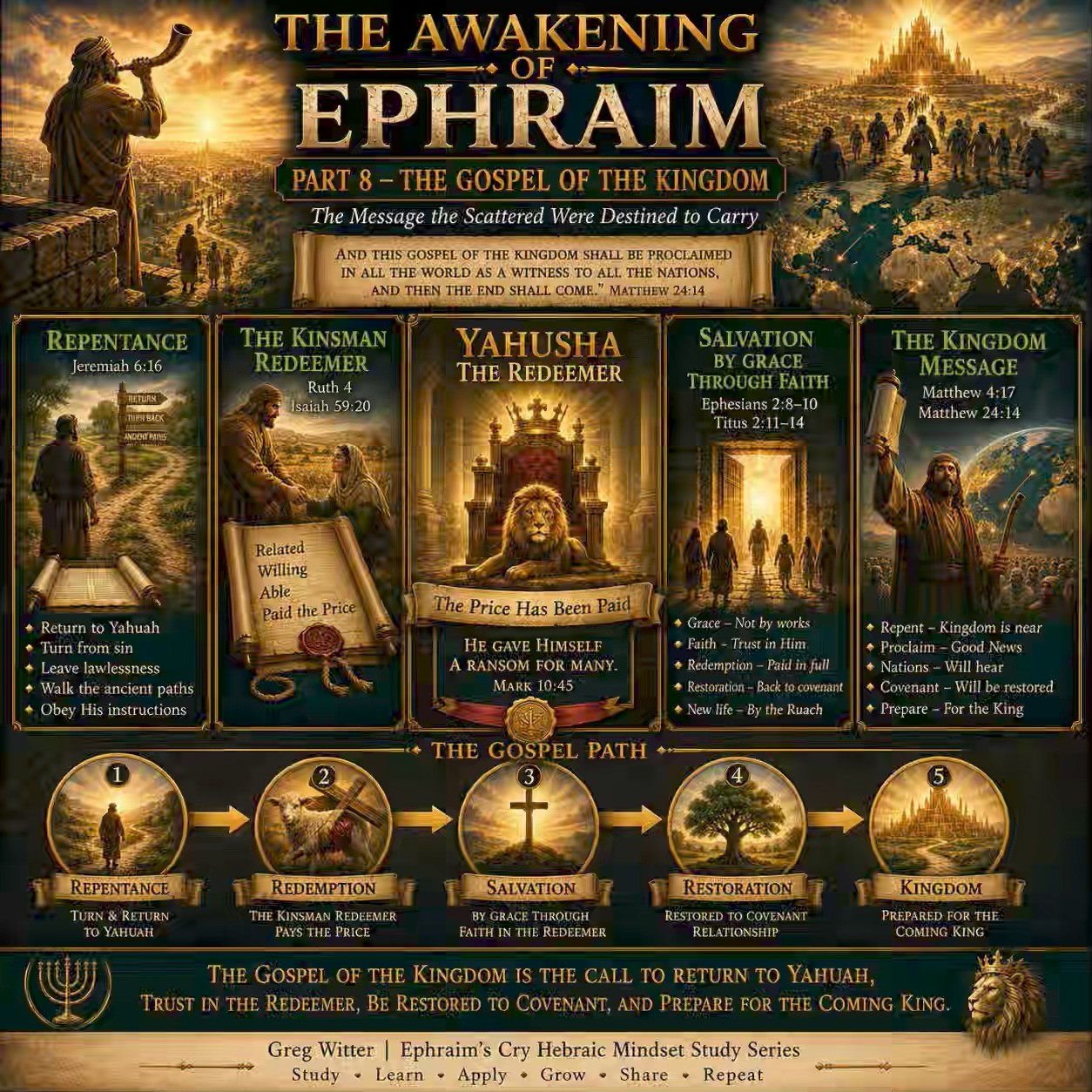
THE AWAKENING OF EPHRAIM
PART 8 — THE GOSPEL OF THE KINGDOM
The Message the Scattered Were Destined to Carry
The awakening of Ephraim is not the destination.
It is the beginning of the journey.
One of the greatest mistakes people make is assuming that awakening alone fulfills prophecy.
It does not.
Awakening is the beginning.
Restoration is the objective.
Covenant is the goal.
Kingdom is the destination.
Mission is the assignment.
Throughout Scripture, Yahuah never called His people merely to discover who they were.
He called them to return to Him.
The purpose of restoration was never genealogy.
The purpose was never ethnicity.
The purpose was never national identity.
The purpose was always covenant relationship.
This is why every restoration prophecy eventually returns to covenant.
Every restoration prophecy eventually returns to repentance.
Every restoration prophecy eventually returns to obedience.
Every restoration prophecy eventually returns to the Kingdom.
The prophets consistently move from awakening to repentance.
From repentance to redemption.
From redemption to restoration.
From restoration to obedience.
From obedience to covenant blessing.
From covenant blessing to Kingdom inheritance.
This pattern appears repeatedly throughout Scripture.
The scattered are awakened.
The awakened repent.
The repentant are redeemed.
The redeemed are restored.
The restored walk in covenant.
The covenant people inherit the Kingdom.
This is the pattern.
This has always been the pattern.
One of the clearest examples appears in the prophecy of Hosea.
The House of Israel had become Lo-Ammi.
Not My people.
The covenant people had become indistinguishable from the nations.
Yet the solution was never simply recognizing their identity.
The solution was returning to Yahuah.
In Hosea 6:1-3, the prophet declares:
“Come, and let us return to יהוה.”
Notice the emphasis.
Return.
Not speculate.
Not argue.
Not debate endlessly.
Return.
The restoration begins with returning.
The restoration begins with repentance.
The restoration begins with covenant renewal.
This is why the awakening taking place throughout the nations is only significant if it leads people back to covenant obedience.
Knowledge alone is not enough.
Information alone is not enough.
Identity alone is not enough.
Many people become fascinated with prophecy.
Many become fascinated with tribes.
Many become fascinated with Ephraim.
Many become fascinated with Israelite identity.
Yet if the awakening does not produce repentance, it has missed its purpose.
Repentance is not merely feeling sorry.
Repentance is not merely confessing wrongdoing.
Repentance is not merely emotional conviction.
The Hebrew concept is far deeper.
Repentance means to turn.
To change direction.
To leave one path and walk another.
To abandon rebellion.
To abandon lawlessness.
To abandon false worship.
To abandon compromise.
To abandon the traditions of men that nullify the commandments of Elohim.
Repentance is a return to the ancient paths.
This is why Jeremiah declares:
“Stand in the ways and see, and ask for the ancient paths, where the good way is, and walk in it” (Jeremiah 6:16).
The Gospel of the Kingdom begins with that call.
Return.
Turn back.
Come home.
Leave Babylon.
Leave lawlessness.
Leave rebellion.
Return to Yahuah.
Return to covenant.
Return to His ways.
Return to the Kingdom.
But repentance alone is not enough.
Repentance creates a problem.
If we have sinned, who pays the debt?
If we have broken covenant, who repairs the breach?
If we have rebelled, who satisfies justice?
If we have become lost sheep, who brings us home?
This is where redemption enters the Gospel.
The Gospel of the Kingdom is not merely a message of repentance.
It is also a message of redemption.
The entire biblical story points toward the Kinsman Redeemer.
From Genesis to Revelation, redemption is woven into the fabric of Scripture.
A kinsman redeemer had to be related.
A kinsman redeemer had to be willing.
A kinsman redeemer had to be able.
A kinsman redeemer had to pay the price.
This pattern appears throughout Torah.
It appears in the redemption of land.
It appears in the redemption of inheritance.
It appears in the redemption of family.
It appears most clearly in the book of Ruth.
Boaz becomes a picture of the coming Redeemer.
He is related.
He is willing.
He pays the price.
He restores inheritance.
He restores family.
He restores covenant continuity.
Yet Boaz points beyond himself.
He points to Yahusha.
Yahusha is the ultimate Kinsman Redeemer.
He entered humanity.
He became our brother.
He became our representative.
He became our Redeemer.
He paid the redemption price.
He purchased back what was lost.
He restored access to covenant relationship.
He accomplished what no man could accomplish.
This is why Scripture repeatedly describes redemption in covenant terms.
The issue was never merely forgiveness.
The issue was restoration.
The issue was bringing the lost back into covenant relationship.
This is why the Gospel of the Kingdom cannot be reduced to merely “Jesus died for your sins.”
That statement is true.
But it is incomplete.
Why did He die?
What was the purpose?
What was the objective?
The objective was restoration.
The objective was redemption.
The objective was covenant.
The objective was Kingdom.
The objective was bringing a scattered people back into relationship with their Creator.
The objective was restoring what had been broken.
This leads directly into salvation.
Many people begin with salvation.
Scripture begins with repentance.
Then redemption.
Then salvation.
Salvation is the result of the work of the Redeemer.
Salvation is not earned.
Salvation cannot be purchased.
Salvation cannot be deserved.
Salvation is by grace through faith.
Grace is the favor of Elohim.
Faith is trusting in the work of the Redeemer.
The Redeemer paid the price.
We receive the benefit.
The Redeemer opened the door.
We enter through faith.
The Redeemer made restoration possible.
We respond through repentance and trust.
This is the biblical pattern.
Repentance.
Redemption.
Salvation.
Restoration.
Kingdom.
Many modern presentations reverse the order.
Scripture does not.
The Gospel of the Kingdom calls people to repent because the Kingdom is drawing near.
The Redeemer has come.
The price has been paid.
The door has been opened.
Now people must choose.
Will they remain in rebellion?
Or will they return to covenant?
This is why salvation cannot be separated from restoration.
The purpose of salvation is not merely avoiding judgment.
The purpose of salvation is restoration to relationship.
The purpose of salvation is reconciliation with the Creator.
The purpose of salvation is covenant.
The purpose of salvation is preparing a people for the Kingdom.
This is why the renewed covenant is so important.
Jeremiah 31:31-33 does not describe a new religion.
It describes restoration.
Ezekiel 36:26-27 does not describe the abolition of covenant.
It describes restoration.
The Torah is written upon the heart.
The Spirit empowers obedience.
The covenant relationship is restored.
The citizen is prepared for the Kingdom.
This is the true Gospel of the Kingdom.
Repent.
Return.
Be redeemed.
Be restored.
Walk in covenant.
Prepare for the Kingdom.
This is the message Yahusha preached.
Matthew 4:17:
“Repent, for the reign of the heavens has drawn near.”
Not merely believe.
Repent.
Turn.
Return.
The Kingdom is coming.
The King is calling.
The Redeemer has arrived.
The scattered are being summoned home.
The covenant is being restored.
This is why Matthew 24:14 is so important.
“And this Gospel of the Kingdom shall be proclaimed in all the world as a witness to all the nations, and then the end shall come.”
Notice carefully.
The Gospel of the Kingdom.
Not the gospel of lawlessness.
Not the gospel of rebellion.
Not the gospel of cheap grace.
Not the gospel of covenant abandonment.
The Gospel of the Kingdom.
A Gospel that calls for repentance.
A Gospel that proclaims redemption.
A Gospel that offers salvation.
A Gospel that restores covenant.
A Gospel that prepares people for the reign of the King.
This connects directly to the awakening of Ephraim.
If Ephraim was scattered among the nations, then the message must go to the nations.
If the House of Israel became as the Gentiles, then the Gospel of the Kingdom must call them out from among the Gentiles.
If the scattered were dispersed to the four corners of the earth, then the proclamation must go to the four corners of the earth.
The scattering positioned the witnesses.
The awakening activates the witnesses.
The restoration gives them the message.
The Kingdom gives them the mission.
This is why the awakening cannot remain private.
It cannot remain merely personal.
It cannot remain merely academic.
It cannot remain merely prophetic curiosity.
The awakened must proclaim.
The restored must testify.
The redeemed must witness.
The scattered must cry out.
The dry bones that live must become an army.
The Gospel of the Kingdom must go where Ephraim was scattered.
The awakened are not called merely to win arguments.
They are not called merely to prove identity.
They are not called merely to expose error.
They are called to proclaim the Kingdom.
They are called to teach the truth.
They are called to call the scattered home.
They are called to warn the rebellious.
They are called to prepare the remnant.
They are called to declare that the King is coming.
The dry bones are not raised so they can sit silently.
They are raised to stand.
They are raised as an army.
They are raised to bear witness.
They are raised to proclaim.
They are raised to call others out of the valley and into life.
This is why the Gospel of the Kingdom must be central to the awakening of Ephraim.
Without the Kingdom message, awakening becomes identity obsession.
Without the Kingdom message, restoration becomes tribal speculation.
Without the Kingdom message, Torah becomes information without mission.
Without the Kingdom message, prophecy becomes curiosity instead of commission.
The Gospel of the Kingdom gives the awakening its purpose.
It gives the restoration its voice.
It gives the scattered their assignment.
It gives the remnant their mission.
The message is simple, but it is not shallow.
Repent.
Return to the ancient paths.
Trust in the Kinsman Redeemer.
Receive redemption.
Receive salvation by grace through faith.
Be restored to covenant relationship.
Walk in obedience.
Proclaim the Kingdom.
Prepare for the return of the King.
This is the message Yahusha preached.
This is the message the apostles carried.
This is the message the scattered must proclaim.
This is the message that must go to all nations.
And according to Yahusha, when this Gospel of the Kingdom is proclaimed in all the world as a witness to all nations, then the end shall come.
Greg Witter | Ephraim’s Cry Hebraic Mindset Study Series Study • Learn • Apply • Grow • Share • Repeat
#EphraimsCry#GregWitter#HebraicMindset#HebraicMindsetStudySeries#TheAwakeningOfEphraim#Part8#GospelOfTheKingdom
#KinsmanRedeemer#CovenantRestoration#ReturnToYahuah#ReturnToTorah#Repentance#Redemption#Salvation#KingdomMessage
#Matthew2414#HouseOfIsrael#Ephraim#ScatteredIsrael#Awakening#Remnant#Watchman#TruthMatters#PreparingTheWay
#KingdomCitizens
