
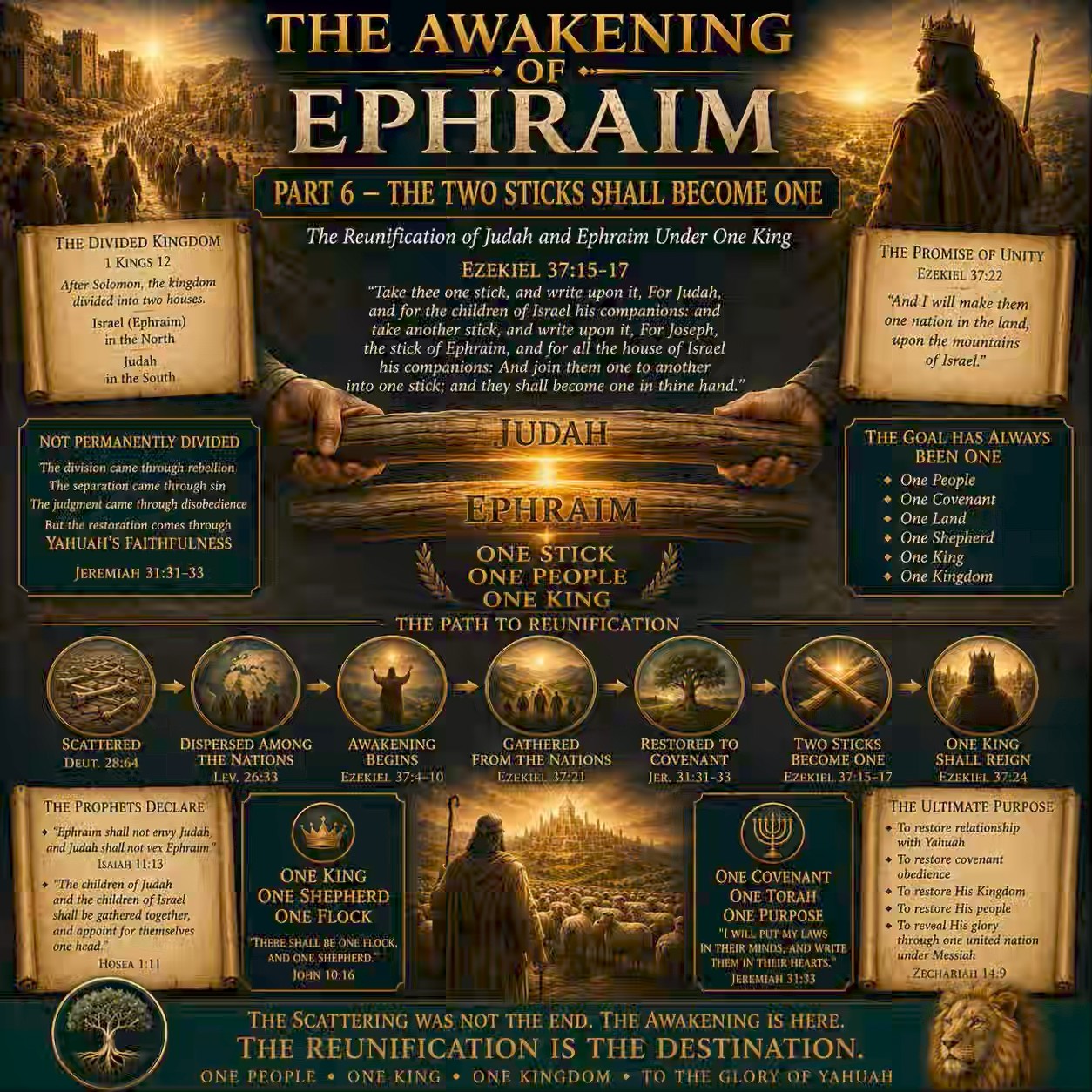
THE AWAKENING OF EPHRAIM
PART 6 — THE TWO STICKS SHALL BECOME ONE
The Reunification of Judah and Ephraim Under One King
One of the greatest prophetic promises in all of Scripture is not merely the restoration of Ephraim.
It is the reunification of Ephraim and Judah.
Many believers understand the scattering.
Many understand the exile.
Many understand the restoration.
Far fewer understand the ultimate destination of the restoration.
The goal was never two kingdoms.
The goal was never two peoples.
The goal was never two covenants.
The goal was never two destinies.
The goal has always been one people under one King.
To understand this prophecy, we must first understand the division.
Following the death of Solomon, the kingdom divided (1 Kings 11:11-13; 1 Kings 12:1-24).
The Northern Kingdom became known as Israel, Ephraim, or the House of Israel.
The Southern Kingdom became known as Judah, or the House of Judah.
From that point forward, Scripture repeatedly speaks of two houses.
Two kingdoms.
Two peoples.
Two national identities.
Yet the division was never intended to be permanent.
Yahuah allowed the division because of rebellion.
Yahuah allowed the separation because of covenant unfaithfulness.
Yahuah allowed the judgment because of sin.
But from the beginning He promised restoration.
The prophets repeatedly looked beyond the division.
They repeatedly looked beyond the exile.
They repeatedly looked beyond the scattering.
They repeatedly looked toward reunification.
This is why Ezekiel 37 is so important.
Most people focus on the dry bones.
Few continue reading into the prophecy that immediately follows.
Yet the prophecy of the two sticks is the direct continuation of the dry bones vision.
The dry bones live.
Then the two houses become one.
The awakening leads to reunification.
The restoration leads to unity.
The gathering leads to one kingdom.
In Ezekiel 37:15-17, Yahuah commands Ezekiel to take two sticks.
One stick is for Judah.
One stick is for Joseph, the stick of Ephraim, and all the House of Israel associated with him.
Then Yahuah commands Ezekiel to join them together.
The two sticks become one in his hand.
The symbolism is unmistakable.
The divided kingdom becomes one kingdom.
The divided people become one people.
The divided houses become one house.
This is not political language.
This is covenant language.
This is Kingdom language.
This is restoration language.
Notice carefully what Yahuah says next.
“I shall take the children of Israel from among the nations wherever they have gone, and shall gather them from every side, and bring them into their own land. And I shall make them one nation in the land” (Ezekiel 37:21-22).
The gathering comes first.
The reunification follows.
The restoration culminates in unity.
This is why the awakening of Ephraim cannot be understood apart from Judah.
Nor can Judah be understood apart from Ephraim.
The prophets consistently speak of both houses.
The renewed covenant is made with both houses (Jeremiah 31:31-33).
The restoration involves both houses.
The Kingdom involves both houses.
The King rules over both houses.
One of the greatest errors in modern theology is reading the Scriptures as though the division no longer matters.
The prophets never ignored the division.
They repeatedly addressed it.
They repeatedly promised its healing.
They repeatedly promised its reversal.
Isaiah saw the day coming when Ephraim would no longer envy Judah and Judah would no longer vex Ephraim (Isaiah 11:13).
The hostility would end.
The division would end.
The separation would end.
The rivalry would end.
The two houses would once again become one people.
Hosea saw the same reality.
“The children of Judah and the children of Israel shall be gathered together and appoint for themselves one head” (Hosea 1:11).
One head.
One King.
One Kingdom.
One people.
The prophets are remarkably consistent.
Jeremiah speaks of both houses.
Ezekiel speaks of both houses.
Hosea speaks of both houses.
Isaiah speaks of both houses.
Again and again the prophetic picture remains unchanged.
The scattering is not the end.
The gathering is not the end.
The reunification is the goal.
What many believers fail to recognize is that the reunification of the two houses was part of Yahuah’s plan long before the kingdoms ever divided.
The covenant promises given to Abraham, Isaac, and Jacob were never divided.
The promises were given to one family.
The promises were given to one people.
The promises were given to one covenant nation.
The division of the kingdom was the result of man’s rebellion.
The reunification of the kingdom is the result of Yahuah’s faithfulness.
The division was temporary.
The covenant promises are eternal.
This is why the language of restoration is so important.
Yahuah does not create a new people.
He restores His people.
Yahuah does not abandon His promises.
He fulfills His promises.
Yahuah does not forget His covenant.
He remembers His covenant.
The reunification of Judah and Ephraim is therefore not an afterthought.
It is a central component of the restoration story.
Another important detail often overlooked is that the prophecy specifically identifies Joseph and Ephraim together (Ezekiel 37:16).
This is significant because Ephraim became the dominant tribe of the Northern Kingdom.
Throughout the prophets, Ephraim often functions as a representative name for the entire House of Israel.
When the prophets speak of Ephraim, they are frequently speaking about the Northern Kingdom as a whole.
This explains why the restoration of Ephraim becomes such a major prophetic theme.
The awakening of Ephraim is not merely about one tribe.
It is about the restoration of the entire Northern Kingdom.
It is about the restoration of the House of Israel.
It is about the fulfillment of promises stretching back centuries.
The reunification prophecy also helps explain why the dry bones vision comes first.
Dead bones cannot be reunited.
Scattered bones cannot function as one body.
Life must come first.
Awakening must come first.
Restoration must come first.
Then unity can follow.
The sequence matters.
First comes awakening.
Then comes gathering.
Then comes restoration.
Then comes reunification.
Then comes Kingdom.
This prophetic pattern appears repeatedly throughout Scripture.
The scattered are awakened.
The awakened are gathered.
The gathered are restored.
The restored become one.
The one people serve one King.
This is the prophetic destination.
This is the prophetic trajectory.
This is the prophetic expectation.
The restoration story does not stop with people rediscovering Torah.
It does not stop with people rediscovering Sabbath.
It does not stop with people rediscovering the appointed times.
It does not stop with people rediscovering covenant identity.
All of those things are important.
All of those things are part of the process.
But the ultimate goal is unity under the reign of the King.
The ultimate goal is one people serving one Elohim under one covenant administration through one King.
This becomes even more significant when we consider Yahusha’s own words.
In John 10:16 He declares:
“And other sheep I have which are not of this fold. I have to bring them as well, and they shall hear My voice, and there shall be one flock, one shepherd.”
The language echoes the restoration promises.
One flock.
One shepherd.
One people.
One King.
The prophetic picture remains remarkably consistent from Torah through the Prophets and into the Apostolic Witnesses.
The same theme appears again and again.
What was divided becomes united.
What was scattered becomes gathered.
What was broken becomes restored.
What was estranged becomes reconciled.
What was separated becomes one.
This is why the prophecy of the two sticks remains one of the most important end-time prophecies in Scripture.
It reveals where the restoration is going.
It reveals what Yahuah is accomplishing.
It reveals the ultimate purpose behind the awakening.
The dry bones live.
The scattered are gathered.
The covenant is restored.
The two sticks become one.
The King reigns.
The Kingdom advances.
The promises are fulfilled.
And the Elohim who scattered His people proves Himself faithful by bringing them together again exactly as He promised.
The story of Ephraim is ultimately not a story about Ephraim alone.
The story of Judah is ultimately not a story about Judah alone.
The story is about restoration.
The story is about covenant.
The story is about reunification.
The story is about the Kingdom.
The story is about one people under one King.
And according to the prophets, that day is drawing near.
Greg Witter | Ephraim’s Cry Hebraic Mindset Study Series Study • Learn • Apply • Grow • Share • Repeat
#EphraimsCry#GregWitter#HebraicMindset#HebraicMindsetStudySeries#TheAwakeningOfEphraim#Part6#TwoSticks#Ezekiel37
#HouseOfIsrael#HouseOfJudah#Ephraim#RestorationOfIsrael#OneKing#OnePeople#OneKingdom#Jeremiah31#Hosea1
#Isaiah11#John10#GospelOfTheKingdom#CovenantRestoration#ReturnToTorah#Awakening#Watchman#KingdomCitizens
