
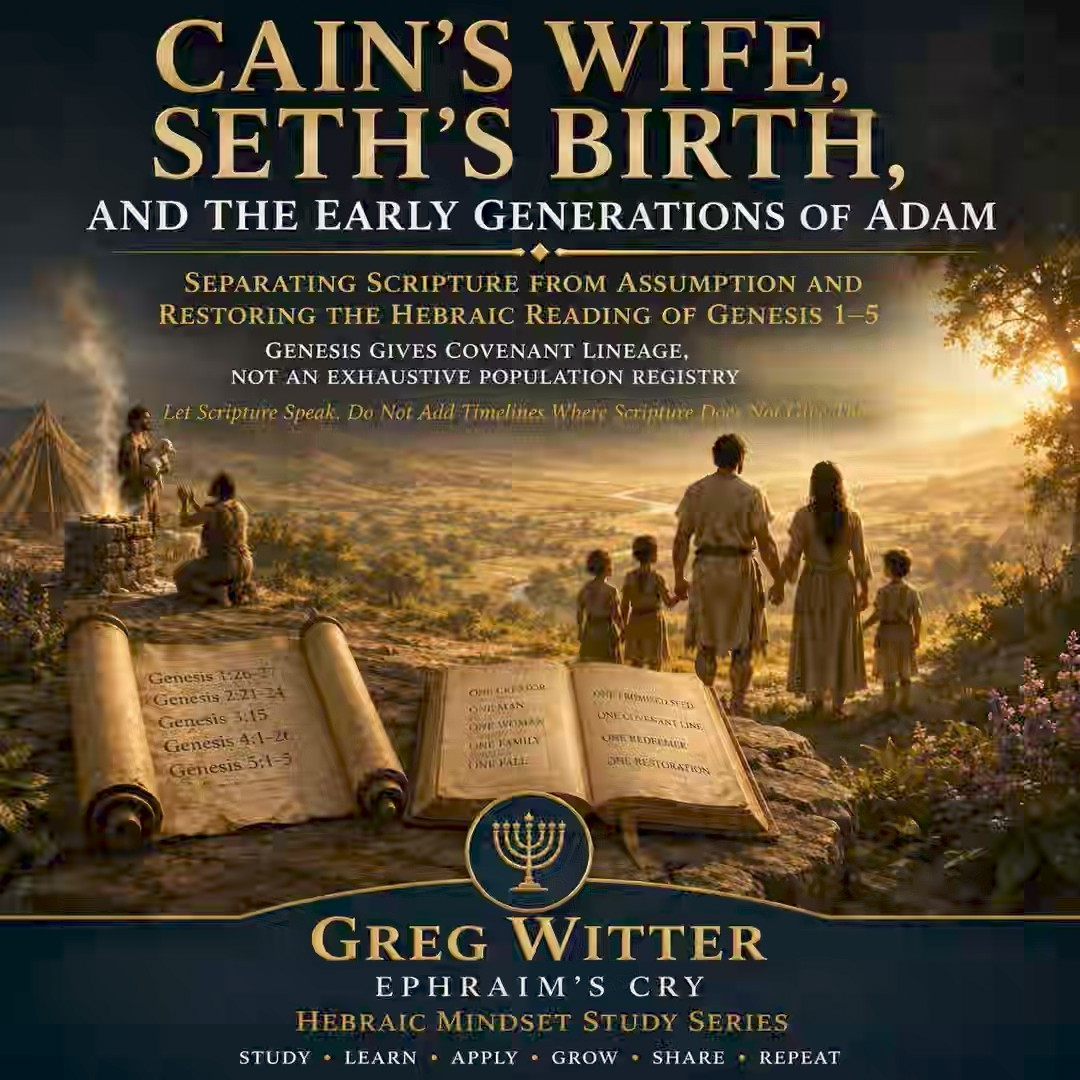
Cain’s Wife, Seth’s Birth, and the Early Generations of Adam
Separating Scripture From Assumption and Restoring the Hebraic Reading of Genesis 1–5
Genesis Is Giving Covenant Lineage, Not an Exhaustive Population Registry
Declaring the End from the Beginning Through the Whole Counsel of Elohim**
Greg Witter Ephraim’s Cry
Hebraic Mindset Study Series**Study • Learn • Apply • Grow • Share • Repeat
One of the most common objections raised against Genesis is the question, “Where did Cain get his wife?”
On the surface, some people think this is a devastating argument. They read Genesis 4, see Cain kill Abel, see Cain go out from the presence of Yahuah, and then see Cain’s wife mentioned. Then they assume Scripture has made a mistake because no other children have been named yet.
But that objection is not built on what Scripture says.
It is built on what people assume Scripture should have said.
That is the first problem.
Genesis is not a modern birth certificate record. It is not attempting to list every child, every daughter, every marriage, every generation, every date, and every family branch. Genesis is giving redemptive history. It is tracing covenant themes, covenant conflict, seed lines, rebellion, judgment, exile, restoration, and the promise of the coming Seed.
Genesis names the people necessary to the covenant story.
It does not name every person who existed.
That matters.
The Bible never says Adam and Eve had no other children before Seth.
The Bible never says Cain and Abel were the only children alive at the time Abel was murdered.
The Bible never says Seth was Adam and Eve’s third child.
People say that.
Scripture does not.
Genesis 5:4 says:
“After he brought forth Seth, the days of Adam were eight hundred years. And he brought forth sons and daughters.”
The text plainly tells us Adam had sons and daughters. It does not tell us all their names. It does not tell us when every one of them was born. It does not tell us how many were born before Seth. It does not tell us how many were born after Seth. It simply tells us Adam had many children.
That alone answers the question of Cain’s wife.
Cain’s wife came from Adam and Eve’s expanding family, most likely a sister or close relative.
At the beginning of humanity, there was only one human family. Marriage within that first family was necessary for humanity to obey the original command:
“Be fruitful and increase, and fill the earth.”
Genesis 1:28
Modern people often react emotionally to this because they force later conditions, later prohibitions, and later genetic realities back onto the first generations. But Genesis is describing the beginning of humanity, not the world after many generations of genetic decline and covenant regulation.
Later, in the Torah, close-relative marriage was restricted. Leviticus 18 gives boundaries that were not yet given in Genesis 4. You cannot take later covenant legislation and retroactively condemn what was necessary in the first generation of mankind.
That is not careful Bible reading.
That is confusion.
Now let us address another common mistake.
Genesis 5:3 says:
“And Adam lived one hundred and thirty years, and brought forth a son in his own likeness, after his image, and called his name Seth.”
This tells us Adam was 130 years old when Seth was born.
It does not say Seth was born 130 years after Cain killed Abel.
Those are two completely different statements.
People keep taking the number 130 and attaching it to the wrong event.
Genesis does not say:
Abel was killed.
Then 130 years passed.
Then Seth was born.
That timeline is not in the text.
Scripture only says Adam was 130 years old when Seth was born.
That is an age marker for Adam.
It is not a timestamp from Abel’s death.
We are never told how old Adam was when Cain was born.
We are never told how old Eve was when Cain was born.
We are never told how old Adam was when Abel was born.
We are never told how old Cain and Abel were when the offerings were brought.
We are never told how old Cain was when he killed Abel.
We are never told how old Abel was when he died.
We are never told how much time passed between Abel’s murder and Seth’s birth.
We are never told how many sons and daughters Adam and Eve already had by then.
So the safest rule is simple:
Do not add timelines where Scripture does not give them.
What Scripture says, we affirm.
What Scripture does not say, we do not invent.
Seth was born when Adam was 130 years old.
That is what we know.
Seth was not necessarily Adam and Eve’s third child.
That is what people assume.
Seth is highlighted because he becomes the covenant replacement for Abel in the promised seed line.
Genesis 4:25 says:
“And Adam knew his wife again, and she bore a son and called his name Seth, ‘For Elohim has appointed me another seed instead of Abel, because Cain had slain him.’”
That is the point.
Seth is not introduced because he is merely the next biological child.
He is introduced because he is the appointed seed line after Abel’s death.
Cain was the line of rebellion.
Abel was righteous but was killed.
Seth becomes the appointed line through which the covenant story continues.
That is why Genesis 5 follows Seth’s line.
Genesis is not trying to satisfy modern curiosity.
Genesis is tracing covenant history.
Now we must go back even further and address the creation of man.
Genesis 1:26–27 says:
“And Elohim said, ‘Let Us make man in Our image, according to Our likeness, and let them rule over the fish of the sea, and over the birds of the heavens, and over the livestock, and over all the earth and over all the creeping creatures that creep on the earth.’ And Elohim created the man in His image, in the image of Elohim He created him, male and female He created them.”
Some people wrongly use this passage to claim that other humans were created apart from Adam and Eve.
That is not what the text says.
Genesis 1 gives the overview of creation.
Genesis 2 gives the focused account of the formation of Adam, the planting of the garden, Adam’s placement in the garden, the command concerning the tree, the naming of the animals, and the forming of the woman from Adam’s side.
Genesis 2 is not a different creation story.
Genesis 2 is the zoomed-in explanation of the creation of mankind introduced in Genesis 1.
Genesis 1 is the wide-angle view.
Genesis 2 is the close-up view.
There is no contradiction.
There are not two separate human origins.
There is one human origin, explained from two angles.
Genesis 2:7 says:
“And Yahuah Elohim formed the man out of dust from the ground, and breathed into his nostrils breath of life. And the man became a living being.”
Genesis 2:21–22 says:
“So Yahuah Elohim caused a deep sleep to fall on the man, and he slept. And He took one of his sides, and closed up the flesh in its place. And the side which Yahuah Elohim had taken from the man He made into a woman, and He brought her to the man.”
That is the formation account of the same humanity described in Genesis 1.
Genesis 1 says male and female were created.
Genesis 2 explains how the woman was formed from the man.
This is confirmed later in Genesis 5:1–2:
“This is the book of the genealogy of Adam. In the day that Elohim created man, He made him in the likeness of Elohim. Male and female He created them, and He blessed them, and called their name Adam in the day they were created.”
That passage directly ties Genesis 1 and Genesis 2 together.
There is one mankind.
There is one Adamic origin.
There is one first man.
There is one first woman.
There is one human family.
This is also confirmed by Eve’s name.
Genesis 3:20 says:
“And the man called his wife’s name Chawwah, because she became the mother of all living.”
That statement matters.
Eve is not called the mother of some living.
She is not called the mother of one tribe of humans.
She is called the mother of all living.
In context, this means all living human beings.
This destroys the idea that there were other human populations created separately outside the garden.
If Eve is the mother of all living, then all humanity descends from her.
The apostolic witness agrees.
Acts 17:26 says:
“And He has made from one blood every nation of men to dwell on all the face of the earth.”
Paul says all nations come from one.
Romans 5 also builds its theology on one man, Adam.
Through one man sin entered the world.
Through one man death came.
Through one Man, Messiah Yahusha, redemption comes.
If there were other unrelated humans outside Adam, Paul’s argument collapses.
But Scripture does not collapse.
Man’s assumptions collapse.
Adam stands as the covenant head of humanity because all humanity descends from him.
Eve is the mother of all living because all humanity comes through her.
This is why the “other people outside the garden” theory fails.
It is not Scripture.
It is speculation inserted into Scripture.
Now let us address the image of Elohim.
Genesis 1 says man was created in the image and likeness of Elohim.
What does that mean?
Some assume it means physical appearance.
But Scripture is far deeper than that.
Yahuah is Spirit. He is not a created physical being. He is not an idol-shaped deity. He is not made of dust. Man is not the image of Elohim because man has arms, legs, eyes, and a face.
The image of Elohim is primarily functional, relational, moral, and representative.
Man was created to represent Elohim’s authority in creation.
Man was created to rule under Elohim.
Man was created to reflect Elohim’s character.
Man was created for covenant relationship.
Man was created with moral responsibility.
Man was created with the capacity to hear, obey, speak, name, guard, work, multiply, and exercise dominion under divine command.
Genesis 1:26 connects the image directly to dominion:
“Let Us make man in Our image, according to Our likeness, and let them rule…”
That is not accidental.
The image is tied to vocation.
Man is placed in creation as Yahuah’s earthly representative, His appointed steward, His covenant image-bearer.
Adam was not created to be autonomous.
Adam was created to rule under the rule of Elohim.
That is why the fall was so devastating.
Sin was not merely eating fruit.
Sin was rebellion against authority.
Sin was man rejecting the Word of Elohim and attempting to define good and evil for himself.
That is the root of all rebellion.
The serpent’s question was:
“Is it true that Elohim has said…?”
Genesis 3:1
That attack continues today.
Every false doctrine begins by questioning, twisting, or adding to what Elohim has said.
That is why this discussion matters.
When people insert other humans into Genesis, insert imaginary timelines, insert a second creation account, or insert contradictions the text never gives, they are repeating the same old pattern:
“Did Elohim really say?”
Now let us examine the formation of Eve.
Most English translations say Eve was made from Adam’s rib. The Hebrew word is **tsela**.
The word **tsela** does not primarily mean rib as a bone by itself. It means side, flank, side structure, or side chamber. It is used elsewhere for the side of the ark, the sides of the tabernacle, and side chambers in sacred architecture.
This does not mean a rib was not involved physically. It may have been. But the Hebrew word is broader than merely “rib.”
Genesis says Yahuah took from Adam’s side.
That is rich with meaning.
Eve was not taken from Adam’s head to rule over him.
She was not taken from Adam’s feet to be trampled by him.
She was taken from his side.
This speaks of correspondence, partnership, covenant union, and shared human nature.
Adam himself says:
“This is now bone of my bones and flesh of my flesh. This one is called woman, because she was taken out of man.”
Genesis 2:23
Eve is not a separate species.
She is not a lesser creature.
She is not an afterthought.
She is the corresponding helper, the covenant counterpart, the woman taken from man and brought back to man so that the two become one flesh.
Genesis 2:24 says:
“For this cause a man shall leave his father and mother, and cleave to his wife, and they shall become one flesh.”
The first marriage is rooted in creation.
The woman comes from the man.
The man receives the woman.
The two become one flesh.
Then through that union, humanity multiplies.
This is why the family is not a social invention.
It is creation order.
Now we must ask: how long was Adam in the garden before the fall?
The honest answer is:
Scripture does not tell us.
There are several views.
Some believe Adam and Eve fell the same day they were created. This view is based on the close sequence of Genesis 1–3 and the absence of any mention of children before the fall.
But absence of detail is not proof.
Genesis often compresses time.
Others believe the fall happened shortly afterward, perhaps days, weeks, or months later. This allows time for Adam to be placed in the garden, receive instruction, name the animals, recognize the absence of a corresponding helper, receive Eve, and live under the command before the serpent’s deception.
This is possible, but still not stated directly.
Others suggest an extended period, perhaps years or even longer, because Genesis 1:28 commanded humanity to be fruitful and multiply, and because Genesis does not tell us how much time passed.
That is also possible, but Scripture gives no direct evidence that Adam and Eve lived in the garden for years, decades, or centuries before the fall.
So we must be honest.
We do not know how long Adam and Eve were in the garden before the fall.
We know they were created on Day Six.
We know Adam was placed in the garden to work it and guard it.
We know Adam received the command regarding the tree.
We know Eve was formed from Adam’s side.
We know the serpent deceived Eve.
We know Adam sinned willfully.
We know they were expelled from the garden before Cain and Abel were born.
We know Cain and Abel were born after the fall.
But we do not know the exact length of time between creation and the fall.
Any precise number is speculation.
There is no scriptural evidence that Adam and Eve lived in the garden for hundreds of years before sin.
There is also no verse that explicitly says they fell the very same day they were created.
The honest teacher must say:
Scripture does not tell us.
That is not weakness.
That is faithfulness.
Now what about Cain and Abel?
Genesis 4:1–2 says:
“And Adam knew Chawwah his wife, and she conceived and bore Cain, and said, ‘I have gained a man from Yahuah.’ And again, she gave birth to his brother Abel. And Abel became a keeper of sheep, but Cain became a tiller of the ground.”
This tells us Cain was born first and Abel after him.
It does not tell us how much time passed between their births.
It does not tell us whether they were twins.
It does not tell us how old Adam and Eve were when Cain was born.
It does not tell us how old they were when Abel was born.
It does not tell us how old Cain and Abel were when they brought their offerings.
It does not tell us how old Cain was when he murdered Abel.
Those details are not given.
What is given is the covenant contrast.
Abel brought an acceptable offering.
Cain did not.
Yahuah warned Cain that sin was crouching at the door.
Cain refused correction.
Cain murdered his brother.
Cain became the first murderer.
The seed conflict of Genesis 3:15 immediately appears in Genesis 4.
That is the point.
Genesis 3:15 says there would be enmity between the seed of the serpent and the seed of the woman.
Genesis 4 shows that conflict in the first family.
Cain represents rebellion, jealousy, false worship, and violence.
Abel represents righteousness, acceptable worship, and innocent blood.
Seth represents the appointed continuation of the covenant line after Abel is killed.
That is why Genesis is focused on Cain, Abel, and Seth.
Not because they were the only children.
Because they carry the covenant meaning of the narrative.
Now let us address the land of Nod.
Genesis 4:16 says:
“So Cain went out from the presence of Yahuah and dwelt in the land of Nod on the east of Eden.”
Some people say, “See, Cain went to another land, so there must have been other people there.”
That is another assumption.
The text does not say there were other humans living in Nod before Cain arrived.
The text does not say Cain found a foreign nation there.
The text does not say Cain married a woman from another race of pre-Adamic people.
The text simply says Cain went to the land of Nod.
The word “Nod” is connected to wandering. Cain had been cursed to be a fugitive and a wanderer. Nod represents exile, wandering, separation, and life east of Eden, away from the presence of Yahuah.
Nod is not proof of other human civilizations.
Nod is the place of Cain’s exile.
Then Genesis 4:17 says:
“And Cain knew his wife, and she conceived and bore Chanoch. And he built a city, and called the name of the city after the name of his son, Chanoch.”
Again, people assume Cain found his wife in Nod.
The text does not say that.
Cain may have already had a wife before leaving.
His wife may have gone with him.
Or she may have joined him later from Adam’s family.
The text does not specify.
But since Eve is the mother of all living, Cain’s wife must come from Adam and Eve’s family line.
That is the scriptural answer.
Now someone may ask, “Why was Cain afraid someone would kill him if there were no other people?”
Genesis 4:14 says:
“See, You have driven me from the face of the ground today, and I am hidden from Your face. I shall be a fugitive and a wanderer on the earth, and it shall be that anyone who finds me kills me.”
Cain’s fear does not require another race of humans.
It requires only an expanding family of Adam.
Cain had murdered Abel. Other brothers, sisters, nephews, nieces, or later descendants would have had motive to avenge Abel’s blood.
Cain knew his guilt.
He knew he would be hated.
He knew the family would grow.
He knew his life was exposed.
Yahuah placed a sign upon Cain so that whoever found him would not kill him.
That makes sense inside the Adamic family.
No outside race is needed.
Now let us put the timeline together carefully.
Adam was created on Day Six.
Eve was formed from Adam’s side.
They were placed under command.
They sinned before Cain and Abel were born.
They were expelled from the garden.
Cain was born.
Abel was born.
Other sons and daughters were born, though not named in Genesis 4.
Cain and Abel grew old enough to work, worship, and bring offerings.
Cain murdered Abel.
Cain was exiled to the land of Nod.
Cain’s wife came from Adam and Eve’s family.
Cain had descendants.
Seth was born when Adam was 130 years old.
Seth became the appointed covenant line in place of Abel.
Adam lived 800 more years after Seth and had sons and daughters.
Adam died at 930 years old.
That is what Scripture allows us to say.
Now we must be careful not to say more than Scripture says.
We cannot say Adam and Eve had no children before Cain.
We cannot say Cain and Abel were the only children alive.
We cannot say Seth was the third child.
We cannot say Abel was killed when Adam was 130.
We cannot say Seth was born 130 years after Abel died.
We cannot say Cain found his wife among another human race.
We cannot say Genesis 1 and Genesis 2 describe two different creations of humanity.
We cannot say Eve was only the mother of one branch of mankind.
Those are assumptions.
Some are careless.
Some are dangerous.
Some directly contradict the text.
The whole counsel points in one direction:
One Creator.
One first man.
One first woman.
One human family.
One fall.
One entrance of sin and death.
One promised Seed.
One covenant line.
One Redeemer.
That is the framework.
This also matters for the Gospel.
If Adam is not the first man and covenant head of humanity, then Paul’s teaching in Romans 5 and 1 Corinthians 15 is damaged.
Romans 5:12 says:
“Therefore, as through one man sin entered into the world, and death through sin, and thus death spread to all men, because all sinned.”
1 Corinthians 15:22 says:
“For as all die in Adam, so also all shall be made alive in Messiah.”
The Gospel is built on the Adam-to-Messiah framework.
Adam brought sin and death.
Messiah brings righteousness and life.
Adam’s disobedience brought condemnation.
Messiah’s obedience brings redemption.
Adam was formed from dust.
Messiah is the second Man, from heaven.
Adam failed in the garden.
Messiah overcame in the wilderness and submitted in the garden.
Adam brought exile.
Messiah brings restoration.
Adam lost access to the tree of life.
Messiah restores access to the tree of life.
That is why Genesis matters.
These are not children’s stories.
These are covenant foundations.
When people twist Genesis, they weaken the Gospel.
When people insert other human origins, they undermine Eve as mother of all living, Adam as covenant head, sin’s entrance through one man, and Messiah’s role as the last Adam.
That is not a small error.
It is a foundational crack.
The safest way forward is to let Scripture speak.
Genesis 1 gives the creation overview.
Genesis 2 gives the garden and formation detail.
Genesis 3 gives the fall and the promise of the Seed.
Genesis 4 gives the first visible seed conflict between Cain and Abel.
Genesis 5 gives the covenant genealogy through Seth.
The text is not confused.
Modern readers are confused because they demand Genesis answer questions it was not written to answer, and then accuse Scripture of contradiction when it refuses to serve their assumptions.
Silence is not contradiction.
Selective genealogy is not error.
Covenant focus is not omission.
Genesis is doing exactly what it was designed to do.
It is revealing the beginning of creation, the beginning of humanity, the beginning of marriage, the beginning of sin, the beginning of death, the beginning of exile, the beginning of false worship, the beginning of murder, the beginning of cities, the beginning of seed conflict, and the beginning of the promised redemption.
Cain’s wife is not a problem.
The land of Nod is not a problem.
Seth at 130 is not a problem.
Genesis 1 and 2 are not a problem.
The problem is assumption.
The problem is reading into the text.
The problem is demanding exhaustive details from a covenant narrative.
The problem is using silence as a weapon against Scripture.
So let the warning be clear.
Do not build doctrine from silence.
Do not create contradictions from missing details.
Do not force modern assumptions onto an ancient Hebraic text.
Do not invent other human races to solve a problem Scripture never created.
Do not separate Genesis 1 from Genesis 2.
Do not detach Adam from the Gospel.
Do not detach Eve from all living humanity.
Do not detach Seth from the covenant seed line.
Do not detach Cain from the serpent-seed pattern of rebellion.
And do not pretend the Bible is unclear where it is actually very clear.
Eve was the mother of all living.
Adam was the first man.
Humanity came from one blood.
Cain’s wife came from Adam’s family.
Seth was born when Adam was 130.
Genesis does not tell us how long Adam and Eve were in the garden before the fall.
Genesis does not tell us how old Cain and Abel were when Abel died.
Genesis does not tell us how many unnamed children Adam and Eve had before Seth.
What Scripture says, we affirm.
What Scripture does not say, we leave alone.
That is the discipline of a faithful student.
That is the responsibility of a teacher.
That is the warning of a watchman.
Because once we allow assumption to rule the text, we are no longer studying Scripture.
We are editing it.
And no servant of Yahuah has permission to do that.
#CainWife#AdamAndEve#GenesisStudy#HebraicMindset#EphraimsCry#GregWitter
#MotherOfAllLiving#LandOfNod#Seth#CainAndAbel#GenesisOne#GenesisTwo#ImageOfElohim
#CovenantLineage#SeedOfTheWoman#WholeCounselOfElohim#TorahFoundations#BiblicalCreation
#StudyLearnApplyGrowShareRepeat
