
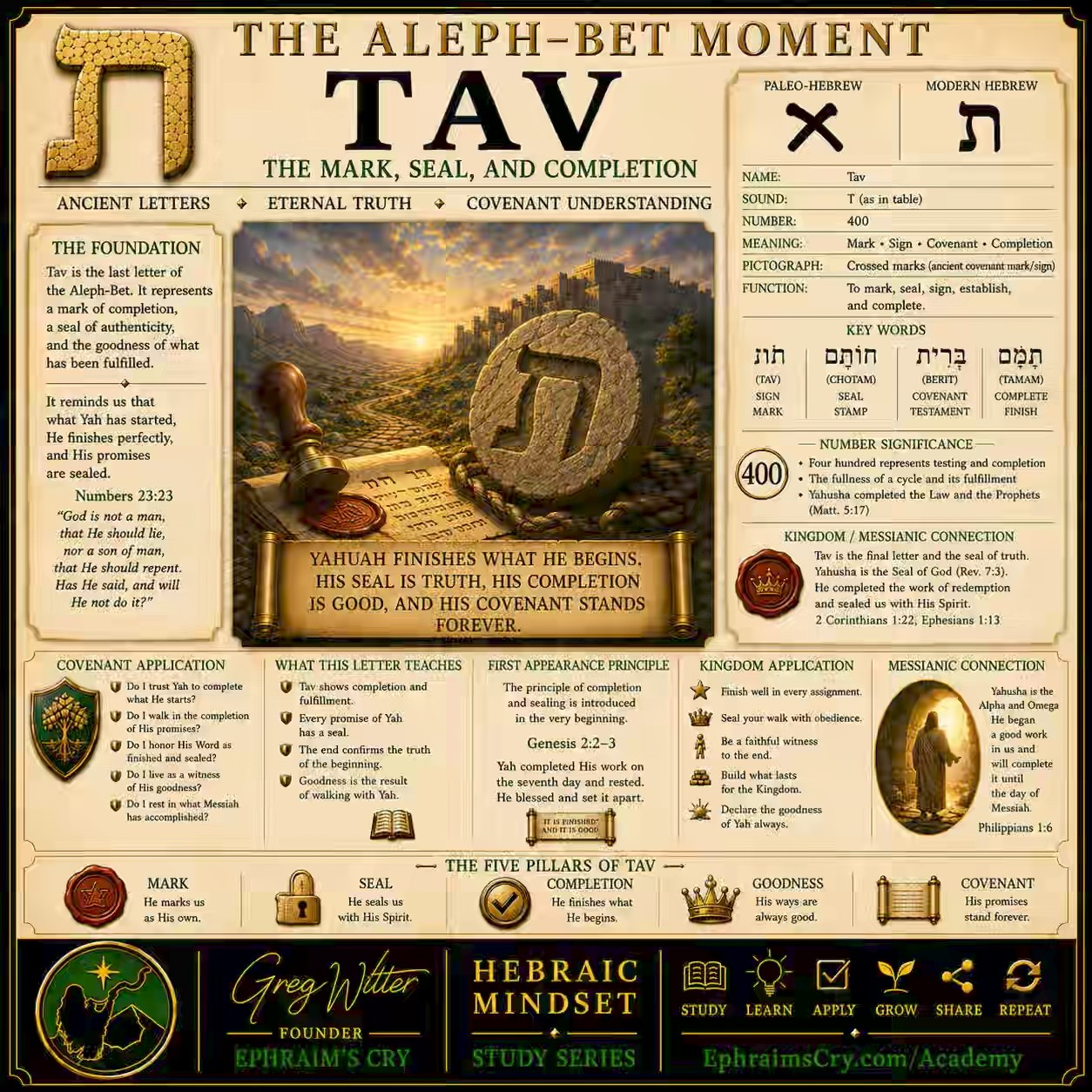
THE ALEPH-BET MOMENT
Tav
The Mark, Covenant Sign, and Completion
Ancient Letters • Eternal Truth • Covenant Understanding
Greg Witter | Ephraim’s Cry
Hebraic Mindset Study Series
Study • Learn • Apply • Grow • Share • Repeat
Introduction
The twenty-second and final letter of the Hebrew Aleph-Bet is Tav. If Shin teaches us about transformation through refinement, Tav teaches us the destination toward which that transformation leads.
Tav is the letter of the mark.
The letter of the sign.
The letter of covenant identity.
The letter of completion.
From the beginning of Scripture to the end, Yahuah places signs, marks, tokens, memorials, and witnesses before His people. These signs identify ownership, covenant relationship, protection, remembrance, and belonging.
Tav reminds us that covenant is not merely something we believe.
Covenant is something that identifies us.
The Letter
Paleo-Hebrew: 𐤕
Modern Hebrew: ת
Name: Tav
Sound: T
Numerical Value: 400
The Ancient Picture
The original Paleo-Hebrew Tav was drawn as a mark or sign.
Ancient forms often appeared as a cross-shaped mark, intersecting lines, or covenant sign.
To the ancient Hebrew, a mark represented ownership.
A mark identified belonging.
A mark identified authority.
A mark identified purpose.
The pictograph became one of the strongest covenant symbols in the Hebrew language.
Definition
Mark.
Sign.
Covenant Witness.
Function
To identify.
To seal.
To testify.
To complete.
Covenant Role
Tav reminds us that covenant produces identity.
The people of Yahuah are distinguished from the nations.
They bear His Name.
They keep His covenant.
They walk in His instructions.
They become living witnesses of His Kingdom.
Throughout Scripture, signs and marks repeatedly identify those who belong to Yahuah.
The Number Four Hundred
Tav carries the numerical value of four hundred.
Throughout Scripture, four hundred is frequently associated with completion, fulfillment, and the conclusion of a divinely appointed process.
Examples include:
The four hundred years spoken concerning Abraham’s descendants.
Periods of preparation before covenant fulfillment.
Seasons that move toward completion according to Yahuah’s timing.
The number often points toward a completed purpose.
Word-Picture Development
A builder places his mark upon completed work.
A king seals an official decree.
A shepherd identifies his flock.
The ancient Hebrew understood that marks carried authority and meaning.
The pictograph teaches covenant identity, ownership, and completion.
What belongs to Yahuah bears His witness.
Key Hebrew Words
Tav (תו)
Mark.
Sign.
Covenant witness.
Torah (תורה)
Instruction.
Teaching.
Direction.
Tamim (תמים)
Complete.
Whole.
Blameless.
Todah (תודה)
Thanksgiving.
Praise.
Gratitude.
These words reveal recurring themes of covenant identity, instruction, completeness, and worship.
First Appearance Principle
One of the clearest Tav themes appears in the covenant signs established throughout Genesis.
The rainbow becomes a sign.
Circumcision becomes a sign.
Memorials become signs.
Witnesses become signs.
Yahuah continually establishes visible reminders of invisible covenant realities.
Letter Throughout Scripture
Tav themes appear throughout the Bible.
The blood upon the doorposts serves as a sign.
The Sabbath serves as a sign.
The covenant serves as a sign.
The prophets speak of marks distinguishing the faithful.
Again and again Scripture reveals that Yahuah identifies His people through covenant faithfulness.
One of the most powerful examples appears in Ezekiel 9:4, where a mark is placed upon those who grieve over the abominations committed within the land.
The mark identifies those who remain faithful.
The Letter and Yahusha
The themes of Tav find their ultimate fulfillment in Yahusha.
He completes the mission given by the Father.
He fulfills the prophetic promises.
He becomes the perfect covenant witness.
He identifies His people and calls them to follow Him.
In Him, covenant purpose reaches completion.
The Letter in the Name of Yahuah
The themes associated with Tav reveal Yahuah as the One who establishes covenant, identifies His people, fulfills His promises, and brings His purposes to completion.
The Letter in the Name of Yahusha
The ministry of Yahusha reflects the themes of fulfillment, completion, covenant identity, and faithful witness associated with Tav.
Covenant Application
Tav challenges us to examine our identity.
Who do we belong to?
What mark identifies our lives?
Do our actions reflect covenant faithfulness?
Can others recognize the influence of Yahuah in the way we live?
The covenant is not merely spoken.
It is demonstrated.
The mark is not merely external.
It becomes visible through obedience, faithfulness, and transformed living.
Aleph-Bet Moment
A mark identifies ownership.
A sign communicates meaning.
A witness reveals truth.
Tav reminds us that covenant life produces visible evidence.
The people of Yahuah are called to bear His witness before the world.
Discussion Questions
- Why is Tav represented by a mark or sign?
- What significance did marks carry in ancient Hebrew culture?
- How does Tav relate to covenant identity?
- What significance does the number four hundred carry?
- How did Yahusha fulfill the themes of Tav?
- What signs identify covenant faithfulness?
- How should believers demonstrate covenant identity today?
Fill-in-the-Blank Review
- Tav is the __________ letter of the Hebrew alphabet.
- The original pictograph for Tav was a __________.
- Tav carries the numerical value of __________.
- Tav is associated with covenant __________.
- The Hebrew word Tav means __________.
- Covenant faithfulness becomes a visible __________.
- Yahuah identifies His __________.
Key Terms
Tav — The twenty-second letter of the Hebrew alphabet.
Mark — The original pictographic image associated with Tav.
Sign — A visible witness of covenant reality.
Identity — Who we belong to.
Witness — Evidence that reveals truth.
Completion — The fulfillment of purpose.
Closing Charge
The journey through the Aleph-Bet concludes with Tav.
The letter of the mark.
The letter of covenant identity.
The letter of completion.
Aleph taught us authority.
Bet taught us the house.
Gimel taught us provision.
Dalet taught us access.
Hey taught us revelation.
Waw taught us connection.
Zayin taught us defense.
Chet taught us boundaries.
Tet taught us hidden character.
Yod taught us action.
Kaph taught us stewardship.
Lamed taught us instruction.
Mem taught us provision.
Nun taught us continuity.
Samekh taught us support.
Ayin taught us perception.
Pe taught us proclamation.
Tsade taught us righteousness.
Qoph taught us pursuit.
Resh taught us leadership.
Shin taught us transformation.
Tav teaches us completion.
From Aleph to Tav, the covenant story has been present from the very beginning. The Hebrew letters reveal a language designed not merely to communicate information, but to proclaim the purposes of Yahuah, the Gospel of the Kingdom, and the unfolding story of redemption.
Want to go deeper?
Get the Aleph-Bet Restoration Bundle and continue your journey through the language of Scripture.
Restore the Language. Recover the Covenant.
Study it. Learn it. Teach it. Share it.
#GregWitter #EphraimsCry #HebraicMindsetStudySeries #AlephBetMoment #Tav #Mark #CovenantSign #Completion #PaleoHebrew #AncientHebrew #HebrewAlphabet #BiblicalHebrew #HebraicMindset #TorahStudy #BibleStudy #ScriptureStudy #HebrewLetters #CovenantLanguage #Identity #Witness #Fulfillment #KingdomLiving #GospelOfTheKingdom #Remnant #Watchman #BiblicalTruth #Torah #Yahuah #Yahusha
