
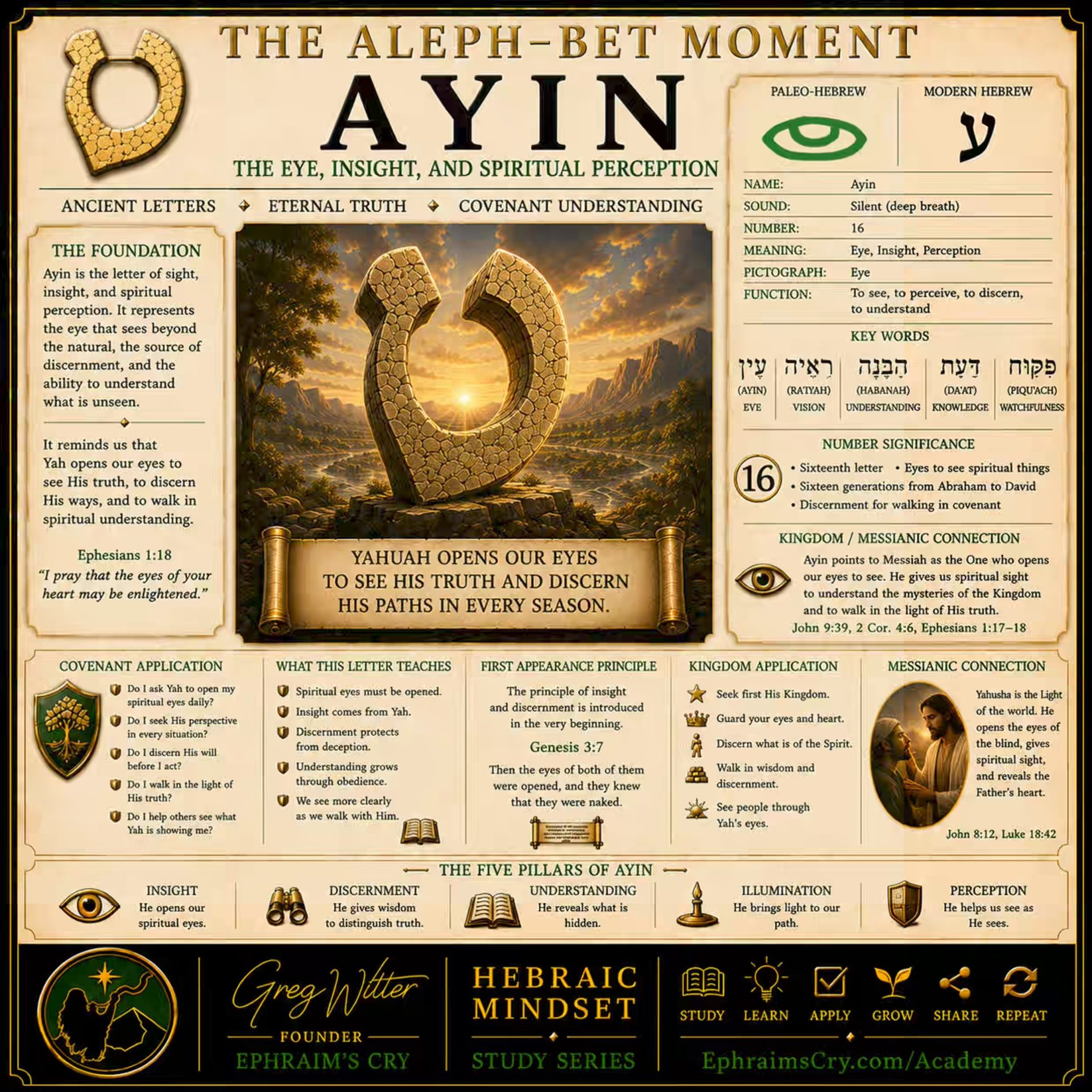
THE ALEPH-BET MOMENT
Ayin
The Eye, Understanding, and Spiritual Perception
Ancient Letters • Eternal Truth • Covenant Understanding
Greg Witter | Ephraim’s Cry
Hebraic Mindset Study Series
Study • Learn • Apply • Grow • Share • Repeat
Introduction
The sixteenth letter of the Hebrew Aleph-Bet is Ayin. If Samekh teaches us about the support that sustains covenant life, Ayin teaches us how we perceive that support.
Ayin is the letter of the eye.
The letter of vision.
The letter of perception.
The letter of understanding.
Throughout Scripture, seeing is often connected to understanding. Blindness is often connected to ignorance, deception, rebellion, or unbelief. The issue is not merely physical sight. The greater issue is spiritual perception.
Many people can see with their eyes yet remain blind to truth.
Others may never see the full picture physically yet possess tremendous spiritual understanding.
Ayin reminds us that what we perceive determines how we live.
The Letter
Paleo-Hebrew: 𐤏
Modern Hebrew: ע
Name: Ayin
Sound: Traditionally a guttural sound; often silent in modern pronunciation
Numerical Value: 70
The Ancient Picture
The original Paleo-Hebrew Ayin was drawn as an eye.
To the ancient Hebrew, the eye represented far more than sight.
The eye gathered information.
The eye observed danger.
The eye recognized opportunity.
The eye discerned truth.
The eye guided action.
What entered through the eye influenced the heart and mind.
Definition
Eye.
Vision.
Perception.
Function
To see.
To observe.
To understand.
To discern.
Covenant Role
Ayin reminds us that covenant life requires spiritual discernment.
The people of Yahuah must learn to see as He sees.
The world evaluates by appearance.
Yahuah evaluates by truth.
The world values the temporary.
Yahuah values the eternal.
The covenant requires transformed vision.
The Number Seventy
Ayin carries the numerical value of seventy.
Throughout Scripture, seventy frequently represents:
Nations.
Leadership.
Completeness among peoples.
Expanded responsibility.
Examples include:
The seventy descendants of Jacob entering Egypt.
The seventy elders assisting Mosheh.
The seventy years of exile.
The seventy nations traditionally associated with Genesis 10.
The number often points toward broader vision and greater responsibility.
Word-Picture Development
An eye provides direction.
Without vision, people stumble.
Without perception, danger goes unnoticed.
Without understanding, wisdom cannot be applied.
The ancient Hebrew understood that seeing correctly often determined survival.
The pictograph teaches awareness, discernment, and understanding.
Key Hebrew Words
Ayin (עין)
Eye.
Vision.
Perception.
Am (עם)
People.
Nation.
Community.
Etsah (עצה)
Counsel.
Advice.
Wisdom applied.
Olam (עולם)
Age.
Eternity.
That which extends beyond immediate sight.
These words reveal recurring themes of perception, wisdom, community, and eternal perspective.
First Appearance Principle
One of the earliest Ayin themes appears in the Garden of Eden.
The woman sees the tree.
The eyes become central to the decision.
What is seen influences what is desired.
This becomes a recurring biblical theme.
Seeing correctly leads toward life.
Seeing incorrectly often leads toward deception.
Letter Throughout Scripture
Ayin themes appear throughout the Bible.
The spies view the Promised Land.
The prophets receive visions.
The watchmen observe approaching danger.
The Psalms repeatedly ask Yahuah to open the eyes of understanding.
Wisdom literature emphasizes perception and discernment.
Again and again Scripture reveals that spiritual sight is essential to covenant faithfulness.
The Letter and Yahusha
The themes of Ayin find powerful fulfillment in Yahusha.
He repeatedly restores sight.
He opens understanding.
He exposes hidden motives.
He reveals truth.
He teaches people how to see the Kingdom.
Physical healings often become pictures of spiritual awakening.
Yahusha consistently calls people to see beyond appearances.
The Letter in the Name of Yahuah
The themes associated with Ayin reveal Yahuah as the One who sees all things.
Nothing is hidden from His sight.
Nothing escapes His understanding.
His vision is complete and perfect.
The Letter in the Name of Yahusha
The ministry of Yahusha reflects the themes of Ayin through revelation, discernment, wisdom, and the opening of spiritual eyes.
Covenant Application
Ayin challenges us to examine how we see.
Do we view life through the lens of culture or covenant?
Do we see according to appearance or according to truth?
Do we recognize deception when it appears?
Do we discern the hand of Yahuah at work around us?
The covenant life requires more than knowledge.
It requires discernment.
Aleph-Bet Moment
The eye determines direction.
The eye gathers information.
The eye influences decisions.
Ayin reminds us that covenant faithfulness begins with learning to see correctly.
The person who sees through the wisdom of Yahuah will often recognize what others overlook.
Spiritual vision changes everything.
Discussion Questions
- Why is Ayin represented by an eye?
- What significance did the eye hold in ancient Hebrew culture?
- How does Ayin relate to spiritual discernment?
- What significance does the number seventy carry?
- How did Yahusha demonstrate the themes of Ayin?
- Why is perception important in covenant life?
- How can believers develop greater spiritual discernment?
Fill-in-the-Blank Review
- Ayin is the __________ letter of the Hebrew alphabet.
- The original pictograph for Ayin was an __________.
- Ayin carries the numerical value of __________.
- Ayin is associated with perception and __________.
- The Hebrew word Ayin means __________.
- Spiritual sight requires __________.
- What we see influences what we __________.
Key Terms
Ayin — The sixteenth letter of the Hebrew alphabet.
Eye — The original pictographic image associated with Ayin.
Discernment — The ability to recognize truth from error.
Vision — Spiritual perception and understanding.
Counsel — Wisdom applied to life.
Understanding — Seeing according to truth.
Closing Charge
The journey through the Aleph-Bet continues with Ayin.
The letter of the eye.
The letter of perception.
The letter of understanding.
Aleph taught us authority.
Bet taught us the house.
Gimel taught us provision.
Dalet taught us access.
Hey taught us revelation.
Waw taught us connection.
Zayin taught us defense.
Chet taught us boundaries.
Tet taught us hidden character.
Yod taught us action.
Kaph taught us stewardship.
Lamed taught us instruction.
Mem taught us provision.
Nun taught us continuity.
Samekh taught us support.
Ayin teaches us that covenant faithfulness requires learning to see life through the wisdom, truth, and perspective of Yahuah.
Want to go deeper?
Get the Aleph-Bet Restoration Bundle and continue your journey through the language of Scripture.
Restore the Language. Recover the Covenant.
Study it. Learn it. Teach it. Share it.
#GregWitter #EphraimsCry #HebraicMindsetStudySeries #AlephBetMoment #Ayin #Eye #Vision #Discernment #PaleoHebrew #AncientHebrew #HebrewAlphabet #BiblicalHebrew #HebraicMindset #TorahStudy #BibleStudy #ScriptureStudy #HebrewLetters #CovenantLanguage #SpiritualSight #Understanding #Wisdom #KingdomLiving #GospelOfTheKingdom #Remnant #Watchman #BiblicalTruth #Torah #Yahuah #Yahusha
