
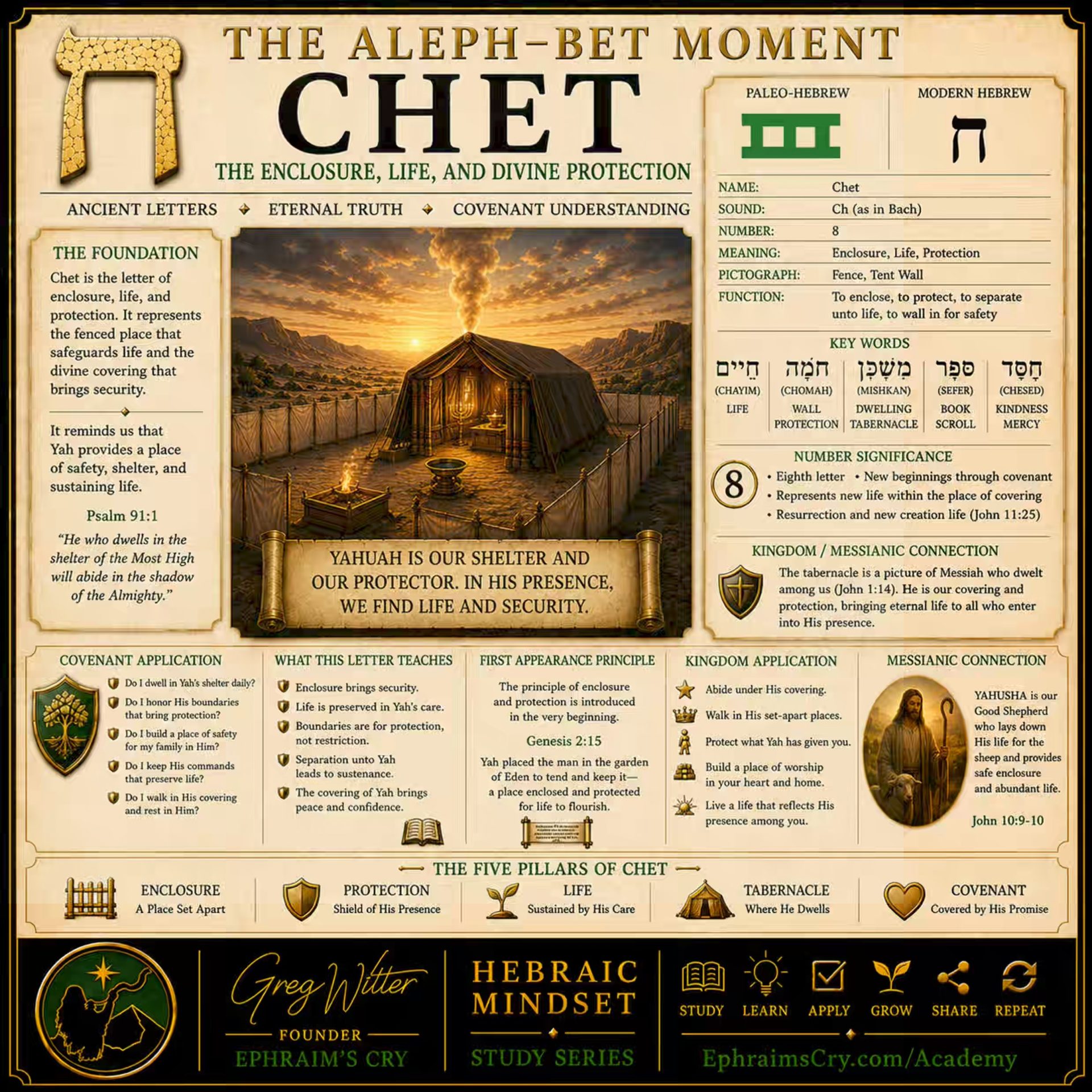
THE ALEPH-BET MOMENT
Chet
The Fence, Separation, and Covenant Boundary
Ancient Letters • Eternal Truth • Covenant Understanding
Greg Witter | Ephraim’s Cry
Hebraic Mindset Study Series
Study • Learn • Apply • Grow • Share • Repeat
Introduction
The eighth letter of the Hebrew Aleph-Bet is Chet. If Zayin teaches us about defending the covenant, Chet teaches us why the covenant must be protected.
Chet is the letter of the fence.
The letter of separation.
The letter of boundaries.
The letter of protection.
Throughout Scripture, Yahuah establishes distinctions between the set-apart and the common, the clean and the unclean, the righteous and the wicked, obedience and rebellion.
Modern culture often views boundaries as restrictions.
Scripture presents them as protection.
Chet reminds us that boundaries do not exist to limit life. They exist to preserve life.
The Letter
Paleo-Hebrew: 𐤇
Modern Hebrew: ח
Name: Chet
Sound: Ch (as in Bach)
Numerical Value: 8
The Ancient Picture
The original Paleo-Hebrew Chet is commonly understood as a fence or enclosure.
To the ancient Hebrew, a fence served several important purposes.
It protected the family.
It protected livestock.
It protected crops.
It established ownership.
It marked a boundary.
The fence distinguished what belonged inside from what remained outside.
Without boundaries, confusion follows.
Without boundaries, protection is lost.
Without boundaries, identity becomes blurred.
Definition
Fence.
Boundary.
Separation.
Function
To protect.
To enclose.
To distinguish.
To preserve.
Covenant Role
Chet reminds us that Yahuah establishes boundaries for His people.
The Sabbath establishes a boundary in time.
Dietary instructions establish boundaries in food.
Marriage establishes boundaries in relationships.
The covenant establishes boundaries in behavior.
The Tabernacle established boundaries in worship.
These boundaries were never intended as burdens.
They were intended as protections.
The Number Eight
Chet carries the numerical value of eight.
Throughout Scripture, eight frequently represents:
New beginning.
Renewal.
Restoration.
A new cycle.
Life beyond completion.
The eighth day follows the completion of the seven-day cycle.
It represents continuation.
Renewal.
A fresh beginning.
The combination of fence and new beginning reveals an important truth.
Boundaries often preserve the conditions necessary for renewal.
Word-Picture Development
A fence does not exist to imprison.
A fence exists to protect.
The shepherd builds a fence to protect the flock.
The farmer builds a fence to protect the harvest.
Parents establish boundaries to protect children.
Yahuah establishes covenant boundaries to protect His people.
The ancient Hebrew would immediately recognize that healthy boundaries produce stability, security, and growth.
Key Hebrew Words
Chay (חי)
Life.
One of the most recognized Hebrew words.
The concept of life itself begins with Chet.
Chesed (חסד)
Loving-kindness.
Covenant loyalty.
Faithful love.
A foundational covenant word.
Chokmah (חכמה)
Wisdom.
The ability to walk properly within Yahuah’s instructions.
Chag (חג)
Appointed feast.
Pilgrimage festival.
A set-apart time established by Yahuah.
These words reveal recurring themes of life, covenant faithfulness, wisdom, and appointed boundaries.
First Appearance Principle
One of the earliest Chet themes appears in the Garden of Eden.
Yahuah establishes boundaries.
Trees are provided.
Instructions are given.
Limits are defined.
The boundary itself becomes a test of covenant loyalty.
From the beginning, boundaries play a central role in the relationship between Yahuah and mankind.
Letter Throughout Scripture
Chet themes appear throughout the Bible.
The Garden had boundaries.
Noah’s Ark had boundaries.
The Tabernacle had boundaries.
The Temple had boundaries.
The Land had boundaries.
The Sabbath establishes boundaries in time.
The Torah establishes boundaries for covenant living.
Again and again Yahuah reveals Himself as the One who establishes righteous boundaries.
The Letter and Yahusha
The themes of Chet find fulfillment in Yahusha.
He never abolished covenant boundaries.
He taught their proper purpose.
He exposed traditions that distorted them.
He demonstrated perfect obedience within the covenant established by the Father.
Yahusha showed that true freedom is found within the boundaries established by Yahuah, not outside them.
The Letter in the Name of Yahuah
The themes associated with Chet reveal Yahuah as protector, shepherd, and covenant keeper.
He establishes boundaries because He desires life, blessing, and preservation for His people.
The Letter in the Name of Yahusha
The ministry of Yahusha consistently reflects the life, wisdom, faithfulness, and covenant loyalty associated with Chet.
Covenant Application
Chet challenges us to examine how we view boundaries.
Do we see them as restrictions?
Or do we see them as protection?
The world often rejects boundaries.
Yahuah establishes them.
The covenant life requires understanding that His instructions are not barriers to blessing.
They are pathways to blessing.
The fence protects what is valuable.
The covenant protects what is precious.
Aleph-Bet Moment
A fence marks what belongs.
A fence protects what is valuable.
A fence preserves life.
Chet reminds us that covenant boundaries are expressions of the wisdom and love of Yahuah.
The same Creator who establishes boundaries is the One who desires life, blessing, and restoration for His people.
The question is not whether boundaries exist.
The question is whether we trust the One who established them.
Discussion Questions
- Why is Chet represented by a fence?
- What purpose did fences serve in ancient Hebrew culture?
- How do covenant boundaries provide protection?
- What significance does the number eight carry?
- How does Chet relate to the concept of life?
- How did Yahusha demonstrate the proper purpose of boundaries?
- Why does modern culture often resist boundaries?
Fill-in-the-Blank Review
- Chet is the __________ letter of the Hebrew alphabet.
- The original pictograph for Chet was a __________.
- Chet carries the numerical value of __________.
- Chet is associated with boundaries and __________.
- The Hebrew word Chay means __________.
- Boundaries were given for __________.
- The covenant protects what is __________.
Key Terms
Chet — The eighth letter of the Hebrew alphabet.
Fence — The original pictographic image associated with Chet.
Boundary — A line of distinction and protection.
Chay — Life.
Chesed — Covenant loyalty and loving-kindness.
Renewal — Restoration and new beginning.
Closing Charge
The journey through the Aleph-Bet continues with Chet.
The letter of the fence.
The letter of protection.
The letter of covenant boundaries.
Aleph taught us authority.
Bet taught us the house.
Gimel taught us provision.
Dalet taught us access.
Hey taught us revelation.
Waw taught us connection.
Zayin taught us defense.
Chet teaches us that what is valuable must be protected, and that the boundaries established by Yahuah are expressions of His wisdom, love, and covenant faithfulness.
Want to go deeper?
Get the Aleph-Bet Restoration Bundle and continue your journey through the language of Scripture.
Restore the Language. Recover the Covenant.
Study it. Learn it. Teach it. Share it.
#GregWitter #EphraimsCry #HebraicMindsetStudySeries #AlephBetMoment #Chet #Fence #Boundary #Protection #PaleoHebrew #AncientHebrew #HebrewAlphabet #BiblicalHebrew #HebraicMindset #TorahStudy #BibleStudy #ScriptureStudy #HebrewLetters #CovenantLanguage #Chay #Chesed #Wisdom #KingdomLiving #GospelOfTheKingdom #Discipleship #Remnant #Watchman #BiblicalTruth #Torah #Yahuah #Yahusha
