
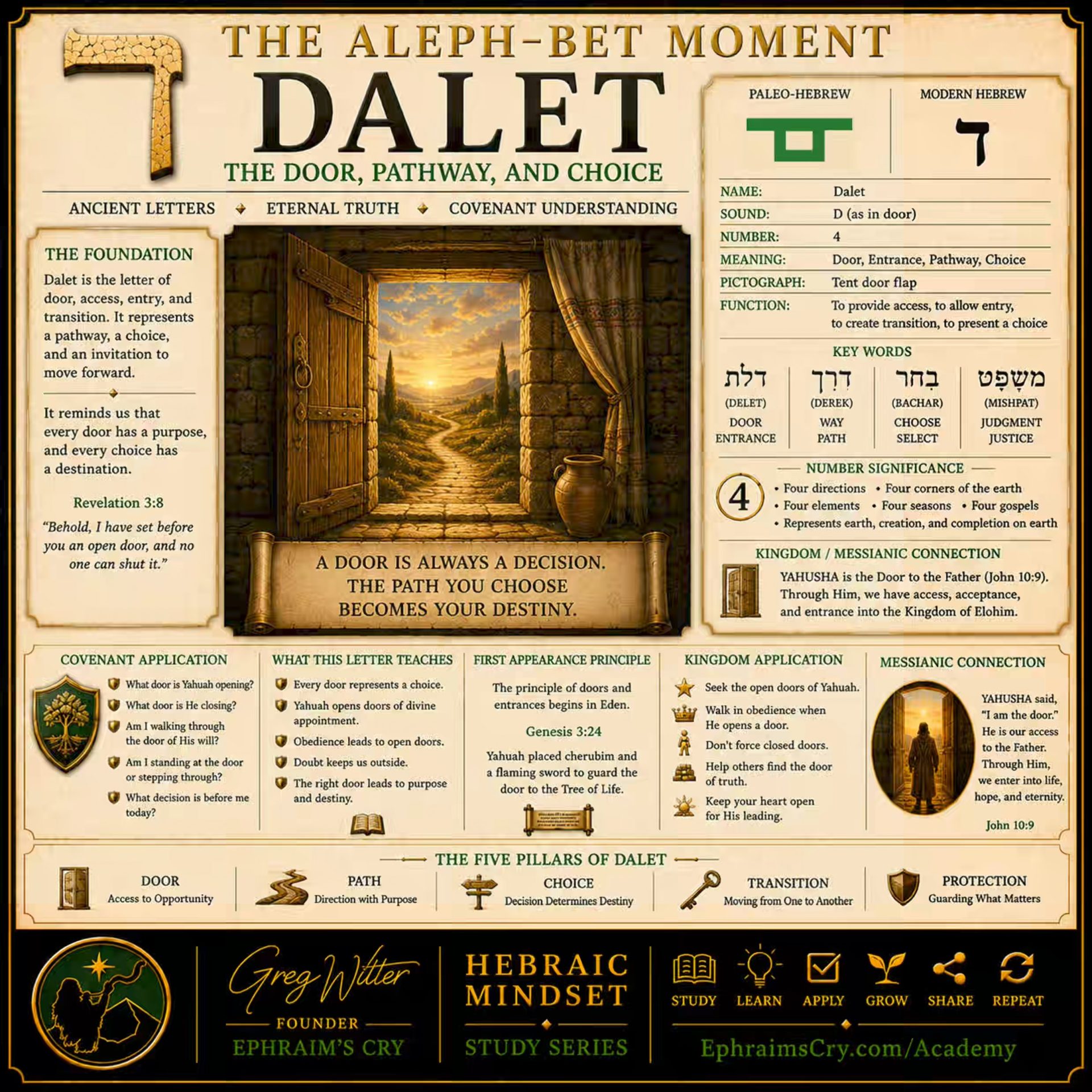
THE ALEPH-BET MOMENT
Dalet
The Door, Pathway, and Choice
Ancient Letters • Eternal Truth • Covenant Understanding
Greg Witter | Ephraim’s Cry
Hebraic Mindset Study Series
Study • Learn • Apply • Grow • Share • Repeat
Introduction
The fourth letter of the Hebrew Aleph-Bet is Dalet. If Aleph teaches us about authority, Bet teaches us about the house, and Gimel teaches us about provision, Dalet introduces us to the concept of access.
Dalet is the letter of the door.
A door separates one place from another. It can be opened or closed. It can provide access or prevent entry. Every door presents a decision. Every doorway represents an opportunity. Every entrance requires a choice.
Throughout Scripture, Yahuah repeatedly places doors before His people. Some lead toward life. Others lead toward destruction. Some lead into covenant blessing. Others lead away from His instructions.
Dalet reminds us that covenant always involves choice.
The Letter
Paleo-Hebrew: 𐤃
Modern Hebrew: ד
Name: Dalet
Sound: D
Numerical Value: 4
The Ancient Picture
The original Paleo-Hebrew Dalet was drawn as the flap of a tent door.
To the ancient Hebrew, the doorway was one of the most important parts of the dwelling.
The door controlls access.
The door provided protection.
The door marked the transition between outside and inside.
The door represented entry into the household.
Without a doorway, there could be no entrance.
Without an entrance, there could be no access.
Definition
Door.
Pathway.
Entrance.
Function
To provide access.
To allow entry.
To create transition.
To present a choice.
Covenant Role
Dalet reminds us that Yahuah continually places choices before His people.
Will they obey?
Will they trust?
Will they enter?
Will they remain outside?
The covenant is not forced upon anyone.
A door may be opened, but a person must still choose to enter.
Throughout Scripture, covenant blessings and covenant responsibilities are presented as decisions that require a response.
The Number Four
Dalet carries the numerical value of four.
Throughout Scripture, four often represents:
The earth.
The created order.
Universality.
The four directions.
The four corners.
The four winds.
The number frequently points toward something extending throughout the earth.
Dalet therefore reminds us that the invitation of Yahuah extends throughout His creation.
Word-Picture Development
A door creates opportunity.
A door connects one space to another.
A door allows movement.
A door requires a decision.
The ancient Hebrew would have understood that a doorway was never merely an opening in a wall.
It was a place of transition.
It was the point at which a person either entered or remained outside.
The pictograph teaches that covenant involves responding to opportunities placed before us.
Key Hebrew Words
Delet (דלת)
Door.
Gate.
Entrance.
The direct word associated with Dalet.
Derek (דרך)
Way.
Path.
Journey.
A central biblical concept describing one’s walk.
David (דוד)
Beloved.
The name of King David begins with Dalet.
Din (דין)
Judgment.
Justice.
A decision rendered by authority.
These words reveal recurring themes of access, journey, decision, and responsibility.
First Appearance Principle
One of the earliest Dalet themes appears in the Garden of Eden.
Adam and Chavah were given access to the Garden.
Access carried responsibility.
A choice was presented.
The outcome of that choice affected everything that followed.
From the beginning, Scripture connects access with accountability.
Letter Throughout Scripture
Dalet themes appear throughout the Bible.
Noah entered the ark through a door.
The blood was placed upon the doorposts at Passover.
Israel stood at the entrance of the Promised Land.
The gates of Jerusalem became places of judgment.
The Temple contained entrances leading toward worship.
Again and again, Scripture presents doors, gates, entrances, and decisions.
The Letter and Yahusha
The themes of Dalet find one of their clearest expressions in Yahusha.
He declared:
“I am the door.”
Through Him, access is provided.
Through Him, entry is made possible.
Through Him, people enter into a covenant relationship with the Father.
The imagery of Dalet becomes a powerful picture of access, invitation, and response.
The Letter in the Name of Yahuah
The themes associated with Dalet reveal Yahuah as the One who opens doors, establishes pathways, and calls His people to walk in covenant faithfulness.
The Letter in the Name of Yahusha
Yahusha embodies the invitation represented by Dalet. He provides the way, opens the door, and calls people to enter and follow.
Covenant Application
Dalet challenges us to examine the doors standing before us.
What opportunities has Yahuah placed before us?
What decisions are we being called to make?
What pathways are we choosing to follow?
Every day presents choices.
Every choice moves us toward something.
The question is whether we are moving toward covenant faithfulness or away from it.
Aleph-Bet Moment
A door can be opened.
A pathway can be revealed.
An invitation can be extended.
But each person must still choose whether to enter.
Dalet reminds us that covenant always involves response.
Yahuah provides the opportunity.
Yahuah provides the invitation.
Yahuah provides the way.
But we must choose whether we will walk through the door He has opened before us.
Discussion Questions
- Why is Dalet represented by a door?
- What significance did doors have in ancient Hebrew life?
- How does Dalet relate to covenant choice?
- What significance does the number four carry?
- How does Yahusha fulfill the themes of Dalet?
- What doors has Yahuah placed before His people throughout Scripture?
- How should Dalet influence our daily decisions?
Fill-in-the-Blank Review
- Dalet is the __________ letter of the Hebrew alphabet.
- The original pictograph for Dalet was a __________.
- Dalet carries the numerical value of __________.
- Dalet is associated with access and __________.
- The Hebrew word Delet means __________.
- Covenant requires a __________.
- A door may be opened, but a person must choose to __________.
Key Terms
Dalet — The fourth letter of the Hebrew alphabet.
Delet — Door or entrance.
Derek — Way, path, or journey.
Access — The ability to enter.
Choice — A decision requiring response.
Transition — Moving from one place or condition to another.
Closing Charge
The journey through the Aleph-Bet continues with Dalet.
The letter of the door.
The letter of access.
The letter of decision.
Aleph taught us authority.
Bet taught us the house.
Gimel taught us provision.
Dalet teaches us that covenant requires a response.
The door stands open.
The invitation has been extended.
The question is whether we will enter and walk the path Yahuah has set before us.
Want to go deeper?
Get the Aleph-Bet Restoration Bundle and continue your journey through the language of Scripture.
Restore the Language. Recover the Covenant.
Study it. Learn it. Teach it. Share it.
#GregWitter #EphraimsCry #HebraicMindsetStudySeries #AlephBetMoment #Dalet #Door #Pathway #Choice #PaleoHebrew #AncientHebrew #HebrewAlphabet #BiblicalHebrew #HebraicMindset #TorahStudy #BibleStudy #ScriptureStudy #HebrewLetters #CovenantLanguage #Derek #Delet #KingdomLiving #GospelOfTheKingdom #Discipleship #FamilyDiscipleship #HomeFellowship #Remnant #Watchman #BiblicalTruth #Torah #Yahuah #Yahusha
