
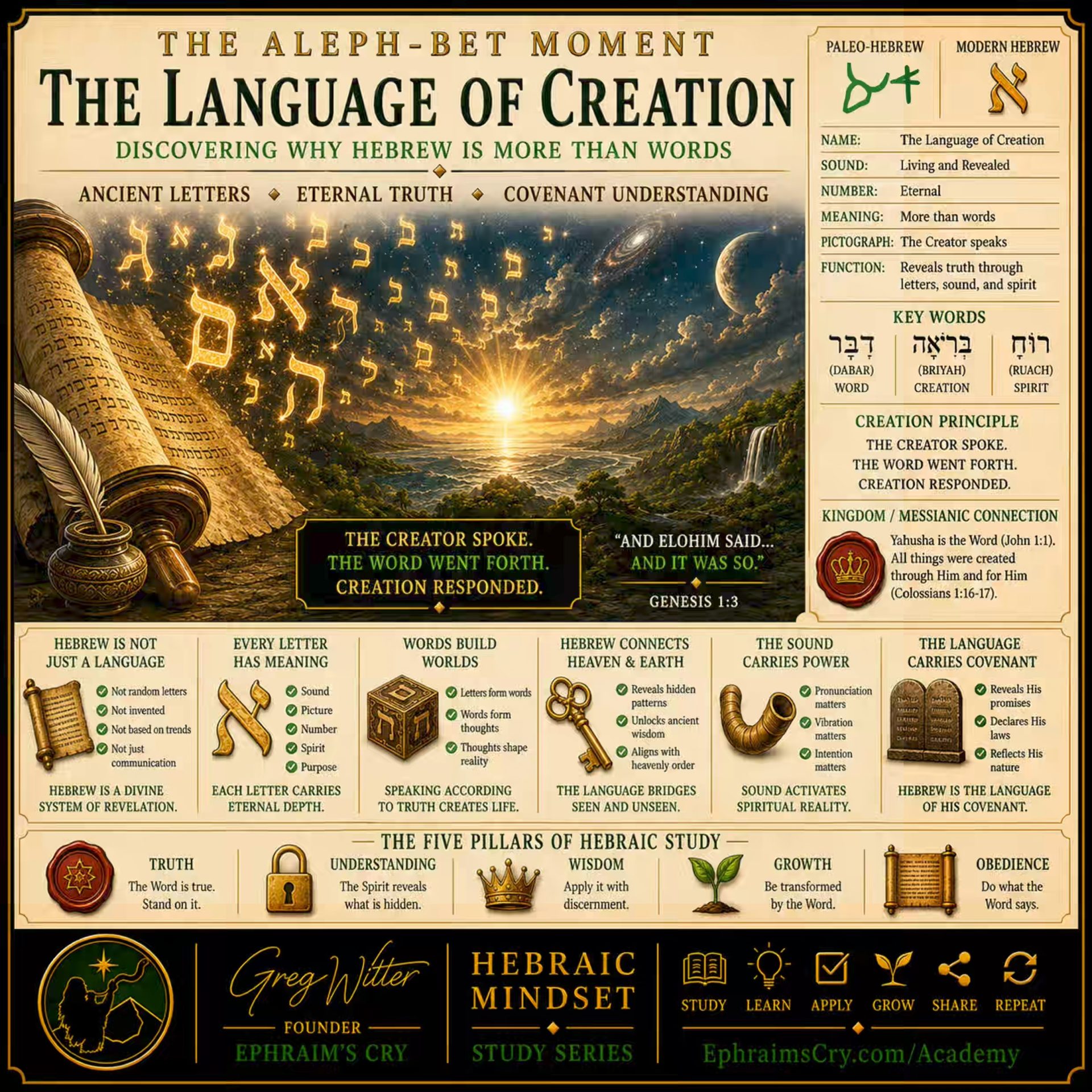
THE ALEPH-BET MOMENT
The Language of Creation
Discovering Why Hebrew Is More Than Words
Ancient Letters • Eternal Truth • Covenant Understanding
Greg Witter | Ephraim’s Cry
Hebraic Mindset Study Series
Study • Learn • Apply • Grow • Share • Repeat
Introduction
Language is one of the most powerful gifts Yahuah has given mankind. Through language we communicate truth, preserve knowledge, establish relationships, and pass understanding from one generation to the next. Yet Scripture reveals something even deeper. Before there were nations, kingdoms, cultures, or civilizations, there was the voice of Yahuah.
The opening chapter of Genesis introduces us to a Creator who speaks. Again and again we read the words, “And Elohim said…” Creation itself responds to His voice. Light appears. The heavens are established. The waters are gathered. Life emerges. The universe responds to the spoken word of its Creator.
This is where our study begins. Language is not merely a human invention. Language is one of the first witnesses to the authority, wisdom, and power of Yahuah.
The First Recorded Words
The first recorded words in Scripture are found in Genesis 1:3:
“And Elohim said, ‘Let light come to be,’ and light came to be.”
Creation begins with speech. The world does not come into existence through human effort, chance, or accident. It comes into existence through the spoken word of Elohim.
This establishes a foundational principle throughout Scripture: words matter.
Yahuah chose to reveal Himself through language. He chose to communicate His instructions through language. He chose to preserve His covenant through language.
The Language of Scripture
While Scripture does not specifically identify the language spoken in Eden, Yahuah chose Hebrew as the primary language through which His covenant would be recorded and preserved.
The Torah was written in Hebrew.
The Prophets were written in Hebrew.
The Writings were written in Hebrew.
The covenant was recorded in Hebrew.
The names of the patriarchs, prophets, and kings were preserved in Hebrew.
This matters because language carries more than vocabulary. Language carries worldview. It carries culture. It carries understanding. It carries perspective.
To better understand Scripture, we must better understand the language through which much of Scripture was revealed.
A Picture Language
One of the unique characteristics of Paleo-Hebrew is its pictographic nature.
The earliest Hebrew letters were pictures.
An ox.
A house.
A door.
A hand.
Water.
A shepherd’s staff.
A seed.
A covenant mark.
These were not abstract symbols. They were visual representations of concepts familiar to everyday life.
Ancient Hebrews learned meaning through pictures. The letters themselves communicated ideas. The alphabet became a teaching tool that helped preserve understanding from generation to generation.
More Than Sounds
Most modern alphabets focus primarily on sounds. The Hebrew Aleph-Bet contains much more.
Each letter possesses:
A name.
A sound.
A numerical value.
A pictographic image.
A functional meaning.
A covenant role.
These multiple layers create a language rich with meaning and depth. The letters become witnesses. The words become witnesses. The language itself becomes a witness.
As we study the Aleph-Bet, we will discover recurring themes of authority, covenant, redemption, kingship, righteousness, obedience, and restoration woven throughout the language.
Function Rather Than Abstraction
Modern thinking often asks, “What does this mean?”
Hebraic thinking often asks, “What does this do?”
Hebrew is practical. It is action-oriented. It focuses on function, relationship, and covenant.
This is why Hebrew words frequently communicate truth through pictures, actions, and real-life examples rather than abstract philosophical definitions.
The language itself reflects the covenant life Yahuah intended His people to live.
Why This Matters Today
Many people read Scripture through modern assumptions, traditions, and cultural lenses far removed from the world of the Bible.
As a result, important concepts are often misunderstood.
Returning to the language of Scripture helps restore the context of Scripture.
The goal is not to become scholars.
The goal is understanding.
The goal is restoration.
The goal is to see the Word more clearly and walk more faithfully.
Covenant Application
The farther we move from the language and mindset of Scripture, the easier it becomes to misunderstand Scripture.
The closer we move toward the covenant language, through which Yahuah revealed His Word, the more clearly we begin to understand His purposes.
Language becomes a bridge between the text and the reader.
It becomes a tool that helps us understand covenant, obedience, redemption, and the Kingdom.
Aleph-Bet Moment
Creation begins with a voice.
Yahuah spoke, and creation responded.
The language of Scripture is not a random collection of symbols and sounds. It is the vehicle through which Yahuah chose to reveal His truth, preserve His covenant, and communicate His purposes.
As we study the Aleph-Bet, we are not merely learning letters.
We are learning the language through which covenant was revealed.
Discussion Questions
- Why is it significant that creation begins with the spoken word of Elohim?
- How does language influence understanding?
- Why did Yahuah preserve His covenant through Hebrew?
- What makes Paleo-Hebrew unique?
- Why are pictographs important?
- How does Hebraic thinking differ from modern thinking?
- Why is restoring biblical context important?
Fill-in-the-Blank Review
- Creation begins with the __________ word of Elohim.
- Hebrew is more than vocabulary; it carries __________.
- Paleo-Hebrew letters were originally __________.
- Every Hebrew letter contains multiple layers of __________.
- Hebrew focuses on __________ rather than abstraction.
- The goal of this study is __________.
- Language helps preserve __________ understanding.
Key Terms
Language of Creation — The concept that creation begins with the spoken word of Yahuah.
Paleo-Hebrew — The ancient pictographic form of Hebrew writing.
Pictograph — A visual symbol that communicates meaning.
Covenant — The relationship established between Yahuah and His people.
Hebraic Mindset — A covenant-centered way of thinking rooted in Scripture.
Restoration — Returning to the original foundation and understanding of Scripture.
Closing Charge
Before we study the individual letters of the Aleph-Bet, we must first understand that language itself matters.
The Creator chose to reveal Himself through language.
He chose to preserve His covenant through language.
He chose to communicate His truth through language.
As we continue this journey, we will discover that the Hebrew letters are far more than symbols. They are witnesses to the covenant, the Kingdom, and the redemptive plan of Yahuah from the beginning.
Want to go deeper?
Get the Aleph-Bet Restoration Bundle and continue your journey through the language of Scripture.
Restore the Language. Recover the Covenant.
Study it. Learn it. Teach it. Share it.
#GregWitter #EphraimsCry #HebraicMindsetStudySeries #AlephBetMoment #LanguageOfCreation #PaleoHebrew #AncientHebrew #HebrewAlphabet #BiblicalHebrew #HebraicMindset #TorahStudy #BibleStudy #ScriptureStudy #HebrewLetters #CovenantLanguage #Creation #Genesis1 #WordOfElohim #GospelOfTheKingdom #KingdomLiving #Discipleship #FamilyDiscipleship #HomeFellowship #Remnant #Watchman #BiblicalTruth #RestoringTheLanguageOfCreation #Torah #Yahuah #Yahusha
