
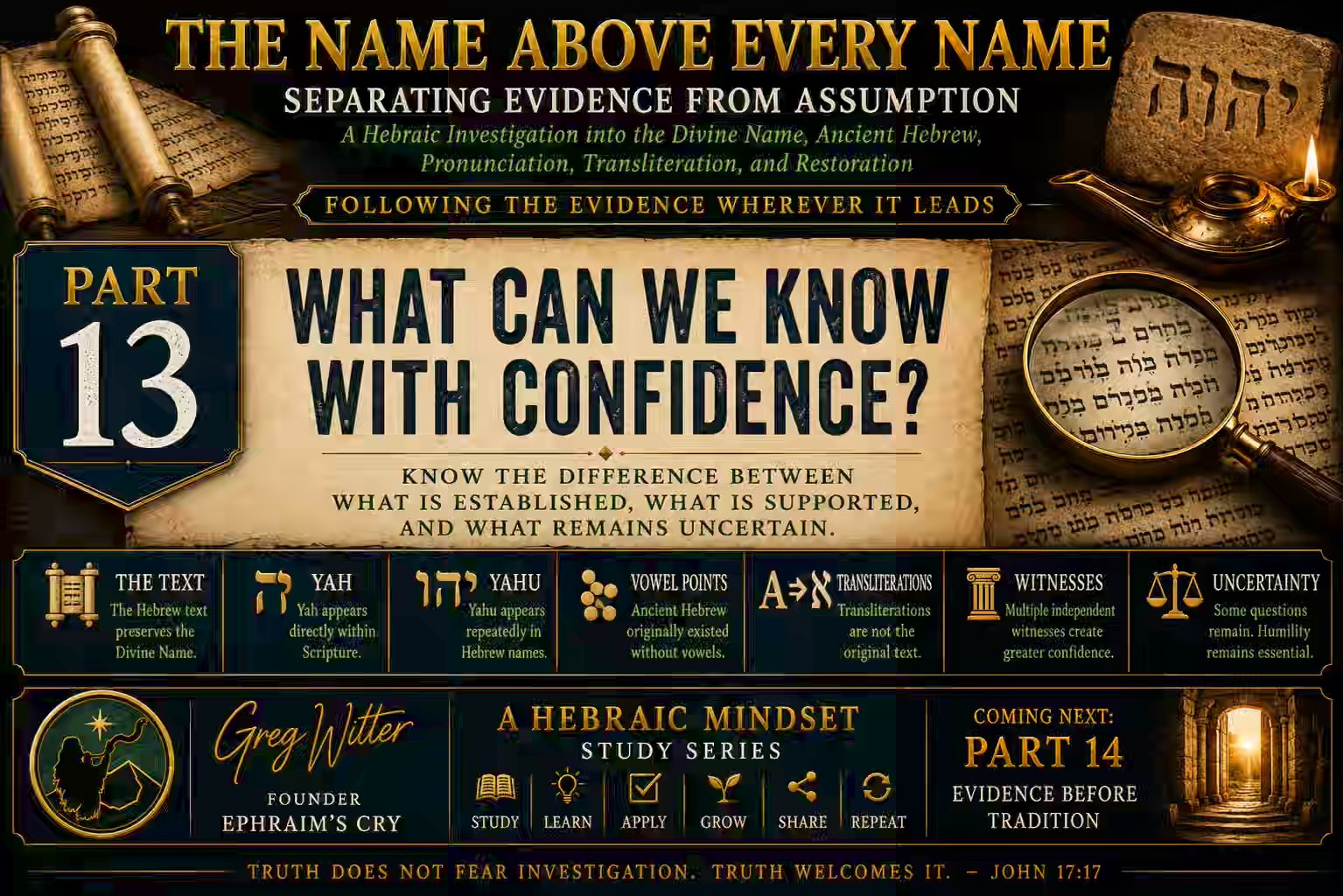
The Name Above Every Name
Part 13: What Can We Know With Confidence?
Separating Evidence from Assumption
A Hebraic Investigation into the Divine Name, Ancient Hebrew, Pronunciation, Transliteration, and Restoration
Following the Evidence Wherever It Leads
Greg Witter | Ephraim’s Cry
A Hebraic Mindset Study Series
Study • Learn • Apply • Grow • Share • Repeat
After examining the Hebrew text, the Hebrew letters, Paleo-Hebrew, the absence of original vowel points, transliteration, Yah, Yahu, ancient external witnesses, the vowel point controversy, and the limitations of historical proof, we arrive at one of the most important questions in the entire series:
What can we actually know with confidence?
This question is important because many discussions about the Divine Name eventually reach a crossroads.
One group demands absolute certainty.
Another group claims absolute certainty.
A third group concludes that nothing can be known.
All three approaches create problems.
The purpose of this series has never been to promote uncertainty.
The purpose has never been to promote dogmatism.
The purpose has never been to defend traditions.
The purpose has never been to attack traditions.
The purpose has been to follow the evidence wherever it leads.
The purpose has been to separate evidence from assumption.
The purpose has been to distinguish between what is known, what is supported, what is probable, and what remains uncertain.
These distinctions matter.
When they are ignored, confusion grows.
When they are understood, clarity increases.
The goal of the faithful student is not to know everything.
The goal of the faithful student is to know what the evidence actually supports.
The Difference Between Confidence And Certainty
One of the greatest sources of confusion in biblical investigation is the failure to distinguish between confidence and certainty.
The two are related.
But they are not identical.
Certainty implies that all questions have been answered.
Certainty implies that no alternatives remain.
Certainty implies that every possibility has been eliminated.
Confidence operates differently.
Confidence grows as evidence accumulates.
Confidence grows as witnesses multiply.
Confidence grows as independent sources begin pointing in the same direction.
Confidence grows as conclusions survive scrutiny.
This distinction matters because many people assume that if absolute certainty cannot be achieved, confidence is impossible.
That assumption is false.
Historians operate with confidence.
Archaeologists operate with confidence.
Linguists operate with confidence.
Biblical investigators operate with confidence.
Confidence is built upon evidence.
Confidence is built upon witnesses.
Confidence is built upon patterns.
Confidence is built upon convergence.
This is how investigation works.
The inability to know everything does not mean we know nothing.
What The Hebrew Text Establishes
The strongest witness in this entire discussion remains the Hebrew text itself.
The Hebrew text establishes that the Divine Name exists.
The Hebrew text establishes that the Name appears thousands of times.
The Hebrew text establishes that the Name was written.
The Hebrew text establishes the letters:
יהוה
Yod.
Heh.
Waw.
Heh.
This is not theory.
This is not tradition.
This is not interpretation.
This is manuscript evidence.
The text itself remains one of the strongest witnesses available.
Any conclusion that ignores the Hebrew text immediately places itself on weak ground.
The text must remain primary.
The text must remain foundational.
The text must remain the starting point.
Every other witness is measured against the text.
Not the other way around.
What We Can Know About Preservation
We can know with confidence that the Divine Name has been remarkably preserved.
Generation after generation copied the Scriptures.
Generation after generation preserved the Name.
The Name survived exile.
The Name survived dispersion.
The Name survived persecution.
The Name survived the destruction of Jerusalem.
The Name survived the centuries.
The letters remain.
The written witness remains.
This fact alone is significant.
The existence of the Name is not in doubt.
The preservation of the Name is not in doubt.
The debate concerns pronunciation.
Not preservation.
Many discussions become confused because they fail to distinguish between those two issues.
The Name exists.
The Name survives.
The question is how it was originally pronounced.
What We Can Know About Yah
We can know with confidence that Yah appears within Scripture.
This is one of the strongest pieces of evidence examined throughout this series.
Yah is not hidden.
Yah is not speculative.
Yah is not dependent upon external sources.
Yah appears directly within the biblical witness.
The evidence is textual.
The evidence is visible.
The evidence is substantial.
The repeated appearance of Yah deserves serious consideration.
The student does not need to invent the evidence.
The evidence already exists.
The text itself provides the witness.
What We Can Know About Yahu
We can also know with confidence that Yahu appears repeatedly within Hebrew names.
This pattern is too widespread to dismiss casually.
Names such as:
Yeshayahu.
Yirmeyahu.
Obadyahu.
Zekaryahu.
Eliyahu.
And many others preserve the Yahu element.
Names matter.
Names preserve information.
Names preserve language patterns.
Names preserve history.
Names often preserve ancient realities long after other forms of evidence become scarce.
The repeated appearance of Yahu creates an important witness that must be considered honestly.
The evidence deserves examination.
The evidence deserves weight.
The evidence deserves respect.
The question is not whether the evidence exists.
The question is what conclusions the evidence supports.
What We Can Know About Ancient Hebrew
We can know with confidence that ancient Hebrew originally functioned differently than modern Hebrew.
Ancient Hebrew was written without the vowel pointing system familiar to many readers today.
The earliest manuscripts did not contain the dots and marks that later became part of the Masoretic tradition.
The language was learned through hearing.
The language was learned through speaking.
The language was learned through repetition.
The language was learned through transmission from one generation to the next.
This reality matters because it reminds us that the earliest written witness consisted primarily of consonants.
The letters came first.
The vowel traditions came later.
This does not make later traditions worthless.
Neither does it make them original.
The distinction matters.
The faithful investigator must continually separate the earliest evidence from later evidence.
Both have value.
Both contribute information.
But they do not occupy the same position in the chain of evidence.
What We Can Know About Vowel Points
We can know with confidence that the vowel points were added long after the original writings.
This fact is not controversial among Hebrew scholars.
The Masoretic scribes developed a system designed to preserve pronunciation traditions and reading traditions.
Their work was significant.
Their work helped preserve the Hebrew text.
Their work deserves appreciation.
Yet appreciation should never eliminate investigation.
The vowel points are witnesses.
They are not the original text.
The vowel points provide information.
They do not automatically settle every question.
The Divine Name presents a unique challenge because substitute readings became attached to the Name.
Readers often spoke Adonai.
Readers sometimes spoke Elohim.
The written Name remained.
The spoken substitution changed.
This reality creates questions that cannot simply be ignored.
The student must carefully distinguish between the written witness and the reading tradition.
The two are connected.
But they are not identical.
What We Can Know About Transliterations
We can know with confidence that transliterations are not the original text.
This point cannot be repeated too often.
Many debates begin with transliterations.
Few begin with the Hebrew letters themselves.
Yet the Hebrew letters remain primary.
Transliterations are attempts to represent Hebrew using another writing system.
Every transliteration contains interpretation.
Every transliteration contains assumptions.
Every transliteration contains limitations.
YHWH is a transliteration.
YHVH is a transliteration.
Jehovah is a transliteration.
Yahweh is a transliteration.
Yahuah is a transliteration.
Yahuwah is a transliteration.
None of these forms are the original Hebrew letters.
Some may preserve evidence more accurately.
Some may preserve evidence less accurately.
But all remain representations.
The student must continually return to the Hebrew witness.
The text remains primary.
Everything else remains secondary.
What We Can Know About Ancient External Witnesses
We can know with confidence that ancient external witnesses contribute valuable information.
Ancient inscriptions.
Ancient historians.
Ancient transliterations.
Elephantine documents.
Lachish letters.
Arad inscriptions.
Dead Sea Scroll evidence.
Samaritan traditions.
Each contributes something.
None should be ignored.
None should be treated as though they settle the entire question by themselves.
The strength of these witnesses is not found merely in their existence.
The strength of these witnesses is found in their cumulative testimony.
When independent witnesses begin reflecting similar patterns, their collective value increases.
This principle applies throughout historical investigation.
It applies throughout archaeology.
It applies throughout biblical studies.
Multiple independent witnesses deserve careful consideration.
What We Can Know About Multiple Witnesses
Scripture repeatedly establishes the principle of multiple witnesses.
A matter is established through witnesses.
The same principle applies here.
One witness may suggest.
Two witnesses may support.
Three witnesses may strengthen.
Multiple independent witnesses create a cumulative case.
This is exactly what we find in the Divine Name discussion.
The Hebrew text contributes a witness.
Yah contributes a witness.
Yahu contributes a witness.
Hebrew names contribute a witness.
Ancient inscriptions contribute a witness.
Historical references contribute a witness.
Linguistic patterns contribute a witness.
External witnesses contribute a witness.
No single witness carries the entire burden.
Yet together they begin forming a picture.
The more witnesses align, the stronger the cumulative case becomes.
This is not speculation.
This is the normal process of investigation.
What We Can Know About Remaining Uncertainties
Intellectual honesty requires acknowledging that some questions remain.
Not every question has been answered.
Not every detail can be proven absolutely.
Not every conclusion carries identical strength.
Some evidence is stronger than other evidence.
Some conclusions are stronger than other conclusions.
This reality should not frighten the student.
Every field of investigation contains unanswered questions.
History contains unanswered questions.
Archaeology contains unanswered questions.
Linguistics contains unanswered questions.
Biblical studies contain unanswered questions.
The presence of unanswered questions does not invalidate what can be known.
The presence of unanswered questions does not eliminate meaningful conclusions.
The presence of unanswered questions simply reminds us to remain humble.
To remain teachable.
To remain willing to continue learning.
The faithful investigator does not pretend to know what he cannot know.
Neither does he ignore what can be known.
He follows the evidence.
He acknowledges the limits.
He remains committed to truth.
Why Confidence Matters
Some people hear the word confidence and immediately think compromise.
They assume confidence is somehow weaker than certainty.
They assume confidence represents doubt.
They assume confidence represents indecision.
That is not how confidence functions.
Confidence is built upon evidence.
Confidence is built upon witnesses.
Confidence is built upon investigation.
Confidence is built upon patterns that survive examination.
Confidence grows as evidence accumulates.
Confidence grows as witnesses align.
Confidence grows as conclusions continue surviving scrutiny.
This is how historians operate.
This is how archaeologists operate.
This is how linguists operate.
This is how responsible biblical investigators operate.
The inability to achieve absolute certainty does not eliminate confidence.
In fact, some conclusions may be held with very strong confidence even while acknowledging that absolute proof remains unavailable.
Understanding this distinction protects the investigator from two dangerous extremes.
The first extreme is blind certainty.
The second extreme is blind skepticism.
Neither serves truth.
The faithful student seeks evidence.
The faithful student seeks understanding.
The faithful student seeks truth.
Why Humility Remains Essential
One of the greatest dangers in any investigation is pride.
Pride often appears long before evidence has been fully examined.
Pride reaches conclusions quickly.
Pride resists correction.
Pride defends positions.
Pride protects assumptions.
Humility operates differently.
Humility listens.
Humility investigates.
Humility examines.
Humility tests.
Humility remains teachable.
The deeper a person studies Scripture, history, languages, and ancient manuscripts, the more he begins to appreciate how much remains to be learned.
That realization does not weaken faith.
It strengthens faith.
It strengthens integrity.
It strengthens investigation.
The goal is not to prove ourselves right.
The goal is to discover what is true.
Truth must remain greater than tradition.
Truth must remain greater than pride.
Truth must remain greater than personal preference.
The faithful student follows truth wherever truth leads.
Why This Discussion Is Bigger Than The Name
At first glance, this series appears to be about pronunciation.
It appears to be about letters.
It appears to be about Hebrew.
It appears to be about the Divine Name.
In reality, the discussion reaches much further.
The deeper issue concerns methodology.
How do we investigate truth?
How do we evaluate evidence?
How do we weigh witnesses?
How do we test traditions?
How do we distinguish fact from assumption?
How do we separate evidence from speculation?
The same principles used in this investigation apply to every area of biblical study.
They apply to prophecy.
They apply to covenant.
They apply to Torah.
They apply to doctrine.
They apply to restoration.
They apply to discipleship.
The principles remain the same.
Evidence first.
Conclusions second.
Truth above tradition.
Truth above assumptions.
Truth above preferences.
This is the real lesson.
A Watchman’s Warning
Many people have already decided what they believe before they begin investigating.
They are not searching.
They are defending.
They are not examining.
They are protecting assumptions.
They are not testing evidence.
They are protecting conclusions.
This temptation exists in every generation.
It existed in the days of the prophets.
It existed in the days of Yahusha.
It existed in the days of the apostles.
And it exists today.
The faithful student must resist that temptation.
The faithful student must remain willing to ask difficult questions.
The faithful student must remain willing to examine difficult evidence.
The faithful student must remain willing to revisit long-held assumptions.
Truth does not fear investigation.
Truth does not fear questions.
Truth does not fear scrutiny.
Truth survives examination.
Truth survives testing.
Truth survives investigation.
The person who fears investigation often reveals more confidence in tradition than confidence in truth.
The faithful student welcomes investigation because truth has nothing to hide.
Summary
What can we know with confidence?
We can know that the Divine Name exists.
We can know that the Hebrew text preserves it.
We can know that the four Hebrew letters have survived.
We can know that Yah appears within Scripture.
We can know that Yahu appears within Hebrew names.
We can know that ancient Hebrew originally functioned without vowel points.
We can know that transliterations are not the original text.
We can know that ancient external witnesses contribute valuable evidence.
We can know that multiple independent witnesses strengthen conclusions.
We can know that some questions remain unresolved.
We can know that confidence and certainty are not identical.
We can know that humility remains necessary.
Most importantly, we can know that truth is discovered through honest investigation.
The goal is not defending assumptions.
The goal is not defending traditions.
The goal is not winning arguments.
The goal is following the evidence wherever it leads.
Rule #12
Know the difference between what is proven.
Know the difference between what is supported.
Know the difference between what is probable.
Know the difference between what remains uncertain.
Honor the evidence.
Honor the witnesses.
Remain humble.
Remain teachable.
Follow the evidence wherever it leads.

Continue the Journey
The Name Above Every Name — Orientation Booklet
Pay What You Want
This resource is offered on a Pay-What-You-Want basis. Download it completely free, or support the ongoing work of Ephraim’s Cry through a voluntary contribution.
Your support helps fund future study guides, charts, teachings, broadcasts, discipleship resources, and the ongoing proclamation of the Gospel of the Kingdom.
Suggested Contribution: $19.95

Coming Next
Part 14: Evidence Before Tradition
When evidence and tradition appear to conflict, which should take priority? Should tradition interpret evidence, or should evidence test tradition? In our final lesson, we examine the proper relationship between evidence, assumptions, traditions, and truth.
Following the Evidence Wherever It Leads.
#GregWitter #EphraimsCry #HebraicMindset #HebraicMindsetStudySeries #TheNameAboveEveryName
#SeparatingEvidenceFromAssumption #FollowingTheEvidence #DivineName #SacredName #AncientHebrew #BiblicalHebrew
#HebrewLanguage #EvidenceMatters #TruthMatters #Restoration #Yah #Yahu #ScriptureStudy
#BibleStudy #StudyLearnApplyGrowShareRepeat #RuleNumberTwelve
