
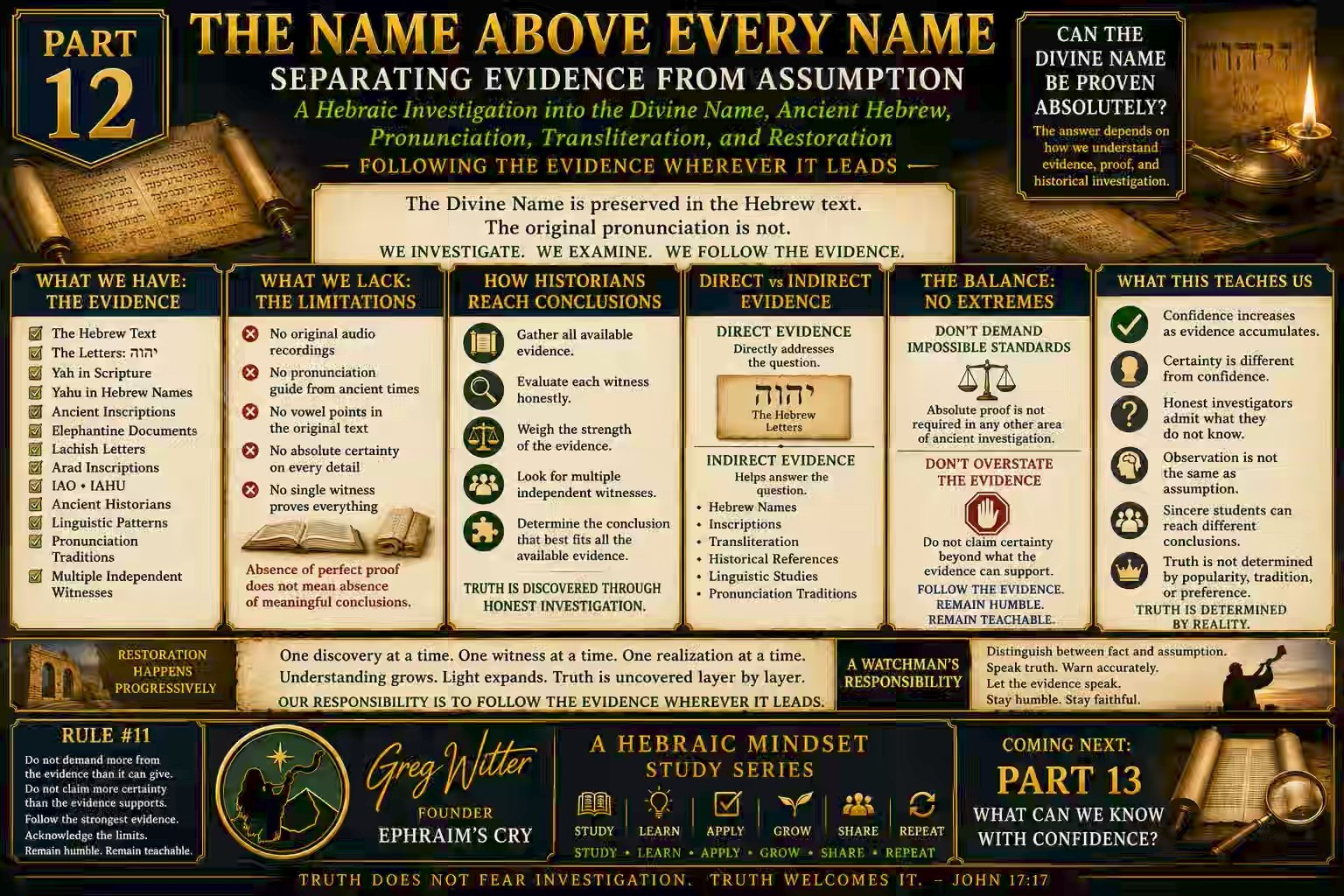
The Name Above Every Name
Part 12: Can the Divine Name Be Proven Absolutely?
Separating Evidence from Assumption
A Hebraic Investigation into the Divine Name, Ancient Hebrew, Pronunciation, Transliteration, and Restoration
Following the Evidence Wherever It Leads
Greg Witter | Ephraim’s Cry
A Hebraic Mindset Study Series
Study • Learn • Apply • Grow • Share • Repeat
Throughout this series we have followed the evidence step by step.
We began with the Hebrew text.
We examined the Hebrew letters.
We examined Paleo-Hebrew.
We examined the absence of original vowel points.
We distinguished letters from sounds.
We distinguished sounds from pronunciations.
We examined Tav and Tau.
We examined Waw and Vav.
We examined transliteration.
We examined the evidence for Yah.
We examined the evidence for Yahu.
We examined ancient external witnesses.
We examined the vowel point controversy.
Each lesson has removed assumptions.
Each lesson has added evidence.
Each lesson has contributed another witness.
Now we arrive at a question that stands at the center of the entire investigation.
Can the Divine Name be proven absolutely?
Can we establish a pronunciation beyond all possible dispute?
Can we eliminate every alternative?
Can we remove every question?
Can we arrive at absolute certainty?
Many people assume the answer is yes.
Many people assume the answer is no.
Before answering either way, we must first understand the nature of evidence itself.
Before answering either way, we must understand the nature of historical investigation.
Before answering either way, we must understand the difference between certainty, confidence, probability, evidence, and proof.
These are not identical concepts.
Confusing them creates confusion.
Separating them creates clarity.
What Do We Mean By Absolute Proof?
The phrase absolute proof is often used carelessly.
People speak of absolute proof as though it were simple.
Yet absolute proof is one of the highest standards imaginable.
Absolute proof leaves no uncertainty.
Absolute proof eliminates all alternatives.
Absolute proof removes every question.
Absolute proof ends every debate.
If absolute proof is our standard, then we must honestly ask:
What would absolute proof actually look like?
Would it require hearing Mosheh pronounce the Name?
Would it require hearing Aharon pronounce the Name?
Would it require hearing Yehoshua pronounce the Name?
Would it require hearing Dawid pronounce the Name?
Would it require hearing Eliyahu pronounce the Name?
Would it require hearing Yeshayahu pronounce the Name?
Would it require hearing Yirmeyahu pronounce the Name?
Would it require hearing Yahusha pronounce the Name?
Would it require an ancient audio recording?
Would it require an ancient pronunciation guide preserved from the days of Mosheh?
No such evidence exists.
The ancient world preserved writing.
The ancient world did not preserve sound.
The ancient world preserved inscriptions.
The ancient world preserved manuscripts.
The ancient world preserved names.
The ancient world preserved records.
The written witness survives.
The spoken witness does not survive in the same direct form.
This reality affects every discussion involving ancient pronunciation.
Not just the Divine Name.
Every ancient language faces the same challenge.
The Difference Between Preservation And Pronunciation
One of the greatest sources of confusion in this debate is the failure to distinguish between preservation and pronunciation.
The Divine Name itself has been preserved.
The Hebrew text preserves it.
The manuscripts preserve it.
The inscriptions preserve it.
The Name appears thousands of times throughout Scripture.
The existence of the Name is not in doubt.
The Name is written.
The Name is preserved.
The Name is real.
The pronunciation question is different.
The written form survives.
The spoken form must be reconstructed.
The first question concerns preservation.
The second concerns pronunciation.
The first concerns what was written.
The second concerns how it was spoken.
The two should never be confused.
Many debates become confused because people treat them as though they were identical.
They are not.
What The Evidence Actually Gives Us
The evidence gives us far more than many people realize.
The evidence gives us:
יהוה
Yod.
Heh.
Waw.
Heh.
The evidence gives us:
Yah.
The evidence gives us:
Yahu.
The evidence gives us Hebrew names.
The evidence gives us ancient inscriptions.
The evidence gives us Elephantine documents.
The evidence gives us Lachish letters.
The evidence gives us Arad inscriptions.
The evidence gives us ancient historians.
The evidence gives us IAO.
The evidence gives us IAHU.
The evidence gives us comparative Semitic language studies.
The evidence gives us ancient pronunciation traditions.
The evidence gives us independent witnesses.
The evidence gives us multiple lines of investigation.
The evidence is substantial.
The evidence is broad.
The evidence is diverse.
The evidence is not dependent upon a single witness.
This matters.
Because historical conclusions become stronger when multiple independent witnesses begin pointing in similar directions.
The Hierarchy Of Evidence
Not all evidence carries equal weight.
This is one of the first lessons every investigator must learn.
A rumor is not equal to a manuscript.
A tradition is not equal to an inscription.
An opinion is not equal to a witness.
A theory is not equal to evidence.
The strength of a conclusion is directly connected to the strength of the evidence supporting it.
The Hebrew text carries tremendous weight because it is the primary witness.
Hebrew names carry significant weight because they preserve portions of the Name within the language itself.
Ancient inscriptions carry significant weight because they provide independent confirmation.
Ancient historians contribute useful information because they preserve historical observations.
Pronunciation traditions contribute useful information because they preserve how communities understood and transmitted the Name.
Each witness has value.
Each witness contributes something.
But each witness must be weighed according to its strength.
The wise investigator does not treat every witness equally.
The wise investigator evaluates every witness honestly.
Direct Evidence Versus Indirect Evidence
Another important distinction must be understood.
Direct evidence and indirect evidence are not the same thing.
Direct evidence directly addresses the question.
Indirect evidence contributes information that helps answer the question.
The Hebrew letters themselves represent direct evidence.
Hebrew names represent indirect evidence.
Ancient inscriptions represent indirect evidence.
Ancient transliterations represent indirect evidence.
Historical references represent indirect evidence.
Comparative linguistic studies represent indirect evidence.
Neither category should be ignored.
Both categories matter.
Both categories contribute.
The strongest conclusions are often built when direct and indirect evidence begin supporting one another.
The Principle Of Multiple Witnesses
Scripture repeatedly establishes the principle of multiple witnesses.
A matter is established by witnesses.
The same principle applies here.
One witness may suggest.
Two witnesses may support.
Three witnesses may strengthen.
Multiple independent witnesses create a cumulative case.
This is exactly what we find in the Divine Name discussion.
Yah.
Yahu.
Hebrew names.
Ancient inscriptions.
IAO.
IAHU.
Elephantine documents.
Historical references.
Dead Sea Scroll evidence.
Independent witnesses.
No single witness proves everything.
No single witness carries the entire burden.
Together they create a growing body of evidence.
This is how responsible investigation works.
This is how historical investigation works.
This is how biblical investigation works.
Why Historians Rarely Possess Absolute Proof
Many people assume historians possess certainty about the ancient world.
The reality is quite different.
Historians work with fragments.
Records.
Documents.
Artifacts.
References.
Inscriptions.
Pieces of evidence.
The historian gathers those pieces and determines what explanation best fits the evidence.
The Divine Name discussion functions the same way.
We are not reconstructing a modern event.
We are investigating an ancient reality.
The farther back we travel, the more dependent we become upon cumulative evidence.
This is not weakness.
This is the normal process of historical investigation.
Why Archaeologists Think Differently
Archaeologists rarely uncover complete answers.
They uncover pieces.
A broken inscription.
A damaged seal.
A fragment of pottery.
A manuscript fragment.
A partial record.
Yet entire civilizations are reconstructed from such discoveries.
Why?
Because evidence accumulates.
One witness supports another.
One discovery confirms another.
One piece strengthens another.
Eventually a pattern emerges.
The Divine Name discussion operates in much the same way.
No single discovery settles everything.
Yet multiple discoveries begin pointing in similar directions.
That matters.
Why Linguists Reconstruct Ancient Pronunciations
No ancient language survives with perfect pronunciation records.
Linguists reconstruct ancient pronunciations by examining language patterns, related languages, historical spellings, ancient transliterations, pronunciation traditions, grammatical structures, and comparative evidence.
The Divine Name discussion is not unique.
The same process is used throughout historical linguistics.
The question is never:
Can every uncertainty be eliminated?
The question is:
What explanation best fits the available evidence?
That is how reconstruction works.
The Difference Between Proof And Probability
Many discussions become confused because people fail to distinguish between proof and probability.
Absolute proof eliminates every possible alternative.
Probability identifies the conclusion best supported by available evidence.
Most historical conclusions operate through cumulative probability.
Historians rarely possess absolute proof.
Archaeologists rarely possess absolute proof.
Linguists rarely possess absolute proof.
Yet conclusions are still reached.
Why?
Because evidence matters.
Patterns matter.
Witnesses matter.
Convergence matters.
The Divine Name discussion operates in the same manner.
The question is not:
Can every alternative be eliminated?
The question is:
What conclusion is best supported by the available evidence?
That is often the more honest question.
The Error Of Demanding Impossible Standards
Some people demand a standard of proof they would never require anywhere else.
If absolute proof cannot be produced, they conclude nothing can be known.
That approach creates serious problems.
By that standard, much of ancient history would become unknowable.
Ancient civilizations would become unknowable.
Ancient languages would become unknowable.
Archaeology would become meaningless.
Historical investigation would become impossible.
Yet no serious investigator operates that way.
Historians do not demand absolute proof before reaching conclusions.
Archaeologists do not demand absolute proof before reaching conclusions.
Linguists do not demand absolute proof before reaching conclusions.
Researchers do not demand absolute proof before reaching conclusions.
Instead, they evaluate the evidence.
They evaluate the witnesses.
They evaluate the probabilities.
They evaluate the cumulative case.
Then they determine which conclusion best explains the available evidence.
The inability to know everything does not mean we know nothing.
Strong evidence remains strong evidence.
Multiple witnesses remain multiple witnesses.
Truth remains truth.
Evidence remains evidence.
The absence of perfect certainty does not eliminate meaningful conclusions.
The Error Of Overstating The Evidence
The opposite error is equally dangerous.
Some people move beyond the evidence.
They claim certainty where certainty cannot be demonstrated.
They claim proof where only probability exists.
They claim finality where questions remain.
They claim more than the evidence can support.
This creates a different problem.
The evidence should never be stretched beyond what it actually demonstrates.
Truth does not need exaggeration.
Truth does not need embellishment.
Truth does not need emotional appeals.
Truth does not need intimidation.
Truth does not need assumptions disguised as facts.
The faithful investigator allows the evidence to speak for itself.
No more.
No less.
The conclusion should never be larger than the evidence supporting it.
When conclusions exceed the evidence, credibility suffers.
When evidence exceeds the conclusion, credibility grows.
The Burden Of Proof
Many discussions fail because people misunderstand the burden of proof.
The person making a claim carries responsibility.
The claim must be supported.
The claim must be demonstrated.
The claim must be examined.
Assertions are not evidence.
Repetition is not evidence.
Popularity is not evidence.
Tradition is not evidence.
Emotion is not evidence.
Confidence is not evidence.
Evidence is evidence.
The investigator must continually return to the witnesses.
What does the text say?
What do the names say?
What do the inscriptions say?
What do the historical records say?
What do the ancient witnesses say?
What do the linguistic patterns say?
The burden remains on the claim itself.
Every conclusion must be tested.
Every conclusion must be weighed.
Every conclusion must be measured against the available evidence.
Why Confidence And Certainty Are Not Identical
Confidence and certainty are related.
But they are not identical.
Confidence increases as evidence accumulates.
Confidence grows as witnesses multiply.
Confidence grows as patterns emerge.
Confidence grows as conclusions withstand scrutiny.
Certainty is different.
Certainty removes all questions.
Certainty removes all alternatives.
Certainty removes all doubt.
Confidence may become very strong.
Confidence may become extremely strong.
Confidence may become persuasive.
Yet confidence and absolute certainty remain different categories.
Understanding this distinction protects honest investigation.
It prevents exaggeration.
It prevents overstatement.
It prevents dogmatism.
It prevents claims that exceed the evidence.
The faithful investigator seeks truth.
Not merely certainty.
Why Honest Investigators Sometimes Say “I Don’t Know”
Many people view uncertainty as weakness.
They believe admitting uncertainty damages credibility.
The opposite is often true.
An honest investigator is willing to say:
I know this.
I believe this.
The evidence strongly supports this.
The evidence suggests this.
The evidence points here.
The evidence favors this conclusion.
And when necessary:
I do not know.
That statement does not weaken the investigation.
It strengthens credibility.
Truth does not require bluffing.
Truth does not require pretending.
Truth does not require certainty beyond the evidence.
Honesty strengthens investigation.
Humility strengthens investigation.
Integrity strengthens investigation.
Observation Versus Assumption
Observation:
The Divine Name exists.
Observation:
The Hebrew text preserves the Name.
Observation:
Yah appears repeatedly in Scripture.
Observation:
Yahu appears repeatedly in Hebrew names.
Observation:
Ancient witnesses preserve related forms.
Observation:
The earliest Hebrew manuscripts lacked vowel points.
Observation:
The original pronunciation must be reconstructed.
Observation:
Multiple witnesses converge toward common patterns.
Assumption:
Therefore every detail of the original pronunciation can be known with absolute certainty.
That conclusion exceeds what the evidence directly demonstrates.
The evidence should never be forced beyond its limits.
Observation must remain observation.
Assumption must remain assumption.
The two should never be confused.
Many errors begin when assumptions are treated as evidence.
Many traditions survive because assumptions are repeated often enough to be mistaken for facts.
The faithful student must continually separate observation from assumption.
Why Sincere Students Reach Different Conclusions
Not every disagreement originates from rebellion.
Not every disagreement originates from deception.
Not every disagreement originates from ignorance.
Sometimes disagreement emerges because people begin with different assumptions.
One student begins with tradition.
Another begins with linguistic evidence.
Another begins with Hebrew names.
Another begins with ancient inscriptions.
Another begins with historical witnesses.
Another begins with vowel traditions.
Each believes he is following the evidence.
Yet each begins from a different starting point.
This explains why sincere students can reach different conclusions.
The goal is not to attack sincerity.
The goal is to evaluate evidence.
Truth is not determined by sincerity.
Truth is determined by reality.
The question is not:
Are people sincere?
The question is:
What does the evidence support?
Why Restoration Happens Progressively
Restoration rarely happens all at once.
Truth is often recovered one witness at a time.
One discovery at a time.
One manuscript at a time.
One inscription at a time.
One realization at a time.
This pattern appears throughout Scripture.
Understanding grows.
Knowledge increases.
Light expands.
The people of Yahuah grow in understanding.
The Divine Name discussion reflects the same reality.
Many things that were hidden become visible through investigation.
Many assumptions are exposed.
Many traditions are examined.
Many questions are revisited.
Restoration advances one step at a time.
The goal is not instant perfection.
The goal is continual faithfulness.
The goal is continual growth.
The goal is continual pursuit of truth.
Why This Matters For Restoration
Ultimately this discussion is larger than pronunciation.
It is larger than linguistics.
It is larger than philology.
It is larger than historical reconstruction.
At its core, this discussion concerns how we approach truth itself.
Do we begin with conclusions and then search for evidence?
Or do we begin with evidence and allow it to shape our conclusions?
That question affects every area of biblical study.
It affects how we understand the Sabbath.
It affects how we understand Torah.
It affects how we understand covenant.
It affects how we understand prophecy.
It affects how we understand the Name.
It affects how we understand restoration.
Many people claim to seek truth.
Far fewer are willing to follow truth when it challenges long-held assumptions.
Yet restoration has always required change.
Restoration requires examination.
Restoration requires humility.
Restoration requires a willingness to revisit inherited traditions.
The history of Scripture repeatedly demonstrates this reality.
Yisra’el repeatedly drifted from covenant faithfulness.
The prophets repeatedly called the people back.
Reformation required examination.
Renewal required correction.
Restoration required repentance.
The same principle applies today.
The goal is not merely defending what we inherited.
The goal is determining whether what we inherited aligns with the evidence.
This is why the investigation matters.
This is why the discussion matters.
This is why methodology matters.
Because the principles we apply to the Divine Name will inevitably affect every other area of study.
Faith And Evidence
Some people incorrectly assume faith and evidence stand in opposition to one another.
Scripture presents a different picture.
Biblical faith is not blind belief.
Biblical faith is trust grounded in reality.
Trust grounded in evidence.
Trust grounded in witness.
Trust grounded in covenant.
Throughout Scripture, Yahuah repeatedly provided witnesses.
Witnesses in creation.
Witnesses in history.
Witnesses in prophecy.
Witnesses in covenant.
Witnesses in miracles.
Witnesses in fulfilled promises.
Faith was never intended to function independently of evidence.
Rather, evidence and faith work together.
Evidence informs faith.
Faith acts upon truth.
The Divine Name discussion should be approached the same way.
Evidence should be examined honestly.
Conclusions should be reached honestly.
Faith should rest upon truth rather than assumption.
Why Traditions Become Difficult To Examine
One of the greatest challenges facing every generation is the power of tradition.
Traditions become familiar.
Traditions become comfortable.
Traditions become accepted.
Traditions become protected.
Over time people often stop asking questions.
They stop examining assumptions.
They stop testing inherited beliefs.
Eventually traditions can become so familiar that they are treated as unquestionable.
Yet familiarity does not establish truth.
Popularity does not establish truth.
Age does not establish truth.
Only evidence establishes truth.
This is not an argument against all traditions.
Some traditions preserve valuable information.
Some traditions preserve important history.
Some traditions preserve genuine understanding.
The question is not whether a tradition exists.
The question is whether the tradition is supported by the evidence.
Every tradition must remain subject to examination.
Every tradition must remain subject to testing.
Every tradition must remain subject to Scripture.
Why Evidence Challenges Tradition
Evidence has a unique quality.
Evidence does not care about preferences.
Evidence does not care about popularity.
Evidence does not care about comfort.
Evidence simply exists.
When evidence conflicts with assumptions, a choice must be made.
Will the assumption be preserved?
Or will the evidence be followed?
This is where many people struggle.
Following evidence often requires humility.
Following evidence often requires correction.
Following evidence often requires change.
Yet this is exactly how growth occurs.
This is exactly how restoration occurs.
This is exactly how understanding increases.
The faithful student does not fear evidence.
The faithful student welcomes evidence.
Because truth has nothing to fear from investigation.
Why Intellectual Humility Matters
The longer a person studies, the more he should appreciate the limits of his own knowledge.
Arrogance often accompanies shallow investigation.
Humility often accompanies deeper investigation.
The deeper one digs into ancient history, ancient languages, and ancient manuscripts, the more one realizes how much remains to be learned.
Humility protects the investigator.
Humility prevents overstatement.
Humility prevents dogmatism.
Humility prevents conclusions from exceeding evidence.
Humility allows the investigator to follow truth wherever it leads.
This is especially important in discussions involving the Divine Name.
The goal is not winning arguments.
The goal is not defeating opponents.
The goal is not defending pride.
The goal is discovering truth.
Truth must remain greater than ego.
Truth must remain greater than tradition.
Truth must remain greater than personal preference.
The Watchman’s Responsibility
A watchman has a responsibility.
The responsibility is not merely to speak.
The responsibility is to speak truth.
The responsibility is not merely to warn.
The responsibility is to warn accurately.
The responsibility is not merely to challenge error.
The responsibility is to challenge error using evidence.
The watchman must distinguish between fact and assumption.
The watchman must distinguish between evidence and speculation.
The watchman must distinguish between truth and tradition.
The watchman must distinguish between what can be demonstrated and what is merely asserted.
This requires discipline.
This requires integrity.
This requires honesty.
The watchman who exaggerates damages credibility.
The watchman who ignores evidence damages credibility.
The watchman who refuses correction damages credibility.
The faithful watchman remains committed to truth above all else.
A Watchman’s Warning
Many people have already chosen their conclusion before examining the evidence.
They are not investigating.
They are defending.
They are not testing.
They are repeating.
They are not examining.
They are assuming.
The faithful student must resist that temptation.
Our responsibility is not to defend inherited traditions.
Our responsibility is not to defend modern movements.
Our responsibility is not to defend assumptions.
Our responsibility is to follow the evidence wherever it leads.
Even when the evidence challenges traditions.
Even when the evidence challenges assumptions.
Even when the evidence challenges conclusions we once held.
Truth does not fear investigation.
Truth welcomes investigation.
Truth survives scrutiny.
Truth survives examination.
Truth survives testing.
Summary
Can the Divine Name be proven absolutely?
Not in the sense of producing an ancient audio recording.
Not in the sense of eliminating every possible question.
Not in the sense of removing every conceivable alternative.
Yet much can be known with confidence.
The Hebrew text preserves the Divine Name.
The letters are preserved.
The manuscripts are preserved.
The inscriptions are preserved.
Yah appears within Scripture.
Yahu appears within Hebrew names.
Ancient witnesses preserve related forms.
Ancient inscriptions contribute evidence.
Historical references contribute evidence.
Linguistic patterns contribute evidence.
Multiple independent lines of evidence converge upon common patterns.
The evidence may not provide absolute certainty concerning every detail.
But it provides far more than speculation.
Far more than assumption.
Far more than tradition alone.
The faithful student should not demand impossible proof.
Neither should the faithful student claim more certainty than the evidence provides.
The goal is not blind certainty.
The goal is not blind skepticism.
The goal is honest investigation.
The goal is faithfulness to the evidence.
The goal is following the evidence wherever it leads.
The investigation has never been about forcing a conclusion.
The investigation has never been about defending a tradition.
The investigation has never been about winning an argument.
The investigation has been about separating evidence from assumption.
Separating observation from speculation.
Separating witnesses from traditions.
Separating what can be demonstrated from what is merely asserted.
The student who follows this path may not possess absolute certainty concerning every detail.
But he will possess something far more valuable.
Intellectual honesty.
Integrity.
Humility.
And a willingness to follow truth wherever truth leads.
Rule #11
Absolute certainty and strong evidence are not the same thing.
Do not demand more from the evidence than the evidence can provide.
Do not claim more certainty than the evidence can support.
Do not confuse assumptions with facts.
Do not confuse traditions with proof.
Let the witnesses speak.
Let the evidence speak.
Let the text speak.
Follow the strongest evidence.
Acknowledge the limitations.
Remain teachable.
Remain humble.
Remain faithful.
Truth is discovered through honest investigation.
Truth survives examination.
Truth survives scrutiny.
Truth welcomes investigation.

Continue the Journey
The Name Above Every Name — Orientation Booklet
Pay What You Want
This resource is offered on a Pay-What-You-Want basis. Download it completely free, or support the ongoing work of Ephraim’s Cry through a voluntary contribution.
Your support helps fund future study guides, charts, teachings, broadcasts, discipleship resources, and the ongoing proclamation of the Gospel of the Kingdom.
Suggested Contribution: $19.95

Coming Next
Part 13: What Can We Know With Confidence?
If absolute proof is not available, what conclusions can honestly be reached?
What does the evidence actually support?
What can be known with confidence?
What remains uncertain?
What conclusions go beyond the evidence?
In the next lesson we gather the witnesses, weigh the evidence, and identify the conclusions that can honestly be reached without exaggeration, assumption, or speculation.
Following the Evidence Wherever It Leads.
#GregWitter #EphraimsCry #HebraicMindset #HebraicMindsetStudySeries #TheNameAboveEveryName#SeparatingEvidenceFromAssumption #FollowingTheEvidence #DivineName #SacredName #AncientHebrew #BiblicalHebrew #HebrewLanguage #HistoricalInvestigation #EvidenceMatters #TruthMatters #Restoration #Yah #Yahu #ScriptureStudy #BibleStudy #StudyLearnApplyGrowShareRepeat #RuleNumberEleven
