
The Name Above Every Name
Part 10: Ancient External Witnesses
Separating Evidence from Assumption
A Hebraic Investigation into the Divine Name, Ancient Hebrew, Pronunciation, Transliteration, and Restoration
Following the Evidence Wherever It Leads
Greg Witter | Ephraim’s Cry
A Hebraic Mindset Study Series
Study • Learn • Apply • Grow • Share • Repeat
Throughout this series we have followed a deliberate path.
We began with the Hebrew letters.
We examined the absence of original vowel points.
We separated letters from sounds.
We separated sounds from pronunciations.
We separated transliteration from evidence.
We examined the written witness for Yah.
We examined the repeated appearance of Yahu within Hebrew names.
Now we arrive at another important stage of the investigation.
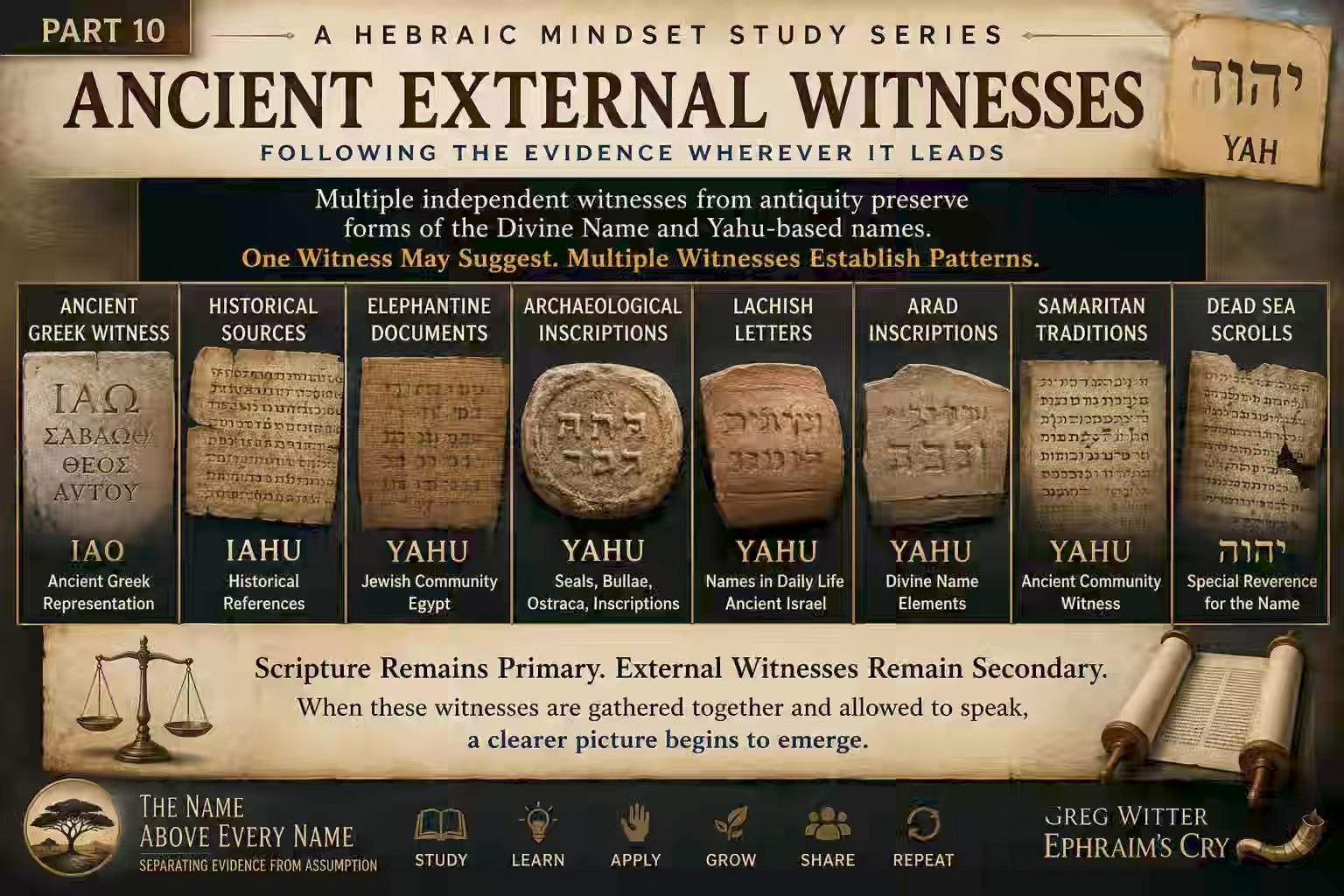
Ancient external witnesses.
What did ancient people outside the Hebrew biblical manuscripts preserve concerning the Divine Name?
Did anyone record forms of the Name before many later traditions developed?
Do ancient inscriptions, documents, historians, and linguistic witnesses contribute evidence to the discussion?
These questions matter.
Because if independent witnesses preserve information that aligns with the biblical evidence, the cumulative case becomes stronger.
Not because external witnesses replace Scripture.
But because they can confirm patterns already found within Scripture.
Beginning With Proper Priorities
Before proceeding, we must establish a boundary.
Scripture remains the highest authority.
Torah.
Prophets.
Writings.
Apostolic Witness.
These remain the foundation.
Ancient historians are not Scripture.
Ancient inscriptions are not Scripture.
Ancient documents are not Scripture.
Ancient traditions are not Scripture.
External witnesses are secondary evidence.
Valuable.
Useful.
Important.
But secondary.
They can support.
They can illuminate.
They can confirm.
They cannot override the written witness.
The text remains primary.
Why External Witnesses Matter
Some people reject all external evidence.
Others elevate external evidence above Scripture.
Both positions create problems.
A wise investigator does neither.
External evidence matters because it provides historical snapshots.
It shows how people understood names.
How they wrote names.
How they represented names.
How they transmitted names.
How they remembered names.
The closer a witness stands to the ancient world, the more valuable it may become.
Especially when multiple independent witnesses point in similar directions.
The Principle Of Converging Evidence
One witness may be interesting.
Two witnesses may deserve attention.
Three or four independent witnesses pointing toward the same pattern become difficult to ignore.
This principle is used throughout historical investigation.
A single source may be mistaken.
Multiple independent sources preserving similar information deserve serious consideration.
This is why ancient witnesses, matter.
Not because any single witness settles the debate.
But because multiple witnesses often create a cumulative picture.
Why Independent Witnesses Matter
One of the strongest forms of evidence in historical investigation occurs when multiple witnesses arrive from different directions yet point toward similar conclusions.
Imagine four witnesses describing the same event.
One witness describes what he saw.
Another describes what she heard.
A third preserves a written record.
A fourth preserves a physical artifact.
None of them alone tells the entire story.
Yet when their testimonies begin aligning, confidence increases.
The same principle applies here.
The Hebrew text preserves Yah.
Hebrew names preserve Yahu.
Archaeological inscriptions preserve Yahu.
Ancient Greek writers preserve IAO.
Ancient documents preserve IAHU.
Each witness comes from a different source.
Each witness comes from a different context.
Each witness carries different strengths and weaknesses.
Yet the pattern begins converging.
That convergence matters.
Truth often becomes clearer when independent witnesses point toward the same conclusion.
When multiple witnesses that are separated by geography, language, culture, and time begin preserving similar information, the likelihood of mere coincidence decreases.
This does not mean every witness is correct in every detail.
It means the investigator must pay attention.
The faithful student follows the evidence wherever it leads.
Not because one witness proves everything.
But because many witnesses together often reveal what no single witness could establish alone.
Why External Witnesses Cannot Be Ignored
Many believers become uncomfortable when sources outside Scripture are mentioned.
That concern is understandable.
Scripture remains our highest authority.
However, refusing to examine external evidence is not the same thing as honoring Scripture.
In fact, Scripture itself often references external realities.
Kings.
Nations.
Cities.
Empires.
Treaties.
Wars.
Historical events.
Archaeology frequently confirms these things.
History frequently confirms these things.
External evidence does not compete with Scripture.
Properly understood, it often confirms Scripture.
Likewise, when external witnesses preserve information concerning the Divine Name, they deserve examination.
Not unquestioning acceptance.
Not blind rejection.
Examination.
Truth never fears examination.
Truth welcomes it.
Archaeology Does Not Have Theology
One of the most fascinating aspects of archaeology is that artifacts do not care about modern doctrinal debates.
An inscription does not know whether someone is Christian.
Jewish.
Sacred Name.
Messianic.
Traditional.
Or restoration-minded.
The artifact simply preserves what was written.
That is why archaeological discoveries are valuable.
A seal bearing a Yahu-based name does not exist to support a modern position.
It exists because someone in antiquity used that name.
The evidence stands independently of modern arguments.
This is one reason archaeology often provides powerful witnesses.
Artifacts have no theological agenda.
They simply preserve history.
The Greek Form IAO
One of the most frequently discussed ancient witnesses is:
IAO.
This form appears in various ancient Greek sources.
The significance of IAO is not that it perfectly preserves the Hebrew.
The significance is that it appears remarkably early.
Long before many later pronunciation traditions emerged.
Ancient Greek writers attempting to represent the Divine Name frequently produced forms similar to:
IAO.
This matters.
Because these writers were not using modern sacred-name theories.
They were attempting to represent what they heard or inherited.
Why IAO Matters
Greek lacks certain Hebrew sounds.
That creates limitations.
Greek writers often had to approximate Hebrew sounds using available Greek letters.
This means IAO is not necessarily the Hebrew spelling.
It is a Greek attempt to represent a Hebrew name.
But even with those limitations, the form remains significant.
Notice what is absent.
There is no obvious support for many much later pronunciation traditions.
Instead, the witness points toward a form beginning with an “Ia” type sound.
That deserves attention.
IAO And Yah
Many researchers have observed similarities between:
Yah
and
IAO.
Again, caution is necessary.
Similarity alone does not prove identity.
But similarities contribute evidence.
When the biblical witness preserves Yah and external witnesses preserve IAO-type forms, the investigator takes note.
Patterns matter.
Convergence matters.
Evidence accumulates.
Ancient Greek Witnesses
Several ancient Greek writers attempted to preserve information concerning the Divine Name.
Writers such as Diodorus Siculus, Clement of Alexandria, and Theodoret preserve references that scholars continue examining today.
Again, these men were not prophets.
They were not apostles.
They were not writing Scripture.
But they were recording information available within their own historical periods.
Several of these witnesses preserve forms resembling:
IAO.
Others preserve related forms.
The significance is not that they agree perfectly.
The significance is that they often point in similar directions.
When independent writers separated by time and geography preserve comparable representations, investigators take notice.
Patterns matter.
Convergence matters.
Evidence accumulates.
The Form IAHU
Another important ancient witness is:
IAHU.
This form appears in various historical references and discussions.
Notice the relationship:
Yahu.
IAHU.
The similarity is difficult to ignore.
The difference largely reflects transliteration conventions.
Ancient languages often represented sounds differently.
The underlying pattern remains striking.
Again, this does not settle every question.
But it contributes evidence.
And evidence matters.
The Elephantine Papyri
One of the most discussed sources comes from Elephantine.
Elephantine was a Jewish community in Egypt.
Documents discovered there preserve numerous names and references connected to the Divine Name.
These documents demonstrate something important.
Forms associated with Yahu existed in real Jewish communities.
Not modern communities.
Ancient communities.
These witnesses push the discussion back into antiquity.
They demonstrate that Yahu-related forms were known and used long before modern debates emerged.
Why Elephantine Matters
The Elephantine documents are significant because they come from a Jewish community living outside the Land of Israel.
This means the evidence is not confined to one location.
It demonstrates that forms connected to Yahu were known beyond Jerusalem.
The documents reveal that Jewish communities carried these name forms into other regions of the ancient world.
This is important because it expands the geographical footprint of the evidence.
The witness is not isolated.
The witness is widespread.
When evidence appears across multiple locations, multiple generations, and multiple communities, the cumulative case becomes stronger.
Elephantine demonstrates that forms connected to Yahu were not merely local expressions.
They were known among real covenant communities living in the ancient world.
That matters.
Because widespread evidence is generally stronger than isolated evidence.
Ancient Hebrew Names In Archaeology
Archaeology has uncovered numerous seals, bullae, inscriptions, and ostraca containing Hebrew names.
Many preserve forms ending in:
Yahu.
These discoveries matter.
Because archaeology does not care about modern theological arguments.
The inscriptions simply preserve what ancient people wrote.
Again and again the Yahu element appears.
The witness emerges from physical evidence.
Not merely later traditions.
Not merely theological discussions.
Actual artifacts.
Actual inscriptions.
Actual names.
The Lachish Ostraca
Among the archaeological discoveries frequently discussed are the Lachish letters.
These ancient documents preserve names containing Divine Name elements.
The significance is not that they solve every pronunciation question.
The significance is that they demonstrate the reality of these name forms within ancient Israelite culture.
The evidence is not theoretical.
The evidence is historical.
The evidence is physical.
The names were actually, used.
The forms were actually, written.
The witnesses remain preserved.
The Arad Inscriptions
The Arad inscriptions likewise preserve names connected to Divine Name elements.
Again, we find the recurring pattern.
Again, we encounter forms connected to Yah and Yahu.
Again, the evidence comes from antiquity itself.
The cumulative witness continues growing.
One discovery by itself may not settle a debate.
Many discoveries preserving the same pattern become increasingly difficult to dismiss.
Ancient Communities Preserved The Name In Names
One of the most remarkable aspects of ancient Hebrew culture is the way covenant identity became embedded within personal names.
Today many names are chosen simply because they sound pleasant.
Ancient Hebrew naming practices were often different.
Names carried meaning.
Names carried memory.
Names carried theology.
Names carried testimony.
Names carried covenant identity.
This is why the preservation of Yah and Yahu elements matters.
Ancient families repeatedly embedded those elements into personal names.
Generation after generation.
Century after century.
The witness remained alive.
Not only in manuscripts.
But in people.
The Name became part of covenant memory.
That is a powerful witness.
Ancient Historians And The Divine Name
Various ancient historians attempted to record information concerning the Hebrew people and their Elohim.
Some preserved forms that resemble:
IAO.
Others preserved related representations.
These historians were not prophets.
They were not apostles.
But they provide evidence concerning how the Name was understood and represented in their own historical periods.
That evidence deserves examination.
The Samaritans And The Name
Ancient Samaritan traditions also contribute data to the discussion.
Not because Samaritan tradition determines truth.
But because ancient communities sometimes preserve information lost elsewhere.
Every witness must be tested.
Every witness must be weighed.
But every witness should also be examined.
Evidence should never be ignored merely because it comes from outside our preferred tradition.
The Dead Sea Scrolls
The Dead Sea Scrolls contribute another important witness.
One of the remarkable features of many scrolls is the special treatment given to the Divine Name.
In numerous manuscripts, the Name is preserved differently from surrounding text.
Sometimes ancient Hebrew characters are used.
Sometimes scribes distinguished the Name visually.
This demonstrates something important.
The Name mattered.
The Name remained significant.
The Name was treated with special care.
Even when pronunciation traditions varied, reverence for the Name remained visible.
The Dead Sea Scroll Witness
The Dead Sea Scrolls provide one of the most important manuscript discoveries in modern history.
Among their many contributions is the special treatment frequently given to the Divine Name.
Some scribes paused before writing the Name.
Some preserved the Name in Paleo-Hebrew characters even when the surrounding text was written in square Hebrew script.
Some visually distinguished the Name from the rest of the manuscript.
Why does this matter?
Because it demonstrates that the Name remained important.
The Name remained identifiable.
The Name remained worthy of preservation.
While the Scrolls do not settle every pronunciation question, they provide powerful evidence that the Name itself remained central to the faith and practice of ancient communities.
The Name was not discarded.
The Name was remembered.
The Name was preserved.
The Name was treated differently because it was recognized as different.
That reality should not be ignored.
What External Witnesses Cannot Do
At this point discipline remains critical.
External witnesses cannot prove everything.
They cannot reconstruct every sound.
They cannot eliminate every question.
They cannot establish doctrine by themselves.
They cannot override Scripture.
They cannot replace the Hebrew text.
Evidence must remain within proper boundaries.
External witnesses contribute.
They do not dominate.
What External Witnesses Can Do
They can confirm patterns.
They can demonstrate ancient usage.
They can preserve historical memory.
They can provide independent testimony.
They can strengthen cumulative evidence.
They can reveal how ancient communities represented the Name.
They can help illuminate the historical landscape surrounding the biblical witness.
This is valuable.
Provided we keep Scripture first.
Convergence Is Stronger Than Circular Reasoning
One of the greatest weaknesses in many name debates is circular reasoning.
Someone begins with a conclusion.
Then they interpret every piece of evidence through that conclusion.
Then they use their interpretation as proof of the conclusion they already assumed.
That process proves nothing.
True investigation works differently.
The evidence must produce the conclusion.
The conclusion must not produce the evidence.
This is why convergence matters.
When Yah appears in Scripture.
When Yahu appears in names.
When IAO appears in ancient writers.
When IAHU appears in historical sources.
When archaeological discoveries preserve similar patterns.
The conclusion begins emerging from the evidence itself.
That is not circular reasoning.
That is cumulative investigation.
The Importance Of Cumulative Evidence
One inscription alone proves little.
One historian proves little.
One transliteration proves little.
One name proves little.
But when:
Yah appears in Scripture.
Yahu appears in names.
IAO appears in ancient sources.
IAHU appears in historical witnesses.
Yahu appears in archaeological discoveries.
The cumulative case becomes stronger.
No single witness carries the entire burden.
Together they create a growing body of evidence.
This is how serious investigation works.
The Difference Between Evidence And Proof
Many debates fail because people confuse evidence with proof.
Evidence contributes.
Proof concludes.
Evidence accumulates.
Proof results.
Historical investigation rarely operates on one piece of evidence proving everything.
Instead, investigators gather witnesses.
Documents.
Names.
Inscriptions.
Patterns.
Historical records.
Linguistic evidence.
The question is not:
“Which witness proves everything?”
The question is:
“What conclusion best explains all the witnesses together?”
That is the question we must continue asking throughout this investigation.
Truth is rarely found by isolating one witness.
Truth is found by examining all witnesses together.
Evidence Versus Certainty
Many people demand absolute certainty before considering evidence.
That is not how historical investigation functions.
Historians rarely possess absolute certainty.
What they seek is cumulative evidence.
Probability.
Consistency.
Patterns.
Convergence.
The question is not:
“Can one witness prove everything?”
The question is:
“What direction do the witnesses point?”
That is the proper question.
Restoration Requires Gathering All Witnesses
Many people want a simple answer.
One verse.
One inscription.
One manuscript.
One argument.
One proof.
But restoration rarely works that way.
Restoration gathers.
Restoration compares.
Restoration weighs.
Restoration tests.
Restoration examines every witness available.
Torah.
Prophets.
Writings.
Apostolic Witness.
Names.
Inscriptions.
Archaeology.
History.
Language.
Patterns.
The goal is not to force the evidence.
The goal is to allow all witnesses to speak.
When they begin agreeing, confidence increases.
When they disagree, further investigation becomes necessary.
That is how faithful study works.
The Hebrew Text Still Speaks First
Despite all these external witnesses, our foundational principle remains unchanged.
The Hebrew text speaks first.
External evidence is valuable.
But secondary.
The biblical witness remains primary.
Every external witness must ultimately be measured against Scripture.
Not the other way around.
Why This Matters For Restoration
Restoration is not built upon one argument.
One verse.
One inscription.
One manuscript.
One teacher.
Restoration emerges when multiple witnesses are brought together.
The text.
The names.
The archaeology.
The history.
The linguistic evidence.
The patterns.
The witnesses begin converging.
The picture becomes clearer.
The evidence becomes stronger.
That is what we are witnessing in this investigation.
The Four Witnesses Remain Our Standard
Torah.
Prophets.
Writings.
Apostolic Witness.
These remain our foundation.
External witnesses may support.
External witnesses may illuminate.
External witnesses may confirm.
But Scripture remains supreme.
The written witness remains the standard.
The Four Witnesses And External Evidence
The Four Witnesses remain our foundation.
Torah.
Prophets.
Writings.
Apostolic Witness.
Everything else remains secondary.
But secondary does not mean useless.
External witnesses can strengthen what Scripture already establishes.
External witnesses can illuminate historical context.
External witnesses can preserve information lost elsewhere.
External witnesses can help us understand how ancient communities viewed and represented the Name.
Provided we keep Scripture first, these witnesses become valuable tools rather than dangerous distractions.
The Danger Of Selective Evidence
One of the greatest dangers in any investigation is selecting only the evidence that supports a preferred conclusion.
That is not honest study.
That is advocacy.
The faithful investigator examines all evidence.
Supporting evidence.
Contradictory evidence.
Strong evidence.
Weak evidence.
Ancient evidence.
Modern evidence.
The goal is not to defend a position.
The goal is to discover truth.
Truth is not threatened by evidence.
Truth is strengthened by it.
This is why every witness deserves examination.
Not blind acceptance.
Not blind rejection.
Examination.
Bringing The Witnesses Together
At this stage of the series the evidence is beginning to converge.
Yah is preserved in Scripture.
Yahu is preserved in Hebrew names.
IAO appears in ancient Greek witnesses.
IAHU appears in historical sources.
Archaeological discoveries preserve Yahu elements.
The Dead Sea Scrolls demonstrate continued reverence for the Name.
Ancient communities preserve Name elements across generations.
None of these witnesses alone carries the entire case.
Together they create a growing body of evidence.
That is exactly how serious investigation works.
The evidence accumulates.
The witnesses converge.
The picture becomes clearer.
And the investigation continues.
A Watchman’s Warning
Many people reject evidence before examining it.
Others accept evidence without testing it.
Both approaches are dangerous.
The faithful student does neither.
Examine the evidence.
Test the evidence.
Compare the evidence.
Weigh the evidence.
Then follow the evidence wherever it leads.
Truth does not fear investigation.
Truth welcomes examination.
Truth survives testing.
Summary
Ancient external witnesses such as IAO, IAHU, archaeological inscriptions, Elephantine documents, the Lachish letters, the Arad inscriptions, ancient historians, Samaritan traditions, and the Dead Sea Scrolls contribute important historical evidence concerning the Divine Name. These sources do not replace Scripture, nor do they independently settle every pronunciation question. However, they provide valuable secondary testimony that often aligns with patterns already found within Scripture. When combined with the biblical evidence for Yah and Yahu, these witnesses contribute to a growing cumulative case. The evidence preserved in manuscripts, inscriptions, personal names, historical documents, and ancient communities demonstrates that this subject extends far beyond a single verse, a single argument, or a single tradition. In fact, each of these witnesses could easily become a teaching series of its own. The Elephantine documents, the Dead Sea Scrolls, ancient Greek witnesses, archaeological discoveries, and the preservation of the Divine Name within ancient Hebrew names all contain layers of evidence worthy of much deeper investigation. This lesson serves only as an introduction to the breadth and depth of the available evidence. The purpose here is not to exhaust the subject, but to demonstrate that a substantial body of historical, linguistic, archaeological, and textual evidence exists and deserves careful examination. Scripture remains primary. External witnesses remain secondary. Yet when the witnesses are gathered together and allowed to speak, a clearer picture begins to emerge. The investigation is far from over. In many ways, it is only beginning.
Rule #9
Independent witnesses deserve examination.
One witness may suggest. Multiple witnesses establish patterns.
External evidence may support Scripture but never replace it.
The text remains the highest authority.
Follow the evidence wherever it leads.

Continue the Journey
The Name Above Every Name — Orientation Booklet
Pay What You Want
This resource is offered on a Pay-What-You-Want basis. Download it completely free or support the ongoing work of Ephraim’s Cry through a voluntary contribution.
Your support helps fund future study guides, charts, teachings, broadcasts, discipleship resources, and the ongoing proclamation of the Gospel of the Kingdom.
Suggested Contribution: $19.95

Coming Next
Part 11: The Vowel Point Controversy
Ancient Hebrew was originally written without vowel points. The later Masoretic vowel system preserved a reading tradition, but in the case of יהוה, those vowel points often reflect substitute readings such as Adonai or Elohim rather than the original pronunciation of the Name itself. This controversy is one of the major reasons people arrive at Yahweh, Yehovah, Jehovah, Yahuwah, Yahuah, and other forms while claiming to use the same Hebrew text.
Following the Evidence Wherever It Leads.
#GregWitter #EphraimsCry #HebraicMindset #HebraicMindsetStudySeries #TheNameAboveEveryName
#SeparatingEvidenceFromAssumption #FollowingTheEvidence #DivineName #SacredName #IAO #IAHU #Yahu
#AncientHebrew #PaleoHebrew #BiblicalHebrew #DeadSeaScrolls #ElephantinePapyri #Archaeology #Restoration
#EvidenceOverTradition #TruthMatters #ScriptureStudy #BibleStudy #StudyLearnApplyGrowShareRepeat
#IndependentWitnesses #RuleNumberNine
