
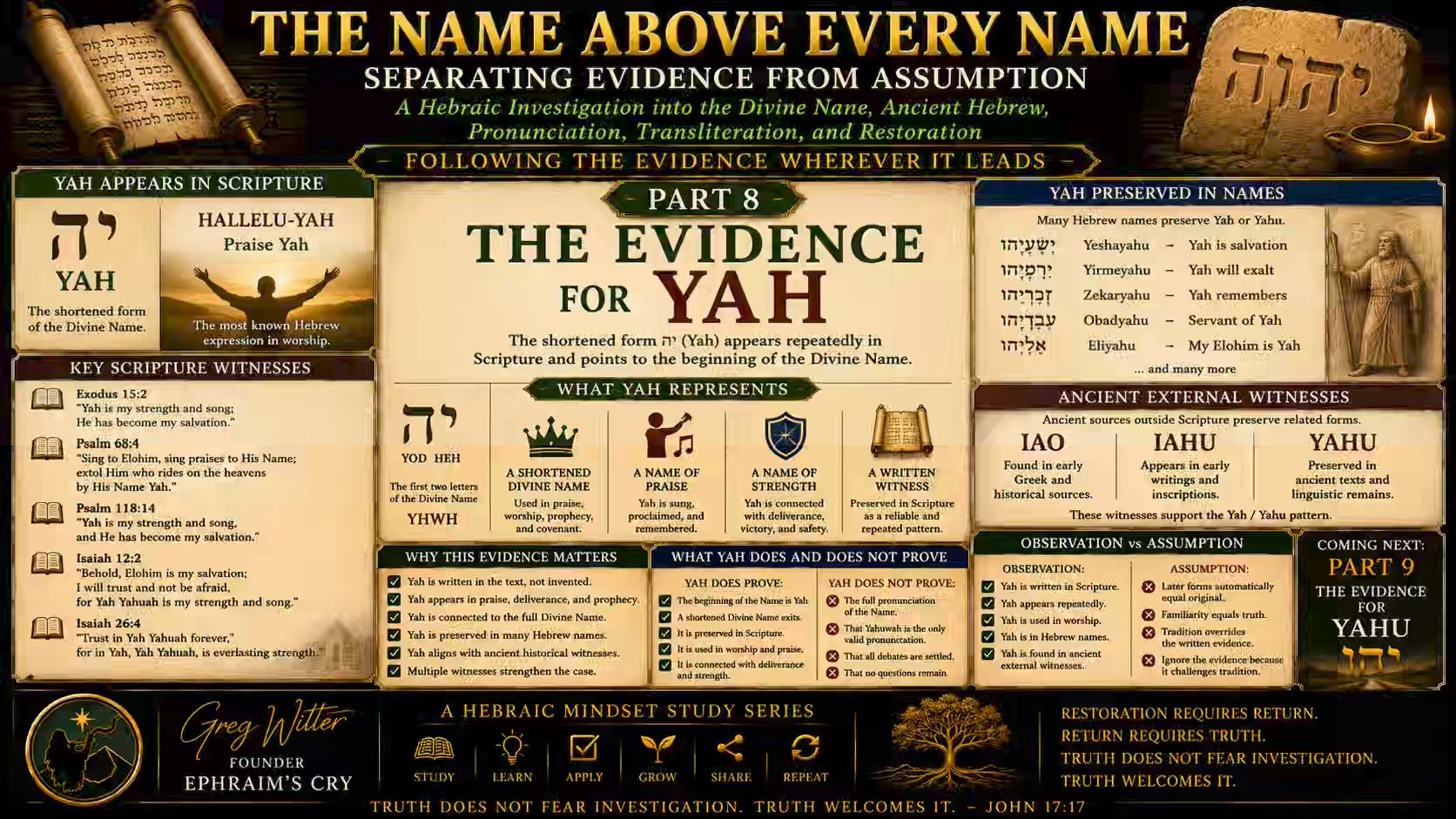
The Name Above Every Name
Part 8: The Evidence for Yah
Separating Evidence from Assumption
A Hebraic Investigation into the Divine Name, Ancient Hebrew, Pronunciation, Transliteration, and Restoration
Following the Evidence Wherever It Leads
Greg Witter | Ephraim’s Cry
A Hebraic Mindset Study Series
Study • Learn • Apply • Grow • Share • Repeat
Throughout this series we have carefully separated:
Letters from sounds.
Sounds from pronunciations.
Pronunciations from transliterations.
Evidence from assumptions.
We have examined the Hebrew letters.
We have examined the absence of original vowel points.
We have examined Waw versus Vav.
We have examined transliteration.
Now we arrive at a crucial turning point in the investigation.
Up to this point we have spent much of our time removing assumptions.
Now we begin examining positive evidence.
Not speculation.
Not tradition.
Not preference.
Evidence.
One of the strongest areas of evidence surrounding the Divine Name concerns the shortened form:
יה
Commonly represented as:
Yah.
The question before us is simple:
Does Scripture itself preserve evidence for the beginning of the Divine Name?
The answer is yes.
And the evidence is substantial.
Beginning With What Is Written
The first principle remains unchanged.
The text comes first.
The written witness comes before later traditions.
The preserved text comes before modern arguments.
When we examine Scripture, we discover that the shortened form:
יה
appears repeatedly.
This is not speculation.
This is not reconstruction.
This is not theory.
It is written.
The letters exist within the text itself.
The question is not whether the form exists.
The question is what that form tells us.
What The Form Yah Actually Contains
The shortened form is written:
יה
Yod.
Heh.
This matters because those are the first two letters of the full Divine Name:
יהוה
Yod.
Heh.
Waw.
Heh.
The shortened form does not come from imagination.
It comes directly from the structure of the Name itself.
This is one of the strongest reasons Yah must be taken seriously.
It is not a later invention.
It is not a modern preference.
It is not merely a sacred-name movement claim.
It is a preserved biblical form built from the very letters of the Name.
The Name Yah Appears In Scripture
Throughout Scripture we encounter:
יה
Yah.
One of the best-known examples appears in:
Hallelu-Yah.
Praise Yah.
Many believers sing or quote this expression without realizing what they are saying.
The phrase literally contains the shortened form of the Divine Name.
Hallelu.
Praise.
Yah.
Yah is not something invented by modern researchers.
Yah is found within the biblical text itself.
This is one reason the discussion becomes so important.
We are no longer dealing merely with theory.
We are dealing with written evidence.
Hallelu-Yah: The Witness Hidden In Plain Sight
The phrase Hallelu-Yah is one of the most widely known Hebrew expressions in the world.
It is spoken in worship.
It is sung in music.
It is repeated in sermons.
It appears across languages and traditions.
Yet many people never stop to ask what it actually means.
Hallelu means praise.
Yah is the shortened form of the Name.
Therefore Hallelu-Yah means:
Praise Yah.
This is significant.
The shortened form of the Name has been preserved in the mouths of people across the nations, even when many did not understand what they were saying.
The witness was hidden in plain sight.
Even when translators obscured the full Name with titles, the shortened form Yah continued to echo through Scripture, worship, and language.
That matters.
Yah In The Writings
The Writings preserve Yah repeatedly, especially in the Psalms.
The Psalms are songs, prayers, declarations, and covenant praises.
They are not detached academic documents.
They are worship texts.
When the Psalms preserve Yah, they preserve the Name in the context of praise, remembrance, covenant loyalty, and public proclamation.
This matters because the Name was not treated as a minor issue.
The Name was sung.
The Name was praised.
The Name was proclaimed.
The Name was remembered.
That means Yah appears not only as a linguistic form but as a worship witness.
Psalm 68:4
One of the clearest passages appears in Psalm 68:4.
Many English translations obscure what is present in the Hebrew.
Yet the Hebrew text preserves:
Yah.
The Psalm explicitly calls upon His people to sing to Elohim and praise His Name by Yah.
Again, the evidence is textual.
The evidence is written.
The evidence exists independently of modern debates.
This matters because our investigation is built upon written witnesses rather than inherited assumptions.
Psalm 118:14
Psalm 118:14 declares:
Yah is my strength and song, and He has become my deliverance.
This passage is significant because Yah is not merely used as a poetic abbreviation.
Yah is identified as strength.
Yah is identified as song.
Yah is connected to deliverance.
This same passage becomes especially important because it connects Yah with salvation and deliverance language.
That connection prepares the way for later discussion concerning names, salvation, and the Name of the Son.
Psalm 118:19
Psalm 118 continues with covenant language.
Open to me the gates of righteousness.
I enter through them.
I thank Yah.
This places Yah within the context of righteousness, entrance, covenant worship, and thanksgiving.
Again, Yah is not treated as a casual sound.
Yah is invoked in worship.
Yah is praised in covenant context.
Yah is connected with deliverance and righteousness.
Isaiah Preserves Yah
The Prophets also preserve Yah.
One of the clearest passages appears in Isaiah 12:2.
Many translations render the passage differently, but the Hebrew text contains:
Yah Yahuah.
The shortened form appears directly within the text beside the fuller Name.
This is extremely important.
The text itself places Yah in direct relationship with Yahuah.
The shortened form is not disconnected from the full Name.
It belongs to it.
Likewise, Isaiah 26:4 preserves:
Yah Yahuah.
Again, the evidence is written.
The text itself preserves Yah.
This becomes important because Scripture is providing a witness concerning the beginning of the Divine Name.
The evidence is not coming from modern teachers.
The evidence is coming from the Hebrew text itself.
Yah Beside The Full Name
When Scripture places Yah beside the fuller Name, it provides a powerful internal witness.
It shows that Yah is not random.
It shows that Yah is not disconnected.
It shows that Yah functions as a legitimate shortened form associated with the full Divine Name.
That matters because it demonstrates continuity.
The shortened form and the full form stand together.
Yah is not competing with the fuller Name.
Yah points toward it.
Exodus 15 and the Song of Deliverance
Another major witness appears in the Song at the Sea.
After Yahuah delivers Israel from Mitsrayim, the people sing a song of victory.
Within that song, Yah is associated with strength, song, and deliverance.
This matters because the first great national song of redemption preserves the shortened form of the Name in connection with salvation and deliverance.
This is not a minor witness.
It places Yah at the center of redemption praise.
The Name is tied to deliverance.
The Name is tied to victory.
The Name is tied to covenant identity.
The Principle Of Multiple Witnesses
Throughout Scripture important matters are established by multiple witnesses.
One witness may suggest.
Two or three witnesses establish.
When we find Yah appearing repeatedly throughout Scripture, we are no longer dealing with an isolated occurrence.
We are dealing with a pattern.
Patterns matter.
Repeated evidence matters.
Multiple witnesses matter.
This is how biblical investigation should function.
Yah Appears In Hebrew Names
The evidence becomes even stronger when we begin examining Hebrew names.
Consider names such as:
Yeshayahu.
Yirmeyahu.
Zekaryahu.
Obadyahu.
Eliyahu.
Again and again we encounter:
Yah.
Or:
Yahu.
Within Hebrew names.
This is significant.
Names often preserve older linguistic forms.
Names frequently preserve information long after spoken language begins to shift.
In many cultures names function as linguistic time capsules.
The same appears true within Hebrew.
Why Names Matter
Many people underestimate the importance of names.
In Scripture names carry meaning.
Identity.
Purpose.
Mission.
Authority.
Relationship.
The Hebrew worldview treats names very differently than modern Western culture.
A name is often a declaration.
A testimony.
A witness.
When the Divine Name appears within personal names, that evidence deserves serious attention.
The Name is not appearing accidentally.
The pattern is too widespread.
The witness is too consistent.
The Yahu Element In Names
Many Hebrew names preserve the Yahu element, especially at the end of names.
Eliyahu.
Yirmeyahu.
Yeshayahu.
Zekaryahu.
Obadyahu.
This becomes important because Yahu appears to preserve a fuller form of the shortened Name element.
Yah shows the beginning.
Yahu shows development.
Together they provide a growing body of evidence.
This is why Part 8 and Part 9 belong together.
Part 8 focuses on Yah.
Part 9 will focus more directly on Yahu.
Yah And Yahu
At this point we encounter an important distinction.
Some names preserve:
Yah.
Others preserve:
Yahu.
Both forms become important.
Both forms contribute evidence.
Both forms help establish patterns.
The shortened form:
Yah.
Appears directly within Scripture.
The expanded form:
Yahu.
Appears repeatedly within names.
Together they begin forming a larger picture.
One witness supports another witness.
Evidence accumulates.
Yah Versus Yeh
This is where the discussion becomes sharper.
If Scripture repeatedly preserves Yah, then the common assumption that the beginning must be Yeh deserves examination.
Many later forms begin with Yeh.
Yehoshua.
Yehonathan.
Yehudah.
Yehovah.
But the shortened Divine form preserved in Scripture is Yah.
This does not mean every Yeh form is automatically false or irrelevant.
But it does mean Yah carries strong textual authority.
The written witness must be allowed to speak.
If the biblical text preserves Yah, we must not ignore Yah because later traditions prefer Yeh.
Evidence must come before tradition.
Why Yah Challenges Later Traditions
The presence of Yah creates a problem for some later pronunciation traditions.
If the beginning of the Name were originally Yeh, then the strong and repeated preservation of Yah requires explanation.
Why does Scripture preserve Yah in praise?
Why does Scripture preserve Yah in prophecy?
Why does Scripture preserve Yah in names?
Why does Scripture place Yah beside the full Name?
These questions matter.
They do not need to be answered by assumption.
They must be answered by evidence.
Ancient Witnesses Outside Scripture
The evidence does not stop with the biblical text.
Ancient sources outside Scripture preserve forms such as:
Iao.
Iahu.
Yahu.
These witnesses are not Scripture.
They do not possess scriptural authority.
But they do possess historical value.
They demonstrate how ancient people represented the Divine Name.
This becomes important because these witnesses frequently align more closely with Yah and Yahu than with many later traditions.
Again, they do not prove everything.
But they contribute evidence.
And evidence matters.
External Witnesses Must Be Used Carefully
External witnesses are valuable.
But they must be kept in their proper place.
They cannot override Scripture.
They cannot replace the Hebrew text.
They cannot become the foundation.
They can confirm.
They can support.
They can contribute.
They can provide historical context.
But the written witness of Scripture remains primary.
That is why we begin with Yah in the biblical text before moving outward to inscriptions, ancient writings, or historical references.
What Yah Does Not Prove
At this point we must remain disciplined.
Evidence should never be forced beyond what it actually proves.
The presence of Yah does not automatically prove the entire pronunciation of the Divine Name.
It does not automatically prove Yahuwah.
It does not automatically prove Yahuah.
It does not automatically prove Yahweh.
It does not automatically settle every debate.
What it does establish is this:
The beginning portion of the Name is strongly connected to Yah.
That conclusion rests upon substantial evidence.
The remaining questions require further investigation.
What Yah Does Prove
Yah proves that Scripture itself preserves a shortened form of the Divine Name.
Yah proves that the beginning of the Name is not merely speculative.
Yah proves that the written witness contains evidence for the opening sound.
Yah proves that the Name was used in praise, worship, deliverance, prophecy, and covenant declaration.
Yah proves that the discussion cannot be dismissed as modern invention.
Yah proves that later traditions must be tested against what Scripture actually preserves.
This is a major step forward in the investigation.
Evidence Versus Assumption
Notice the difference.
Assumption says:
“I already know the answer.”
Evidence says:
“Let’s examine the witnesses.”
Assumption begins with conclusions.
Evidence begins with observations.
Assumption looks for support.
Evidence looks for truth.
The faithful student follows the evidence wherever it leads.
Even when it challenges previously held positions.
The Hebrew Text Speaks First
One of the recurring themes throughout this series is that the Hebrew text must remain primary.
Not traditions.
Not denominations.
Not popularity.
Not familiarity.
The Hebrew text speaks first.
When the Hebrew text repeatedly preserves Yah, we must take that evidence seriously.
We do not have the right to ignore it.
We do not have the right to explain it away.
We must examine it honestly.
That is faithful study.
Why This Matters For Restoration
The restoration movement often becomes distracted by arguments over certainty.
People demand absolute proof.
Absolute certainty.
Absolute conclusions.
But restoration often begins with recovering pieces of evidence that were forgotten, neglected, or hidden.
Yah represents one of those recovered witnesses.
It is not speculation.
It is not imagination.
It is preserved within the text itself.
The faithful student recognizes that restoration begins with returning to what was written.
Restoration Begins With The Witnesses Preserved In The Text
Restoration does not begin with modern slogans.
It does not begin with popular teachers.
It does not begin with personal preference.
Restoration begins by returning to the witnesses Yahuah preserved.
If Yah appears in the text, then Yah must be examined.
If Yah appears in praise, then Yah must be honored as part of the praise witness.
If Yah appears in prophecy, then Yah must be taken seriously as prophetic evidence.
If Yah appears beside the full Name, then Yah must be recognized as connected to the full Name.
Restoration is not invention.
Restoration is return.
The Four Witnesses Remain Our Standard
Torah.
Prophets.
Writings.
Apostolic Witness.
These remain our standard.
Yah is not established by a single teacher.
Yah is not established by a modern movement.
Yah is established because the written witnesses preserve it.
The evidence exists.
The text speaks.
Our responsibility is to listen.
The Apostolic Witness And The Name
While the Apostolic Writings come to us largely through Greek manuscripts, they continually point back to the authority of the Name.
Yahusha said He revealed the Father’s Name.
The apostles proclaimed salvation in the Name.
The remnant in Revelation is marked with the Name.
This means the Apostolic Witness does not minimize the Name.
It intensifies the issue.
The Name remains central from Torah to Revelation.
Therefore, recovering what Scripture preserves about Yah is not a side issue.
It belongs to the larger covenant witness.
A Watchman’s Warning
Many people spend enormous energy defending traditions while spending very little energy examining evidence.
That approach is dangerous.
Traditions should be tested.
Assumptions should be tested.
Conclusions should be tested.
The written witness must remain supreme.
If the text preserves Yah, then Yah deserves serious consideration.
Not because it is popular.
Not because it is unpopular.
But because it is written.
Truth does not fear investigation.
Truth welcomes examination.
Truth survives testing.
Expanded Watchman’s Warning
Do not dismiss what Scripture preserves because tradition taught you to look elsewhere.
Do not ignore Yah because a later system prefers another form.
Do not reduce the Name to a casual pronunciation debate.
Do not pretend the evidence does not exist.
If Scripture preserves Yah, then Yah is part of the witness.
If Scripture preserves Yah in worship, then Yah belongs to worship.
If Scripture preserves Yah in deliverance, then Yah belongs to redemption.
If Scripture preserves Yah in prophecy, then Yah belongs to the prophetic witness.
The danger is not asking questions.
The danger is refusing to ask them.
The danger is not examining tradition.
The danger is defending tradition after the text has spoken.
Summary
The shortened form יה (Yah) appears repeatedly throughout Scripture. It is preserved in passages such as Exodus 15, Isaiah 12:2, Isaiah 26:4, Psalm 68:4, Psalm 118:14, Psalm 118:19, and within expressions such as Hallelu-Yah. The evidence extends beyond direct references into numerous Hebrew names that preserve Yah and Yahu elements. Ancient historical witnesses such as Iao, Iahu, and Yahu further contribute evidence to the discussion. While Yah does not automatically prove the entire pronunciation of the Divine Name, it provides substantial evidence regarding the beginning portion of the Name. Yah is not a modern invention. It is a written witness preserved in Scripture. The written witness remains primary. Evidence comes before conclusions.
Rule #7
When Scripture repeatedly preserves a form, that form deserves serious consideration.
Do not ignore written evidence because it challenges tradition.
Yah is not speculation when Yah is written.
The text speaks first.
The evidence comes before the conclusion.

Continue the Journey
The Name Above Every Name — Orientation Booklet
Pay What You Want
This resource is offered on a Pay-What-You-Want basis. Download it completely free, or support the ongoing work of Ephraim’s Cry through a voluntary contribution.
Your support helps fund future study guides, charts, teachings, broadcasts, discipleship resources, and the ongoing proclamation of the Gospel of the Kingdom.
Suggested Contribution: $19.95

Coming Next
Part 9: The Evidence for Yahu
If Yah provides strong evidence for the beginning of the Divine Name, the repeated appearance of Yahu within Hebrew names and ancient witnesses may provide additional clues regarding the next portion of the Name.
Following the Evidence Wherever It Leads.
#GregWitter #EphraimsCry #HebraicMindset #HebraicMindsetStudySeries #TheNameAboveEveryName#SeparatingEvidenceFromAssumption #FollowingTheEvidence #DivineName #SacredName #Yah #HalleluYah #Yahu #AncientHebrew #PaleoHebrew #BiblicalHebrew #Restoration #ReturnToCovenant #EvidenceOverTradition #TruthMatters #ScriptureStudy #BibleStudy #StudyLearnApplyGrowShareRepeat #YahIsWritten #TextBeforeTradition #RuleNumberSeven
