
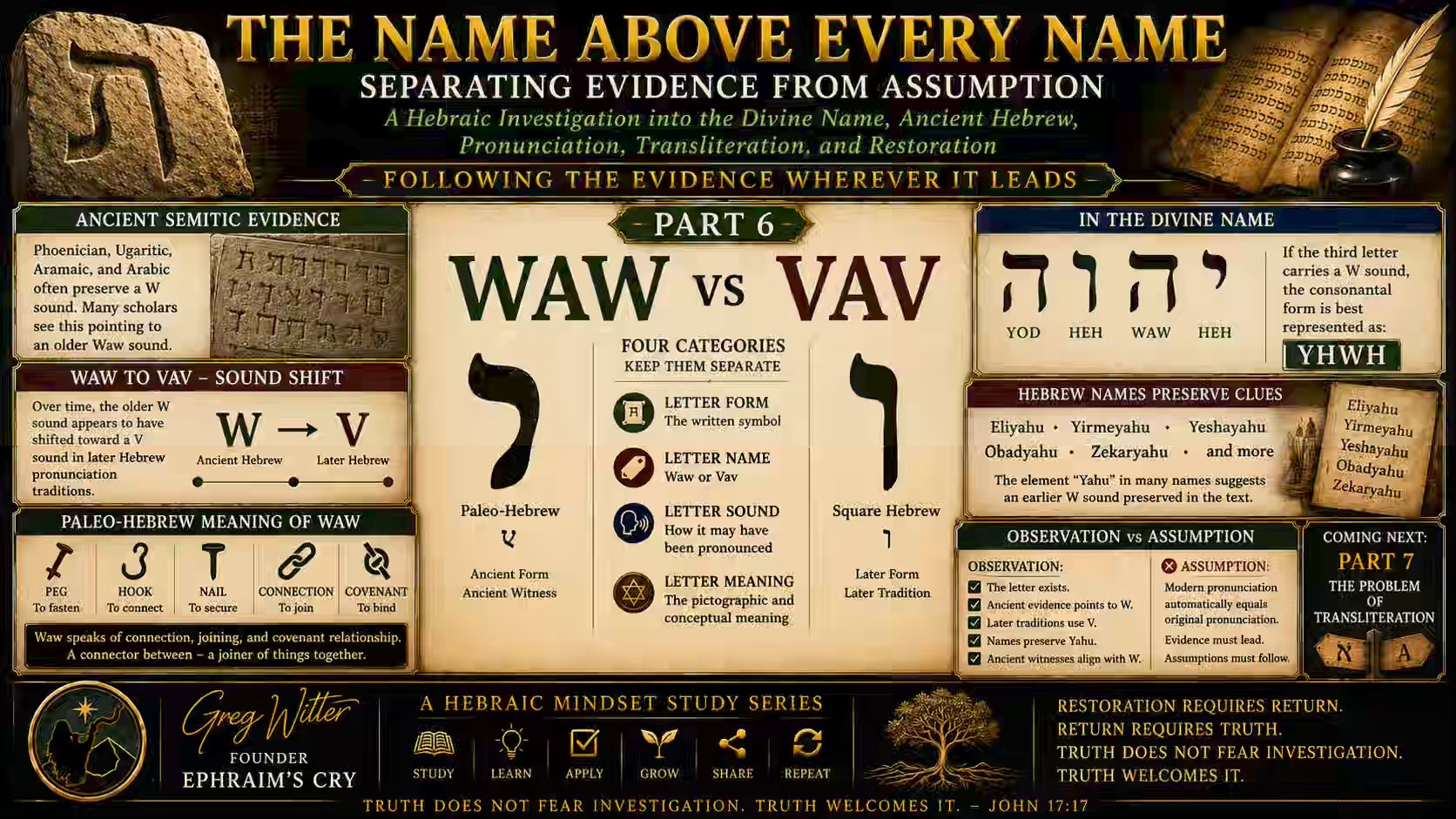
The Name Above Every Name
Part 6: Waw vs Vav
Separating Evidence from Assumption
A Hebraic Investigation into the Divine Name, Ancient Hebrew, Pronunciation, Transliteration, and Restoration
Following the Evidence Wherever It Leads
Greg Witter | Ephraim’s Cry
A Hebraic Mindset Study Series
Study • Learn • Apply • Grow • Share • Repeat
Throughout this series we have repeatedly returned to a foundational principle:
The text comes first.
Evidence comes second.
Conclusions come last.
That principle now brings us to one of the most important letters in the entire Divine Name discussion.
The letter:
𐤅
Known by many as Waw.
Known by others as Vav.
This discussion is far more significant than Tav versus Tau because this letter appears directly within the Divine Name itself.
The Divine Name is written:
𐤉𐤄𐤅𐤄
Yod.
Heh.
Waw.
Heh.
Or according to later Hebrew pronunciation traditions:
Yod.
Heh.
Vav.
Heh.
Immediately we encounter a question.
Is the third letter Waw?
Or is it Vav?
As with every discussion in this series, we must begin by identifying exactly what is being debated.
What Is the Actual Hebrew Letter?
The Hebrew letter under discussion is:
𐤅
In Paleo-Hebrew.
And:
ו
In later square Hebrew script.
The existence of the letter is not disputed.
The identity of the letter is not disputed.
The letter itself is not the issue.
The debate concerns how the letter was pronounced.
This distinction is critical.
The letter is evidence.
The sound is a conclusion.
The written symbol comes first.
The pronunciation comes afterward.
The Four Categories Must Remain Separate
As we learned in Part 5, confusion often arises when multiple categories become blended together.
The same problem appears here.
The Letter Form
𐤅
or
ו
The visual symbol preserved in the text.
The Letter Name
Waw.
Vav.
Or another proposed designation.
The Letter Sound
How the letter may have been pronounced.
The Letter Meaning
Its conceptual and pictographic significance in Paleo-Hebrew.
These categories are related.
But they are not identical.
The letter form is not the letter name.
The letter name is not the sound.
The sound is not the meaning.
The meaning is not the pronunciation.
Confusing these categories creates unnecessary confusion.
Why This Letter Matters So Much
The Tav versus Tau discussion was important.
But this discussion strikes directly at the center of the Divine Name itself.
Consider the Name:
𐤉𐤄𐤅𐤄
If the third letter carried a W sound, certain pronunciations become more likely.
If the third letter carried a V sound, different pronunciations become more likely.
This is why the discussion matters.
Not because the letter changes.
But because the proposed sound influences later pronunciation theories.
The letter itself remains fixed.
The question is what sound that letter carried in the earlier stages of Hebrew.
What Does Ancient Evidence Suggest?
Many Hebrew scholars acknowledge that the older pronunciation associated with:
𐤅
appears to have been closer to a W sound.
This is one reason many academic works refer to the letter as Waw rather than Vav when discussing ancient Hebrew.
The argument is not based merely upon preference.
It is based upon comparative linguistic evidence.
Ancient Semitic languages often preserve related sound patterns.
When those related languages are examined, evidence frequently points toward an older W sound.
This does not automatically settle every question.
But it does explain why many researchers prefer Waw when discussing ancient Hebrew.
Ancient Semitic Languages Preserve Important Evidence
Hebrew did not exist in isolation.
Hebrew belongs to a larger family of Semitic languages.
When researchers examine related languages such as Phoenician, Ugaritic, Aramaic, and Arabic, they often find evidence pointing toward an older W sound rather than a V sound.
This matters because related languages can preserve clues regarding earlier pronunciations.
Languages that share ancestry often retain sound patterns that later dialects may alter.
When multiple related languages point in the same direction, that evidence deserves serious consideration.
This is why the older designation Waw is not merely a personal preference.
It rests upon linguistic comparison.
It rests upon historical development.
It rests upon the broader Semitic context.
The goal is not to make claims without evidence.
The goal is to weigh the evidence honestly.
Where Did Vav Come From?
This is where historical development becomes important.
Languages change.
Pronunciations shift.
Dialects evolve.
Over long periods of time, sounds often move from one form to another.
Many scholars believe that the older W sound gradually shifted toward a V sound within later Hebrew pronunciation traditions.
If that is correct, then both forms represent different stages within Hebrew linguistic history.
The letter remained the same.
The pronunciation evolved.
This phenomenon is not unusual.
Language changes constantly.
English itself demonstrates this reality.
Words spoken a thousand years ago often sound very different from their modern forms.
Hebrew experienced similar developments.
The question is not whether later Hebrew uses Vav.
Many later traditions do.
The question is whether that later pronunciation reflects the earlier sound of the letter.
That is the issue.
Where Is the Ancient V Sound Evidence?
A fair question must also be asked.
If the original pronunciation was Vav, where is the ancient evidence?
The burden of proof applies equally to all positions.
Claims require evidence.
Assertions require support.
Traditions require examination.
If someone claims the original sound was V, evidence should be presented.
If someone claims the original sound was W, evidence should be presented.
The goal is not defending a preferred position.
The goal is examining the evidence honestly.
Many discussions become unbalanced because one side demands evidence while the other side appeals to familiarity or modern usage.
That is not sound investigation.
A faithful student applies the same standard everywhere.
The Letter Has Not Changed
One of the most important observations in this entire discussion is this:
The letter itself has never changed.
The symbol remains:
𐤅
or
ו
The debate concerns the sound associated with that symbol.
Too often people argue as though choosing Waw or Vav changes the text.
It does not.
The text remains the same.
The letter remains the same.
The discussion concerns pronunciation.
Not textual preservation.
The Problem with Assumptions
Many people unknowingly assume:
Modern pronunciation equals original pronunciation.
That assumption should never be accepted without evidence.
History repeatedly demonstrates that languages change.
Pronunciations change.
Dialects change.
Traditions change.
Therefore, every claim regarding pronunciation must be examined carefully.
Evidence must lead.
Assumptions must follow.
Not the other way around.
Waw and the Divine Name
This discussion becomes especially important when examining:
𐤉𐤄𐤅𐤄
The third letter is:
𐤅
If the older pronunciation was closer to Waw, then many scholars argue the consonantal form is best represented as:
YHWH
rather than:
YHVH
Notice what is happening.
The discussion still concerns consonants.
Not vowels.
The debate is not yet about Yahuwah.
Yahuah.
Yahweh.
Yehovah.
Or any other proposed pronunciation.
The discussion remains focused upon the letter itself.
The letter comes first.
The pronunciation comes later.
The consonantal form must be examined before vowels can even be discussed responsibly.
Why Waw Matters in the Divine Name
This discussion is not merely academic.
It directly affects the Divine Name.
If the third letter originally carried a W sound, that affects how researchers evaluate possible pronunciations.
If the third letter originally carried a V sound, different conclusions may follow.
But notice the careful order:
We are not proving a full pronunciation yet.
We are establishing one piece of evidence.
The letter itself becomes part of the investigation.
The sound associated with that letter becomes part of the investigation.
The way that sound appears in names becomes part of the investigation.
The way ancient witnesses represent it becomes part of the investigation.
This is why Waw versus Vav matters.
Not because the text changes.
The text does not change.
The letter does not change.
The question concerns the sound associated with that letter.
That sound becomes one piece of evidence within a much larger investigation.
Ancient Hebrew and the W Sound
Many students are surprised to discover that ancient Hebrew likely contained sounds that do not align perfectly with modern Hebrew pronunciation.
This should not be shocking.
Languages evolve.
Pronunciations evolve.
Even within modern English, pronunciation varies dramatically from region to region.
The farther we move backward into history, the more careful we must become.
This is why researchers examine:
Ancient inscriptions.
Comparative Semitic languages.
Historical linguistic evidence.
Ancient transliterations.
Ancient names.
All of these witnesses contribute evidence.
None should be ignored.
Hebrew Names Preserve Important Clues
Another line of evidence comes from Hebrew names.
Many biblical names preserve elements connected to the Divine Name.
Consider names such as:
Eliyahu.
Yirmeyahu.
Yeshayahu.
Obadyahu.
Zekaryahu.
Many names preserve the element:
Yahu.
This matters.
Names often preserve older linguistic forms long after ordinary speech begins to shift.
Names can function like historical witnesses.
They can preserve sounds, patterns, and elements that later traditions may obscure.
This does not settle every question by itself.
But it contributes valuable evidence.
Evidence accumulates.
One witness may not settle a matter.
But multiple witnesses pointing in the same direction become increasingly significant.
The Yahu Element and the Waw
The presence of Yahu within many Hebrew names becomes especially important when discussing Waw.
If the third letter carried a W/U/O related sound, then the Yahu element becomes easier to understand.
If the third letter were originally a hard V sound, then the preservation of Yahu in names requires further explanation.
Again, this does not prove the entire pronunciation of the Divine Name by itself.
But it does contribute to the larger body of evidence.
The evidence of names must be considered alongside:
The written text.
The consonantal form.
Ancient Semitic language evidence.
Ancient inscriptions.
Ancient external witnesses.
The cumulative case matters.
Ancient Witnesses Begin Pointing in a Direction
As we move further into this series, we will examine ancient witnesses such as:
Iao.
Iahu.
Yahu.
These sources become important because they may preserve clues regarding how the Divine Name was represented or pronounced in earlier periods.
For now, it is enough to recognize that many of these witnesses appear more compatible with a Waw understanding than a later Vav understanding.
We will examine that evidence in greater detail later.
At this stage, we simply note that the discussion does not stand alone.
Multiple witnesses must be considered together.
The strongest conclusions come from convergence.
When the text, names, inscriptions, linguistic patterns, and ancient witnesses begin pointing in the same direction, the case becomes stronger.
Observation Versus Interpretation
Observation:
The letter exists.
Observation:
The letter appears in the Divine Name.
Observation:
Ancient Semitic languages often preserve W sounds.
Observation:
Later Hebrew traditions commonly preserve V sounds.
Observation:
Hebrew names preserve Yahu elements.
Observation:
Ancient witnesses often appear consistent with a Waw understanding.
Interpretation:
Researchers attempt to determine which pronunciation best reflects earlier Hebrew.
Notice the order.
Observation first.
Interpretation second.
Conclusions last.
That order protects us from assumptions.
The Paleo-Hebrew Perspective
The Paleo-Hebrew letter:
𐤅
was originally pictographic in nature.
Many researchers associate it with concepts such as:
Peg.
Hook.
Nail.
Connection.
Joining.
Securing.
Binding together.
Again, these concepts do not determine pronunciation.
But they remind us that Hebrew letters often communicate more than phonetic value alone.
A letter can simultaneously possess:
A visual form.
A phonetic function.
A conceptual meaning.
A symbolic significance.
The more carefully we distinguish these categories, the less confusion we create.
The Paleo-Hebrew Meaning of Waw
The Paleo-Hebrew Waw is often understood as something that connects.
A peg holds things together.
A hook joins one thing to another.
A nail secures.
A connector binds.
From a Hebraic perspective, this becomes deeply significant.
Scripture repeatedly emphasizes covenant relationship.
Connection.
Joining.
Binding.
Reconciliation.
Restoration.
The concept of connection appears throughout the biblical narrative.
The Waw as a connector provides a powerful word-picture insight.
Again, pictographic meaning does not determine pronunciation.
But it does help us understand how ancient Hebrew letters communicated concepts.
The letter communicates more than sound.
It communicates ideas.
It communicates function.
It communicates meaning.
Waw as Connection in the Divine Name
When examining:
𐤉𐤄𐤅𐤄
the Waw stands between the two Heh letters.
This observation has caused many Hebraic students to consider its symbolic significance.
Yod.
Heh.
Waw.
Heh.
Hand.
Behold.
Nail or connector.
Behold.
Many Hebraic students see in this a profound redemptive picture.
Again, the word-picture does not prove pronunciation.
But it does reinforce the reality that Hebrew letters carry more than simple sound values.
They carry layers of meaning.
This is why Paleo-Hebrew study can be valuable when handled carefully.
What Waw vs Vav Actually Teaches Us
Ironically, the greatest lesson of this discussion is not only about Waw or Vav.
It is about methodology.
The debate teaches us how to think.
It teaches us how to separate:
Evidence from assumptions.
Text from tradition.
Observation from interpretation.
Letters from sounds.
Ancient evidence from later pronunciation habits.
This is precisely the purpose of this series.
Why This Matters for Restoration
Many people discover the Waw discussion and immediately believe every pronunciation question has been solved.
That is not the case.
Evidence rarely works that way.
One piece of evidence does not solve every question.
Instead, evidence accumulates.
A manuscript contributes evidence.
An inscription contributes evidence.
A name contributes evidence.
A linguistic pattern contributes evidence.
An ancient witness contributes evidence.
The strongest conclusions emerge when multiple lines of evidence point in the same direction.
The goal is not finding one silver bullet.
The goal is following all the evidence wherever it leads.
That is restoration.
That is honest investigation.
That is faithful study.
The Four Witnesses Remain Our Standard
Throughout Scripture, Yahuah repeatedly points His people back to the written witness.
Torah.
Prophets.
Writings.
Apostolic Witness.
Yahusha appealed to what was written.
The apostles appealed to what was written.
The prophets appealed to what was written.
The written witness remains our foundation.
The text comes first.
Tradition comes second.
Interpretation comes afterward.
A Watchman’s Warning
One of the greatest dangers in restoration movements is replacing one tradition with another.
Some reject later traditions only to embrace new assumptions.
Others become so focused on defending a pronunciation that they stop examining evidence.
That approach is dangerous.
Truth does not fear investigation.
Truth welcomes examination.
Truth survives testing.
The faithful student must remain committed to evidence above tradition.
The goal is not defending a preferred pronunciation.
The goal is discovering truth.
Expanded Watchman’s Warning
Many people defend traditions they inherited.
Others defend reconstructions they inherited.
Both groups face the same danger.
A conclusion becomes precious.
A position becomes personal.
Evidence becomes secondary.
When that happens, truth suffers.
The faithful student must be willing to examine every position.
The faithful student must be willing to test every claim.
The faithful student must be willing to follow the evidence even when the evidence challenges long-held assumptions.
Truth does not fear investigation.
Truth welcomes examination.
Truth survives testing.
Summary
The Waw versus Vav discussion concerns the pronunciation of the Hebrew letter:
𐤅
The letter itself remains unchanged. The debate concerns the sound associated with that letter and how that sound may have influenced later pronunciations of the Divine Name. Ancient Semitic evidence frequently points toward an older W sound, while later Hebrew traditions commonly preserve a V sound. Hebrew names preserving the Yahu element, ancient witnesses such as Iao, Iahu, and Yahu, and broader linguistic evidence must all be considered as part of the cumulative case. This discussion reminds us once again that letters, sounds, pronunciations, traditions, transliterations, and meanings must remain distinct categories. The text remains the evidence. Conclusions must be drawn from that evidence rather than assumed beforehand.
Rule #5
The letter remains the same even when pronunciation traditions change.
Do not confuse the preserved text with later pronunciation traditions.
Ancient evidence deserves greater weight than modern assumptions.
The text is evidence.
Pronunciation is a conclusion.
Follow the evidence wherever it leads.
Continue the Journey
The Name Above Every Name — Orientation Booklet
Pay What You Want
This resource is offered on a Pay-What-You-Want basis. Download it completely free, or support the ongoing work of Ephraim’s Cry through a voluntary contribution.
Your support helps fund future study guides, charts, teachings, broadcasts, discipleship resources, and the ongoing proclamation of the Gospel of the Kingdom.
Suggested Contribution: $19.95
Coming Next
Part 7: The Problem of Transliteration
If Waw versus Vav demonstrates how pronunciation traditions can change while the text remains the same, transliteration reveals how entire languages can reshape the way biblical words are represented and understood.
Following the Evidence Wherever It Leads.
#GregWitter #EphraimsCry #HebraicMindset #HebraicMindsetStudySeries #GospelOfTheKingdom #KingdomOfElohim#Remnant #Covenant #ReturnToCovenant #ScriptureStudy #BibleStudy #StudyLearnApplyGrowShareRepeat #TruthMatters#TestEverything #ProveAllThings #AncientPaths #Restoration #RestorationOfAllThings #TheNameAboveEveryName #SeparatingEvidenceFromAssumption #FollowingTheEvidence #DivineName #SacredName #Tetragrammaton #YHWH#PaleoHebrew #AncientHebrew #BiblicalHebrew #WawVsVav #HebrewLetters #EvidenceOverTradition#ObservationBeforeInterpretation #RuleNumberFive #LetterBeforePronunciation #AncientSemitic #Yahu #Iahu #Iao
