
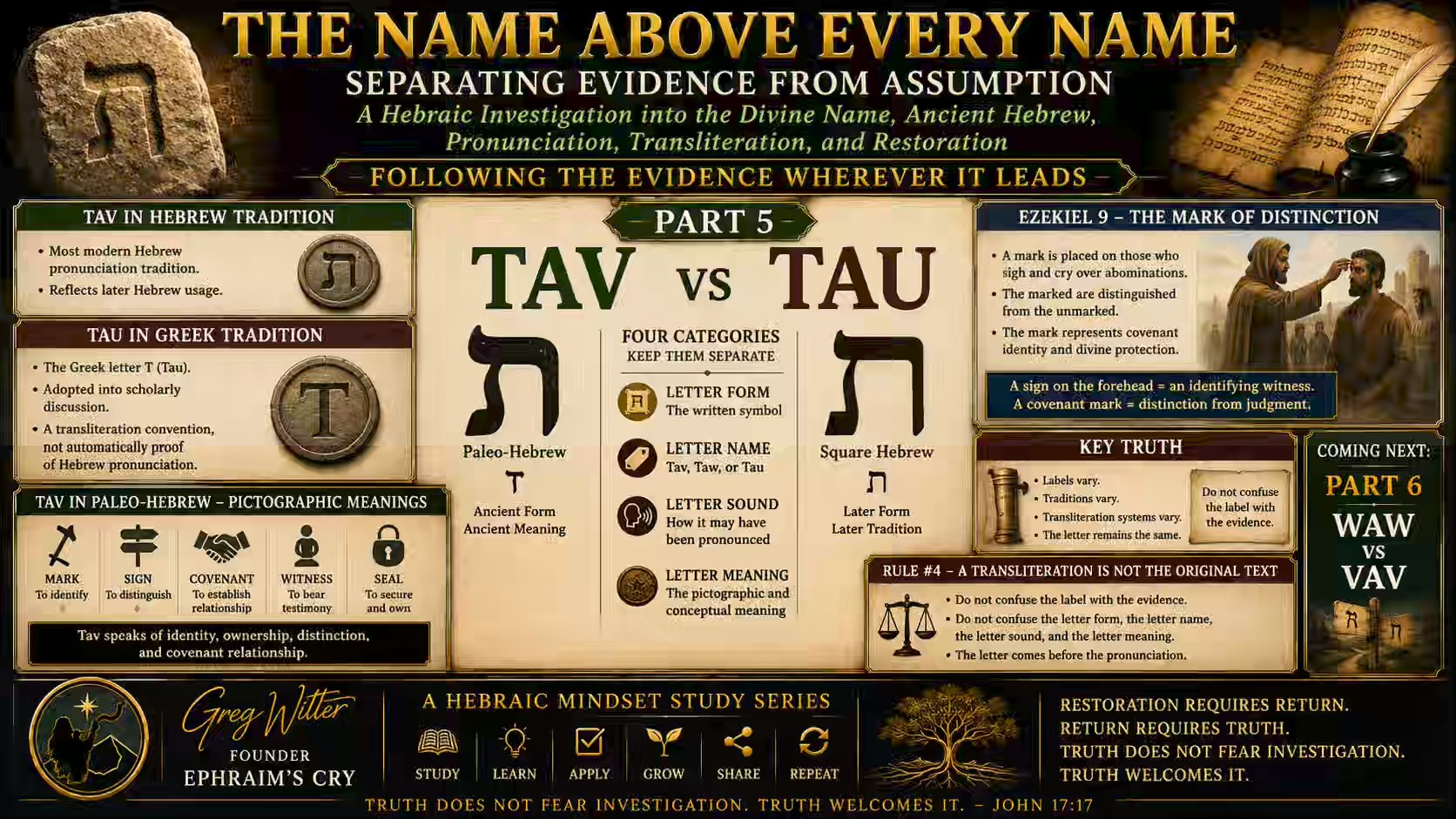
The Name Above Every Name
Part 5: Tav vs Tau
Separating Evidence from Assumption
A Hebraic Investigation into the Divine Name, Ancient Hebrew, Pronunciation, Transliteration, and Restoration
Following the Evidence Wherever It Leads
Greg Witter | Ephraim’s Cry
A Hebraic Mindset Study Series
Study • Learn • Apply • Grow • Share • Repeat
By now we have established several foundational principles.
We have learned why the Name debate exists.
We have learned to begin with the text itself.
We have learned that ancient Hebrew was originally written without vowel points.
We have learned that letters are not sounds.
Now we arrive at one of the most common examples used in discussions surrounding ancient Hebrew:
Tav versus Tau.
For many people, this discussion appears simple.
Others assume it proves far more than it actually does.
Still others use it as evidence for broader claims regarding Hebrew pronunciation.
But before reaching conclusions, we must first identify exactly what is being debated.
As we have learned throughout this series, evidence must come before assumptions.
What Is the Actual Hebrew Letter?
The Hebrew letter under discussion is:
𐤕
In Paleo-Hebrew.
And:
ת
In later square Hebrew script.
This is the final letter of the Hebrew alphabet.
Regardless of whether someone calls it Tav, Taw, or Tau, everyone is discussing the same underlying Hebrew letter.
This is important.
The existence of the letter is not disputed.
The identity of the letter is not disputed.
The debate concerns pronunciation and transliteration.
Not the letter itself.
This distinction must remain clear.
The letter is evidence.
The pronunciation is a conclusion.
The Four Categories That Must Be Kept Separate
One of the greatest sources of confusion in this discussion is that people unknowingly combine multiple categories into one.
They speak as though all four are identical.
They are not.
The Letter Form
The actual written symbol.
For example:
𐤕
or
ת
This is what appears on the page.
This is what the manuscript preserves.
This is objective evidence.
The Letter Name
Tav.
Taw.
Tau.
These are names used to identify the letter.
The Letter Sound
How the letter may have been pronounced.
This is where pronunciation discussions begin.
The Letter Meaning
Particularly within Paleo-Hebrew studies.
The pictographic concepts associated with the letter.
Mark.
Sign.
Seal.
Witness.
Covenant mark.
These four categories are related.
But they are not identical.
The letter form is not the letter name.
The letter name is not the letter sound.
The letter sound is not the letter meaning.
The letter meaning is not the pronunciation.
Much confusion disappears once these distinctions are recognized.
What Is a Transliteration?
A transliteration is an attempt to represent one language using the alphabet of another language.
It is not the original language.
It is not the original spelling.
It is not necessarily the original pronunciation.
It is an approximation.
For example:
The Hebrew letter:
ת
may be represented as:
Tav.
Taw.
Tau.
Each of these is an attempt to communicate something about the same Hebrew letter.
The Hebrew letter itself has not changed.
The transliteration changes.
This is why transliterations should never be confused with the original text.
The original text remains the authority.
The transliteration remains an interpretive tool.
Why Do Some Say Tav?
Most modern Hebrew speakers use the term:
Tav.
This reflects the pronunciation tradition found within later Hebrew.
For many people, this is the form with which they are most familiar.
Consequently, when they encounter:
ת
they naturally refer to it as Tav.
There is nothing unusual about this.
It reflects a particular pronunciation tradition.
Why Do Some Say Taw?
Others prefer:
Taw.
This often reflects attempts to represent what they believe may have been an earlier pronunciation.
Because ancient Hebrew pronunciation changed over time, some researchers prefer Taw as a closer approximation to older forms.
Again, notice what is being discussed.
Not the letter.
The sound.
The letter remains the same.
The proposed pronunciation changes.
Why Do Some Say Tau?
This is where many people become confused.
Tau is often associated with the Greek alphabet.
The Greek letter:
Τ
is called Tau.
Because Greek scholars and translators frequently interacted with Hebrew texts, the term Tau became familiar within linguistic and academic discussions.
This does not automatically prove that ancient Hebrews called the letter Tau.
It simply means Greek terminology became attached to discussions involving the Hebrew letter.
Many people unknowingly confuse a Greek transliteration tradition with a Hebrew pronunciation claim.
Those are not necessarily the same thing.
Greek Terminology Does Not Automatically Prove Hebrew Pronunciation
This point deserves special attention.
Throughout history, Hebrew, Aramaic, Greek, Latin, and later European languages have all interacted with one another.
As ideas moved from one language into another, names often changed.
Labels often changed.
Terminology often changed.
But changing a label does not automatically prove how an ancient Hebrew speaker pronounced a letter.
A Greek scholar using Tau may simply be using Greek terminology.
An English scholar using Tav may simply be using a Hebrew convention.
The label itself does not settle the matter.
Evidence must still be examined.
Evidence must still be weighed.
Evidence must still be tested.
The Same Reality Can Carry Different Labels
Consider the city known today as Jerusalem.
In Hebrew:
Yerushalayim.
In English:
Jerusalem.
In Greek:
Hierosolyma.
Different names.
Different languages.
Same city.
Likewise:
Mosheh becomes Moses.
Yirmeyahu becomes Jeremiah.
Yeshayahu becomes Isaiah.
The label changes.
The underlying person remains the same.
The same principle applies to Hebrew letters.
Different traditions may use different labels.
The underlying letter remains unchanged.
This is why labels alone do not settle questions of pronunciation.
The Mistake Many People Make
At this point many discussions begin moving too quickly.
Someone hears:
Tau.
Then assumes:
Therefore ancient Hebrew pronunciation has been proven.
Not so fast.
The use of Tau may reflect:
A Greek convention.
A scholarly convention.
A transliteration preference.
A pronunciation theory.
Or a combination of these.
The term itself does not automatically settle the question.
The label is not the evidence.
The evidence must still be examined.
The Letter Has Not Changed
One of the most important observations in this entire discussion is this:
The letter remains the same regardless of what someone calls it.
Whether a person says:
Tav.
Taw.
Tau.
The underlying Hebrew letter remains:
𐤕
This illustrates one of the central themes of this series.
Letters.
Sounds.
Pronunciations.
Transliterations.
Labels.
Traditions.
These are related.
But they are not identical.
Confusing them creates unnecessary confusion.
Paleo-Hebrew and the Tav
The discussion becomes even more interesting when we examine the Paleo-Hebrew form of Tav.
Ancient Hebrew was not originally an abstract alphabet in the way modern languages function today.
The earliest Hebrew letters were pictographic in nature.
Each letter represented a picture.
Each picture communicated an idea.
Each idea contributed meaning.
This is one reason Paleo-Hebrew continues to fascinate students of Scripture.
The letter Tav was originally written as:
𐤕
Many researchers associate this ancient form with the concepts of:
Mark.
Sign.
Seal.
Covenant mark.
Witness.
Ownership.
Identification.
Whether one agrees with every proposed pictographic interpretation is not the primary issue.
The important point is that the letter carried conceptual meaning beyond mere pronunciation.
This demonstrates once again that Hebrew letters are more than sounds.
A Hebrew letter can simultaneously possess:
A visual form.
A phonetic value.
A conceptual meaning.
A symbolic significance.
A covenant connection.
These categories should not be confused.
Yet neither should they be ignored.
The Tav as a Mark
The concept most frequently associated with Tav is the idea of a mark or sign.
A mark identifies.
A mark distinguishes.
A mark separates one thing from another.
Throughout Scripture, marks and signs often function as identifiers.
A sign communicates ownership.
A sign communicates authority.
A sign communicates belonging.
A sign communicates covenant relationship.
This becomes extremely important when examining passages where Yahuah marks, seals, identifies, or distinguishes His people.
Ezekiel 9 and the Tav
One of the most significant passages involving Tav appears in Ezekiel chapter 9.
Jerusalem stands under judgment.
Abominations fill the city.
Idolatry has spread throughout the land.
Yahuah then gives a remarkable instruction.
A messenger is told to go throughout the city and place a mark upon the foreheads of those who sigh and cry over the abominations being committed.
Notice who receives the mark.
Not the comfortable.
Not the complacent.
Not the compromising.
The mark is placed upon those who grieve over sin.
Those who mourn over rebellion.
Those who remain faithful while surrounded by corruption.
The marked are distinguished from the unmarked.
The marked are identified before judgment falls.
The marked become separated from the rebellious.
This is a profoundly covenant-oriented picture.
Whether one connects every detail of Ezekiel’s mark directly to the Paleo-Hebrew Tav or not, the thematic relationship remains striking.
The concept of a covenant mark.
A distinguishing sign.
An identifying witness.
All resonate strongly with the ancient understanding associated with Tav.
The Tav and Covenant Identity
Throughout Scripture, covenant identity is repeatedly connected with signs.
Noach received a sign.
Abraham received a sign.
Israel received signs.
The Sabbath itself functions as a sign between Yahuah and His people.
Signs identify.
Signs distinguish.
Signs communicate relationship.
This is one reason many Hebraic students find the Tav so significant.
The letter naturally points toward themes already present throughout Scripture.
Witness.
Identity.
Covenant.
Belonging.
Distinction.
These themes appear repeatedly from Genesis through Revelation.
The Final Letter of the Hebrew Alphabet
Another important observation is that Tav is the final letter of the Hebrew alphabet.
Aleph stands at the beginning.
Tav stands at the end.
This has led many students to associate Tav with ideas such as:
Completion.
Fulfillment.
Conclusion.
Maturity.
Final witness.
Covenant completion.
Whether every proposed association can be proven is not the point.
The point is that Hebrew letters often carry thematic significance beyond their phonetic value.
The letter functions on multiple levels simultaneously.
Again, this reminds us that a Hebrew letter is more than merely a sound.
What Tav vs Tau Actually Teaches Us
Ironically, the greatest lesson of the Tav versus Tau discussion has very little to do with Tav or Tau themselves.
The lesson is methodological.
When someone says:
“Tav is correct.”
Or:
“Tau is correct.”
The first question should be:
Are we discussing:
The letter?
The sound?
The pronunciation?
The transliteration?
The Greek influence?
The Hebrew tradition?
The answer matters.
Because each represents a different category.
Many debates continue for years simply because participants are discussing different categories without realizing it.
Observation Versus Assumption
Observation:
The Hebrew letter exists.
Observation:
The letter appears in Paleo-Hebrew and later Hebrew manuscripts.
Observation:
Different traditions represent the letter differently.
Observation:
Greek uses Tau.
Observation:
Hebrew traditions often use Tav.
Assumption:
Therefore one transliteration automatically proves the original pronunciation.
That conclusion requires additional evidence.
The label itself does not settle the issue.
Evidence must come before conclusions.
Interpretation must come after observation.
The Four Witnesses Remain Our Standard
Throughout this series we have repeatedly returned to the same foundation.
Torah.
Prophets.
Writings.
Apostolic Witness.
Yahusha repeatedly appealed to what was written.
The apostles repeatedly appealed to what was written.
The prophets repeatedly appealed to what was written.
The emphasis remained the same.
The written witness comes first.
Not tradition.
Not speculation.
Not assumptions.
Not popularity.
The written witness remains the foundation.
The Restoration Perspective
One of the reasons many believers are rediscovering these discussions is because the restoration movement has encouraged people to return to the foundations.
Rather than simply accepting inherited conclusions, students are examining the text for themselves.
They are asking questions.
They are studying Hebrew.
They are examining manuscripts.
They are investigating ancient inscriptions.
They are seeking to understand the text rather than merely repeating traditions.
That is a healthy process.
But restoration also carries dangers.
One danger is replacing old assumptions with new assumptions.
Another danger is embracing conclusions before examining evidence.
The goal is not merely to reject tradition.
The goal is to understand the text.
The goal is to follow the evidence wherever it leads.
A Watchman’s Warning
One of the greatest dangers in biblical study is mistaking labels for evidence.
A word can become familiar.
A tradition can become accepted.
A pronunciation can become popular.
None of those things automatically make it true.
Truth is established by evidence.
Not familiarity.
Not repetition.
Not popularity.
Not tradition alone.
Many people defend labels they have never investigated.
Many defend traditions they have never examined.
Many defend conclusions they have never tested.
The faithful student must do better.
The faithful student returns to the text.
Returns to the evidence.
Returns to the witnesses.
Returns to the foundation.
The goal is not to win arguments.
The goal is to discover truth.
Summary
The debate over Tav, Taw, and Tau is not fundamentally about the Hebrew letter itself. The letter remains the same. The discussion concerns pronunciation, transliteration, linguistic history, and tradition. The Paleo-Hebrew Tav also reminds us that Hebrew letters can communicate conceptual meaning in addition to phonetic value. The themes of mark, sign, witness, covenant identity, distinction, and completion all contribute to a deeper appreciation of the letter itself. Most importantly, Tav versus Tau teaches us once again that labels are not evidence. Evidence comes first. Conclusions come later.
Rule #4
A transliteration is not the original text.
Do not confuse the label with the evidence.
Do not confuse the letter form, the letter name, the letter sound, and the letter meaning.
The letter comes before the pronunciation.

Continue the Journey
The Name Above Every Name — Orientation Booklet
Pay What You Want
This resource is offered on a Pay-What-You-Want basis. Download it completely free, or support the ongoing work of Ephraim’s Cry through a voluntary contribution.
Your support helps fund future study guides, charts, teachings, broadcasts, discipleship resources, and the ongoing proclamation of the Gospel of the Kingdom.
Suggested Contribution: $19.95

Coming Next
Part 6: Waw vs Vav
If Tav versus Tau reveals the difference between letters, sounds, and transliterations, Waw versus Vav takes us directly into one of the most important letters in the Divine Name itself.
Following the Evidence Wherever It Leads.
#GregWitter #EphraimsCry #HebraicMindset #HebraicMindsetStudySeries #GospelOfTheKingdom #KingdomOfElohim
#Remnant #Covenant #ReturnToCovenant #ScriptureStudy #BibleStudy #StudyLearnApplyGrowShareRepeat #TruthMatter
#TestEverything #ProveAllThings #AncientPaths #Restoration #RestorationOfAllThings #TheNameAboveEveryName #SeparatingEvidenceFromAssumption #FollowingTheEvidence #DivineName #SacredName #Tetragrammaton #PaleoHebrew
#AncientHebrew #BiblicalHebrew #TavVsTau #HebrewLetters #Transliteration #EvidenceOverTradition
#ObservationBeforeInterpretation #RuleNumberFour #LetterBeforePronunciation #CovenantMark #Ezekiel9 #PaleoHebrewMeaning
