
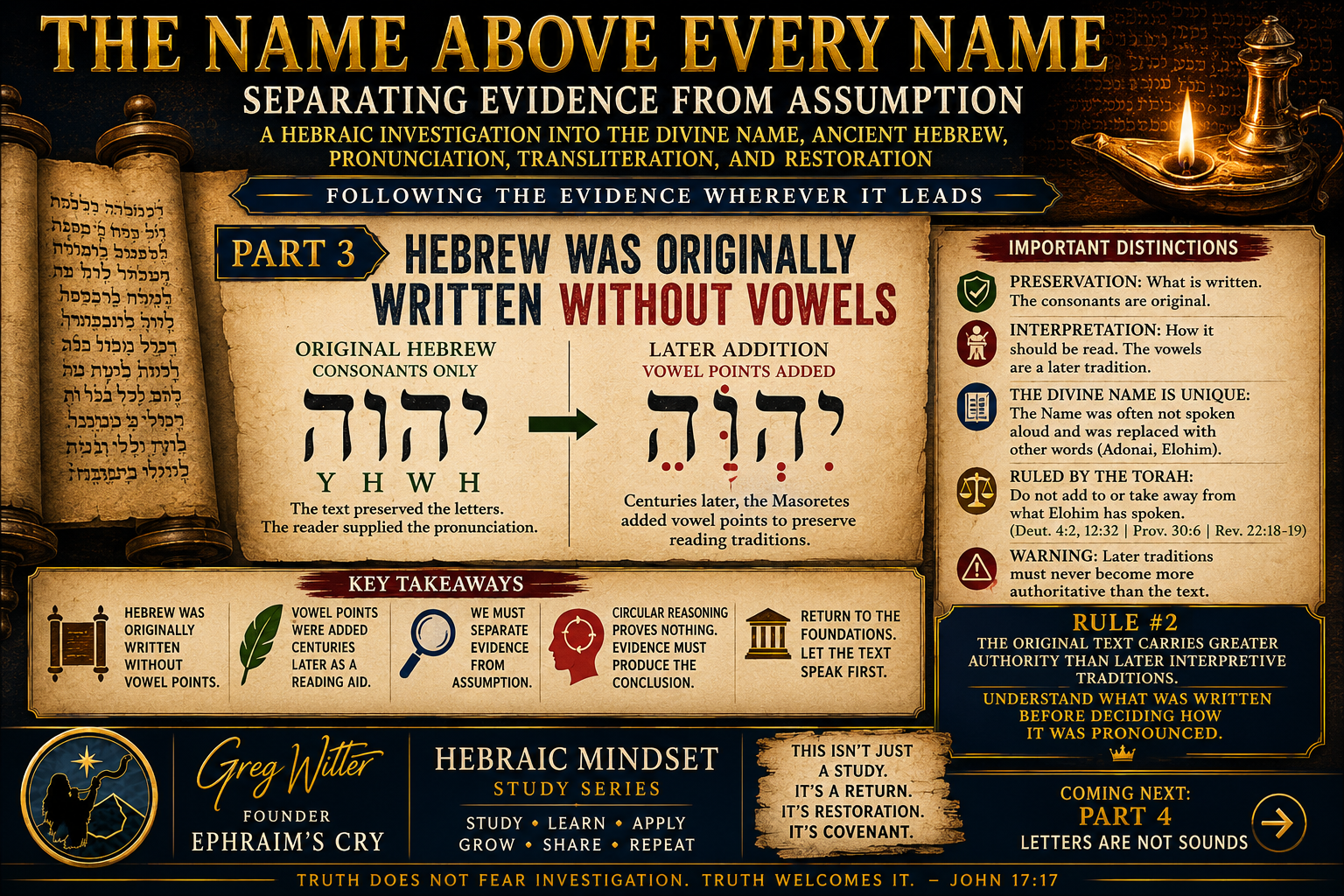
The Name Above Every Name Part 3
Part 3: Hebrew Was Originally Written Without Vowels
Separating Evidence from Assumption
A Hebraic Investigation into the Divine Name, Ancient Hebrew, Pronunciation, Transliteration, and Restoration
Following the Evidence Wherever It Leads
Greg Witter | Ephraim’s Cry
A Hebraic Mindset Study Series
Study • Learn • Apply • Grow • Share • Repeat
One of the most important facts in the entire discussion surrounding the Divine Name is also one of the most overlooked.
Ancient Hebrew was originally written without vowel points.
That statement is not controversial among historians, linguists, or textual scholars.
It is simply a historical reality.
Yet this single fact has enormous implications for the discussion surrounding the Divine Name because it immediately forces us to confront a difficult question:
If the original Hebrew text did not contain vowel points, where did the vowels come from?
Before we answer that question, we must first understand what the original text actually looked like.
The Original Hebrew Text
When Mosheh wrote the Torah, he did not write Hebrew with the vowel point system found in many printed Hebrew Bibles today.
When Dawid wrote the Psalms, he did not write Hebrew with vowel points.
When Yeshayahu, Yirmeyahu, Yehezqel, and the prophets wrote, they did not write Hebrew with vowel points.
The Hebrew Scriptures were originally written as a consonantal text.
Words were written primarily using consonants.
Readers supplied pronunciation from memory, context, and living language.
This was not unusual.
Many ancient languages functioned in exactly the same way.
The language lived within the people.
The text served as a written witness to what they already knew.
When the Divine Name appeared in the text, it appeared simply as:
𐤉𐤄𐤅𐤄
Or later:
יהוה
Four letters.
No vowel points.
No pronunciation guide.
No phonetic symbols.
No marks indicating whether the Name should be read Yahuwah, Yahweh, Yahuah, Yehovah, Jehovah, or anything else.
The text preserved the consonants.
The reader supplied the pronunciation.
That reality stands at the center of this entire discussion.
What Are Vowel Points?
Vowel points are small markings placed above, below, or within Hebrew letters.
Their purpose is to indicate pronunciation.
They tell the reader how a word should be vocalized.
Many modern readers encounter Hebrew through texts that already contain vowel points and unconsciously assume those markings have always been there.
They have not.
The vowel point system was developed centuries after the original Scriptures were written.
As Hebrew ceased being the primary spoken language among many Jewish communities, concern grew that traditional pronunciations might eventually be forgotten.
In response, Jewish scribes known as the Masoretes developed a system of vowel markings designed to preserve reading traditions.
These markings became known as the Masoretic vowel points.
The goal was preservation.
The challenge is that preservation and interpretation are not always the same thing.
Preservation Versus Interpretation
This distinction is critical.
Preservation asks:
“What is written?”
Interpretation asks:
“How should it be understood?”
Preservation asks:
“What letters appear in the text?”
Interpretation asks:
“How should those letters be pronounced?”
The consonants belong to the original written text.
The vowel points represent a later attempt to preserve a reading tradition.
That does not automatically make the vowel points wrong.
Nor does it automatically make them infallible.
It simply means we must recognize the difference between the original witness and later interpretive traditions.
The consonants were inspired as part of the written text.
The vowel points were added later by men attempting to preserve how the text was being read in their day.
Those are not identical things.
The Torah Principle
At this point a legitimate question arises.
Scripture repeatedly warns against adding to or taking away from what Elohim has spoken.
Mosheh wrote:
“You do not add to the word which I command you, and you do not take away from it.”
(Deuteronomy 4:2)
Again:
“Whatever word I command you, guard to do it; do not add to it nor take away from it.”
(Deuteronomy 12:32)
Mishlei declares:
“Do not add to His words, lest He reprove you, and you be found a liar.”
(Proverbs 30:6)
The question naturally follows:
If the original text was written without vowel points, what are we to make of additions that appear centuries later?
To be fair, the Masoretes would argue they were not adding new Scripture.
They were adding reading aids.
They were attempting to preserve pronunciation traditions.
That distinction matters.
However, it still raises an important question that every student must consider:
At what point does a reading aid become an interpretive addition?
That question cannot simply be ignored.
It deserves careful examination.
The Divine Name Is Different
The Divine Name introduces an additional layer of complexity.
Unlike most Hebrew words, the Divine Name was eventually treated differently by many Jewish communities.
Over time, traditions developed discouraging or forbidding the speaking of the Name.
When readers encountered:
יהוה
they often substituted another word.
Instead of reading the Name itself, they read:
Adonai
or
Elohim.
This means something remarkable occurred.
The written text remained unchanged.
The spoken word changed.
The letters remained.
The pronunciation being spoken by the reader changed.
That distinction is absolutely crucial.
Because once substitute readings become common, later pronunciation traditions become much more difficult to evaluate.
Why the Vowel Point Issue Matters
Many people assume the vowel points attached to יהוה settle the pronunciation question.
The reality is not so simple.
In many cases, the vowel markings associated with the Divine Name appear to reflect the substitute word the reader was expected to say rather than the pronunciation of the Name itself.
If that is true, then the vowel points attached to the Divine Name cannot automatically be treated as proof of its original pronunciation.
This does not mean they are useless.
It means they must be interpreted carefully.
The issue is far more complex than many realize.
That is why an entire lesson later in this series will be devoted specifically to the vowel point controversy.
The Circular Reasoning Problem
One of the most common errors in this discussion is circular reasoning.
For example:
“The Name must be pronounced this way because of the vowel points.”
Why are the vowel points correct?
“Because that’s how the Name is pronounced.”
That argument proves nothing.
It simply assumes its own conclusion.
Sound investigation requires independent evidence.
The conclusion cannot be used as proof of itself.
Throughout this series we will continually return to the same principle:
Evidence must produce conclusions.
Conclusions must not produce evidence.
The Issue Extends Beyond the Divine Name
This discussion is not unique to the Tetragrammaton.
Many Hebrew words can be vocalized differently depending upon which vowels are supplied.
Ancient Hebrew readers understood language differently than most modern readers.
The text often required familiarity with vocabulary, grammar, context, and tradition.
This means the issue is larger than simply:
“What is the Name?”
The real issue is:
“How should we approach an ancient consonantal text?”
That question affects every area of biblical interpretation.
The Restoration Perspective
One reason the Divine Name discussion has become increasingly important is because many believers are returning to the foundations of Scripture.
People are asking questions that previous generations often never considered.
They are examining the Hebrew text.
They are studying ancient manuscripts.
They are comparing traditions against Scripture.
They are asking whether inherited conclusions truly reflect the evidence.
This is part of a much larger restoration movement.
The discussion surrounding the Divine Name is not occurring in isolation.
It belongs to a broader return to covenant, Torah, biblical context, and Hebraic understanding.
As people return to the text itself, many long-held assumptions are naturally being reexamined.
The Elephant in the Room
At this point, many readers are already asking the obvious question.
If the original text was written without vowel points, how can anyone claim absolute certainty regarding the pronunciation?
That is an excellent question.
The answer is that the absence of original vowels does not eliminate evidence.
It simply means the evidence must be weighed carefully.
Historical evidence.
Linguistic evidence.
Manuscript evidence.
Ancient witness evidence.
Name element evidence.
All of these become part of the investigation.
This reality does not mean all proposed pronunciations are equally supported.
Nor does it mean the question cannot be investigated.
It simply means the discussion must proceed with humility and intellectual honesty.
Absolute certainty may be more difficult to establish than some claim.
That reality should encourage careful study rather than dogmatic assumptions.
A Covenant Perspective
Why does any of this matter?
Because truth matters.
The text matters.
The covenant matters.
A faithful student seeks to understand what was written before deciding what it means.
That principle applies to the Divine Name.
It applies to Sabbath.
It applies to Torah.
It applies to prophecy.
It applies to salvation.
It applies to every doctrine.
The text must remain the foundation.
The text must remain the authority.
The text must remain the starting point.
A Watchman’s Warning
One of the greatest dangers facing believers is allowing later traditions to become so familiar that they are mistaken for the original text itself.
This has happened repeatedly throughout history.
People inherit traditions.
Those traditions become accepted.
The accepted traditions become unquestioned.
Eventually many cannot distinguish between what Scripture says and what tradition says about Scripture.
The solution is not rebellion.
The solution is examination.
The solution is testing.
The solution is returning to the written witness.
Truth does not fear investigation.
Truth welcomes examination.
Truth survives testing.
That is precisely what we are attempting to do throughout this series.
Summary
Ancient Hebrew was originally written without vowel points. The earliest manuscripts preserve the consonants of the Divine Name but do not directly preserve its vowels. The Masoretic vowel system was developed centuries later to preserve reading traditions, and while valuable as a historical witness, it is not identical to the original consonantal text. Therefore, any investigation into the pronunciation of the Divine Name must carefully distinguish between preservation and interpretation, between the original text and later reading traditions, and between evidence and assumption.
Rule #2
The original text carries greater authority than later interpretive traditions.
Understand what was written before deciding how it was pronounced.
Continue the Journey
The Name Above Every Name — Orientation Booklet
Pay What You Want
This resource is offered on a Pay-What-You-Want basis. Download it completely free or support the ongoing work of Ephraim’s Cry through a voluntary contribution.
Your support helps fund future study guides, charts, teachings, broadcasts, discipleship resources, and the ongoing proclamation of the Gospel of the Kingdom.
Suggested Contribution: $19.95
Coming Next
Part 4: Letters Are Not Sounds
Many people assume that identifying a Hebrew letter automatically tells us how it was pronounced. But letters, sounds, pronunciations, and transliterations are not the same thing. Understanding that distinction is essential if we are going to separate evidence from assumption.
Following the Evidence Wherever It Leads.
#GregWitter #EphraimsCry #HebraicMindset #HebraicMindsetStudySeries #GospelOfTheKingdom #KingdomOfElohim
#Remnant #Covenant #ReturnToCovenant #ScriptureStudy #BibleStudy #StudyLearnApplyGrowShareRepeat
#TruthMatters #TestEverything #ProveAllThings #AncientPaths #Restoration #RestorationOfAllThings
#TheNameAboveEveryName #SeparatingEvidenceFromAssumption #FollowingTheEvidence #DivineName
#SacredName #Tetragrammaton #YHWH #Yahuah #Yahusha #PaleoHebrew #AncientHebrew #BiblicalHebrew #HebrewWithoutVowels #VowelPoints #MasoreticText #ConsonantalHebrew #OriginalText #TextBeforeTradition #EvidenceOverTradition #ScriptureOverTradition #PreservationVsInterpretation #RuleNumberTwo
#ReturnToTheFoundations
