
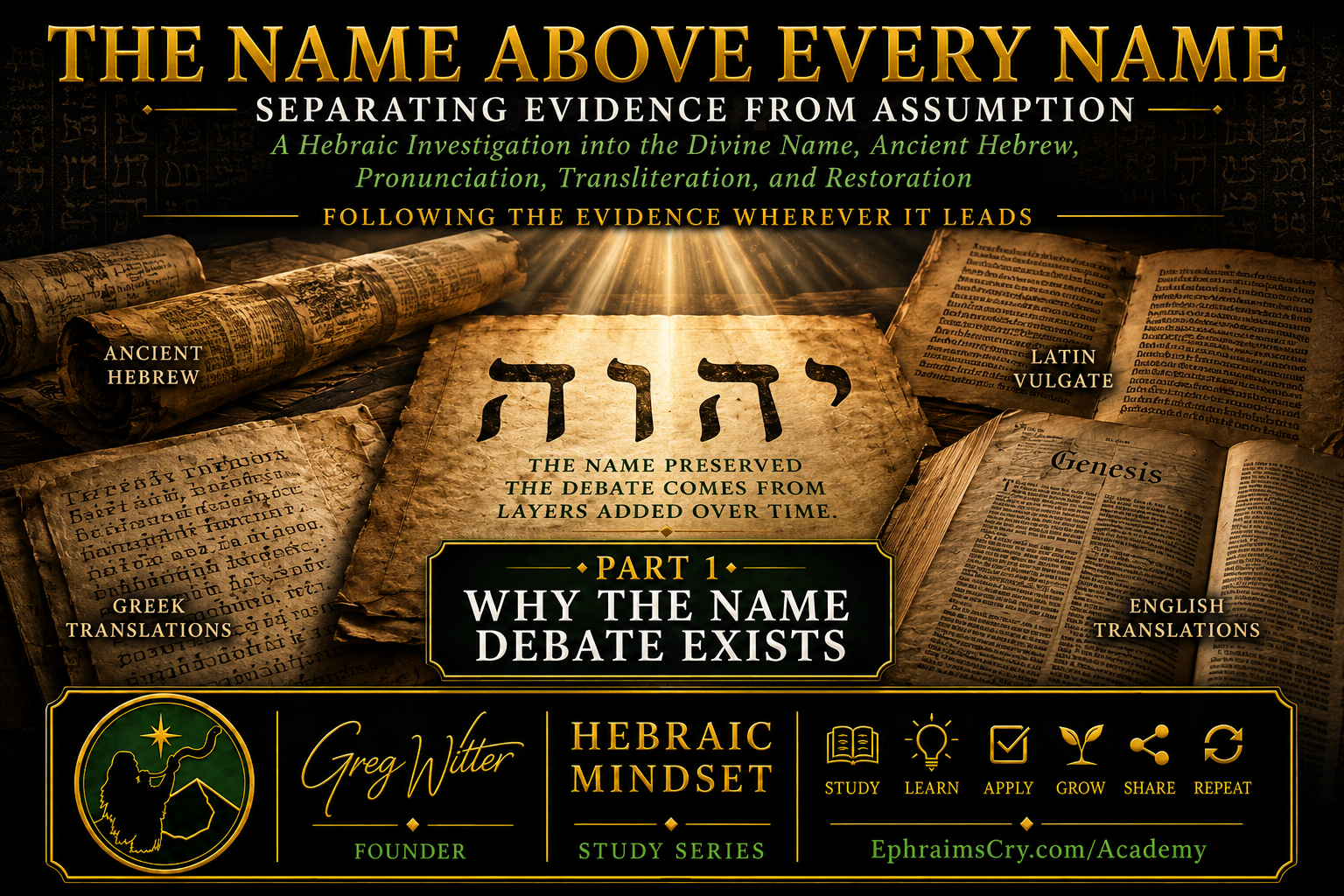
The Name Above Every Name
Part 1: Why the Name Debate Exists
Separating Evidence from Assumption
A Hebraic Investigation into the Divine Name, Ancient Hebrew, Pronunciation, Transliteration, and Restoration
Following the Evidence Wherever It Leads
Greg Witter | Ephraim’s Cry
A Hebraic Mindset Study Series
Study • Learn • Apply • Grow • Share • Repeat
Few subjects generate more discussion, disagreement, and controversy than the question of the Divine Name.
Mention YHWH, Yahuwah, Yahuah, Yahweh, Yehovah, Jehovah, Yahusha, Yeshua, or Jesus, and people immediately begin defending positions, traditions, denominations, scholars, teachers, manuscripts, and assumptions.
But before we discuss pronunciation, transliteration, or preferred forms, we must first ask a more fundamental question:
Why is there a debate at all?
More importantly:
Why does it matter?
Many people dismiss the discussion entirely.
Some claim, “The Name doesn’t matter.”
Others insist, “Any name is acceptable.”
Still others argue, “God knows who you’re talking about.”
Yet Scripture places extraordinary importance on the Name.
Yahuah revealed His Name to Mosheh and declared:
“This is My Name forever, and this is My remembrance to all generations.”
(Exodus 3:15)
The priests were commanded to place His Name upon the children of Yisra’el.
(Numbers 6:27)
The prophets declared that His people would know His Name.
(Isaiah 52:6)
Yirmeyahu warned about those who caused His people to forget His Name.
(Jeremiah 23:27)
Yahusha declared that He had revealed His Father’s Name.
(John 17:6)
Kepha proclaimed that salvation is found in no other Name.
(Acts 4:12)
The book of Revelation describes the remnant as having the Father’s Name written upon their foreheads.
(Revelation 14:1)
Clearly, Scripture treats the Name as something far more significant than a mere label.
In Scripture, a name represents identity.
A name represents authority.
A name represents character.
A name represents ownership.
A name represents covenant.
To know someone’s name is to know who they are.
To bear someone’s name is to belong to them.
To act in someone’s name is to operate under their authority.
The question of the Name is therefore not merely linguistic.
It is covenantal.
It is prophetic.
It is spiritual.
So why is there a debate?
Because the history of the Name is complicated.
The Hebrew Scriptures preserved the Divine Name in written form thousands of times.
Yet over centuries, traditions developed concerning how it should be spoken.
Titles were substituted for names.
Translations replaced original forms.
Languages changed.
Pronunciations shifted.
Hebrew was translated into Greek.
Greek was translated into Latin.
Latin was translated into English and other languages.
As these changes accumulated, assumptions often became traditions, and traditions eventually became unquestioned beliefs.
Many people today hold strong opinions regarding the Divine Name without ever examining the evidence that produced those opinions.
Some inherited Yahweh.
Some inherited Jehovah.
Some inherited LORD.
Some inherited Adonai.
Some inherited Yahuwah.
Some inherited Yahuah.
Others inherited the belief that the entire discussion is unnecessary.
But inherited belief is not the same thing as proven truth.
That is the purpose of this series.
This series is not an attempt to force conclusions.
It is not an attempt to replace one tradition with another.
It is not an attempt to win arguments.
It is an attempt to separate evidence from assumption.
Throughout this series we will examine:
What does the Hebrew text actually preserve?
What do the manuscripts actually say?
What evidence do ancient inscriptions provide?
What role do vowel points play?
What can linguistic evidence tell us?
What can history tell us?
What assumptions have become traditions?
What conclusions can reasonably be supported by the evidence?
And perhaps most importantly:
What can we know with confidence, and what remains uncertain?
The goal is not merely to arrive at a preferred pronunciation.
The goal is to establish a sound method of investigation.
Truth should never fear examination.
If a belief is true, it can withstand scrutiny.
If a tradition is correct, it can survive testing.
If an assumption is valid, it can be supported by evidence.
As students of Scripture, we are commanded to test all things and hold fast to what is good.
That principle applies here as much as anywhere else.
We are living in a time when many believers are returning to the ancient paths, reexamining inherited traditions, and asking difficult questions that previous generations were often unwilling to ask.
The discussion surrounding the Divine Name is part of that larger restoration.
Whether one ultimately concludes Yahuwah, Yahuah, Yahweh, or another reconstruction, the path forward must begin with evidence rather than assumptions.
Before we discuss pronunciation, we must first understand the text itself.
Before we discuss conclusions, we must understand the foundation.
That is where our journey begins.
Summary
The debate over the Divine Name exists because questions of language, pronunciation, translation, tradition, manuscript transmission, and history have become intertwined over centuries. Scripture places extraordinary importance upon the Name, making this far more than a linguistic discussion. Before conclusions can be reached, assumptions must be examined and evidence must be tested. This series is dedicated to that process.

Continue the Journey
The Name Above Every Name — Orientation Booklet
Pay What You Want
This resource is offered on a Pay-What-You-Want basis. Download it completely free, or support the ongoing work of Ephraim’s Cry through a voluntary contribution.
Your support helps fund future study guides, charts, teachings, broadcasts, discipleship resources, and the ongoing proclamation of the Gospel of the Kingdom.
Suggested Contribution: $19.95

Coming Next
Part 2: What Are We Actually Looking At?
Before discussing pronunciation, transliteration, or tradition, we must first identify the actual Hebrew letters preserved in the text and understand the difference between letters, sounds, pronunciations, and transliterations.
Following the Evidence Wherever It Leads.
#GregWitter #EphraimsCry #HebraicMindset #HebraicMindsetStudySeries #GospelOfTheKingdom
#KingdomOfElohim #Remnant #Covenant #ReturnToCovenant #ScriptureStudy #BibleStudy
#StudyLearnApplyGrowShareRepeat #TruthMatters #TestEverything #ProveAllThings #AncientPaths
#Restoration #RestorationOfAllThings #TheNameAboveEveryName #SeparatingEvidenceFromAssumption
#FollowingTheEvidence #DivineName #SacredName #Tetragrammaton #YHWH #Yahuah #Yahusha
#PaleoHebrew #AncientHebrew #BiblicalHebrew #EvidenceOverTradition #ScriptureOverTradition
#CovenantIdentity #KingdomTeaching #WhyTheNameDebateExists #EvidenceVsAssumption
#QuestionEverything #ExamineTheEvidence #TestTheTraditions #RestoringTruth #FoundationsMatter
