
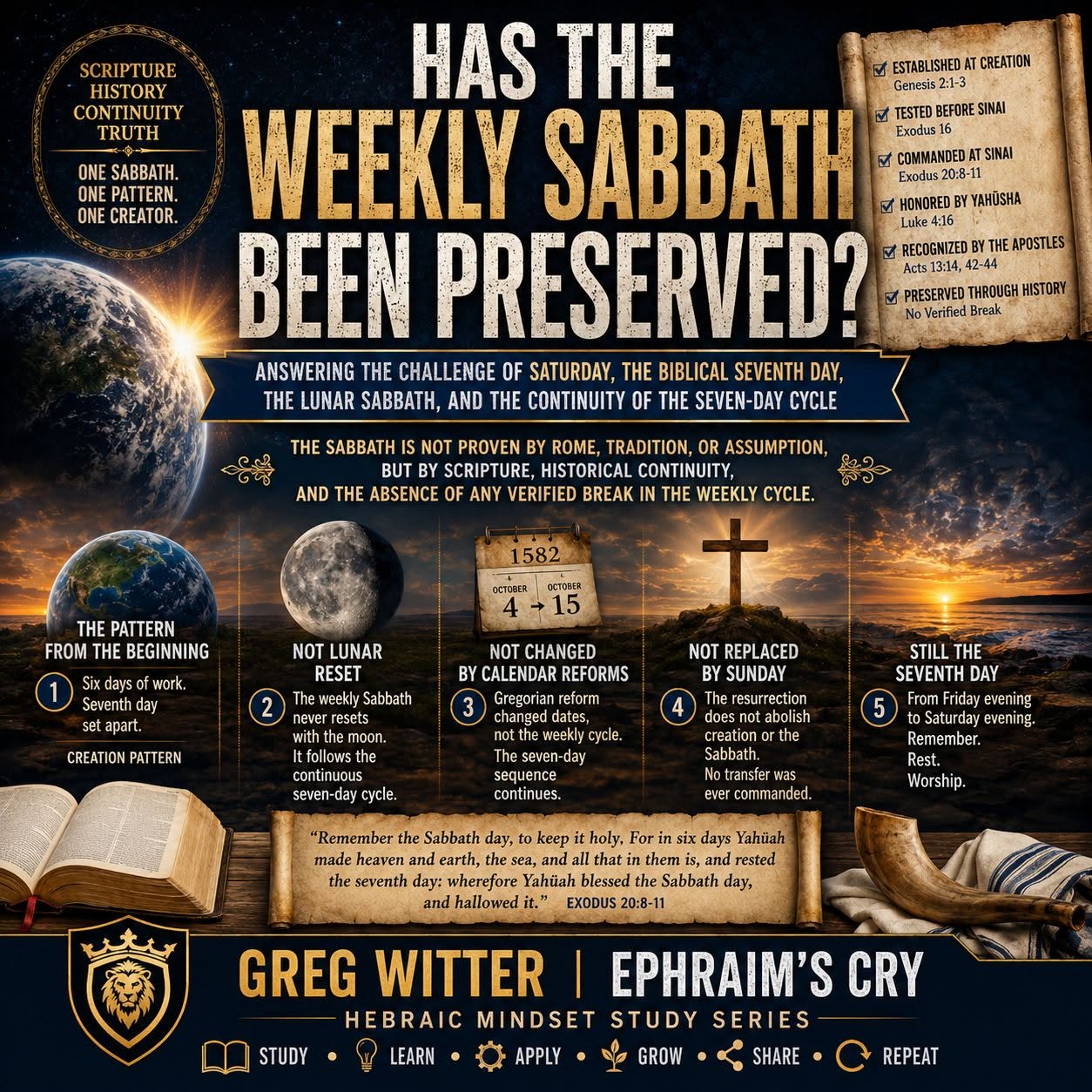
Has the Weekly Sabbath Been Preserved?
Answering the Challenge of Saturday, the Biblical Seventh Day, the Lunar Sabbath, and the Continuity of the Seven-Day Cycle
The Sabbath Is Not Proven by Rome, Tradition, or Assumption, but by Scripture, Historical Continuity, and the Absence of Any Verified Break in the Weekly Cycle
Greg Witter | Ephraim’s Cry
Hebraic Mindset Study Series
Study • Learn • Apply • Grow • Share • Repeat
One of the common challenges raised against the Sabbath is this:
How do we know the seventh day has been preserved?
Some ask sincerely.
Some ask because they are confused.
Some ask because they have been taught that Sunday replaced the Sabbath.
Some ask because they have encountered lunar Sabbath arguments.
Some ask because they assume the Gregorian calendar changed everything.
The question deserves a serious answer.
The issue is not whether the English word “Saturday” appears in Scripture.
It does not.
The issue is not whether Rome named the days of the week.
It did.
The issue is not whether the Gregorian calendar is biblical.
It is not.
The issue is whether the continuous seven-day weekly cycle has been preserved.
That is the real question.
Scripture does not command us to keep a Roman day called Saturday.
Scripture commands us to work six days and rest the seventh.
The Sabbath is the seventh day of the continuous weekly cycle, beginning at evening and ending at evening.
In modern civil-calendar language, that corresponds to Friday evening through Saturday evening.
That distinction matters.
Saturday, as a Gregorian civil day, runs midnight to midnight.
The biblical Sabbath runs evening to evening.
So we should speak carefully.
The Sabbath is not “Saturday” in the Roman sense.
The Sabbath is the biblical seventh day, which overlaps what the modern civil calendar calls Friday evening through Saturday evening.
The First Witness: Creation
The Sabbath begins in Genesis.
Before Sinai.
Before Moses.
Before Israel as a nation.
Before the Levitical priesthood.
Before the tabernacle.
Before the temple.
Before the written tablets at Sinai.
Genesis 2:1-3 declares that Elohim completed His work, rested on the seventh day, blessed the seventh day, and set it apart.
That is the foundation.
The Sabbath is not introduced as a Jewish invention.
The Sabbath is not introduced as a rabbinic tradition.
The Sabbath is not introduced as a Roman calendar issue.
The Sabbath is established at creation.
The pattern is simple:
Six days of work.
The seventh day set apart.
That is the creation pattern.
The Second Witness: Exodus 16
Before Israel reaches Sinai, the Sabbath is already being tested through the manna.
Yahûah gives manna for six days.
On the sixth day, Israel receives a double portion.
On the seventh day, there is no manna to gather.
This is devastating to the idea that the Sabbath was invented at Sinai.
It was not.
Exodus 16 shows that Israel was being trained in the Sabbath before the Ten Words were spoken from the mountain.
The pattern again is simple:
Six days gather.
Seventh day rest.
Repeat.
There is no lunar reset.
There is no new moon restart.
There is no instruction to count the Sabbath by moon phases.
There is only the continuous seven-day pattern.
The Third Witness: The Ten Words
Exodus 20 does not introduce the Sabbath as a new concept.
It says:
“Remember the Sabbath day, to keep it holy.”
You cannot remember what was never previously known.
The command points backward to creation.
“For in six days Yahûah made heaven and earth, the sea, and all that in them is, and rested the seventh day.”
The Sabbath command is not rooted in Rome.
It is not rooted in later Judaism.
It is not rooted in church tradition.
It is rooted in creation.
That means the weekly Sabbath is creation-based, not moon-phase based.
The Fourth Witness: Yahûsha
Yahûsha kept the Sabbath.
That fact matters.
By the first century, the Jewish people were keeping a known weekly Sabbath.
Yahûsha never corrected them on the day.
He corrected their man-made traditions.
He corrected their hypocrisy.
He corrected their harshness.
He corrected their misuse of Sabbath boundaries.
But He never said:
“You are keeping the wrong day.”
He never said:
“The weekly cycle has been lost.”
He never said:
“You should be using lunar Sabbaths.”
He never said:
“The Sabbath floats by the moon.”
Instead, He entered the synagogue on the Sabbath as His custom was.
That alone is powerful evidence.
If the Jewish people of the first century had lost the weekly Sabbath, Yahûsha would have corrected it.
He did not.
The Fifth Witness: The Apostles
The apostles also knew which day the Sabbath was.
The book of Acts repeatedly shows Sabbath gatherings, Sabbath teaching, and Sabbath recognition.
Paul went into the synagogue on the Sabbath.
The Gentiles asked to hear the word again the next Sabbath.
The Sabbath was recognized by Jews, proselytes, and Gentile hearers.
There is no apostolic confusion.
There is no apostolic correction of the weekly cycle.
There is no apostolic teaching of a lunar Sabbath.
There is no apostolic declaration that the Sabbath had shifted.
This matters.
The apostolic witness confirms that the Sabbath was still identifiable after the death, burial, resurrection, and ascension of Yahûsha.
The Calendar Reform Objection
Some argue that because the Julian calendar changed to the Gregorian calendar, the Sabbath may have been lost.
That argument fails.
The Gregorian reform changed dates.
It did not break the seven-day weekly cycle.
In 1582, calendar dates were skipped to correct the drift of the solar year.
But the sequence of weekdays continued.
The reform adjusted the numbering of dates.
It did not reset the week.
This is the critical distinction.
Changing from October 4 to October 15 is a date correction.
It is not a weekday-cycle correction.
The week kept moving.
The seven-day cycle was not restarted.
The Sabbath was not lost because calendar dates were adjusted.
A calendar can change its numbering system without changing the weekly sequence.
The Jewish Preservation Witness
The Jewish people have preserved Sabbath observance for thousands of years.
They have lived across continents.
They have lived under Babylon, Persia, Greece, Rome, Islam, Christianity, Europe, exile, dispersion, persecution, and return.
Yet Jewish communities across the world still recognize the same weekly Sabbath.
That does not make rabbinic tradition our final authority.
Scripture is the final authority.
But historical preservation matters when the question being asked is historical continuity.
If the Sabbath cycle had been lost, interrupted, reset, or shifted, there should be evidence of that break.
Where is it?
Who changed it?
When did it happen?
Where is the historical record?
Where is the dispute among worldwide Jewish communities over which day is the seventh day?
The silence is loud.
The burden of proof is not on those who accept the preserved weekly cycle.
The burden of proof is on those claiming it was lost.
The Lunar Sabbath Problem
The lunar Sabbath theory claims that the weekly Sabbath resets each month according to the new moon.
This teaching fails the biblical test.
Scripture does connect the moon to months and appointed times.
That is true.
New moons matter.
The annual moedim are calculated within the biblical calendar.
But the weekly Sabbath is never commanded to reset by the moon.
That is the point.
Genesis gives a seven-day creation pattern.
Exodus 16 gives a repeating six-and-one manna pattern.
Exodus 20 roots the Sabbath in creation.
The prophets mention Sabbaths and new moons together because both are appointed times, not because they are calculated the same way.
Mentioning two appointed times together does not make them the same system.
If the weekly Sabbath reset every month, Scripture would have to explain how to handle the extra days between lunar phases.
It does not.
If the Sabbath always fell on the 8th, 15th, 22nd, and 29th of the month, Scripture would state that.
It does not.
If new moon day interrupted the weekly count, Torah would command that.
It does not.
The lunar Sabbath theory requires assumptions that Scripture never commands.
That is not restoration.
That is invention.
The Roman Name Objection
Some say:
“Saturday is named after Saturn, so it cannot be the Sabbath.”
That argument confuses a pagan name with a biblical sequence.
The English name “Saturday” is not holy.
The Roman name is not holy.
The Gregorian label is not holy.
The seventh day is holy because Yahûah blessed it and set it apart.
Changing the name of a day does not change the sequence of the week.
Calling the first month “January” does not make the moon disappear.
Calling the seventh day “Saturday” does not make the Sabbath pagan.
The name is not the authority.
The sequence is the issue.
The Sabbath is the seventh day of the week, regardless of what later languages call it.
The Sunday Replacement Problem
Many Christians argue that Sunday replaced the Sabbath because Yahûsha rose from the dead on the first day of the week.
That argument also fails.
The resurrection is glorious.
The resurrection is central.
The resurrection is foundational.
But nowhere does Scripture say the resurrection changed the Sabbath.
There is no command transferring Sabbath holiness to the first day.
There is no verse saying the first day became the Sabbath.
There is no apostolic decree abolishing the seventh day.
There is no prophetic witness saying the Sabbath would be replaced by Sunday.
The first day and the seventh day are not the same day.
The resurrection does not abolish creation.
Yahûsha is Master of the Sabbath.
That does not mean He abolished it.
A king does not become king of a thing by destroying it.
The Empirical Evidence Question
Can we prove the Sabbath with absolute scientific laboratory certainty?
No.
Historical questions are not normally proven that way.
But we can examine the evidence.
The evidence shows:
The seven-day week existed in antiquity.
The Jewish people preserved the Sabbath as the seventh day.
Yahûsha recognized the Sabbath in the first century and never corrected its timing.
The apostles recognized the Sabbath after the resurrection.
The Gregorian reform changed dates, not the weekly cycle.
There is no verified historical break in the seven-day cycle.
There is no biblical command for lunar Sabbath resets.
There is no apostolic teaching that the Sabbath was lost, shifted, or replaced.
That is strong cumulative evidence.
The question is not whether someone can invent doubt.
Anyone can invent doubt.
The question is whether the doubt is supported by Scripture and history.
In this case, the doubt does not stand.
The Burden of Proof
Those who reject the preserved seventh-day Sabbath must answer basic questions.
When was the weekly cycle lost?
Who lost it?
Where did it happen?
Who changed the Sabbath?
Where is the historical record of the change?
Why did Yahûsha never correct it?
Why did the apostles never correct it?
Why do Jewish communities worldwide still recognize the same weekly Sabbath?
Why does Scripture never teach lunar Sabbath resets?
Why does Scripture never transfer Sabbath holiness to Sunday?
Without answers, the objection is speculation.
Speculation cannot overturn Scripture.
The Proper Conclusion
The Sabbath is not proven by Rome.
The Sabbath is not dependent upon the Gregorian calendar.
The Sabbath is not established by the name Saturday.
The Sabbath is established by Yahûah.
Creation gives the pattern.
Exodus confirms the cycle.
Sinai commands remembrance.
Yahûsha honors the day.
The apostles recognize the day.
History preserves the continuity.
The Gregorian calendar does not erase it.
The lunar Sabbath theory does not prove otherwise.
Sunday does not replace it.
The biblical Sabbath remains the seventh day.
In modern civil-calendar language, that is the period from Friday evening to Saturday evening.
Not because Rome made it holy.
Not because Judaism has final authority.
Not because tradition saves anyone.
But because Yahûah blessed the seventh day, set it apart, commanded His people to remember it, and never abolished it.
The question is not whether men have created confusion.
They have.
The question is whether Yahûah’s witness has been preserved.
It has.
The Sabbath remains.
#GregWitter#EphraimsCry#HebraicMindset#HebraicMindsetStudySeries#StudyLearnApplyGrowShareRepeat#BibleStudy
#ScriptureStudy#TorahStudy#Discipleship#KingdomTeaching#CovenantTeaching#BiblicalTruth#WatchmanTeaching#Sabbath
#Shabbat#SeventhDay#FridayEveningToSaturdayEvening#BiblicalCalendar#CreationPattern#Exodus16#Matthew5#Acts#Yahûah
#Yahûsha#Torah#Covenant#Obedience#Truth
