
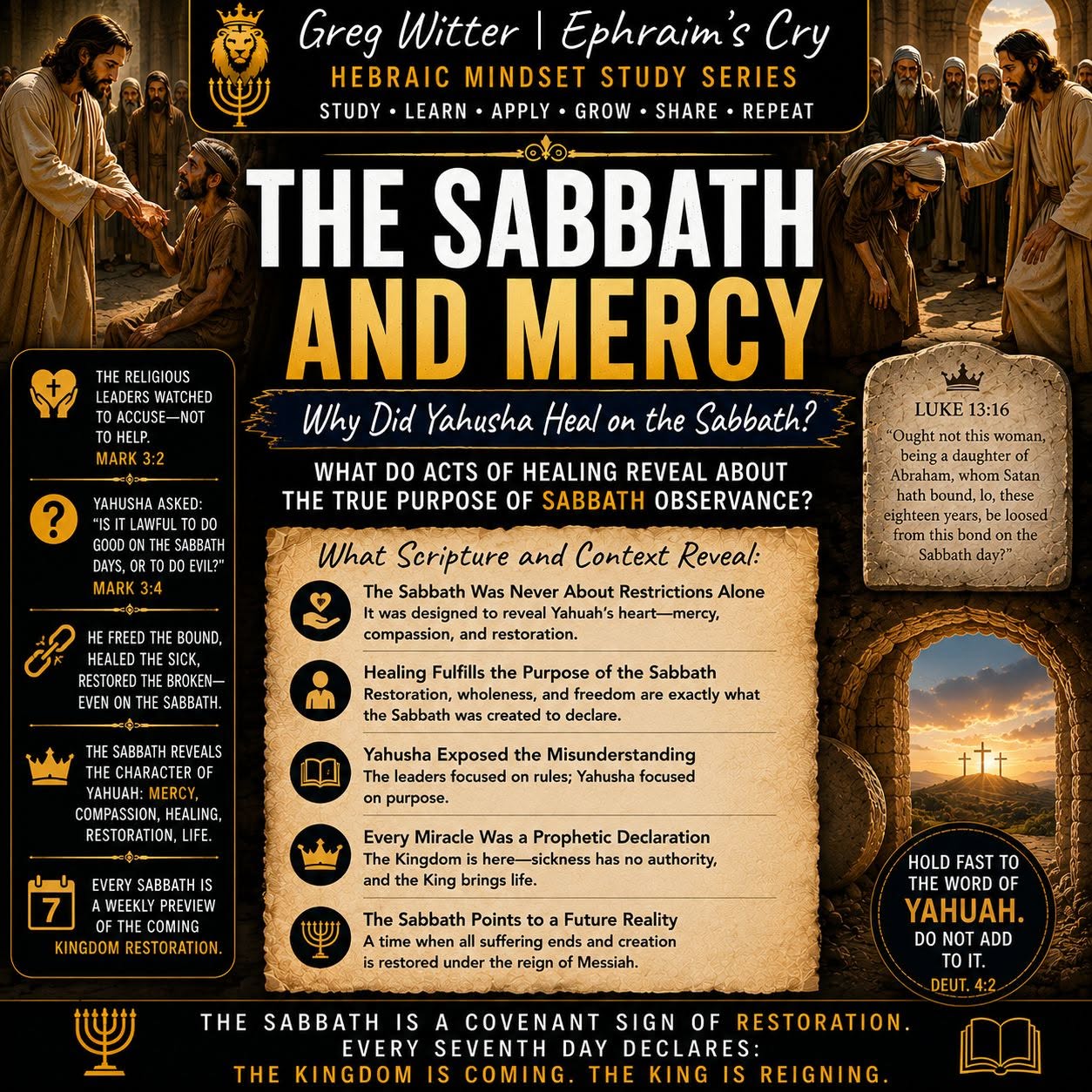
The Sabbath and Mercy
Why Did Yahusha Heal on the Sabbath?
What Do Acts of Healing Reveal About the True Purpose of Sabbath Observance?
Greg Witter | Ephraim’s Cry
Hebraic Mindset Study Series
Study Learn Apply Grow Share Repeat
One of the most common accusations leveled against Yahusha was that He healed on the Sabbath.
Again and again the religious leaders objected.
Again and again they accused.
Again and again they sought fault.
Yet the remarkable thing is this:
They never accused Him of violating Torah.
They accused Him of violating their interpretation of Torah.
That distinction is critical.
Throughout the Gospel accounts, Yahusha repeatedly performs acts of healing on the Sabbath.
The man with the withered hand.
The woman bent over for eighteen years.
The man suffering from dropsy.
The paralytic.
The blind.
The lame.
The suffering.
The broken.
The afflicted.
And every time the same controversy emerges.
Why?
Because Yahusha was exposing a fundamental misunderstanding of the Sabbath itself.
The religious leaders had become so focused on restrictions that they had lost sight of the purpose.
The Sabbath had become an end in itself.
Yet the Sabbath was never meant to be an end.
It was always intended to reveal the character of Yahuah.
This becomes clear in Mark 3.
A man with a withered hand is present.
The religious leaders are watching.
Not because they care about the man.
Not because they care about his suffering.
Not because they desire his restoration.
They are watching to accuse.
Mark 3:2 says:
“And they watched Him, whether He would heal him on the Sabbath day; that they might accuse Him.”
Notice the condition of their hearts.
A suffering man stands before them.
Their concern is not mercy.
Their concern is finding a violation.
Yahusha immediately exposes the problem.
Mark 3:4:
“Is it lawful to do good on the Sabbath days, or to do evil? To save life, or to kill?”
The question is devastating.
Because the answer is obvious.
The Sabbath cannot become an excuse for withholding mercy.
The Sabbath cannot become a justification for refusing compassion.
The Sabbath cannot become a reason to ignore suffering.
If the Sabbath reflects the character of Yahuah, then acts reflecting His character are entirely appropriate on the Sabbath.
And what is the character of Yahuah?
Mercy.
Compassion.
Healing.
Restoration.
Deliverance.
Life.
The irony is profound.
The religious leaders claimed to defend the Sabbath while opposing the very things the Sabbath was designed to reveal.
The Sabbath is a picture of restoration.
What is healing if not restoration?
The Sabbath is a picture of wholeness.
What is healing if not wholeness?
The Sabbath is a picture of freedom.
What is healing if not freedom?
The Sabbath is a picture of the coming Kingdom.
What is healing if not a preview of that Kingdom?
Every miracle performed on the Sabbath becomes a prophetic declaration.
This is what the Kingdom looks like.
The blind see.
The lame walk.
The broken are restored.
The oppressed are delivered.
The weary find rest.
The Sabbath and healing belong together because both point toward the same future reality.
This becomes even clearer in Luke 13.
A woman had been bent over for eighteen years.
Eighteen years.
Eighteen years of suffering.
Eighteen years of limitation.
Eighteen years of pain.
Yahusha heals her on the Sabbath.
Immediately the ruler of the synagogue objects.
Again the issue is not Torah.
The issue is interpretation.
Yahusha responds:
“Ought not this woman, being a daughter of Abraham, whom Satan hath bound, lo, these eighteen years, be loosed from this bond on the Sabbath day?” (Luke 13:16)
Notice the language.
Loosed.
Freed.
Released.
Restored.
The Sabbath itself is about release.
The Sabbath itself is about freedom.
The Sabbath itself is about restoration.
Yahusha is not violating the Sabbath.
He is demonstrating it.
He is showing the people what Sabbath truly points toward.
The deeper we examine the Gospels, the more obvious the pattern becomes.
The religious leaders viewed the Sabbath primarily through restriction.
Yahusha viewed the Sabbath through restoration.
The religious leaders focused on prohibition.
Yahusha focused on purpose.
The religious leaders emphasized boundaries.
Yahusha emphasized meaning.
Both matter.
Boundaries matter.
Obedience matters.
Commandments matter.
But commandments divorced from purpose become distorted.
The Sabbath was never designed merely to stop activity.
The Sabbath was designed to reveal the Kingdom.
This explains why Isaiah 58 connects the Sabbath with delight.
It explains why Genesis connects the Sabbath with blessing.
It explains why Hebrews connects the Sabbath with future rest.
It explains why Yahusha connects the Sabbath with healing.
All of them point toward the same reality.
The Sabbath is a covenant sign of restoration.
Every seventh-day Sabbath proclaims that the curse will not last forever.
Every Sabbath announces that suffering has an expiration date.
Every Sabbath declares that Messiah’s Kingdom is coming.
Every Sabbath testifies that healing, restoration, and peace are ultimately the destiny of creation under the reign of the King.
This is why mercy belongs on the Sabbath.
This is why healing belongs on the Sabbath.
This is why restoration belongs on the Sabbath.
Because the Sabbath itself is a weekly rehearsal of restoration.
The religious leaders saw a violation.
Yahusha saw a fulfillment of purpose.
The Sabbath was never diminished by mercy.
The Sabbath was always intended to reveal it.
NEXT STUDY:
Doing Good on the Sabbath
What did Yahusha mean when He asked, “Is it lawful to do good on the Sabbath?” Does the Sabbath merely prohibit certain actions, or does it actively call believers to certain actions?
#Sabbath#Shabbat#SabbathAndMercy#HealingOnTheSabbath#Yahusha#Torah#TorahStudy#HebraicMindset#Mark3
#Luke13#Isaiah58#KingdomRest#Restoration#Healing#Compassion#Mercy#KingdomOfElohim#CovenantFaithfulness
#WholeCounselOfElohim#BiblicalSabbath#CommandmentsOfElohim#KingdomLiving#ReturnToCovenant#StudyScripture#WalkInTruth
#Yahuah#EphraimsCry#GregWitter#StudyLearnApplyGrowShareRepeat#BiblicalTruth
