
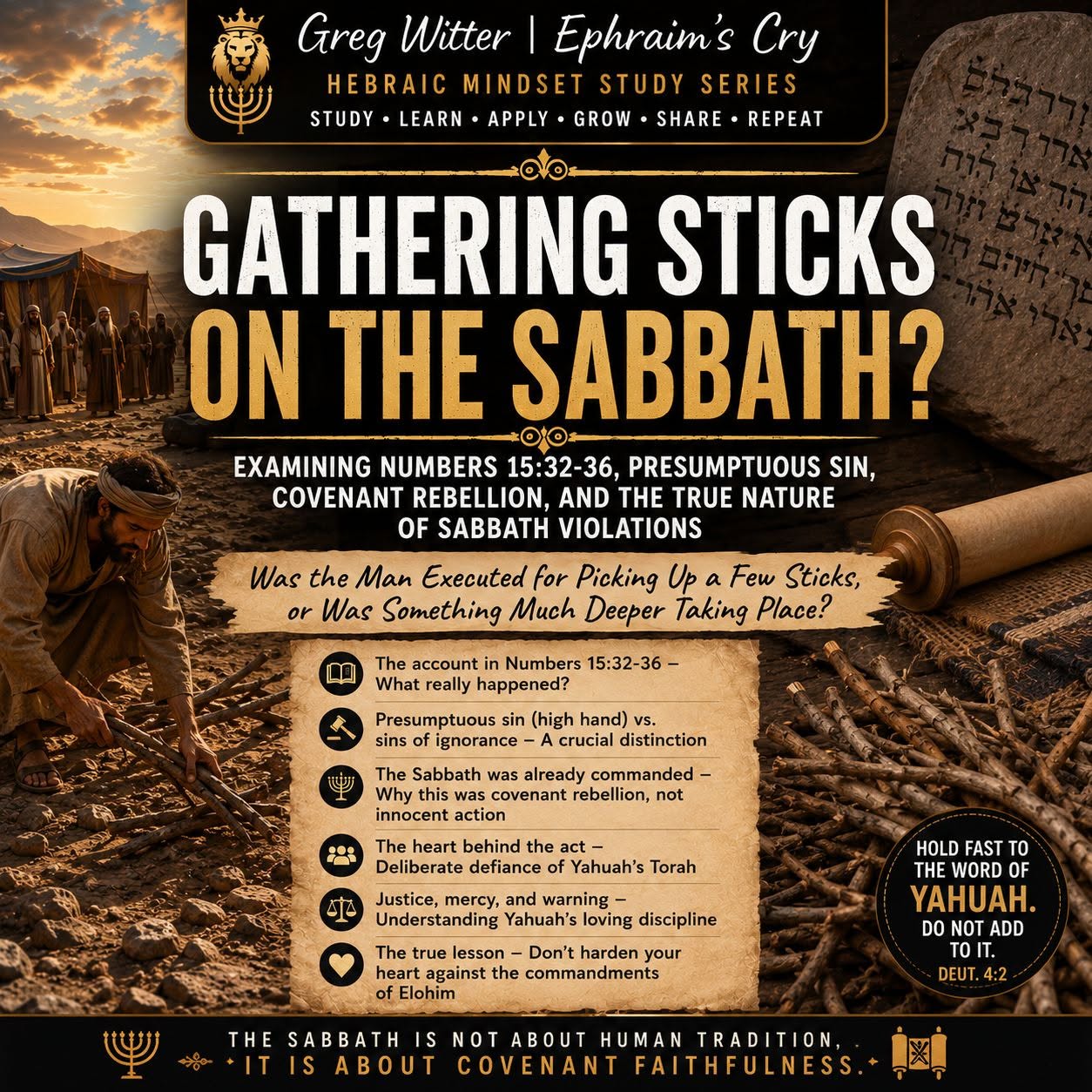
Gathering Sticks on the Sabbath?
Examining Numbers 15:32-36, Presumptuous Sin, Covenant Rebellion, and the True Nature of Sabbath Violations
Was the Man Executed for Picking Up a Few Sticks, or Was Something Much Deeper Taking Place?
Greg Witter | Ephraim’s Cry
Hebraic Mindset Study Series
Study Learn Apply Grow Share Repeat
Among all the passages used to define Sabbath observance, few are quoted more frequently than the account of the man found gathering sticks on the Sabbath in Numbers 15:32-36.
For many readers, the conclusion appears obvious.
A man picked up sticks.
Yahuah commanded his execution.
Therefore, gathering sticks on the Sabbath must be a serious violation.
But as with many difficult passages, the real question is not what happened.
The real question is why it happened.
Scripture often records events without immediately explaining the covenant context behind them. When we fail to examine that context, we can easily misunderstand the lesson being taught.
The account is brief:
“And while the children of Israel were in the wilderness, they found a man that gathered sticks upon the Sabbath day.”
Numbers 15:32
The man is brought before Moses and Aaron.
The matter is presented before Yahuah.
Yahuah commands that the man be taken outside the camp and stoned.
At first glance, many conclude that merely picking up sticks brought a death sentence.
But the immediate context raises important questions.
Why is this case treated differently from ordinary mistakes?
Why is Moses required to seek judgment?
Why does the narrative appear immediately after instructions regarding intentional sin?
The answer begins before the story itself.
Numbers 15:27-31 discusses two categories of sin.
The first category involves sins committed in ignorance.
The second category involves what Scripture calls sin committed with a “high hand.”
The Hebrew concept describes deliberate, defiant, covenant rebellion.
This is not accidental failure.
This is not misunderstanding.
This is not weakness.
This is open-handed defiance against Yahuah’s authority.
Immediately after this discussion comes the account of the man gathering sticks.
The placement is unlikely to be accidental.
The narrative appears to function as an example of presumptuous rebellion.
The issue may not have been the sticks themselves.
The issue may have been the deliberate rejection of a known commandment.
The difference is enormous.
The Torah consistently distinguishes between weakness and rebellion.
Between stumbling and defiance.
Between repentance and hard-heartedness.
This distinction becomes essential when discussing Sabbath observance.
Many people approach the passage as though Yahuah was waiting for someone to pick up a few twigs so He could impose a death sentence.
But that interpretation creates serious problems throughout the rest of Scripture.
The character of Yahuah revealed throughout Torah, the Prophets, the Writings, and the Apostolic Witness consistently demonstrates justice, mercy, patience, warning, instruction, and opportunities for repentance.
Therefore the question becomes:
Was this man innocently gathering firewood?
Or was he openly rejecting a commandment that had already been repeatedly established before the nation?
The larger covenant context suggests the latter.
The Sabbath had already been clearly commanded.
The manna test had already occurred.
The people had already been instructed regarding Sabbath observance.
The issue appears to be deliberate covenant rebellion rather than simple physical activity.
This distinction is critical because many modern Sabbath discussions completely miss it.
The lesson of Numbers 15 is not:
“Never touch a stick.”
The lesson is:
“Do not harden your heart against the commandments of Elohim.”
The deeper issue is covenant allegiance.
The next question naturally follows:
What did Yahusha say about Sabbath activity?
Did He reinforce man-made restrictions?
Did He loosen the commandment?
Or did He restore the proper understanding of Sabbath observance that had become buried beneath layers of tradition?
That is where our study must go next.
#Sabbath#Shabbat#Numbers15#GatheringSticks#HebraicMindset#Torah#TorahStudy#PresumptuousSin#HighHandedSin
#CovenantFaithfulness#WholeCounselOfElohim#BiblicalSabbath#CommandmentsOfElohim#Yahuah#Yahusha#ScriptureFirst
#TraditionsOfMen#KingdomLiving#SabbathTruth#StudyScripture#ReturnToCovenant#HebrewRoots#WalkInTruth
#CovenantTeaching#EphraimsCry#GregWitter#StudyLearnApplyGrowShareRepeat#KingdomOfYahuah#BiblicalTruth#SabbathRest
