
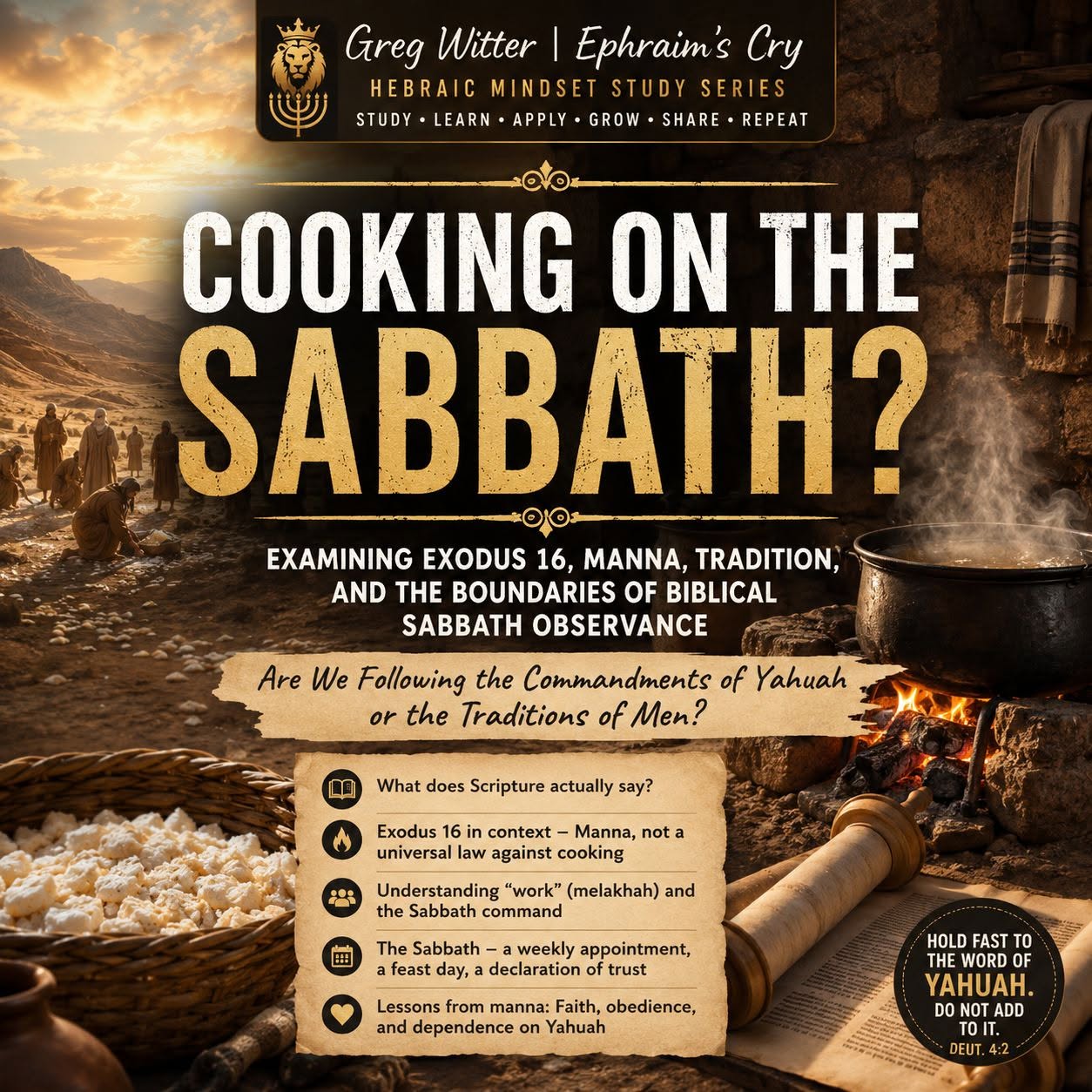
Examining Exodus 16, Manna, Tradition, and the Boundaries of Biblical Sabbath Observance
Are We Following the Commandments of Yahuah or the Traditions of Men?
Greg Witter | Ephraim’s Cry
Hebraic Mindset Study Series
Study Learn Apply Grow Share Repeat
One of the most debated questions among Sabbath keepers is whether cooking food on the Sabbath is prohibited by Scripture. Entire communities have divided over the issue. Some insist that all food preparation must be completed before the Sabbath begins. Others argue that Scripture never actually commands such a restriction.
The problem is not that people desire to honor the Sabbath. That desire should be commended. The problem arises when assumptions become doctrines, traditions become commandments, and interpretations become elevated to the level of Torah itself.
The question before us is not what Judaism teaches.
The question is not what Christianity teaches.
The question is not what our favorite teacher teaches.
The question is simple:
What does Scripture actually say?
If we are going to bind something upon the people of Elohim as a commandment, we must be able to demonstrate it from the written Word. If we cannot demonstrate it from the written Word, then we must be careful not to add to the commandments of Yahuah.
This principle is foundational to covenant faithfulness.
Deuteronomy 4:2 warns:
“You shall not add unto the word which I command you, neither shall ye diminish ought from it.”
Likewise Deuteronomy 12:32 states:
“What thing soever I command you, observe to do it: thou shalt not add thereto, nor diminish from it.”
Adding to Torah is just as dangerous as subtracting from Torah.
Most believers understand the danger of removing commandments. Far fewer understand the danger of creating commandments that Yahuah never gave.
The issue of Sabbath cooking forces us to examine whether we are dealing with a commandment of Elohim or an interpretation that has gradually been elevated into a commandment.
The primary text used to prohibit cooking on the Sabbath is Exodus 16.
Therefore, that is where we must begin.
The context of Exodus 16 is not Sinai.
The context of Exodus 16 is not the Tabernacle.
The context of Exodus 16 is not the complete Torah legislation that would later be given.
The context is manna.
Yahuah had delivered Israel from Egypt and was now teaching them dependence upon Him. Every morning bread appeared upon the ground. Israel was instructed to gather only enough for that day.
The lesson was trust.
Would they trust Yahuah enough to gather only what He provided?
Would they trust Him enough not to hoard?
Would they trust Him enough to believe tomorrow’s provision would arrive tomorrow?
Exodus 16:19-20 records what happened when some refused to trust Him:
“Let no man leave of it till the morning. Notwithstanding they hearkened not unto Moses; but some of them left of it until the morning, and it bred worms, and stank.”
The manna could not normally be preserved.
It spoiled.
It rotted.
It became unusable.
Then comes the Sabbath instruction.
On the sixth day the people were instructed to gather twice as much manna.
Exodus 16:23 states:
“Bake that which ye will bake today, and seethe that ye will seethe; and that which remaineth over lay up for you to be kept until the morning.”
This is the verse frequently cited as proof that cooking on the Sabbath is forbidden.
But does the verse actually say that?
Notice carefully what the text does not say.
It does not say:
“Thou shalt not cook on the Sabbath.”
It does not say:
“All food must be prepared before the Sabbath.”
It does not say:
“Cooking constitutes Sabbath-breaking.”
Instead, the command appears within a very specific discussion regarding manna that normally spoiled overnight.
For six days manna spoiled.
On the sixth day Yahuah performed a miracle.
The Sabbath portion did not spoil.
The immediate context is unmistakably about manna.
This observation does not automatically prove that cooking on the Sabbath is permissible.
However, it does prove something equally important.
Exodus 16 by itself does not contain an explicit universal prohibition against cooking food on the Sabbath.
That is an extremely important distinction.
We must always distinguish between what Scripture explicitly states and what we infer from Scripture.
Confusing those two categories is one of the primary ways traditions develop.
The actual focus of Exodus 16 is not cooking.
The actual focus is obedience.
Yahuah Himself explains the purpose of the manna.
Exodus 16:4:
“Then said Yahuah unto Moses, Behold, I will rain bread from heaven for you; and the people shall go out and gather a certain rate every day, that I may prove them, whether they will walk in my Torah, or no.”
The manna was a test.
The gathering was a test.
The storing was a test.
The preparation was a test.
The Sabbath was a test.
Would Israel trust Yahuah?
That is the central lesson.
Unfortunately, many discussions become consumed with cooking while completely missing the actual purpose of the manna narrative.
The lesson was dependence.
The lesson was faith.
The lesson was obedience.
The lesson was trusting divine provision rather than human effort.
In many ways, this remains one of the primary lessons of the Sabbath itself.
Every Sabbath we cease from ordinary labor.
Every Sabbath we declare that provision comes from Yahuah.
Every Sabbath we confess that our security is not found in endless productivity.
Every Sabbath we testify that Yahuah remains our Provider.
The manna account is therefore much bigger than a discussion about meal preparation.
It is a covenant lesson about trust.
The question that remains is this:
If Exodus 16 does not explicitly prohibit cooking, are there other passages that do?
That brings us to Exodus 35:3, the prohibition against kindling fire on the Sabbath.
This passage must be examined carefully because many assume it settles the debate. However, the context, Hebrew terminology, covenant setting, and relationship to Tabernacle construction require a much deeper investigation than is often given.
That is where the next stage of this study must take us.
#Hashtags
#Sabbath#SeventhDaySabbath#Shabbat#Torah#TorahObservance#HebraicMindset#HebrewRoots#Exodus16
#MannaFromHeaven#TrustYahuah#CovenantFaithfulness#WholeCounselOfElohim#StudyScripture#BiblicalTruth
#TraditionsOfMen#DoNotAddToTorah#SabbathRest#AppointedTimes#Moedim#KingdomLiving#FaithAndObedience
#Exodus35#PreparationDay#CovenantTeaching#EphraimsCry#GregWitter#StudyLearnApplyGrowShareRepeat
#KingdomOfYahuah#WalkInTruth#ReturnToCovenant
