
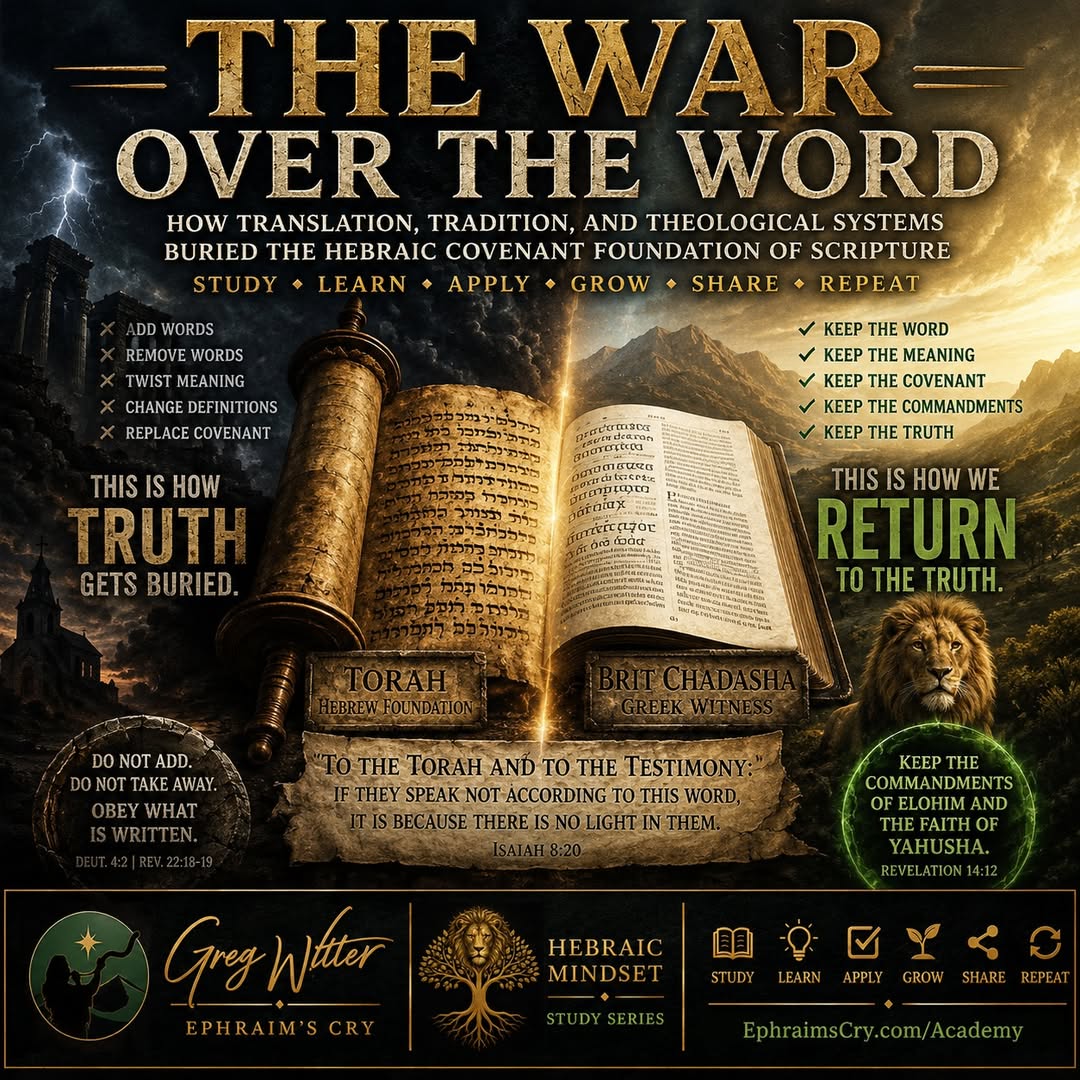
The War Over the Word
How Translation, Tradition, and Theological Systems Buried the Hebraic Covenant Foundation of Scripture
The Bible Was Not Written from a Modern Western Religious Mindset — And That Changes Everything
Greg Witter | Ephraim’s Cry
Hebraic Mindset Study Series
Study • Learn • Apply • Grow • Share • Repeat
There is a war happening over the Word of 𐤉𐤄𐤅𐤄 (Yahuah).
Not a symbolic war.
Not a minor denominational disagreement.
Not merely a debate between scholars and theologians.
A real war.
A war over meaning.
A war over definitions.
A war over covenant.
A war over authority.
A war over obedience.
A war over who has the right to define truth.
And most believers do not even realize they are standing in the middle of it.
Because the greatest deception was never getting people to reject Scripture outright.
The greatest deception was convincing people they already understood it while slowly redefining the words, concepts, frameworks, and covenant meanings inside of it.
That is the real battle.
Most modern believers genuinely think they are reading the Bible plainly.
They are not.
They are reading:
Hebraic covenant writings,
through Greek philosophical categories,
filtered through Romanized church systems,
processed through centuries of theological assumptions,
translated into modern English,
and then taught through denominational traditions that often contradict the very framework the Scriptures were originally written in.
And because this layered system has existed for generations, people mistake inherited interpretation for the actual text itself.
That is one of the greatest dangers in all of modern religion.
Because once tradition becomes more authoritative than Scripture itself, deception becomes institutionalized.
And Scripture warned this would happen repeatedly.
Yeshayahu (Isaiah) declared:
“To the Torah and to the testimony: if they speak not according to this word, it is because there is no light in them.” — Isaiah 8:20
Yirmeyahu (Jeremiah) warned:
“How do ye say, We are wise, and the Torah of 𐤉𐤄𐤅𐤄 is with us? Lo, certainly in vain made he it; the pen of the scribes is in vain.” — Jeremiah 8:8
Mishlĕ (Proverbs) warns:
“Every word of Elohim is pure… Add thou not unto His words, lest He reprove thee, and thou be found a liar.” — Proverbs 30:5–6
Mosheh (Moses) warned:
“Ye shall not add unto the word which I command you, neither shall ye diminish ought from it…” — Deuteronomy 4:2
Again:
“What thing soever I command you, observe to do it: thou shalt not add thereto, nor diminish from it.” — Deuteronomy 12:32
And at the very end of Scripture:
“If any man shall add unto these things… and if any man shall take away from the words…” — Revelation 22:18–19
Notice something terrifying:
The warning against adding to and taking away from the Word appears at the beginning, throughout, and at the end.
Why?
Because altering the Word alters doctrine.
Altering doctrine alters covenant understanding.
Altering covenant understanding alters behavior.
Altering behavior alters worship.
And altered worship eventually produces an altered people.
That is exactly what happened throughout biblical history.
Israel rarely fell all at once.
The corruption usually began subtly.
A blended practice here.
A compromised definition there.
A foreign idea introduced slowly.
A commandment softened.
A tradition elevated.
A prophet ignored.
A warning dismissed.
And eventually an entire generation no longer recognized the covenant they were supposed to be walking in.
Modern Christianity has repeated the exact same pattern.
The issue today is not whether Scripture is true.
The issue is whether people are actually reading Scripture from the covenant framework it was written in.
Because the Bible was not written from a modern Western Christian mindset.
It was written from a Hebraic covenant worldview.
That changes everything.
Hebrew thought is:
covenantal,
functional,
action-oriented,
kingdom-centered,
communal,
identity-driven,
and rooted in relationship expressed through obedience.
Modern Western religious systems are often:
philosophical,
abstract,
individualistic,
emotion-driven,
belief-centered,
and detached from covenant structure.
Hebrew thought asks:
“How do I walk faithfully with 𐤉𐤄𐤅𐤄?”
Modern systems often ask:
“What is the minimum I must believe to avoid judgment?”
Those are not the same religion.
In Hebrew thought:
faithfulness is demonstrated through obedience.
Trust produces action.
Belief transforms life.
Covenant creates responsibility.
Love expresses itself through submission.
That is why 𐤉𐤄𐤅𐤔𐤏 (Yahusha) said:
“If ye love Me, keep My commandments.” — John 14:15
Not:
“If you love Me, redefine obedience.”
Not:
“If you love Me, explain away Torah.”
Not:
“If you love Me, replace covenant with feelings.”
Keep My commandments.
Simple.
Direct.
Clear.
Yet modern religious systems spend enormous amounts of time explaining away the plainest instructions in Scripture while building entire doctrines upon the most difficult and debated passages.
That alone should be a warning sign.
The clearest commandments are constantly minimized.
The clearest definitions are constantly softened.
The clearest covenant structures are constantly reinterpreted.
But isolated English renderings from difficult Pauline passages become elevated above:
Torah,
the Prophets,
the Psalms,
the words of Yahusha,
the covenant promises,
and the direct biblical definition of sin itself.
That is not interpretation.
That is inversion.
And Peter warned it would happen.
“And account that the longsuffering of our Master is salvation; even as our beloved brother Paul also according to the wisdom given unto him hath written unto you… in which are some things hard to be understood, which they that are unlearned and unstable twist, as they do also the other scriptures, unto their own destruction.” — 2 Peter 3:15–16
Peter did not say Paul abolished Torah.
Peter did not say Paul taught against obedience.
Peter did not say Paul overthrew Moses.
Peter warned unstable people would twist Paul.
Now look honestly at modern Christianity.
Entire denominations use isolated English renderings of Paul to overturn:
Torah,
Sabbath,
feast days,
dietary instructions,
covenant identity,
holiness,
obedience,
and even the biblical definition of sin.
That is exactly what Peter warned about.
And the problem becomes even more dangerous when people fail to understand the difference between translation and interpretation.
Most believers assume translation is neutral.
It is not.
Translation always involves interpretation.
Every translator must decide:
Which word to use.
Which nuance to emphasize.
Which theological framework to prioritize.
Which idiom to flatten.
Which Hebrew concept to simplify.
Which implied meaning to make explicit.
Which doctrinal conflict to smooth out.
That means translation committees do not merely transfer words from one language into another.
They often transfer theological assumptions from one worldview into another.
And if the translators themselves already operate from anti-Torah theology, replacement theology, institutional church assumptions, or Greek philosophical frameworks, those biases inevitably shape the translation itself.
Sometimes subtly.
Sometimes aggressively.
This is why modern English translations often drift away from the Hebraic covenant framework of the text.
Words are inserted.
Words are softened.
Words are removed.
Tenses are adjusted.
Concepts are reframed.
Doctrinal assumptions are embedded directly into the wording.
Sometimes entire doctrines are built upon italicized words the translators themselves admitted were added.
Think about how dangerous that is.
Men insert explanatory wording.
The inserted wording shapes theology.
The theology shapes denominations.
The denominations shape generations.
And eventually questioning the inserted wording itself becomes treated as heresy.
That is how institutional systems protect themselves.
Now add another layer:
most modern believers cannot read Hebrew.
Most cannot read Greek.
Most do not understand covenant structure.
Most do not understand Hebraic idioms.
Most do not understand first-century context.
So they trust the English rendering blindly.
But what happens if the rendering itself already contains theological bias?
Then the reader unknowingly inherits the bias as though it were Scripture itself.
That is exactly what happened in many modern systems.
Take the word תורה (Torah).
Most modern believers hear:
law,
legalism,
bondage,
control,
oppression,
religious burden.
But Torah does not fundamentally mean oppressive legal code.
Torah comes from the Hebrew root ירה (yarah):
to instruct,
to direct,
to point toward the mark,
to guide.
Torah is covenant instruction.
Divine teaching.
The revealed path of covenant life.
But once translators filtered Hebrew covenant language through Greco-Roman legal categories, generations began emotionally reacting to the commandments themselves before even studying what the word actually meant.
That is conditioning.
Now entire systems teach believers to fear the very thing David delighted in.
“O how love I thy law! it is my meditation all the day.” — Psalm 119:97
Sha’ul himself said:
“Wherefore the law is holy, and the commandment holy, and just, and good.” — Romans 7:12
Yet modern churches often treat Torah as the enemy.
That contradiction alone should force people to stop and rethink everything.
And then there is the phrase:
“under the law.”
Most modern believers automatically interpret that phrase to mean:
“obeying God.”
But in Paul’s context, the issue is often condemnation under the penalty structure of the law, or seeking justification through legal standing apart from covenant faith and transformation — not covenant obedience itself.
Yet entire systems now teach that obedience itself is the problem.
Paul never taught that.
Paul said:
“Do we then make void the law through faith? Elohim forbid: yea, we establish the law.” — Romans 3:31
Paul said:
“For I delight in the law of Elohim after the inward man.” — Romans 7:22
Paul said:
“Circumcision is nothing, and uncircumcision is nothing, but the keeping of the commandments of Elohim.” — 1 Corinthians 7:19
Paul repeatedly kept Sabbaths.
Observed feasts.
Entered synagogues.
Quoted Torah.
Appealed to Torah.
And when accused of teaching against Moses in Acts 21, what happened?
Did Paul celebrate abolishing Torah?
No.
He publicly demonstrated obedience to prove the accusation false.
“That all may know that those things, whereof they were informed concerning thee, are nothing; but that thou thyself also walkest orderly, and keepest the law.” — Acts 21:24
Modern theology almost never teaches that passage honestly.
Why?
Because it destroys the narrative.
If Paul truly taught against Torah itself, Acts 21 makes absolutely no sense.
And yet countless teachers continue building entire doctrines around selective readings while ignoring the broader covenant context.
That is not honest exegesis.
That is theological engineering.
And the deeper problem is this:
most believers have never been taught how much modern translations themselves drift toward interpretive readability rather than covenant precision.
Older translations often attempted more literal structure.
Modern translations increasingly prioritize:
dynamic equivalence,
reader comfort,
thought-for-thought rendering,
and theological smoothing.
But the more interpretive freedom translators take, the more translators become commentators instead of translators.
Eventually the reader is no longer reading what the text says.
They are reading what the translation committee believes the text means.
Those are not the same thing.
Now entire passages become softened:
judgment language reduced,
obedience language reframed,
repentance weakened,
fear of 𐤉𐤄𐤅𐤄 diluted,
kingdom language minimized,
covenant identity blurred,
and holiness transformed into vague spirituality.
Even chapter headings and footnotes often precondition interpretation before the reader even begins reading the passage itself.
Most people never notice.
But the cumulative effect over centuries becomes enormous.
Thousands of small interpretive shifts eventually produce entirely different theological systems.
Not through blatant rejection of Scripture.
Through gradual definitional drift.
Redefine grace.
Redefine faith.
Redefine law.
Redefine sin.
Redefine obedience.
Redefine covenant.
Redefine Gospel.
And eventually you can make the Bible appear to teach almost anything.
That is exactly where much of modern Christianity now stands.
The Gospel of the Kingdom became the gospel of personal comfort.
Grace became permission.
Faith became intellectual agreement.
Repentance became emotional sorrow.
Salvation became a transaction instead of transformation.
And obedience became suspicious.
Yet Scripture itself never presents those categories that way.
Sin is defined plainly:
“Sin is transgression of the law.” — 1 John 3:4
The remnant is defined plainly:
“Here is the patience of the set-apart ones: here are they that keep the commandments of Elohim, and the faith of Yahusha.” — Revelation 14:12
Both.
Faith and obedience.
Grace and covenant faithfulness.
Redemption and transformation.
Not the counterfeit gospel of lawlessness being preached across much of the modern world.
And this is why returning to the Hebrew covenant framework matters so deeply.
Because once believers begin studying:
Hebrew concepts,
Greek context,
covenant structure,
Torah foundations,
Prophetic continuity,
and the full witness of Scripture together—
the contradictions begin collapsing.
Suddenly:
Moses and Messiah agree.
The Prophets align with the Apostles.
Grace empowers obedience.
Faith produces covenant loyalty.
The Torah becomes instruction instead of bondage.
The Gospel reconnects to the Kingdom.
And Scripture becomes one continuous covenant story instead of two competing religions.
That is why the enemy attacks the foundation so aggressively.
Because if believers ever truly reconnect to the Hebraic covenant framework of Scripture, entire institutional systems begin collapsing under the weight of their own contradictions.
And that is precisely why this battle matters.
This is not academic trivia.
This is a war over truth itself.
Because whoever controls the definitions eventually controls the doctrine.
And whoever controls the doctrine eventually controls the people.
That is why believers must stop blindly trusting inherited systems and begin testing everything:
through Torah,
through the Prophets,
through the Writings,
through the Apostolic witness,
through language,
through covenant consistency,
through context,
and through the actual words of 𐤉𐤄𐤅𐤄 instead of institutional tradition.
Not arrogantly.
Not pridefully.
Not rebelliously.
But faithfully.
Because the warnings about deception were not written to pagans.
They were written to people who believed they already knew the truth.
#HebraicMindset #EphraimsCry #GregWitter #TruthMatters #Covenant #Torah #Yahuah #Yahusha #WholeCounselOfElohim #TranslationBias #ScriptureContext #BiblicalTruth #FaithAndObedience #GraceAndTruth #KingdomGospel #ReturnToCovenant #HebrewRoots #EndTimeDeception #ToTheLawAndTheTestimony #WatchmanWarning
