
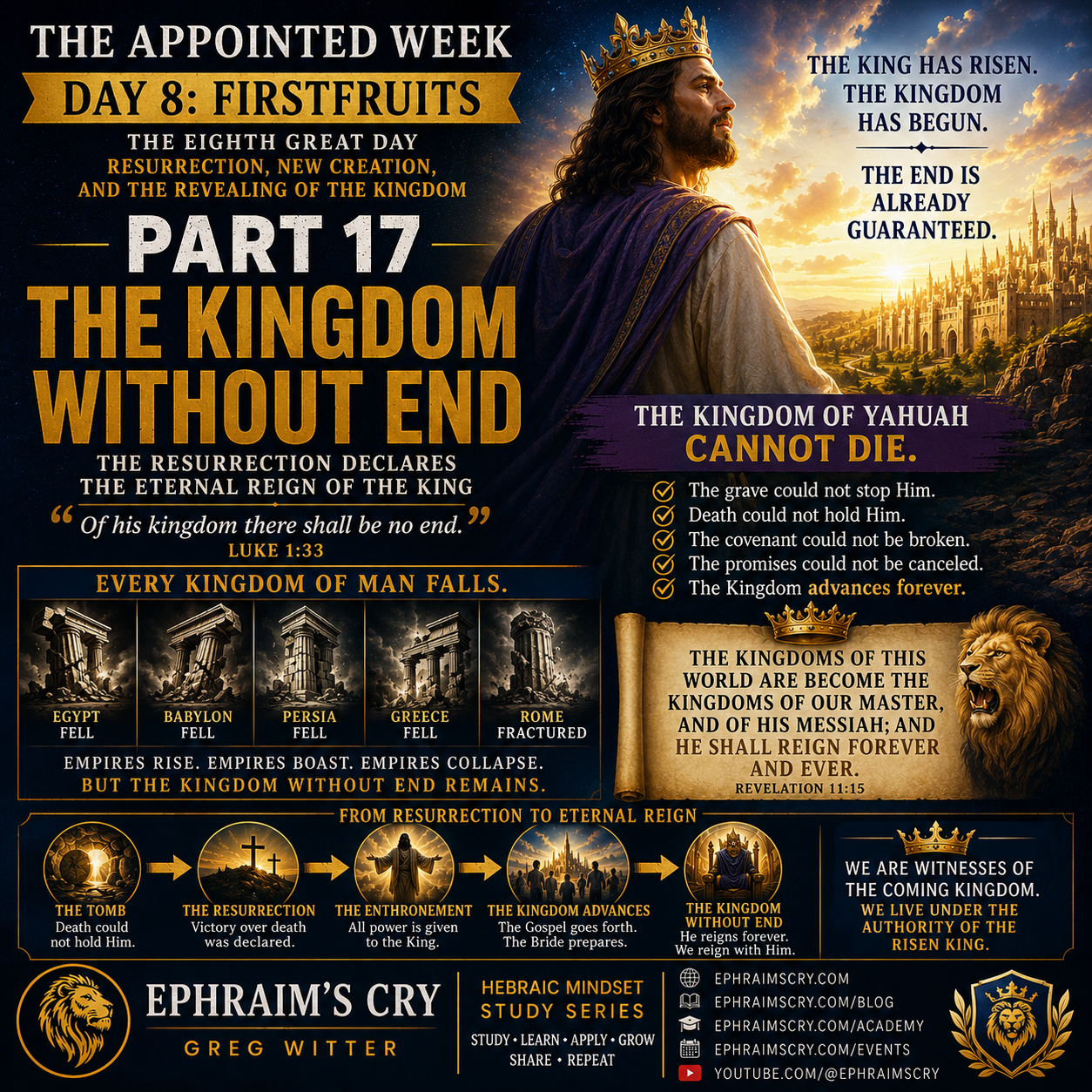
The Appointed Week — Day 8: Firstfruits
The Eighth Great Day — Resurrection, New Creation, and the Revealing of the Kingdom
“Day 7 ended in silence. Day 8 begins in revelation.”
Part 17 — The Kingdom Without End
The Resurrection Declares the Eternal Reign of the King
“Of his kingdom there shall be no end.” (Luke 1:33)
Greg Witter | Ephraim’s Cry
Hebraic Mindset Study Series
Study Learn Apply Grow Share Repeat
Every kingdom of man eventually falls.
Egypt fell.
Babylon fell.
Persia fell.
Greece fell.
Rome fractured.
Empires rise, expand, dominate, boast, devour, and eventually collapse beneath the weight of their own corruption. The kingdoms of men always appear powerful for a season, but none of them possess permanence. Their monuments crumble. Their rulers die. Their decrees fade. Their armies weaken. Their economies fracture. Their gods are exposed as powerless. Their thrones pass to others. Their glory becomes dust.
This becomes one of the deepest realities Scripture repeatedly forces mankind to confront:
The kingdoms of men are temporary.
No matter how powerful they appear outwardly, every earthly kingdom remains subject to judgment, decay, succession, corruption, and death.
But the resurrection declared something the nations were never prepared to hear:
The Kingdom of Yahuah cannot die.
The grave could not stop the King.
Death could not hold the King.
Corruption could not overturn the covenant.
Rome could execute Him, but Rome could not retain authority over Him.
The religious authorities could condemn Him, but they could not cancel the decree of Yahuah.
The tomb could receive Him, but the tomb could not keep Him.
And because the King lives, the Kingdom continues advancing.
This becomes one of the deepest revelations hidden within Day 8:
The resurrection was not merely victory over death.
The resurrection was the public declaration that the eternal Kingdom had entered history.
That distinction matters profoundly because many people reduce the resurrection to personal salvation alone. Personal redemption is real, necessary, and glorious. But the resurrection is larger than personal rescue. The resurrection confirms the Kingdom. It vindicates the King. It declares that the throne promised through the covenant line still stands. It announces that the reign of Yahuah cannot be overthrown by death, Rome, Babylon, religious corruption, or the grave itself.
This is why Gabriel’s words concerning Yahusha carry such enormous covenant weight:
“He shall reign over the house of Jacob for ever; and of his kingdom there shall be no end” (Luke 1:33).
That statement did not begin as a vague spiritual slogan. It stands rooted in the covenant promises given throughout Scripture.
Yahuah promised David:
“Thine house and thy kingdom shall be established for ever before thee: thy throne shall be established for ever” (2 Samuel 7:16).
Daniel saw a Kingdom that would not pass away:
“His dominion is an everlasting dominion, which shall not pass away, and his kingdom that which shall not be destroyed” (Daniel 7:14).
Daniel also saw the stone cut without hands striking the image of human empires and becoming a great mountain filling the whole earth (Daniel 2:34–35, 44–45).
The prophets were not describing a temporary movement.
They were pointing toward an eternal Kingdom.
This becomes one of the greatest revelations hidden within resurrection morning:
The risen King confirms the everlasting Kingdom.
Without resurrection, the Kingdom promises appear buried beneath the grave.
Without resurrection, David’s throne appears broken.
Without resurrection, the prophets appear unfulfilled.
Without resurrection, the nations appear victorious.
Without resurrection, death appears stronger than the promise.
But the empty tomb destroys every one of those conclusions.
The King has risen.
The throne stands.
The covenant continues.
The Kingdom advances.
And the final outcome is already guaranteed.
This is why Day 8 must be understood as Kingdom revelation, not merely resurrection celebration. The Eighth Day reveals that the King who passed through death has emerged beyond its reach. Death could not dethrone Him. The grave could not annul His authority. The systems of men could not permanently silence His witness. Therefore the Kingdom He representscannot be destroyed by the powers of this age.
This directly confronts Babylon.
Babylon always believes its systems are permanent.
Babylon builds towers.
Babylon builds empires.
Babylon builds economic structures.
Babylon builds religious systems.
Babylon builds political thrones.
Babylon builds cultural narratives.
Babylon builds false peace.
Babylon builds identity apart from covenant.
And Babylon always says, “This will stand.”
But Scripture says otherwise.
The tower of Babel did not stand.
Egypt did not stand.
Nebuchadnezzar’s Babylon did not stand.
Belshazzar’s feast ended in judgment.
Rome did not remain whole.
And every future beast system will likewise fall beneath the authority of Yahuah.
This is why Revelation declares:
“The kingdoms of this world are become the kingdoms of our Master, and of his Messiah; and he shall reign for ever and ever” (Revelation 11:15).
The resurrection is the first open declaration that this outcome is certain.
Babylon still rages.
The nations still rebel.
The systems of men still boast.
Darkness still operates temporarily.
But the empty tomb has already declared the deeper truth:
The Kingdom without end is coming.
This is why the resurrection also becomes one of the greatest revelations concerning authority itself.
The question of Scripture has never merely been:
“Does Yahuah exist?”
The deeper question has always been:
“Who truly rules?”
Babylon continually claims authority.
Empires claim authority.
Religious systems claim authority.
Political systems claim authority.
Economic systems claim authority.
Humanity itself seeks autonomous authority apart from covenant submission to Yahuah.
But resurrection morning confronts every competing throne openly.
The grave represented the ultimate boundary of human power.
Kings could conquer nations.
Empires could dominate lands.
Armies could expand territories.
Religious leaders could manipulate populations.
But none of them possessed authority over death itself.
Death remained the final enemy standing over all human kingdoms.
And yet resurrection morning revealed that Yahusha possessed authority beyond the grave.
This changes everything.
Because if the King possesses authority over death itself, then every earthly authority becomes temporary and subordinate beneath Him.
This becomes one of the deepest revelations hidden within the statement:
“All power is given unto me in heaven and in earth” (Matthew 28:18).
That statement is staggering.
The risen King declares universal authority.
Not partial authority.
Not tribal authority.
Not regional authority.
Universal authority.
This becomes one of the deepest revelations hidden within Day 8:
The resurrection openly reveals the enthronement authority of the King.
This is why Psalm 2 becomes so important prophetically.
The nations rage.
The peoples imagine vain things.
The kings of the earth set themselves against Yahuah and His Anointed.
That pattern continues throughout history repeatedly.
Human systems continually resist covenant rule.
But Psalm 2 ultimately reveals the final outcome:
“Yet have I set my king upon my holy hill of Zion” (Psalm 2:6).
The resurrection confirms that decree openly.
The King rejected by men becomes the enthroned King established by Yahuah.
This is why Peter later proclaims in Acts:
“Yahuah hath made that same Yahusha… both Master and Messiah” (Acts 2:36).
The resurrection vindicates the King publicly.
This becomes profoundly important because modern culture often attempts to reduce Yahusha into:
- moral teacher,
- inspirational figure,
- spiritual guide,
- religious founder,
- or symbolic example.
But resurrection destroys those reductions completely.
The risen Messiah is not merely teacher.
He is reigning King.
This is why the Apostolic writings repeatedly use enthronement language:
- seated at the right hand,
- exalted,
- given dominion,
- reigning,
- ruling,
- and awaiting the final subjection of all enemies beneath His feet.
This becomes one of the deepest revelations hidden within the Kingdom without end itself.
The Kingdom does not merely survive history.
The Kingdom governs history toward appointed fulfillment.
That distinction matters profoundly.
The nations often appear dominant temporarily.
Babylon often appears victorious outwardly.
Corruption often appears widespread.
The faithful often appear marginalized.
And yet the resurrection already revealed the deeper reality beneath visible appearances:
The King already reigns.
This changes how the remnant interprets present events.
The remnant does not panic ultimately because earthly systems appear unstable.
The remnant understands:
- earthly kingdoms rise temporarily,
- earthly kingdoms fall temporarily,
- but the Kingdom of Yahuah remains permanent.
This becomes one of the deepest revelations hidden within Daniel’s visions.
The beasts rise from the sea one after another.
Empires emerge.
Empires devour.
Empires persecute.
Empires boast arrogantly.
And yet each beast ultimately falls beneath the judgment of Yahuah.
Then Daniel sees:
“One like the Son of man…” receiving everlasting dominion (Daniel 7:13–14).
The resurrection openly confirms that vision.
The Son of Man has risen.
The Kingdom has begun openly entering history.
And the final dominion already belongs to the King.
This becomes deeply important for the remnant in every generation.
The faithful must not interpret reality merely through visible political structures, economic systems, cultural narratives, or Babylonian appearances.
The faithful must interpret history through resurrection truth.
The empty tomb already revealed the final direction history is moving.
This becomes one of the deepest revelations hidden within hope itself.
Hope is not rooted in earthly stability.
Hope is rooted in the reign of the risen King.
Empires collapse.
Nations shift.
Systems change.
Babylon mutates repeatedly across history.
But the Kingdom without end remains anchored beneath the authority of the resurrected King.
This is why the remnant continues proclaiming resurrection truth even while darkness still operates temporarily.
Because the resurrection already declared:
- the King reigns,
- the covenant stands,
- the Kingdom advances,
- and the final outcome is already secured beneath the authority of Yahuah.
This is why the Kingdom without end also becomes one of the greatest revelations concerning inheritance and dominion restored.
From the very beginning, humanity was created to operate beneath the authority of Yahuah within covenant order.
Adam was given stewardship.
Humanity was commissioned to:
- rule rightly,
- cultivate faithfully,
- guard covenant order,
- and reflect the authority of Yahuah within creation.
But rebellion corrupted dominion.
Instead of righteous stewardship, humanity began building kingdoms apart from Yahuah.
Violence multiplied.
Pride multiplied.
Empire-building replaced covenant stewardship.
This becomes one of the deepest revelations hidden within Babylon itself.
Babylon represents humanity attempting to establish dominion independently from Yahuah.
This pattern appears repeatedly:
- Nimrod,
- Pharaoh,
- Nebuchadnezzar,
- Caesar,
- and every beast system afterward.
The kingdoms of men continually seek glory without covenant submission.
But resurrection morning openly declares that true dominion belongs to the risen King.
This becomes one of the deepest revelations hidden within Psalm 8 itself.
Humanity was originally crowned with delegated authority beneath Yahuah.
That authority became corrupted through sin.
Now the risen Messiah appears as the faithful King restoring righteous dominion and covenant order.
Paul later writes:
“For he must reign, till he hath put all enemies under his feet” (1 Corinthians 15:25).
That verse matters profoundly.
The resurrection is not passive survival after death.
The resurrection initiates Kingdom conquest over every enemy opposing the reign of Yahuah.
This includes:
- death,
- corruption,
- rebellion,
- injustice,
- false worship,
- beast systems,
- and the kingdoms of darkness themselves.
This becomes one of the deepest revelations hidden within the phrase:
“Kingdom without end.”
The Kingdom does not merely continue forever chronologically.
The Kingdom ultimately restores righteous order throughout creation.
This is why Isaiah repeatedly describes:
- justice,
- peace,
- righteousness,
- restoration,
- and covenant harmony beneath the reign of the King.
The resurrection guarantees those promises because the King Himself has already conquered death openly.
This becomes deeply important because modern culture often assumes corruption is simply permanent human nature.
The world teaches:
- greed is inevitable,
- violence is inevitable,
- injustice is inevitable,
- corruption is inevitable,
- and domination by power structures is inevitable.
But resurrection morning openly contradicts that worldview.
The Kingdom of Yahuah is moving creation toward restored covenant order.
This is why Revelation ultimately describes:
- no more curse,
- no more death,
- no more sorrow,
- no more corruption,
- and the throne established openly among His people (Revelation 21–22).
Those promises are not disconnected from Day 8.
The resurrection is the first public announcement that restoration has already begun.
This becomes one of the deepest revelations hidden within the remnant itself.
The faithful are not merely waiting to escape the world.
The faithful are preparing to inherit the Kingdom.
This is why Yahusha repeatedly speaks about inheritance:
- inheriting the earth,
- inheriting the Kingdom,
- ruling faithfully,
- and reigning with Him.
This language matters profoundly because inheritance belongs within household structure.
The Kingdom restores the covenant household beneath the authority of the King.
This becomes one of the deepest revelations hidden within the resurrection body itself.
The resurrection body demonstrates:
- continuity,
- transformation,
- incorruption,
- and restored dominion beyond death.
The risen Messiah eats with the disciples.
He speaks with them.
He walks among them.
And yet He also stands beyond corruption, decay, and mortality.
This becomes one of the deepest revelations hidden within the future resurrection of the remnant.
The future Kingdom is not disembodied abstraction detached from creation.
The future Kingdom involves restored creation beneath resurrection life and righteous rule.
This is why the prophets repeatedly describe:
- restored land,
- restored peace,
- restored worship,
- restored justice,
- and restored Kingdom order upon the earth.
The resurrection confirms those promises openly.
This changes how the remnant understands present suffering.
The faithful may presently appear weak outwardly.
Babylon may presently appear dominant outwardly.
The nations may presently rage outwardly.
And yet the resurrection already revealed the deeper reality:
The Kingdom without end has already entered history through the risen King.
This becomes one of the deepest revelations hidden within endurance itself.
The remnant endures not because Babylon appears weak.
The remnant endures because Babylon has already been judged ultimately through resurrection reality.
The final outcome has already been revealed.
The King reigns.
The Kingdom advances.
The inheritance remains secure.
And the world itself is moving toward restored covenant dominion beneath the authority of Yahuah.
Website:
https://ephraimscry.com
Blog:
https://ephraimscry.com/blog
Academy:
https://ephraimscry.com/academy
Events & Live Teachings:
https://ephraimscry.com/events
YouTube:
https://www.youtube.com/@EphraimsCry
#TheAppointedWeek #Day8 #Firstfruits #TheEighthGreatDay #KingdomWithoutEnd #ResurrectionMorning #KingdomOfYahuah #HebraicMindset #EphraimsCry #GregWitter #Torah #WholeCounselOfElohim #Resurrection #Covenant #Truth #Scripture #Kingdom #Restoration #StudyLearnApplyGrowShareRepeat
