
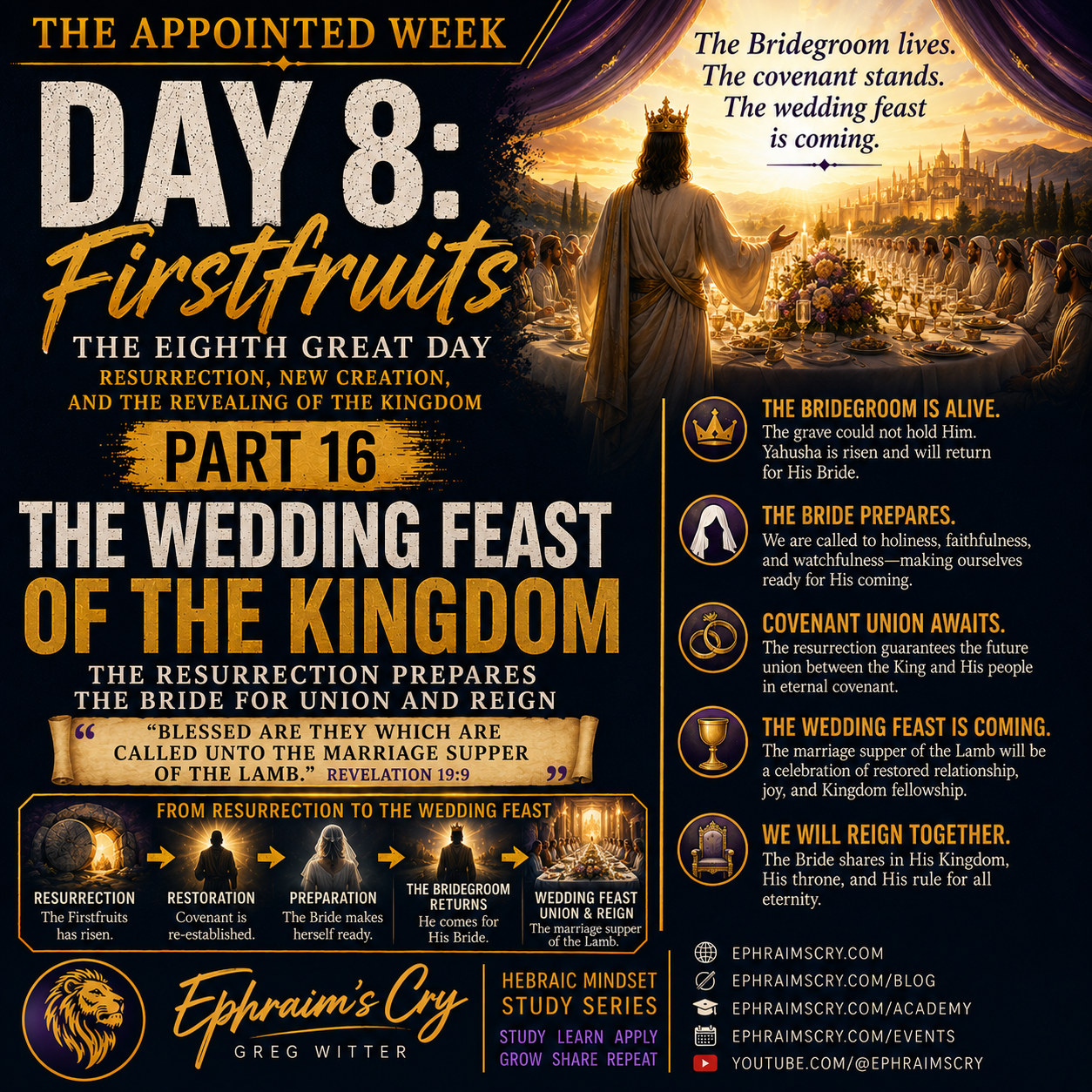
The Appointed Week — Day 8: Firstfruits
The Eighth Great Day — Resurrection, New Creation, and the Revealing of the Kingdom
“Day 7 ended in silence. Day 8 begins in revelation.”
Part 16 — The Wedding Feast of the Kingdom
The Resurrection Prepares the Bride for Union and Reign
“Blessed are they which are called unto the marriage supper of the Lamb.” (Revelation 19:9)
Greg Witter | Ephraim’s Cry
Hebraic Mindset Study Series
Study Learn Apply Grow Share Repeat
The resurrection was not only about victory over death.
The resurrection was preparation for covenant union.
That distinction matters profoundly because the covenant story of Scripture has always moved toward relationship, union, inheritance, household restoration, and Kingdom fellowship beneath the reign of Yahuah.
From the very beginning, Scripture unfolds through covenant marriage imagery.
Eden itself begins with covenant union.
Adam and Chavah become one flesh within covenant relationship.
The prophets later describe Israel repeatedly as:
- bride,
- wife,
- covenant partner,
- and household joined to Yahuah.
The entire biblical narrative moves toward:
- covenant relationship,
- restoration of fellowship,
- reconciliation,
- and final union beneath the Kingdom.
This becomes one of the deepest revelations hidden within Day 8 itself:
The resurrection does not merely restore life.
The resurrection restores the pathway toward covenant union.
This is why the resurrection cannot be separated from wedding imagery throughout Scripture.
The Bridegroom lives.
The covenant stands.
The union remains future.
And the Kingdom wedding is still approaching.
This becomes profoundly important because many people reduce salvation into individual escape disconnected from covenant household structure. But Scripture repeatedly presents redemption through:
- family imagery,
- inheritance imagery,
- household imagery,
- covenant imagery,
- and wedding imagery.
Again and again the same pattern appears.
Yahuah calls Israel His bride (Isaiah 54:5; Hosea 2:19–20).
The prophets describe covenant unfaithfulness as spiritual adultery.
The restoration promises repeatedly speak of reunion, cleansing, faithfulness, and renewed covenant relationship.
Now resurrection morning openly guarantees that the Bridegroom still lives and that the covenant promises remain secure.
This becomes one of the deepest revelations hidden within the empty tomb itself:
The resurrection guarantees the future wedding.
Why?
Because the Bridegroom cannot return for His bride if the grave still holds Him.
The empty tomb therefore becomes more than victory over death.
The empty tomb becomes the public declaration that the covenant relationship still stands and the final union is still coming.
This is why Yahusha repeatedly uses wedding imagery throughout His earthly ministry.
He speaks of:
- the bridegroom,
- the wedding feast,
- the wise virgins,
- the prepared household,
- and the invitation to the banquet.
These were not isolated illustrations.
These parables revealed the structure of the Kingdom itself.
This becomes one of the deepest revelations hidden within the Appointed Week.
Passover reveals redemption.
Unleavened Bread reveals separation and burial.
Firstfruits reveals resurrection.
And now Day 8 begins pointing openly toward:
- union,
- inheritance,
- Kingdom fellowship,
- and the wedding feast still ahead.
This becomes profoundly important because resurrection creates expectation.
The remnant is not merely waiting for abstract spiritual existence.
The remnant is preparing for covenant union beneath the reign of the King.
This is why Revelation declares:
“Let us be glad and rejoice… for the marriage of the Lamb is come, and his wife hath made herself ready” (Revelation 19:7).
Notice carefully:
preparation matters.
The bride makes herself ready.
This becomes one of the deepest revelations hidden within covenant faithfulness itself.
The resurrection does not abolish responsibility.
The resurrection intensifies preparation.
Because the Bridegroom lives, the bride must prepare.
This is why Scripture repeatedly calls the remnant toward:
- holiness,
- faithfulness,
- endurance,
- covenant obedience,
- watchfulness,
- and readiness.
The wise virgins prepare oil.
The faithful servants remain alert.
The household waits expectantly.
Again and again the same covenant pattern appears:
prepare for the coming King.
This becomes one of the deepest revelations hidden within Day 8 itself:
The Eighth Day does not merely announce resurrection life.
The Eighth Day begins preparing creation for final covenant union beneath the Kingdom of Yahuah.
This is why the resurrection changes the emotional structure of the remnant entirely.
Without resurrection:
- hope collapses,
- expectation collapses,
- covenant promises collapse,
- and the wedding imagery becomes empty symbolism.
But resurrection changes everything.
The Bridegroom lives.
The covenant stands.
The invitation remains open.
And the Kingdom wedding is guaranteed.
This is why Revelation ultimately ends not merely with judgment, but with union.
“The tabernacle of Elohim is with men…” (Revelation 21:3).
That statement matters profoundly.
The story of Scripture begins with fellowship broken in Eden.
The story ends with fellowship restored beneath the Kingdom.
This becomes one of the deepest revelations hidden within the wedding feast itself.
The wedding feast represents:
- restored fellowship,
- restored inheritance,
- restored covenant order,
- restored household life,
- restored Kingdom joy,
- and restored communion beneath the reign of Yahuah.
The feast therefore points beyond symbolic celebration.
The feast points toward the restoration of covenant life itself.
This is why the prophets repeatedly describe the coming Kingdom through banquet imagery, abundance imagery, peace imagery, and restored household imagery.
The resurrection guarantees that future because the Bridegroom has already conquered death openly.
This becomes one of the deepest revelations hidden within Firstfruits itself.
The Firstfruits has risen.
Therefore the wedding feast is certain.
The Bridegroom already lives.
Therefore the union is still ahead.
The Kingdom already entered history.
Therefore the restoration of all things is guaranteed.
This is why the wedding imagery also becomes one of the greatest revelations concerning covenant loyalty itself.
Marriage throughout Scripture is never presented merely as emotional attachment.
Marriage represents covenant commitment.
This becomes profoundly important because modern Babylon continually reduces relationships into:
- temporary convenience,
- emotional instability,
- self-centered desire,
- and disposable commitment.
But covenant marriage operates differently.
Covenant marriage involves:
- faithfulness,
- endurance,
- loyalty,
- preparation,
- exclusivity,
- and shared inheritance beneath covenant authority.
This is exactly why Scripture repeatedly uses marriage imagery to describe the relationship between Yahuah and His people.
The issue has always been covenant faithfulness.
This is why idolatry is repeatedly described through adultery language in the prophets.
Israel continually pursued:
- false gods,
- foreign systems,
- compromise,
- mixture,
- and covenant unfaithfulness.
And yet the prophets also repeatedly speak of restoration.
Hosea becomes one of the clearest prophetic pictures of this reality.
Even after unfaithfulness, Yahuah speaks of restoring covenant relationship:
“And I will betroth thee unto me for ever…” (Hosea 2:19).
That verse becomes deeply connected to resurrection itself.
The resurrection openly declares that covenant restoration remains possible because the Bridegroom lives.
This becomes one of the deepest revelations hidden within Day 8:
The resurrection restores hope for covenant reconciliation.
Without resurrection:
- the covenant appears broken permanently,
- exile appears final,
- separation appears irreversible,
- and the story ends in loss.
But resurrection changes everything.
The Bridegroom rises.
The covenant stands.
The invitation remains open.
And restoration becomes possible.
This is why the remnant is repeatedly called to remain faithful.
Faithfulness matters because covenant union matters.
This becomes one of the deepest revelations hidden within the wise virgins parable (Matthew 25:1–13).
The issue was not merely waiting.
All ten virgins waited.
The issue was preparation.
Some prepared properly.
Some did not.
This becomes profoundly important because many people assume resurrection truth automatically removes the necessity of covenant readiness.
But the opposite is true.
Because the Bridegroom lives, preparation becomes even more urgent.
This is why Scripture repeatedly emphasizes:
- watchfulness,
- endurance,
- holiness,
- covenant obedience,
- and spiritual readiness.
The remnant is not called to passive belief alone.
The remnant is called to active preparation for the coming King.
This becomes one of the deepest revelations hidden within the marriage supper itself.
The wedding feast is not merely celebration after suffering.
The wedding feast represents the public unveiling of covenant union fully restored.
Everything broken through rebellion begins reaching restoration:
- fellowship restored,
- inheritance restored,
- household restored,
- covenant restored,
- creation restored,
- and Kingdom order restored beneath the reign of Yahuah.
This is why Revelation places the marriage supper before the final restoration imagery of Revelation 21–22.
Union precedes the fully restored Kingdom order openly revealed across creation.
Again the covenant pattern appears:
- redemption,
- cleansing,
- preparation,
- union,
- inheritance,
- and Kingdom reign.
This becomes one of the deepest revelations hidden within resurrection hope itself.
The resurrection does not merely promise survival after death.
The resurrection promises restored covenant fellowship with the living King.
That changes everything.
This is why the apostles repeatedly describe the future Kingdom using inheritance language.
The remnant is not merely escaping destruction.
The remnant is entering inheritance.
This connects directly back to Eden itself.
Humanity lost inheritance through rebellion.
The Kingdom restores inheritance through covenant redemption and resurrection life.
This is why Paul later declares believers are:
“heirs of Elohim, and joint-heirs with Messiah” (Romans 8:17).
Inheritance language matters profoundly because inheritance belongs within household structure.
The Kingdom restores household order beneath the authority of the King.
This becomes one of the deepest revelations hidden within the title “Bride.”
The bride is not random individuals disconnected from one another.
The bride represents covenant people joined together beneath shared covenant identity and Kingdom allegiance.
This is why the remnant must resist Babylonian fragmentation.
Babylon isolates.
Babylon divides.
Babylon produces mixture and compromise.
But the Kingdom gathers, restores, prepares, and unites covenant people beneath the reign of Yahuah.
This becomes one of the deepest revelations hidden within Day 8 itself:
The Eighth Day is not merely the announcement of resurrection life.
The Eighth Day begins preparing the covenant household for final union, restored inheritance, and Kingdom reign beneath the living Bridegroom.
This is why the resurrection still matters so profoundly now.
The Bridegroom lives.
The covenant stands.
The invitation remains open.
The remnant is still preparing.
And the wedding feast of the Kingdom is still approaching.
This is why the wedding feast also becomes one of the greatest revelations concerning Kingdom joy itself.
The Kingdom is not moving merely toward survival.
The Kingdom is moving toward celebration.
That distinction matters profoundly because many people only understand covenant through:
- judgment,
- correction,
- warfare,
- endurance,
- suffering,
- and resistance against Babylon.
Those realities are true and necessary within the present age.
But the story does not end there.
The covenant story ultimately moves toward:
- restoration,
- union,
- fellowship,
- inheritance,
- abundance,
- peace,
- and Kingdom joy beneath the reign of Yahuah.
This is why wedding feast imagery matters so deeply.
A feast represents:
- abundance,
- fellowship,
- household unity,
- celebration,
- covenant confirmation,
- and shared joy beneath restored order.
This becomes one of the deepest revelations hidden within the Kingdom itself:
The resurrection guarantees not merely victory over death, but the restoration of covenant joy itself.
This is profoundly important because sin fractured joy in Eden.
Fear entered.
Shame entered.
Separation entered.
Humanity hid from the presence of Yahuah.
But the resurrection begins reversing that separation openly.
The Bridegroom lives.
The pathway toward restored fellowship is reopened.
This becomes one of the deepest revelations hidden within the phrase:
“Blessed are they which are called unto the marriage supper…”
Blessed.
Favored.
Invited into covenant fellowship.
Restored into the household.
Welcomed into the Kingdom celebration.
This becomes one of the deepest covenant themes in all of Scripture:
Yahuah desires to dwell among His people.
From Eden…
to the Tabernacle…
to the Temple…
to Messiah dwelling among men…
to the indwelling of the Ruach…
to the New Jerusalem…
The movement of Scripture continually points toward restored dwelling and restored fellowship.
The wedding feast therefore becomes the public celebration of covenant restoration completed openly.
This is why Revelation 21 declares:
“Behold, the tabernacle of Elohim is with men…”
The story ends where it was always moving:
restored fellowship beneath the Kingdom.
This becomes one of the deepest revelations hidden within resurrection itself.
The resurrection is not merely escape from wrath.
The resurrection restores access to covenant life with the King.
This is why the feast imagery also carries strong inheritance themes.
In Scripture, feasts were often connected to:
- appointed times,
- covenant remembrance,
- household participation,
- harvest,
- and shared inheritance within the land.
Now the marriage supper becomes the final covenant feast anticipating the fully restored Kingdom.
This becomes one of the deepest revelations hidden within Firstfruits itself.
Firstfruits points toward harvest.
Harvest points toward gathering.
Gathering points toward the Kingdom household assembled fully beneath the reign of the King.
The resurrection therefore guarantees the future gathering of the covenant people.
This is why the remnant continues enduring even during difficult seasons.
The present age still contains:
- suffering,
- warfare,
- persecution,
- deception,
- Babylonian pressure,
- and refining.
But the resurrection already revealed the final outcome beforehand.
The wedding feast is coming.
This changes how the remnant interprets present suffering.
The remnant is not enduring meaninglessly.
The remnant is moving toward inheritance.
The remnant is moving toward restoration.
The remnant is moving toward covenant fulfillment.
This becomes one of the deepest revelations hidden within Kingdom anticipation itself.
The faithful are not merely waiting for destruction to fall upon Babylon.
The faithful are preparing for union with the living King.
That changes the emotional posture of the remnant entirely.
Preparation becomes hopeful.
Watchfulness becomes meaningful.
Faithfulness becomes purposeful.
Endurance becomes anchored in promised restoration.
This is why Revelation repeatedly calls the remnant:
- saints,
- overcomers,
- faithful witnesses,
- and those keeping covenant beneath pressure.
The wedding imagery therefore becomes inseparable from perseverance.
The bride prepares because the Bridegroom truly lives.
This becomes one of the deepest revelations hidden within Day 8 itself:
The Eighth Day does not merely announce resurrection victory over death.
The Eighth Day announces that creation itself is moving toward restored covenant joy, restored fellowship, restored inheritance, and the final wedding feast of the Kingdom beneath the reign of Yahuah.
Website:
https://ephraimscry.com
Blog:
https://ephraimscry.com/blog
Academy:
https://ephraimscry.com/academy
Events & Live Teachings:
https://ephraimscry.com/events
YouTube:
https://www.youtube.com/@EphraimsCry
#TheAppointedWeek #Day8 #Firstfruits #TheEighthGreatDay #WeddingFeast #MarriageSupper #Bridegroom #KingdomOfYahuah #HebraicMindset #EphraimsCry #GregWitter #Torah #WholeCounselOfElohim #Resurrection #Covenant #Truth #Scripture #Kingdom #Restoration #StudyLearnApplyGrowShareRepeat
