
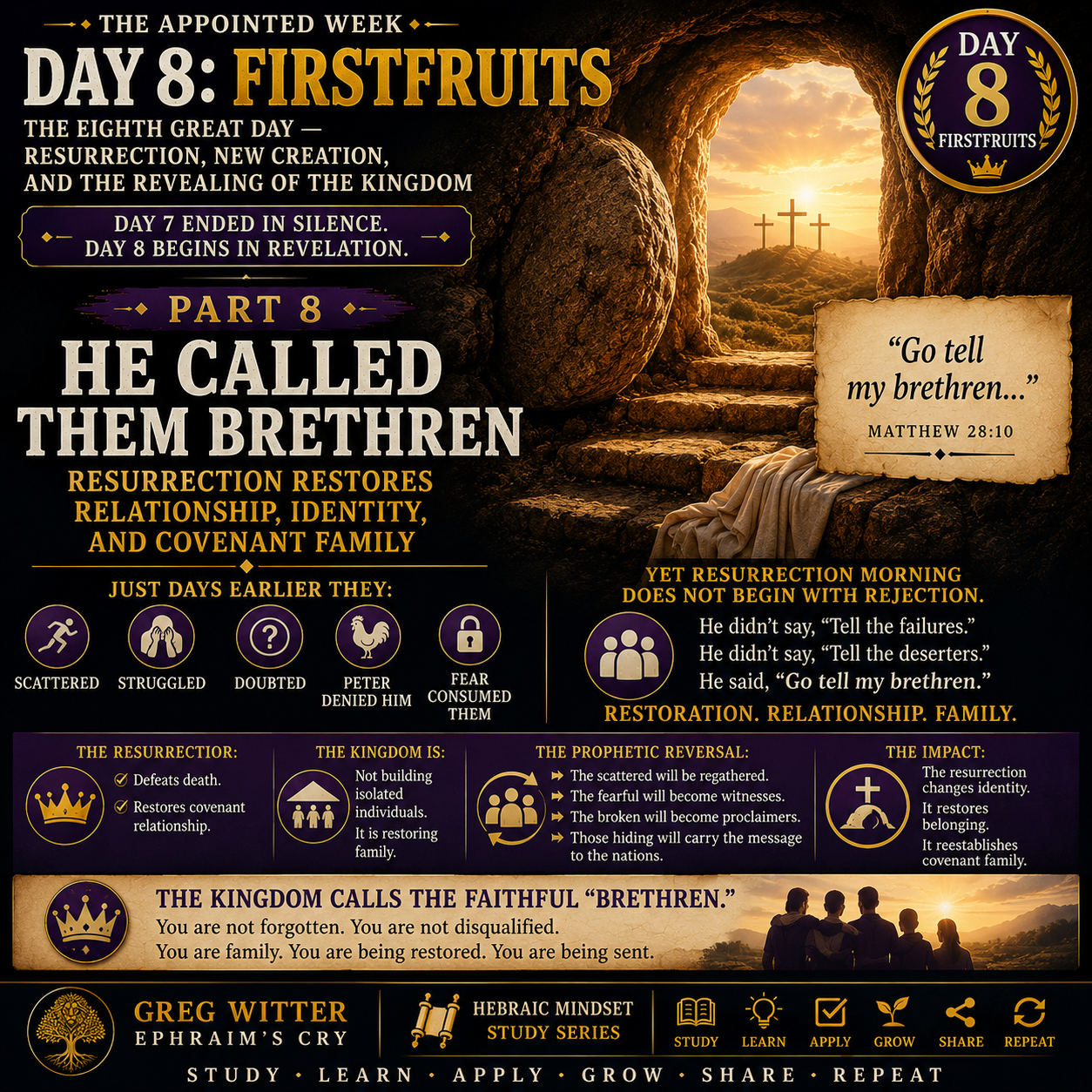
The Appointed Week — Day 8: Firstfruits
The Eighth Great Day — Resurrection, New Creation, and the Revealing of the Kingdom
“Day 7 ended in silence. Day 8 begins in revelation.”
Part 8 — He Called Them Brethren
Resurrection Restores Relationship, Identity, and Covenant Family
“Go tell my brethren…” (Matthew 28:10)
Greg Witter | Ephraim’s Cry
Hebraic Mindset Study Series
Study Learn Apply Grow Share Repeat
One of the most overlooked moments of resurrection morning is not merely the empty tomb.
It is the language Yahusha uses afterward.
“Go tell my brethren…” (Matthew 28:10).
That single word changes everything.
Just days earlier:
- they scattered,
- they struggled,
- they doubted,
- Peter denied Him openly,
- fear consumed many of them,
- and the disciples hid behind locked doors uncertain of what would come next.
Everything outwardly suggested failure.
Everything outwardly suggested collapse.
Everything outwardly suggested brokenness, shame, and disqualification.
And yet resurrection morning does not begin with rejection.
It begins with restoration.
Yahusha does not say:
“Go tell the failures.”
He does not say:
“Go tell the cowards.”
He does not say:
“Go tell the deserters.”
He says:
“Go tell my brethren.”
This becomes one of the deepest revelations hidden within Day 8:
The resurrection does not merely defeat death.
The resurrection restores covenant relationship.
That distinction matters profoundly.
Many people understand resurrection only in terms of victory over the grave. But resurrection morning reveals something much deeper unfolding beneath the surface.
The Kingdom is restoring family.
This is why the word “brethren” matters so profoundly.
The disciples failed.
They fled.
They struggled.
Their faith wavered beneath pressure and fear.
And yet Yahusha still identifies them relationally rather than merely according to their moment of weakness.
This becomes one of the deepest revelations hidden within covenant identity:
The covenant is not sustained by human perfection.
The covenant is sustained by the faithfulness of Yahuah.
That does not excuse sin, compromise, or rebellion. Scripture repeatedly calls the remnant toward obedience, repentance, endurance, and covenant faithfulness. But resurrection morning reveals that temporary failure did not erase covenant relationship for those who still belonged to Him.
This becomes deeply important because many believers interpret identity according to moments of weakness rather than according to covenant redemption.
Peter denied Him publicly.
Thomas struggled with unbelief.
The disciples scattered.
And yet resurrection morning moves immediately toward restoration rather than abandonment.
This becomes one of the greatest revelations hidden within the Gospel itself:
The Kingdom is not merely rescuing isolated individuals from judgment.
The Kingdom is restoring covenant family.
This is why resurrection language repeatedly moves toward relationship:
- sons,
- brethren,
- inheritance,
- household,
- family,
- adoption,
- and reconciliation.
The resurrection restores what Eden lost.
Sin fractured relationship.
The curse scattered humanity.
Death separated creation from covenant life.
But resurrection morning begins openly restoring what the fall shattered.
This is why the resurrection becomes deeply connected to reconciliation throughout the Apostolic writings.
Paul later writes:
“And you, that were sometime alienated and enemies in your mind by wicked works, yet now hath he reconciled…” (Colossians 1:21).
Reconciliation matters because the Kingdom moves toward restored relationship rather than mere legal transaction alone.
This is why Yahusha saying “brethren” carries enormous prophetic weight.
The disciples still belonged.
The relationship still stood.
The covenant still stood.
The Kingdom was still moving forward despite their weakness and confusion.
This becomes one of the deepest revelations hidden within Firstfruits itself.
The resurrection reveals that failure does not possess greater authority than covenant redemption.
Again and again Scripture reveals this same pattern.
Adam fell, yet the promise of the Seed remained (Genesis 3:15).
Israel rebelled repeatedly, yet Yahuah preserved a remnant.
David sinned deeply, yet covenant mercy continued working through repentance and restoration.
Jonah resisted, yet Yahuah still accomplished His purposes.
Peter denied, yet later became a bold resurrection witness before nations.
Again and again covenant history reveals that Yahuah restores broken people into Kingdom purpose.
This does not minimize holiness.
This magnifies redemption.
This becomes one of the deepest revelations hidden within resurrection morning:
The resurrection restores identity before public Kingdom mission begins moving outward.
Before Pentecost…
Before proclamation to the nations…
Before the Book of Acts unfolds…
Relationship is restored first.
“Go tell my brethren.”
This is profoundly important because identity governs mission.
People uncertain of belonging struggle to walk in Kingdom authority.
But resurrection morning restores relational grounding before Kingdom expansion begins publicly.
The disciples would soon become:
- apostles,
- witnesses,
- proclaimers,
- shepherds,
- and carriers of resurrection testimony.
But first they needed to know:
they still belonged.
This becomes one of the deepest revelations hidden within the Kingdom itself:
Yahuah restores relationship before commissioning witness outward into the nations.
This is why resurrection morning also becomes one of the greatest revelations concerning covenant identity.
The world defines identity through:
- performance,
- achievement,
- failure,
- status,
- public opinion,
- and visible success or weakness.
Babylon continually labels people according to their worst moments, their past failures, their usefulness to systems, or their outward ability to contribute to worldly structures.
But resurrection morning reveals that the Kingdom defines identity covenantally rather than merely circumstantially.
The disciples failed under pressure.
That reality cannot be ignored.
Peter denied Yahusha publicly three times (Luke 22:54–62).
The disciples scattered during the arrest (Matthew 26:56).
Fear overtook many of them after the crucifixion.
And yet resurrection morning still addresses them relationally:
“My brethren.”
This becomes one of the deepest revelations hidden within covenant redemption:
The Kingdom does not erase truth concerning failure.
The Kingdom restores identity through covenant mercy and transformation.
This becomes profoundly important because Babylon weaponizes shame.
The adversary continually accuses.
Failure becomes chains.
Weakness becomes identity.
Past mistakes become prisons.
But resurrection morning reveals that the Kingdom moves toward restoration rather than permanent condemnation for those returning in covenant surrender.
This is why Romans later declares:
“There is therefore now no condemnation to them which are in Messiah Yahusha…” (Romans 8:1).
That does not remove accountability.
That does not abolish obedience.
That does not create lawlessness.
Rather, resurrection reveals that covenant redemption restores relationship so transformation can continue moving forward.
This is why Peter becomes such a powerful resurrection example.
The same Peter who denied Him later stands publicly proclaiming resurrection before Jerusalem itself (Acts 2:14–36).
The same Peter who collapsed beneath fear later stands before authorities declaring:
“We ought to obey Elohim rather than men” (Acts 5:29).
What changed?
The resurrection restored both identity and purpose.
This becomes one of the deepest revelations hidden within Firstfruits:
The resurrection not only restores life.
The resurrection restores people into Kingdom calling.
Again and again Scripture reveals this same pattern.
Jacob the deceiver becomes Israel.
Moses the exile becomes deliverer.
David the shepherd becomes king.
Rahab the outsider becomes part of covenant lineage.
Broken people repeatedly become covenant instruments once redeemed beneath the purposes of Yahuah.
This is why resurrection morning becomes so deeply connected to adoption and inheritance.
The language of “brethren” points toward restored covenant household identity.
The Kingdom is forming family.
This becomes one of the deepest prophetic reversals in all of Scripture.
Sin scattered humanity.
Babylon divides humanity.
Fear isolates humanity.
But resurrection begins regathering covenant family.
This is why Yahusha later prays:
“That they all may be one…” (John 17:21).
The Kingdom moves toward restored covenant unity beneath the authority of Yahuah.
This becomes profoundly important because modern culture increasingly destroys:
- family,
- covenant loyalty,
- household structure,
- brotherhood,
- inheritance,
- and generational continuity.
Babylon thrives through fragmentation.
The Kingdom restores covenant family.
This is why resurrection morning becomes far larger than one isolated miracle at one tomb.
The resurrection begins restoring the covenant household fractured since Eden itself.
Adam’s rebellion fractured relationship with Yahuah.
Cain murdered Abel.
Humanity scattered at Babel.
Israel fractured repeatedly through rebellion and exile.
The nations divided beneath corruption and idolatry.
Now resurrection begins openly restoring covenant relationship through the Kingdom.
This is why the language matters so deeply.
“Brethren.”
Not strangers.
Not abandoned failures.
Not rejected servants.
Brethren.
This becomes one of the deepest revelations hidden within the Gospel itself:
The Kingdom does not merely rescue individuals from judgment.
The Kingdom restores covenant family beneath the authority of the Father.
This is why Paul later writes:
“For whom he did foreknow, he also did predestinate to be conformed to the image of his Son, that he might be the firstborn among many brethren” (Romans 8:29).
Notice the language carefully.
“Firstborn among many brethren.”
Firstfruits now becomes connected directly to family inheritance.
The Firstborn rises first.
The brethren follow afterward.
This is why resurrection morning carries such enormous covenant significance.
The Firstborn has emerged from the grave.
The covenant family will follow.
This becomes one of the deepest revelations hidden within resurrection hope itself.
The resurrection is not merely personal survival after death.
The resurrection moves toward restored covenant household inheritance beneath the Kingdom of Yahuah.
This is why resurrection morning begins with restored relationship before public mission expands outward.
The disciples needed to know:
- they still belonged,
- the covenant still stood,
- the Kingdom was still advancing,
- and the resurrection had not disqualified them from witness.
This becomes one of the deepest revelations for the remnant even now.
Babylon says:
- failure defines you,
- weakness disqualifies you,
- shame imprisons you,
- and fear owns you.
But resurrection morning says:
The Kingdom restores covenant identity through redemption, repentance, and resurrection life.
This is why resurrection morning also becomes one of the greatest revelations concerning regathering.
The disciples had scattered.
Fear fragmented them.
Pressure divided them.
The crucifixion shattered their visible expectations concerning the Kingdom.
But resurrection immediately begins pulling the scattered back together.
This becomes one of the deepest revelations hidden within the covenant structure itself:
The Kingdom regathers what fear scattered.
This pattern extends far beyond the disciples alone.
The entire story of Scripture moves toward regathering.
Adam and Eve were driven from Eden.
Humanity scattered at Babel.
Israel scattered among the nations through judgment and exile.
The tribes fractured.
The nations divided beneath rebellion and corruption.
Again and again history moves toward fragmentation beneath the curse.
But resurrection begins openly reversing that process.
This is why Yahusha repeatedly speaks about gathering:
- gathering the lost sheep,
- gathering the remnant,
- gathering the harvest,
- gathering the nations beneath Kingdom authority.
The resurrection therefore becomes deeply connected to restoration and regathering.
The scattered disciples now begin reuniting around resurrection truth.
This becomes one of the deepest prophetic pictures of the remnant in the last days.
The final regathering is not merely geographical.
The final regathering is covenantal.
Yahuah is restoring:
- identity,
- covenant memory,
- obedience,
- Kingdom understanding,
- and covenant household structure.
This is why resurrection morning begins moving immediately toward restored fellowship and restored witness.
The disciples had hidden separately behind fear.
Soon they would stand together publicly proclaiming the Kingdom.
What changed?
The resurrection restored alignment.
This becomes one of the deepest revelations hidden within Kingdom unity.
True unity is not created artificially through institutions, slogans, or organizational structures.
True unity emerges through shared covenant alignment beneath resurrection truth.
This is why Acts later reveals the believers:
“…continued steadfastly…” together (Acts 2:42).
The resurrection becomes the center of restored covenant community.
This becomes profoundly important because Babylon continually imitates unity while producing conformity instead of covenant alignment.
Babylon gathers people through:
- fear,
- control,
- economics,
- politics,
- compromise,
- emotional manipulation,
- and dependence upon centralized systems.
The Kingdom gathers people through:
- truth,
- covenant,
- resurrection life,
- obedience,
- witness,
- and the authority of Yahuah.
That distinction matters enormously.
This is why the resurrection becomes deeply threatening to Babylonian systems.
Resurrection creates a people whose identity no longer depends upon the systems of the world.
Fear loses control once death itself loses permanence.
This becomes one of the deepest revelations hidden within the disciples themselves.
Before resurrection:
- fear dominated,
- confusion dominated,
- uncertainty dominated,
- and survival instincts dominated.
After resurrection:
- witness emerged,
- boldness emerged,
- proclamation emerged,
- and Kingdom authority emerged.
The same people who hid behind locked doors later confronted rulers openly.
Why?
Because resurrection transformed their understanding of reality itself.
Once death loses permanence, Babylon loses its greatest weapon.
This is why Hebrews later declares that through death Messiah destroyed:
“…him that had the power of death…” (Hebrews 2:14–15).
Fear of death enslaves humanity beneath Babylonian control.
But resurrection breaks that bondage.
This is why the disciples could later endure persecution, imprisonment, exile, and martyrdom while continuing to proclaim the Kingdom.
The resurrection changed everything.
This becomes one of the deepest revelations hidden within “He called them brethren.”
Brethren stand together.
Brethren inherit together.
Brethren witness together.
The resurrection therefore moves beyond individual restoration into covenant household restoration.
This mirrors the entire prophetic trajectory of Scripture.
The prophets repeatedly speak of:
- regathered Israel,
- restored tribes,
- restored inheritance,
- restored covenant identity,
- and restored Kingdom order beneath the reign of Yahuah.
Now resurrection morning becomes the opening declaration that this restoration process has already begun.
This is why Firstfruits matters so profoundly.
Firstfruits never represented isolated blessing detached from the larger harvest.
Firstfruits guaranteed the coming harvest behind it.
Now the Firstborn has risen.
The brethren will follow.
The remnant will be gathered.
The Kingdom will expand.
And restoration will continue unfolding until all things move toward their appointed completion beneath the authority of Yahuah.
This becomes one of the deepest revelations hidden within Day 8 itself.
The Eighth Day is not merely about resurrection life beginning.
The Eighth Day is about covenant restoration beginning openly before creation itself.
Website:
https://ephraimscry.com
Blog:
https://ephraimscry.com/blog
Academy:
https://ephraimscry.com/academy
Events & Live Teachings:
https://ephraimscry.com/events
YouTube:
https://www.youtube.com/@EphraimsCry
#TheAppointedWeek #Day8 #Firstfruits #TheEighthGreatDay #HeCalledThemBrethren #ResurrectionMorning #HebraicMindset #EphraimsCry #GregWitter #Torah #KingdomOfElohim #WholeCounselOfElohim #FirstfruitsOffering #Resurrection #Covenant #Truth #Scripture #Kingdom #Restoration #Watchman #StudyLearnApplyGrowShareRepeat
