
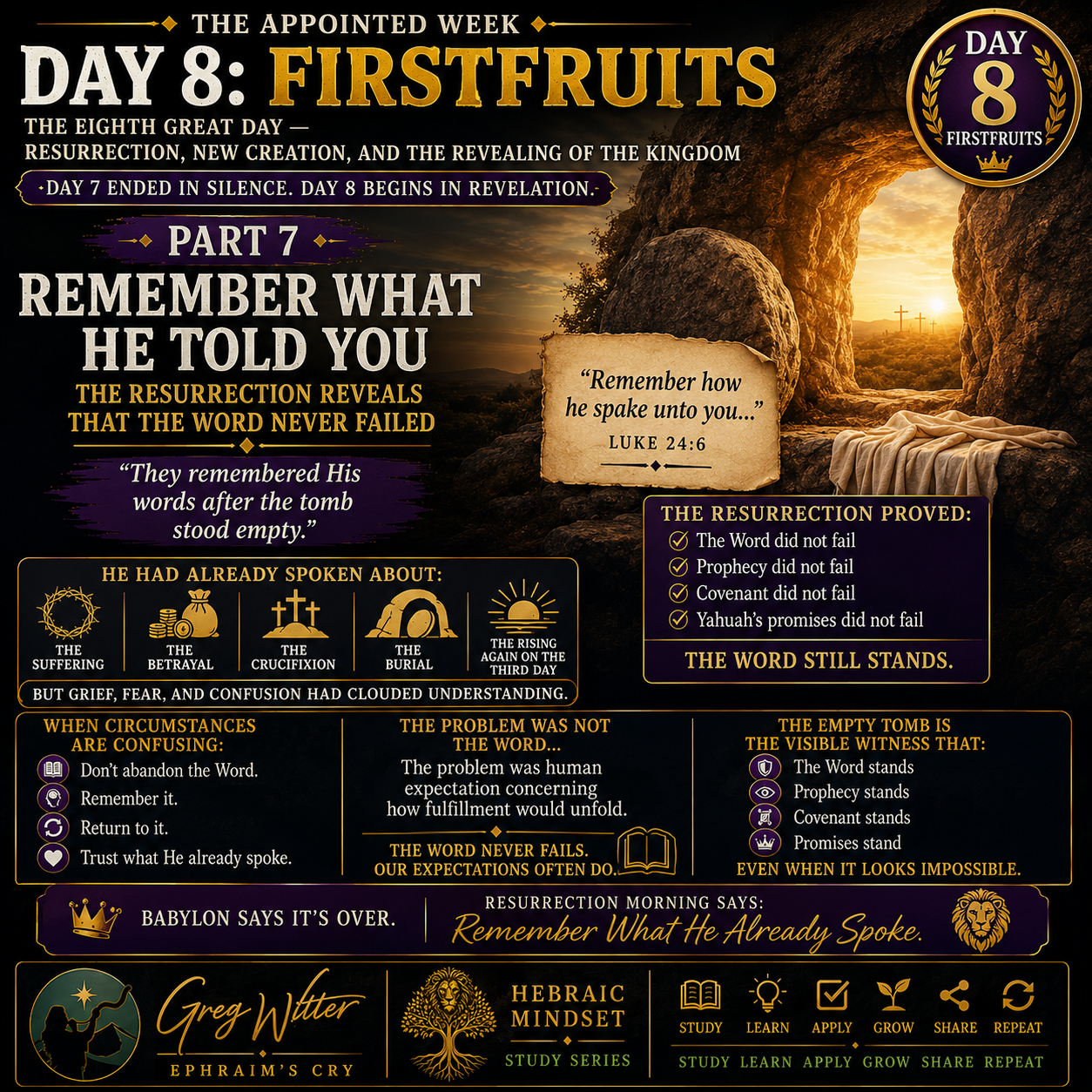
The Appointed Week — Day 8: Firstfruits
The Eighth Great Day — Resurrection, New Creation, and the Revealing of the Kingdom
“Day 7 ended in silence. Day 8 begins in revelation.”
Part 7 — Remember What He Told You
The Resurrection Reveals That the Word Never Failed
“They remembered His words after the tomb stood empty.”
Greg Witter | Ephraim’s Cry
Hebraic Mindset Study Series
Study Learn Apply Grow Share Repeat
The angels did not give the women a new message.
They pointed them back to what had already been spoken.
“Remember how he spake unto you…” (Luke 24:6).
That statement becomes one of the deepest revelations hidden within resurrection morning.
The resurrection was not an unexpected interruption to the covenant plan.
The resurrection was covenant fulfillment unfolding exactly according to the Word already spoken beforehand.
Yahusha had already warned them concerning:
- the betrayal,
- the suffering,
- the rejection,
- the crucifixion,
- the burial,
- and the rising again on the third day.
Again and again He spoke openly concerning what would happen:
“The Son of man must be delivered into the hands of sinful men, and be crucified, and the third day rise again” (Luke 24:7).
But grief clouded memory.
Fear clouded understanding.
Confusion clouded expectation.
And shattered assumptions concerning how the Kingdom would appear caused many to struggle to recognize fulfillment when it unfolded directly before them.
This becomes one of the deepest revelations hidden within Day 8:
The problem was never the reliability of the Word.
The problem was human expectation concerning how fulfillment would unfold.
That distinction matters profoundly.
The Word had not failed.
Prophecy had not failed.
Covenant had not failed.
Yahuah had not failed.
The witnesses simply struggled to reconcile visible suffering with the promises they expected to manifest differently.
This pattern appears repeatedly throughout Scripture.
Joseph received promises before entering the pit and the prison.
Israel received covenant promises before bondage intensified in Egypt.
David was anointed before years of wilderness exile.
The prophets spoke restoration while nations collapsed into judgment.
Again and again covenant fulfillment unfolds through processes humanity does not initially understand correctly.
This becomes one of the deepest lessons hidden within resurrection morning:
Visible circumstances never possess greater authority than the Word already spoken by Yahuah.
The tomb appeared final.
The crucifixion appeared catastrophic.
The silence of Day 7 appeared crushing.
But Heaven now confronts the witnesses with a simple reality:
Remember what He already told you.
This becomes one of the greatest prophetic confrontations for the remnant in every generation.
When circumstances become confusing…
When darkness appears overwhelming…
When visible outcomes appear contrary to expectation…
The answer is not abandoning the Word.
The answer is remembering it.
This is why the resurrection becomes so deeply connected to remembrance throughout Scripture.
The angels direct the women back toward the spoken Word.
Later Yahusha opens Moses, the Prophets, and the Writings to the disciples on the road to Emmaus (Luke 24:27).
Again and again resurrection understanding is rooted in returning to covenant revelation already established beforehand.
This becomes profoundly important because resurrection was never disconnected from the rest of Scripture.
The resurrection stands as the fulfillment of:
- Genesis,
- the Exodus pattern,
- the sacrificial system,
- the Psalms,
- the Prophets,
- and the covenant promises spoken from the beginning.
This is why Psalm 16 becomes so important:
“For thou wilt not leave my soul in Sheol; neither wilt thou suffer thine Holy One to see corruption” (Psalm 16:10).
David spoke it beforehand.
Isaiah spoke of the suffering servant beforehand (Isaiah 53).
Hosea spoke:
“After two days will he revive us: in the third day he will raise us up…” (Hosea 6:2).
Jonah became the prophetic sign beforehand (Matthew 12:40).
Again and again the Word already testified concerning what resurrection morning would reveal openly.
This is why the angels say:
“Remember.”
They are calling the witnesses back to covenant memory.
This becomes one of the deepest revelations hidden within the Kingdom itself:
The Kingdom is understood correctly only when interpreted through the Word already spoken by Yahuah.
Without covenant understanding:
- the cross appears defeat,
- the tomb appears final,
- the silence appears abandonment,
- and the suffering appears contradiction.
But with covenant understanding:
- the cross becomes atonement,
- the tomb becomes witness,
- the silence becomes fulfillment,
- and the resurrection becomes the revelation that the Word never failed.
This is why remembering becomes spiritually critical.
Forgetting produces confusion.
Remembering restores perspective.
Again and again throughout Scripture Yahuah commands remembrance:
- remember the Exodus,
- remember the covenant,
- remember the commandments,
- remember what was spoken,
- remember the works of Yahuah.
Why?
Because forgetting causes people to interpret present circumstances incorrectly.
Israel repeatedly forgot and drifted toward fear.
The disciples forgot and drifted toward despair.
Now resurrection morning restores memory through revelation.
The empty tomb forces the witnesses to reinterpret everything through the Word already spoken beforehand.
This is why remembrance becomes one of the greatest covenant weapons against fear, deception, and spiritual collapse.
Babylon continually pressures humanity to forget.
Forget the covenant.
Forget the commandments.
Forget the promises.
Forget the prophetic warnings.
Forget the works of Yahuah.
Because once people forget, they begin interpreting reality through visible circumstances alone.
This is exactly what happened to many surrounding the crucifixion.
The suffering became so overwhelming…
The silence became so heavy…
The visible defeat appeared so complete…
That many temporarily lost sight of what had already been spoken beforehand.
This becomes one of the deepest revelations hidden within resurrection morning:
Fear grows strongest when memory weakens.
This is why the angels immediately direct the women back toward remembrance rather than speculation.
They do not invent new theology.
They do not reinterpret the covenant.
They point backward toward the already-established Word.
“Remember how he spake unto you…”
That statement becomes profoundly important because the resurrection reveals that covenant truth remains stable even when human understanding temporarily wavers.
The Word did not shift.
The promises did not collapse.
The covenant did not break.
Human perception simply struggled beneath pressure.
This becomes one of the deepest lessons for the remnant.
The final conflict will repeatedly pressure believers through:
- fear,
- delay,
- confusion,
- persecution,
- visible system dominance,
- economic pressure,
- deception,
- and emotional exhaustion.
Babylon will attempt to reshape perception through constant visible pressure.
But resurrection morning already reveals the solution before the final conflict fully unfolds:
Remember what He already spoke.
This is why Yahusha repeatedly warned beforehand concerning:
- deception,
- betrayal,
- persecution,
- lawlessness,
- false prophets,
- tribulation,
- and endurance (Matthew 24).
Why?
Because forewarned covenant understanding stabilizes the remnant when visible events begin unfolding.
This is exactly what the resurrection now reveals.
The disciples struggled partly because they expected immediate visible Kingdom conquest without fully grasping the necessary covenant sequence:
- suffering,
- sacrifice,
- burial,
- silence,
- resurrection,
- proclamation,
- and eventual Kingdom fulfillment.
Their expectations were incomplete.
This becomes one of the deepest revelations hidden within prophetic misunderstanding itself.
People often reject or misinterpret fulfillment because they expect Yahuah to work according to their preferred sequence rather than His actual covenant order.
Israel expected immediate deliverance before wilderness testing.
Many expected Messiah to overthrow Rome immediately.
The disciples expected visible triumph without fully understanding the necessity of suffering first.
Now resurrection morning forces a complete reinterpretation through the Word already spoken.
This becomes one of the greatest prophetic lessons for the remnant:
Covenant fulfillment often unfolds differently than human expectation while still remaining perfectly faithful to the Word of Yahuah.
This is why remembering becomes spiritually essential.
Without remembrance:
- suffering appears meaningless,
- delay appears abandonment,
- silence appears failure,
- and visible darkness appears victorious.
But remembrance restores covenant perspective.
The resurrection proves:
- Yahuah was still governing during the silence,
- the covenant was still unfolding during the burial,
- and the Word was still standing even while the grave appeared occupied.
This becomes one of the deepest revelations hidden within Day 7 and Day 8 together.
Day 7 tested whether people would continue trusting the Word during silence.
Day 8 revealed that the Word had remained true the entire time.
This is why the resurrection becomes such a devastating blow against unbelief.
The resurrection publicly vindicates the reliability of the Word itself.
Every fulfilled detail becomes testimony:
- the betrayal,
- the suffering,
- the crucifixion,
- the burial,
- the third day,
- the empty tomb,
- and the resurrection witness.
Nothing failed.
This is why Yahusha later rebukes the disciples on the road to Emmaus:
“O fools, and slow of heart to believe all that the prophets have spoken…” (Luke 24:25).
Notice the issue carefully.
The problem was not lack of prophecy.
The problem was slowness to believe what had already been spoken.
Again and again Scripture reveals the same pattern:
- the Word speaks beforehand,
- events unfold afterward,
- and the remnant must learn to interpret events through covenant revelation rather than emotional reaction.
This becomes critically important because Babylon continually trains humanity to interpret reality emotionally through immediate appearances.
But the Kingdom calls the remnant to interpret reality covenantally through the Word of Yahuah.
This is why resurrection morning becomes one of the greatest revelations concerning faith itself.
Faith is not denial of visible events.
The cross truly happened.
The suffering truly hurt.
The burial truly occurred.
But covenant faith remembers that visible events never possess greater authority than the promises already spoken by Yahuah.
This is why Abraham believed against visible impossibility.
This is why Moses endured as “seeing him who is invisible” (Hebrews 11:27).
This is why the prophets continued proclaiming restoration during judgment.
And now resurrection morning confirms the same eternal truth:
The Word of Yahuah still stands even when the tomb appears sealed temporarily.
The resurrection did not create truth.
The resurrection revealed that the truth had been standing all along.
This is why resurrection morning also becomes one of the greatest revelations concerning prophetic timing.
The disciples did not merely struggle with belief.
They struggled with timing.
They believed Messiah was the promised One.
They believed the Kingdom promises.
They believed the covenant.
But they expected fulfillment to unfold according to their own immediate expectations rather than according to the full prophetic order established by Yahuah.
This becomes one of the deepest revelations hidden within the resurrection narrative:
Correct truth interpreted through incorrect timing can still produce confusion.
The disciples expected visible Kingdom conquest immediately.
Instead they encountered:
- suffering,
- betrayal,
- crucifixion,
- burial,
- silence,
- and now an empty tomb forcing them to reinterpret everything through the covenant Scriptures.
Again and again Scripture reveals this same pattern.
Abraham received promises long before fulfillment manifested visibly.
Israel carried promises while remaining in bondage for generations.
David received kingship long before sitting fully upon the throne.
The prophets often spoke restoration while judgment still unfolded visibly around them.
Yahuah repeatedly works through appointed timing rather than human urgency.
This is why the Appointed Week framework matters so profoundly.
Every phase unfolds according to appointed order.
Nothing occurred randomly:
- the crucifixion timing,
- the burial timing,
- the Sabbath timing,
- the completion of the sign,
- the resurrection timing,
- and now the revealing of Firstfruits itself.
Everything unfolds according to covenant structure.
This is why resurrection morning becomes one of the greatest vindications of prophetic order in all of Scripture.
The resurrection did not occur eventually.
The resurrection occurred exactly according to the appointed timing already spoken beforehand.
This is why Yahusha repeatedly emphasized:
“the third day.”
The timing mattered.
The sign mattered.
The structure mattered.
This becomes one of the deepest revelations hidden within covenant fulfillment:
Yahuah governs history through appointed order rather than human improvisation.
This is why remembrance becomes so critical.
Remembering restores people back into alignment with prophetic timing.
Forgetting causes people to interpret temporary delay as failure.
This becomes profoundly important for the remnant because the last days will repeatedly test perception concerning timing.
Many will:
- grow weary,
- become impatient,
- compromise,
- abandon endurance,
- or reinterpret truth itself because visible fulfillment appears delayed.
But resurrection morning already reveals the danger of abandoning covenant trust during the waiting period.
The silence of Day 7 was not failure.
The silence was part of fulfillment.
The tomb was not contradiction.
The tomb was part of the prophetic sequence.
The burial was not proof the Word had failed.
The burial was proof the Word was unfolding exactly according to covenant order.
This becomes one of the deepest revelations hidden within suffering itself.
Temporary darkness does not mean Yahuah has abandoned the covenant.
Often the process itself forms part of the fulfillment.
Joseph’s imprisonment formed part of deliverance.
Israel’s wilderness formed part of covenant preparation.
Exile formed part of purification.
And now the burial itself formed part of resurrection fulfillment.
This is why the resurrection completely transforms how the remnant interprets difficult seasons.
Babylon interprets silence as absence.
The Kingdom recognizes silence may conceal fulfillment already unfolding beneath the surface.
This is exactly what Day 7 revealed.
The world saw silence.
Heaven saw completion.
Now Day 8 reveals openly what Heaven had already been accomplishing beneath the visible surface.
This becomes one of the deepest revelations hidden within prophetic endurance.
The remnant must learn to remain aligned with the Word even when visible outcomes temporarily appear contradictory.
This is why Yahusha repeatedly warned:
“He that shall endure unto the end, the same shall be saved” (Matthew 24:13).
Endurance requires remembrance.
The disciples temporarily struggled because grief overwhelmed memory.
Fear distorted perception.
Visible suffering clouded understanding.
Now resurrection morning restores perspective through remembrance of the Word already spoken.
This is why the angels did not say:
“Create a new interpretation.”
They said:
“Remember.”
The solution was not innovation.
The solution was covenant remembrance.
This becomes one of the deepest warnings against modern spiritual drift.
Whenever people disconnect from the already-established Word, confusion multiplies quickly.
Babylon continually pressures humanity toward:
- reinterpretation,
- compromise,
- emotional reaction,
- and abandonment of covenant foundations.
But resurrection morning reveals the opposite path:
Return to what was already spoken.
Remember the covenant.
Remember the promises.
Remember the prophetic structure.
Remember the Word.
This is why the resurrection ultimately becomes one of the greatest public vindications of Scripture itself.
The resurrection proves:
- the prophets were true,
- the covenant stood firm,
- the promises remained trustworthy,
- and Yahuah governs history exactly according to His appointed order.
The empty tomb therefore does not merely reveal resurrection life.
The empty tomb reveals that the Word of Yahuah remains absolutely trustworthy even when humanity temporarily struggles to understand the process of fulfillment itself.
Website:
https://ephraimscry.com
Blog:
https://ephraimscry.com/blog
Academy:
https://ephraimscry.com/academy
Events & Live Teachings:
https://ephraimscry.com/events
YouTube:
https://www.youtube.com/@EphraimsCry
#TheAppointedWeek #Day8 #Firstfruits #TheEighthGreatDay #RememberWhatHeToldYou #ResurrectionMorning #HebraicMindset #EphraimsCry #GregWitter #Torah #KingdomOfElohim #WholeCounselOfElohim #FirstfruitsOffering #Resurrection #Covenant #Truth #Scripture #Kingdom #Restoration #Watchman #StudyLearnApplyGrowShareRepeat
