
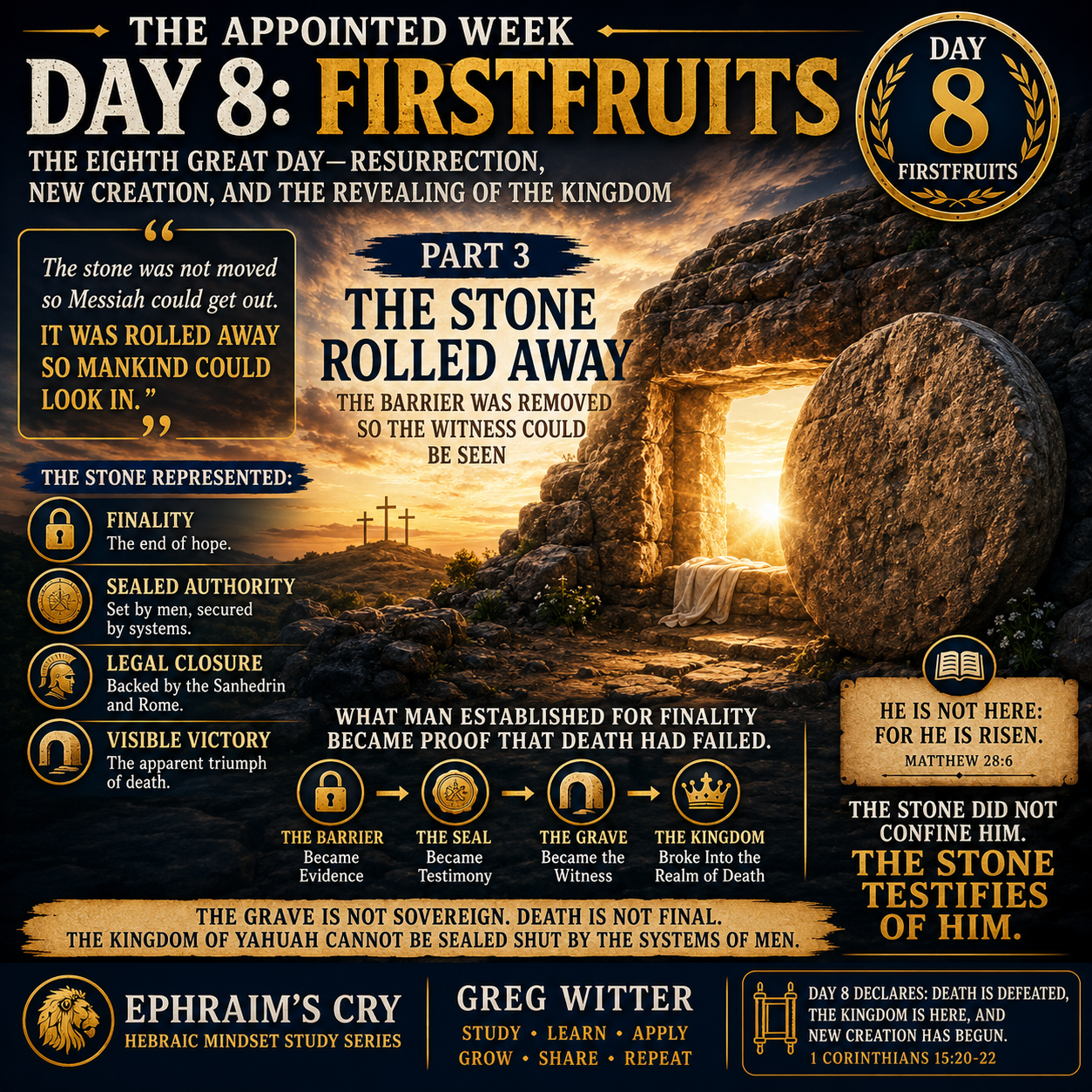
The Appointed Week — Day 8: Firstfruits
The Eighth Great Day — Resurrection, New Creation, and the Revealing of the Kingdom
“Day 7 ended in silence. Day 8 begins in revelation.”
Part 3 — The Stone Rolled Away
The Barrier Was Removed So the Witness Could Be Seen
“The stone was not rolled away so Messiah could get out. It was rolled away so mankind could look in.”
Greg Witter | Ephraim’s Cry
Hebraic Mindset Study Series
Study Learn Apply Grow Share Repeat
The stone mattered.
It represented:
- finality,
- sealed authority,
- legal closure,
- visible victory over life,
- and the apparent triumph of death itself.
Once the stone had been rolled into place and sealed beneath Roman authority, the systems of man believed the matter was finished. The body had been buried. The tomb had been secured. The movement appeared crushed beneath the weight of public execution, political pressure, military oversight, and the silence of the grave.
Rome believed the situation was contained.
The religious authorities believed the threat had ended.
The disciples believed hope itself had collapsed beneath the weight of the crucifixion.
But Heaven had already overturned the verdict.
This becomes one of the deepest revelations hidden within resurrection morning:
The resurrection was not waiting for the stone to move.
The resurrection had already happened.
The stone was not moved so Messiah could escape the tomb.
The stone was moved so witnesses could enter and see.
That distinction changes everything.
The systems of man believed the stone confined Messiah.
But resurrection life was never limited by the barriers of fallen creation.
The stone functioned for witnesses—not for Messiah Himself.
This becomes one of the greatest prophetic reversals in all of Scripture.
The very object meant to secure death became the evidence that death had failed.
The barrier became testimony.
The seal became witness.
The grave became the declaration of resurrection.
This pattern appears repeatedly throughout Scripture.
Pharaoh’s pursuit became evidence of deliverance once the sea closed over Egypt (Exodus 14:26–31).
Haman’s gallows became the instrument of his own reversal (Esther 7:9–10).
Babylon’s pride became evidence of coming judgment (Daniel 5:22–31).
The cross itself, intended as humiliation and destruction, became the place of atonement and victory (Colossians 2:14–15).
And now the sealed stone becomes the public witness that the grave itself has lost authority beneath the Kingdom of Yahuah.
Again and again Scripture reveals the same covenant principle:
The systems opposing Yahuah repeatedly strengthen the testimony they are attempting to suppress.
This is why the stone had to remain visible.
The witnesses needed to see:
- the moved barrier,
- the opened entrance,
- the empty chamber,
- and the undeniable evidence that Heaven had intervened into history.
The resurrection therefore was not hidden in secrecy.
The resurrection was revealed through evidence.
This becomes deeply important because modern presentations often treat faith as though it were blind emotionalism disconnected from historical witness. But the resurrection narratives continually emphasize physical evidence, visible testimony, eyewitnesses, ordered conditions inside the tomb, and publicly observable realities.
The stone had truly been there.
The seal had truly been applied.
The guards had truly been stationed.
The tomb had truly been occupied.
And now the tomb truly stood open and empty.
This is why John carefully records the details of the tomb interior itself (John 20:6–7). The grave clothes remained orderly. The linen lay folded. Nothing suggested panic, theft, struggle, or human interference.
The scene testified to divine authority.
This becomes one of the deepest revelations hidden within the rolled-away stone:
Resurrection did not produce chaos.
Resurrection revealed order.
This mirrors creation itself.
In Genesis, Yahuah brings order from disorder, light from darkness, separation from confusion, and life from emptiness. Now resurrection morning reveals Heaven once again imposing divine order upon a world still buried beneath death and corruption.
The opened tomb therefore becomes more than proof of resurrection.
The opened tomb becomes a prophetic doorway announcing that the old order under death has been breached.
This is why the stone rolling away carries such enormous prophetic significance.
The grave was humanity’s great sealed barrier since Eden.
Since the fall, death had stood as the visible reminder of the curse resting upon creation. Kings died. Prophets died. Priests died. Nations rose and fell beneath the dominion of death.
The grave appeared final.
The stone represented closure.
But resurrection morning announces that death no longer possesses permanent authority.
The barrier has been breached from within.
This becomes one of the deepest revelations hidden within the Eighth Day itself.
The Eighth Day moves beyond the completed cycle of the old creation order into the beginning of restored creation. The stone rolling away visually announces that humanity is no longer trapped permanently beneath the dominion of the grave.
This is why Isaiah prophesied:
“He will swallow up death in victory…” (Isaiah 25:8).
And Hosea declared:
“O death, I will be thy plagues; O grave, I will be thy destruction…” (Hosea 13:14).
Resurrection morning becomes the visible beginning of those promises entering history openly before creation itself.
The grave has been challenged.
The stone has been moved.
And death itself has begun losing its claim over creation.
This is why the opening of the tomb becomes one of the greatest covenant witnesses in all of Scripture.
The tomb was not merely empty.
The tomb was open.
That matters.
Heaven did not simply remove the body invisibly and leave the stone untouched. The opening itself became part of the testimony because Yahuah intended the witnesses to enter, examine, observe, and confront the reality of resurrection openly.
This is why the resurrection narratives repeatedly emphasize seeing:
- seeing the stone moved,
- seeing the empty place,
- seeing the linen,
- seeing the angels,
- seeing the tomb itself standing open before them.
The resurrection therefore was never designed to remain hidden beneath secrecy.
The resurrection was designed to become public witness.
This is why John records:
“Then went in also that other disciple… and he saw, and believed” (John 20:8).
The opened tomb confronts the witnesses with evidence demanding response.
This becomes one of the deepest revelations hidden within the rolled-away stone:
The resurrection forces a decision.
No one can remain neutral before an opened grave.
The empty tomb divides humanity:
- belief or unbelief,
- surrender or resistance,
- covenant truth or manufactured explanation.
This is why the systems of man immediately begin attempting to control the narrative once the tomb stands open.
The authorities cannot reseal the grave.
They cannot reverse the resurrection.
They cannot restore the body to the tomb.
So they attempt to manipulate witness instead.
Matthew records the false narrative immediately spreading:
“Say ye, His disciples came by night, and stole him away while we slept” (Matthew 28:13).
This becomes one of the deepest prophetic warnings hidden within resurrection morning:
When systems cannot stop truth, they attempt to reinterpret it.
That pattern continues throughout history.
Babylon continually survives through narrative manipulation.
The Kingdom advances through witness.
This is why the stone matters so deeply.
The visible evidence now stands publicly before creation itself.
The authorities know the tomb is empty.
The guards know the tomb is empty.
The women know the tomb is empty.
The disciples know the tomb is empty.
The question now becomes how humanity will respond to the witness itself.
This is why the stone rolling away also becomes deeply connected to prophetic access.
Throughout Scripture barriers repeatedly separate humanity from deeper covenant realities:
- the cherubim guarded Eden,
- the veil guarded the Most Holy Place,
- mountains shook beneath divine holiness,
- boundaries separated the clean from the unclean.
But now resurrection morning reveals Heaven opening access through victory over death itself.
This is profoundly important because the tomb now becomes the opposite of Eden’s closed gate.
Adam’s rebellion brought exile outward from the presence of Yahuah beneath the dominion of death.
But resurrection morning announces movement back toward restored covenant life through victory over the grave.
This is why Paul later declares:
“The last enemy that shall be destroyed is death” (1 Corinthians 15:26).
The rolled-away stone becomes the first visible announcement that the destruction of death’s dominion has already begun.
This is also why the stone itself becomes symbolically powerful throughout Scripture.
Stones often function as witnesses:
- Jacob erected stone witnesses (Genesis 31:45–52),
- Joshua established memorial stones after crossing the Jordan (Joshua 4:1–9),
- the commandments themselves were written upon stone,
- altars were built from stone,
- and witnesses were established through standing stones repeatedly throughout covenant history.
Now one of the greatest stones in Scripture becomes a resurrection witness itself.
The stone standing rolled away now testifies:
- Heaven intervened,
- the grave failed,
- death was breached,
- and resurrection life emerged victorious.
This becomes one of the deepest revelations hidden within Day 8:
The stone did not merely move physically.
The stone announced prophetically that barriers separating humanity from restored covenant life had begun collapsing beneath resurrection authority.
This is why the resurrection becomes more than one isolated miracle.
The resurrection becomes the beginning of restoration itself.
The opened tomb therefore stands as the doorway announcing:
- the Kingdom has entered death,
- the curse has been challenged,
- the grave has been breached,
- and new creation has begun.
This is why the stone rolling away becomes one of the greatest declarations in history.
The grave is not sovereign.
Death is not final.
Darkness is not ultimate.
And the Kingdom of Yahuah cannot be sealed shut by the systems of men.
This is why before the disciples fully understand…
Before the nations hear the proclamation…
Before the Gospel begins moving outward into the world…
The first visible witness standing before creation is an opened tomb with a rolled-away stone.
The barrier has moved.
The witness stands open.
And history itself will never be the same again.
This is why the rolled-away stone also becomes one of the greatest prophetic confrontations against fear.
Fear thrives behind sealed barriers.
Fear believes the stone cannot move.
Fear believes the grave is final.
Fear believes the visible systems of man possess ultimate authority.
But resurrection morning publicly shatters every one of those assumptions.
The women approached the tomb asking:
“Who shall roll us away the stone from the door of the sepulchre?” (Mark 16:3).
That question matters deeply.
They were still thinking within the limitations of visible reality.
The stone appeared immovable.
The seal appeared secure.
The guards appeared intimidating.
The obstacle appeared beyond their ability to overcome.
And yet when they arrived, Heaven had already moved the barrier before they reached the tomb.
This becomes one of the deepest revelations hidden within resurrection morning:
The faithful often walk toward impossible situations while Heaven has already begun solving what they cannot yet see.
Again and again Scripture reveals this same covenant pattern.
Abraham climbed Moriah before seeing the ram provided (Genesis 22:13).
Israel approached the sea before the waters divided (Exodus 14:21–22).
Joshua marched toward Jericho before the walls collapsed (Joshua 6:20).
The women walked toward the tomb before realizing the stone had already been moved.
This becomes one of the great lessons of covenant trust:
Yahuah often resolves barriers before His people fully understand how deliverance will come.
This is why resurrection morning becomes so deeply connected to faith itself.
Faith is not denial of visible reality.
The stone truly existed.
The guards truly existed.
The seal truly existed.
The grave truly existed.
But covenant faith recognizes that visible barriers never possess greater authority than the decree of Yahuah.
This becomes one of the deepest prophetic lessons for the remnant because the final conflict repeatedly surrounds fear, intimidation, visible system dominance, and the appearance of impossibility.
Babylon continually seeks to convince humanity that resistance is hopeless.
The beast systems of the earth will appear overwhelming outwardly.
Economic systems will appear immovable.
Political systems will appear entrenched.
The pressure to compromise will appear enormous.
But resurrection morning already reveals the truth before the final conflict fully unfolds:
No barrier established by man possesses permanent authority before the Kingdom of Yahuah.
The stone moved.
The seal failed.
The guards collapsed.
And the grave lost.
This is why the opened tomb becomes one of the greatest declarations of hope in all of history.
Not sentimental hope.
Covenant hope rooted in demonstrated victory over death itself.
This is also why the resurrection morning reverses the atmosphere of Eden.
In Eden, humanity was driven outward from life beneath the authority of death.
The way became guarded.
Access became restricted.
Exile entered history.
Now resurrection morning begins reversing that trajectory.
The tomb opens.
Death is breached.
Access begins restoring.
And new creation emerges from within the grave itself.
This becomes one of the deepest revelations hidden within the Eighth Day.
The resurrection is not merely about returning to the old order.
The resurrection begins the restoration of what was lost in Eden.
This is why Revelation ultimately closes not with graves, but with:
- the Tree of Life restored,
- the curse removed,
- the nations healed,
- and the dwelling of Elohim among men (Revelation 21–22).
The opened tomb therefore points forward prophetically toward the full restoration of creation itself.
This is why the resurrection changes the structure of history.
Before resurrection:
- death appeared permanent,
- the grave appeared final,
- corruption appeared unavoidable,
- and creation groaned beneath the curse.
After resurrection:
- death becomes temporary,
- the grave loses permanence,
- resurrection becomes certain,
- and restoration begins moving openly through history.
This is why the stone matters so profoundly.
The rolled-away stone stands at the intersection between:
- death and life,
- old creation and new creation,
- silence and proclamation,
- concealment and revelation,
- despair and restoration.
The stone becomes the visible witness that the old order under death has already begun collapsing beneath resurrection authority.
This is why the Appointed Week structure moves perfectly into Day 8.
Day 7 completed the sign beneath silence.
Day 8 opens the witness before creation.
The threshold has been crossed.
The barrier has moved.
The tomb stands open.
And the Kingdom of Yahuah has begun openly invading the realm of death itself.
Website:
https://ephraimscry.com
Blog:
https://ephraimscry.com/blog
Academy:
https://ephraimscry.com/academy
Events & Live Teachings:
https://ephraimscry.com/events
YouTube:
https://www.youtube.com/@EphraimsCry
#TheAppointedWeek #Day8 #Firstfruits #TheEighthDay #TheStoneRolledAway #ResurrectionMorning #HebraicMindset #EphraimsCry #GregWitter #Torah #KingdomOfElohim #WholeCounselOfElohim #FirstfruitsOffering #Resurrection #Covenant #Truth #Scripture #Kingdom #Restoration #Watchman #StudyLearnApplyGrowShareRepeat
