
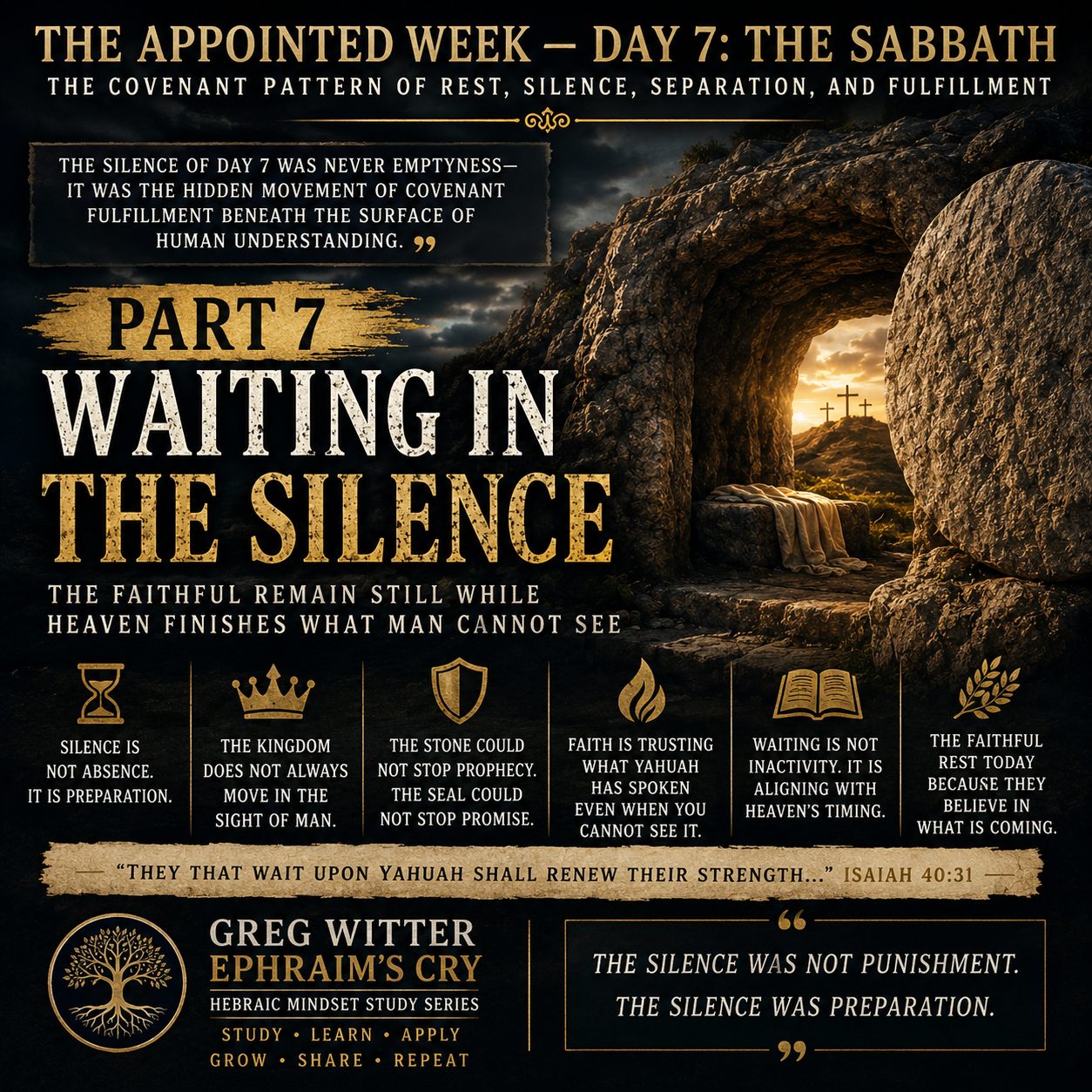
The Appointed Week — Day 7: The Sabbath
The Covenant Pattern of Rest, Silence, Separation, and Fulfillment
“The silence of Day 7 was never emptiness—it was the hidden movement of covenant fulfillment beneath the surface of human understanding.”
Part 7 — Waiting in the Silence
The Faithful Remain Still While Heaven Finishes What Man Cannot See
“The silence was not punishment. The silence was preparation.”
Greg Witter | Ephraim’s Cry
Hebraic Mindset Study Series
Study Learn Apply Grow Share Repeat
Day 7 forces mankind into one of the most uncomfortable places in all of Scripture:
The place between promise and manifestation.
The crucifixion has already taken place. The body of Messiah has already been placed within the tomb (Matthew 27:57–60). The stone has already been rolled into place. The seal has already been secured. Guards stand before the entrance (Matthew 27:62–66). The disciples are scattered beneath grief, fear, confusion, and shattered expectation. Jerusalem settles into Sabbath stillness while the visible world appears frozen between death and resurrection.
And Heaven remains silent.
No visible miracle breaks through the atmosphere.
No public declaration interrupts the stillness.
No outward manifestation relieves the tension.
The city waits beneath silence.
The disciples wait beneath confusion.
The women wait beneath grief.
And hidden beneath the surface, covenant fulfillment continues moving toward manifestation exactly according to the appointed pattern established from the foundation.
This becomes one of the great revelations of Day 7:
The faithful are not called to panic during silence.
They are called to remain aligned while Heaven finishes what man cannot yet see.
Modern culture has conditioned humanity to fear silence because silence removes distraction. Silence forces confrontation with uncertainty. Silence exposes what truly governs the heart. Most people want immediate answers, immediate manifestation, immediate movement, immediate reassurance, and immediate relief from tension. Humanity has become deeply dependent upon continual visible reinforcement.
But covenant faithfulness often matures within waiting.
Again and again Scripture reveals the same pattern.
Israel stood trapped before the sea while Pharaoh’s armies closed in behind them (Exodus 14:10–12). Deliverance had not yet manifested. The path forward remained hidden. Fear filled the people because visible evidence appeared to testify only of death and impossibility.
Joseph waited within prison before elevation manifested openly before Egypt (Genesis 39–41). For years the promise appeared buried beneath silence, obscurity, and injustice.
David waited within caves before enthronement manifested publicly before Israel (1 Samuel 22–24). Saul visibly occupied the throne while the true king wandered through wilderness places hunted like prey.
Abraham waited decades before the covenant promise manifested through Isaac (Genesis 12–21).
The prophets waited generations watching promises move slowly through history while many died without seeing the fullness of what had been spoken.
And now the disciples wait while the tomb remains sealed.
Waiting becomes one of the great testing grounds of covenant trust because waiting strips away the illusion of control.
Humanity wants certainty it can manage.
Humanity wants timelines it can predict.
Humanity wants outcomes it can secure through visible understanding.
But Day 7 removes visible certainty.
The silence itself becomes part of the refining process.
This is one of the reasons Scripture repeatedly commands the faithful to wait upon Yahuah.
“But they that wait upon Yahuah shall renew their strength…” (Isaiah 40:31).
Waiting in Scripture is not passive inactivity.
Waiting is disciplined covenant trust beneath the sovereignty of Yahuah.
It is remaining aligned while manifestation remains hidden.
It is refusing panic while visible answers remain absent.
It is enduring beneath silence without abandoning covenant order.
This becomes deeply important because fear often speaks loudest during silence.
“Did Yahuah fail?”
“Was the promise misunderstood?”
“Did darkness win?”
“Has prophecy collapsed?”
These are the same patterns seen throughout all Scripture.
The serpent attacked trust in Eden by questioning what Elohim had spoken (Genesis 3:1).
Israel repeatedly questioned the reliability of Yahuah whenever delay intensified pressure.
Saul forced unlawful action because he could not endure waiting under uncertainty (1 Samuel 13:8–14).
The wilderness generation repeatedly panicked whenever visible reassurance weakened.
Again and again the same issue surfaces:
Silence exposes whether trust is rooted in covenant—or merely in visible reinforcement.
This becomes one of the deepest revelations hidden within Day 7.
The silence itself is revealing the condition of every heart connected to the moment.
Rome interprets silence as victory.
The religious authorities interpret silence as finality.
The disciples interpret silence through confusion and fear.
But Heaven interprets silence as preparation before revelation.
The silence of Day 7 was never emptiness.
It was concealed fulfillment.
This directly confronts the spirit of Babylon because Babylon depends upon continual visible control. Babylon survives through endless activity, endless stimulation, endless distraction, endless emotional manipulation, endless production, endless accumulation, and endless noise. Silence threatens Babylonian systems because silence exposes what distraction conceals.
This is one of the reasons modern humanity struggles so deeply with stillness.
People fear silence because silence exposes instability.
Without constant distraction, fear surfaces.
Without constant stimulation, uncertainty surfaces.
Without constant visible reassurance, unbelief surfaces.
But Day 7 forces the faithful into silence because silence reveals whether trust remains stable beneath the surface.
The women waiting during Sabbath become one of the clearest covenant witnesses within the entire narrative.
Luke records:
“And they returned, and prepared spices and ointments; and rested the sabbath day according to the commandment” (Luke 23:56).
That statement carries enormous covenant weight.
The tomb still remained sealed.
The grief remained real.
The confusion remained unresolved.
Resurrection had not yet manifested openly.
And yet the command still stood.
The women rested according to the commandment.
Their obedience did not become conditional upon emotional clarity. Covenant alignment did not disappear because visible circumstances became painful. The commandment was not suspended because silence entered the moment.
This becomes one of the greatest revelations of mature covenant faithfulness:
The faithful remain aligned even while understanding remains incomplete.
This becomes one of the great dividing lines between superficial faith and covenant endurance.
Many people remain faithful while outcomes are visible. Many remain stable while prayers appear answered quickly, while provision flows openly, while miracles remain visible, and while understanding appears accessible. But waiting exposes what faith was truly built upon.
Anyone can celebrate after the sea has already opened.
Anyone can rejoice once Jericho has already fallen.
Anyone can praise once resurrection morning has already arrived.
But Day 7 exposes what remains faithful while the stone is still sealed.
This is why waiting becomes such a refining fire throughout Scripture.
Waiting strips away the illusion that man controls fulfillment.
Waiting exposes whether obedience is rooted in trust—or merely in desired results.
Waiting reveals whether covenant loyalty survives silence.
This becomes especially important because modern religious culture has conditioned many people to expect continual emotional reinforcement, immediate manifestation, visible momentum, and constant reassurance that progress is occurring according to personal expectation. But Scripture repeatedly reveals that some of the deepest covenant formation occurswhere visible answers remain delayed.
The wilderness itself functioned this way.
Israel was not merely traveling geographically through wilderness terrain. The wilderness was exposing the condition of the heart. Pressure repeatedly revealed fear, instability, impatience, unbelief, and dependency upon visible reassurance. Whenever visible certainty weakened, panic surfaced quickly.
At the Red Sea they feared death before deliverance manifested (Exodus 14:10–12).
At Marah they murmured before provision emerged (Exodus 15:23–24).
In the wilderness they feared starvation before manna appeared (Exodus 16:2–3).
At Sinai they became unstable because Moses delayed upon the mountain longer than expected (Exodus 32:1–4).
Again and again the same issue surfaced:
They could not endure waiting beneath silence.
This becomes one of the great prophetic warnings hidden within Day 7 because end-time pressure will intensify the same instability within humanity. Many people will abandon covenant alignment because visible outcomes did not arrive according to their preferred timing. Fear will pressure compromise. Delay will pressure surrender. Silence will pressure unbelief.
But the remnant must learn how to endure the silence without abandoning trust.
This is why Revelation repeatedly emphasizes patience and endurance:
“Here is the patience of the saints: here are they that keep the commandments of Elohim, and the faith of Yahusha” (Revelation 14:12).
Patience there is not passive inactivity.
It is enduring covenant alignment while visible manifestation remains incomplete.
It is remaining faithful while systems appear dominant.
It is remaining obedient while Babylon celebrates prematurely.
It is refusing panic while Heaven continues moving beneath the surface.
This becomes one of the deepest lessons hidden within Day 7:
The silence never meant Heaven had stopped moving.
The visible world often misinterprets silence because human reasoning constantly demands outward evidence before remaining stable. But Heaven governs fulfillment beyond visible appearances.
This is why Hebrews 11 becomes so important for understanding waiting.
“Now faith is the substance of things hoped for, the evidence of things not seen” (Hebrews 11:1).
Faith does not depend upon immediate visibility.
Faith becomes visible precisely because manifestation has not yet fully appeared.
Hebrews 11 continues by presenting generation after generation who obeyed while promises remained incomplete before their eyes.
Noah prepared before rain appeared.
Abraham journeyed before inheritance manifested.
Sarah believed before conception occurred.
Moses departed Egypt before deliverance fully unfolded.
Again and again the same covenant pattern emerges:
Obedience precedes manifestation.
Waiting therefore becomes part of covenant formation itself.
This directly confronts the spirit of Babylon because Babylon cannot tolerate stillness. Babylon survives through continual striving, continual production, continual noise, continual emotional manipulation, continual fear, and continual distraction. Silence threatens Babylon because silence creates space for discernment.
This is why modern humanity remains deeply uncomfortable with waiting.
People have become conditioned toward immediate gratification, immediate information, immediate stimulation, and immediate answers. But covenant reality often unfolds according to appointed timing rather than human urgency.
The disciples themselves struggled beneath this pressure during Day 7.
The visible evidence appeared devastating.
The Messiah they followed now lay within the tomb.
The Kingdom expectations they carried appeared shattered beneath visible reality.
Everything outward testified toward defeat.
But Heaven had not lost control.
The silence concealed fulfillment.
This is why the Sabbath atmosphere of Day 7 matters so deeply.
The city rests.
The tomb remains sealed.
The women wait.
The disciples struggle beneath uncertainty.
The visible world appears frozen beneath stillness.
And beneath the silence, prophecy continues moving toward manifestation exactly according to the covenant structure established from the foundation.
This becomes one of the deepest revelations of covenant waiting:
The faithful are not called to manufacture fulfillment.
They are called to remain aligned until Yahuah reveals what He has already ordained.
This is why Isaiah declares:
“In quietness and in confidence shall be your strength…” (Isaiah 30:15).
Quietness stands directly against Babylonian panic systems.
Confidence stands directly against fear-driven striving.
The remnant learns how to remain stable beneath silence because the remnant understands that covenant fulfillment is not dependent upon human observation.
The seal did not stop prophecy.
The stone did not stop fulfillment.
The silence did not stop resurrection.
And waiting did not mean abandonment.
This is why waiting becomes one of the great exposures of human nature.
Waiting reveals what truly governs the heart once visible control is removed.
As long as outcomes remain immediate, many people believe they possess strong faith. As long as visible movement continues, confidence appears stable. As long as emotional reinforcement remains constant, obedience often appears easy. But prolonged silence reveals whether trust was rooted in covenant—or merely in continual reassurance.
This is why Scripture repeatedly connects waiting with purification.
“The trying of your faith worketh patience” (James 1:3).
Patience there is not passive tolerance.
It is enduring stability beneath pressure.
It is remaining aligned while visible understanding remains incomplete.
It is refusing panic while Heaven continues moving beneath the surface beyond what human eyes can presently perceive.
This becomes deeply important because Day 7 strips away the illusion that man can govern fulfillment through fleshly effort.
The disciples could not force resurrection.
The women could not force resurrection.
Rome could not prevent resurrection.
The religious authorities could not contain resurrection.
The silence itself exposed the limits of human power.
This becomes one of the great hidden revelations within the Sabbath structure itself.
The Sabbath interrupts the illusion of self-sustaining control.
For one appointed cycle, mankind ceases labor and acknowledges that creation itself continues functioning beneath the sovereignty of Yahuah apart from continual human striving. Breath continues. Time continues. The earth continues turning. Provision continues flowing. Existence itself remains upheld by the Word of Elohim.
This directly confronts the Babylonian spirit of endless production and fear-driven striving.
Egypt demanded labor without rest because slavery systems survive through continual burden-bearing (Exodus 5:4–19). Babylon likewise teaches endless accumulation, endless productivity, endless stimulation, endless urgency, and endless anxiety. Modern systems train humanity to believe survival depends entirely upon constant visible effort and continual emotional reaction.
But Sabbath declares another reality:
Yahuah remains sovereign even while man rests.
This is why the manna test carried such profound covenant meaning (Exodus 16:16–30). Israel was forced to confront whether trust could remain stable beneath uncertainty. The seventh day required restraint. It required stillness. It required confidence that provision would remain secure beneath the command of Yahuah.
Fear-driven hoarding exposed unbelief because unbelief cannot rest beneath divine sovereignty.
The same principle governs Day 7.
The disciples struggle because visible reality appears to contradict covenant expectation. The women wait while grief remains unresolved. Jerusalem rests while Heaven continues moving beneath the surface. The visible world interprets silence as finality.
But Heaven interprets silence differently.
The silence is preparation before manifestation.
This becomes one of the deepest prophetic lessons for the remnant because the final conflict in Revelation repeatedly pressures humanity through uncertainty, fear, instability, economic dependency, and visible system dominance. Babylon continually weaponizes visible appearances to pressure surrender.
The beast systems of history always appear powerful outwardly.
Egypt appeared immovable before the sea closed over Pharaoh’s armies.
Babylon appeared unconquerable before judgment overtook it.
Rome appeared unstoppable while unknowingly becoming part of the prophetic witness confirming Messiah Himself.
Again and again humanity mistakes temporary visible dominance for ultimate sovereignty.
But Day 7 teaches the remnant not to interpret visible appearances as final reality.
The stone appeared final.
The seal appeared secure.
The tomb appeared silent.
The Kingdom appeared hidden.
And yet beneath the silence, Heaven continued moving toward fulfillment exactly according to the appointed pattern established from the beginning.
This is why Psalm 27 becomes so powerful within the atmosphere of Day 7:
“Wait on Yahuah: be of good courage, and he shall strengthen thine heart: wait, I say, on Yahuah” (Psalm 27:14).
Waiting strengthens the heart because waiting forces trust beyond visible certainty.
Fear weakens the heart because fear depends entirely upon visible control.
The remnant therefore learns to wait differently than the world.
The world waits with panic.
The world waits with frustration.
The world waits demanding immediate relief.
But covenant waiting remains stable because covenant trust is rooted in the character of Yahuah rather than the instability of visible conditions.
This becomes one of the reasons silence can become so spiritually revealing.
Without continual distraction, deeper realities begin surfacing.
Fear surfaces.
Impatience surfaces.
Unbelief surfaces.
Dependency surfaces.
But so does trust.
So does endurance.
So does covenant stability.
This is why the hidden silence of Day 7 becomes so important within the Appointed Week structure.
The silence is not empty space between events.
The silence itself is part of the revelation.
The waiting reveals who remains aligned beneath uncertainty.
The waiting exposes whether covenant faithfulness survives delayed manifestation.
The waiting reveals whether obedience continues while Heaven remains hidden beneath the surface.
This is why the women resting according to the commandment becomes such a powerful covenant witness.
The grief remained real.
The confusion remained unresolved.
The silence remained heavy.
And yet obedience remained intact.
The command did not change because emotions became unstable.
The covenant did not shift because visible understanding remained incomplete.
The faithful remained aligned while Heaven finished what man could not yet see.
This becomes one of the deepest revelations hidden within Day 7:
The remnant learns how to remain still beneath silence because the remnant trusts the One governing fulfillment beneath the surface.
Full teaching series available at:
https://ephraimscry.com/blog
For deeper covenant reconstruction, join here:
https://www.facebook.com/greg.witter/subscribenow?surface=pinned_comments
#TheAppointedWeek #Day7 #TheSabbath #WaitingInTheSilence #CovenantFaithfulness #HebraicMindset #EphraimsCry #GregWitter #Torah #KingdomOfElohim #WholeCounselOfElohim #Faithfulness #Remnant #Covenant #Truth #Scripture #Kingdom #Restoration #Sabbath #Watchman #StudyLearnApplyGrowShareRepeat
