
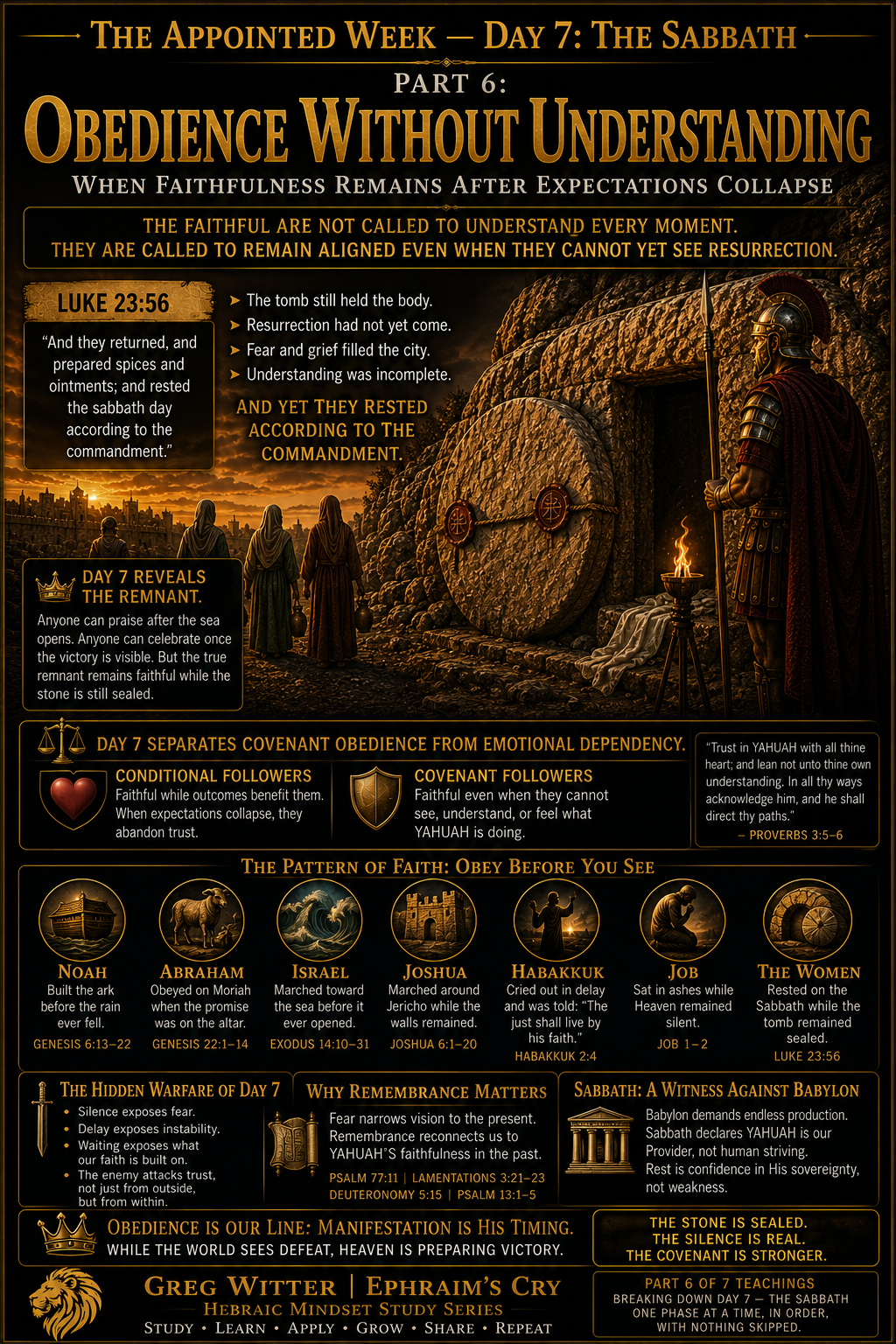
The Appointed Week — Day 7: The Sabbath
The Covenant Pattern of Rest, Silence, Separation, and Fulfillment
“The silence of Day 7 was never emptiness—it was the hidden movement of covenant fulfillment beneath the surface of human understanding.”
Part 6 — Obedience Without Understanding
When Faithfulness Remains After Expectations Collapse
“The faithful are not called to understand every moment. They are called to remain aligned even when they cannot yet see resurrection.”
Greg Witter | Ephraim’s Cry
Hebraic Mindset Study Series
Study Learn Apply Grow Share Repeat
Day 7 is the place where human understanding reaches its breaking point. The crucifixion has already taken place. The body of Messiah has already been removed from the stake and laid within the tomb (Matthew 27:57–60). The stone has already been rolled into place. The religious authorities have already secured the seal and stationed guards before the entrance (Matthew 27:62–66). Rome believes the threat has been eliminated. The chief priests believe the movement has ended. Fear fills Jerusalem. The disciples are scattered. The expectations of the people appear shattered beneath the weight of visible reality.
Everything outward appears to testify that death has won.
And yet Heaven has not altered its decree.
The promises of Yahuah have not failed. The covenant has not collapsed. The Kingdom has not been defeated. The throne has not moved. Silence does not mean abandonment. Stillness does not mean inactivity. Delay does not mean failure.
This is the tension of Day 7.
Visible reality now appears to contradict the expectation of victory. The disciples had witnessed miracles, healings, deliverance, authority over creation itself, and declarations concerning the Kingdom (Matthew 16:21; John 2:19–22). They had heard Yahusha speak concerning suffering, death, and resurrection, yet now the tomb remains sealed while silence settles over the city like a heavy covering.
This is where covenant obedience is tested.
Most people remain faithful while outcomes are visible. Most people trust while circumstances remain favorable. Most people obey while they believe they understand where the path is leading. But covenant obedience is revealed most clearly when understanding disappears.
Noah obeyed before rain ever fell upon the earth (Genesis 6:13–22). Abraham walked toward Moriah carrying the wood for the offering while the promise itself appeared bound to the altar (Genesis 22:1–14). Israel marched toward the Red Sea before the waters ever opened (Exodus 14:10–31). Joshua marched around Jericho while the walls still stood unmoved before him (Joshua 6:1–20). Habakkuk cried out while violence and confusion filled the land and was told, “The just shall live by his faith” (Habakkuk 2:4). Job sat among ashes stripped of visible certainty while Heaven itself remained silent around him for long stretches of suffering (Job 1–2).
Again and again Scripture reveals the same pattern: Yahuah often requires obedience before understanding.
This directly confronts the spirit of the modern age. Modern culture demands explanation before submission, proof before trust, visible evidence before obedience, emotional reassurance before faithfulness, and guarantees before surrender. Humanity wants resurrection without crucifixion, glory without refinement, fulfillment without waiting, and kingdom without submission. But covenant alignment has never operated according to human comfort. The faithful are not called to control outcomes. They are called to remain aligned under command.
That is exactly why Luke 23:56 carries such profound covenant weight:
“And they returned, and prepared spices and ointments; and rested the sabbath day according to the commandment.”
That single statement exposes an enormous spiritual reality. The tomb still held the body of Messiah. Resurrection had not yet been revealed. Fear filled the atmosphere. Understanding remained incomplete. Grief was real. Confusion was real. And yet the Sabbath command still stood.
The women rested according to the commandment.
Their obedience did not become conditional upon emotional clarity. Their alignment did not disappear because circumstances became painful. The commandment was not suspended because confusion entered the moment. Covenant obedience remained intact even while Heaven appeared silent.
This becomes one of the greatest revelations of Day 7: the remnant is revealed in the silence between promise and manifestation.
Anyone can praise after the sea has already opened. Anyone can celebrate once Jericho has already fallen. Anyone can rejoice after resurrection morning has already arrived. But Day 7 exposes what remains faithful while the stone is still sealed.
That is the true testing ground of covenant alignment.
Day 7 separates covenant obedience from emotional dependency. Many people claim faithfulness while outcomes benefit them, but once expectations collapse, their obedience collapses with them because their loyalty was never rooted in covenant. It was rooted in desired results.
This is why Yahusha repeatedly confronted conditional followers throughout His earthly ministry. Crowds followed while miracles multiplied, while bread increased, while healings spread, and while expectations of political deliverance remained alive (John 6:1–26). But when the teachings became difficult, when the path became costly, and when expectations were challenged, many departed (John 6:66).
The same principle appears during Day 7. Visible evidence now appears to contradict expectation, and this is where many lose alignment. But covenant obedience does not wait for complete understanding before remaining faithful.
“Trust in Yahuah with all thine heart; and lean not unto thine own understanding. In all thy ways acknowledge him, and he shall direct thy paths” (Proverbs 3:5–6).
Humanity wants understanding before trust. Covenant faithfulness trusts because Yahuah has already proven Himself trustworthy. This is not irrational faith. Covenant trust is rooted in the character, consistency, promises, and historical faithfulness of Yahuah. The faithful obey because they know who has spoken, even when they do not yet fully understand what He is doing beneath the surface.
This is why Day 7 becomes such a profound prophetic training ground for the remnant. The hidden warfare is not merely external pressure. It is internal instability. Silence forces people to confront what their trust was truly built upon. Fear begins asking dangerous questions during delay:
“Did Yahuah really speak?”
“Has the promise failed?”
“Did obedience accomplish anything?”
“Was the covenant misunderstood?”
These are the same patterns revealed from the beginning. The serpent attacked trust in Eden by questioning what Elohim had spoken (Genesis 3:1). Israel repeatedly questioned the reliability of Yahuah during wilderness pressure. Saul forced outcomes when delay exposed fear within him (1 Samuel 13:8–14). The wilderness generation repeatedly panicked whenever visible certainty weakened, even after witnessing plagues, manna, water from the rock, and the opening of the sea.
Delay exposes instability.
Silence exposes fear.
Waiting exposes whether obedience is rooted in trust or merely in immediate gratification.
This is one of the reasons Scripture continually commands remembrance. Fear narrows vision to the immediate moment, but covenant remembrance reconnects the faithful to the larger pattern of Yahuah’s historical faithfulness. David repeatedly moved from distress into remembrance:
“How long wilt thou forget me, O Yahuah? for ever?” (Psalm 13:1).
Yet later he declares:
“But I have trusted in thy mercy; my heart shall rejoice in thy salvation” (Psalm 13:5).
The visible circumstances had not yet changed, but covenant remembrance stabilized the heart before manifestation appeared.
The same principle exists throughout Day 7. While man sees silence, Heaven sees fulfillment unfolding. While the earth sees a sealed tomb, prophecy continues moving beneath the surface exactly according to the appointed pattern. The hidden work of Yahuah continues even when human perception cannot yet detect it.
Joseph was positioned in prison before elevation arrived (Genesis 39–41). David was prepared in caves before enthronement manifested (1 Samuel 22–24). Israel stood trapped between Pharaoh and the sea before deliverance appeared (Exodus 14). The dry bones remained scattered before breath entered them (Ezekiel 37:1–10). Messiah remained hidden within the sealed tomb before resurrection morning arrived.
Again and again Scripture reveals the same covenant pattern: Yahuah often works most powerfully beneath the surface where human eyes cannot yet perceive what He is preparing.
This becomes essential for understanding prophetic endurance in the last days. Many believers have unknowingly adopted an expectation that covenant faithfulness should always produce immediate visible results. But Scripture repeatedly warns that the faithful will face pressure, delay, uncertainty, opposition, deception, and endurance testing before final manifestation arrives.
“And because iniquity shall abound, the love of many shall wax cold. But he that shall endure unto the end, the same shall be saved” (Matthew 24:12–13).
The remnant is not merely defined by correct information. The remnant is defined by enduring covenant loyalty under pressure.
“Here is the patience of the saints: here are they that keep the commandments of Elohim, and the faith of Yahusha” (Revelation 14:12).
Patience there is not passive inactivity. It is enduring covenant alignment while pressure intensifies. It is remaining faithful while Babylon celebrates prematurely. It is remaining obedient while visible outcomes remain incomplete.
This is why Sabbath itself stands as a witness against every Babylonian system built upon fear-driven striving. Pharaoh demanded endless production without rest (Exodus 5:4–19). Egypt measured value through continual labor, quotas, and burden-bearing. Babylon likewise teaches endless production, endless noise, endless distraction, endless emotional stimulation, endless accumulation, and endless fear.
But Sabbath interrupts slavery systems.
Sabbath declares that provision ultimately flows from Yahuah rather than endless human striving.
This is why the manna test mattered so deeply (Exodus 16:16–30). Israel could not gather manna according to fear-driven panic. The sixth day required preparation. The seventh day required trust. Fear-driven hoarding exposed unbelief.
The same principle remains spiritually true.
Day 7 confronts the illusion that human striving controls outcomes. Humanity continually wants to manage timing, manipulate fulfillment, and secure certainty through visible control. But the sealed tomb exposes the limits of human power. Rome could seal the tomb, but Rome could not stop resurrection. The chief priests could secure guards, but they could not restrain prophecy. Darkness could celebrate temporarily, but darkness could not overturn covenant fulfillment.
The faithful are not called to manufacture resurrection. They are not called to force fulfillment. They are not called to manipulate outcomes through panic-driven striving. They are called to remain aligned until Yahuah reveals what He has already ordained.
This is one of the deepest revelations of covenant rest.
Rest is not laziness.
Rest is not passivity.
Rest is confidence under the sovereignty of Yahuah.
It is the refusal to panic while Heaven governs what man cannot yet see.
That is why Psalm 46:10 declares:
“Be still, and know that I am Elohim.”
Stillness is not weakness. Stillness is covenant confidence under the rule of Yahuah.
The women resting according to the commandment while grief remained unresolved becomes one of the clearest revelations of mature covenant faithfulness in all of Scripture. The pain was real. The confusion was real. The silence was real. And yet obedience remained.
The command remained even while the stone was still sealed.
Full teaching series, expanded studies, Academy courses, live teachings, and covenant resources available through Ephraim’s Cry:
Website:
https://ephraimscry.com
Blog:
https://ephraimscry.com/blog
Academy:
https://ephraimscry.com/academy
Events & Live Teachings:
https://ephraimscry.com/events
YouTube:
https://www.youtube.com/@EphraimsCry
#TheAppointedWeek #Day7 #TheSabbath #ObedienceWithoutUnderstanding #CovenantFaithfulness #HebraicMindset #EphraimsCry #GregWitter #Torah #KingdomOfElohim #WholeCounselOfElohim #Faithfulness #Remnant #Covenant #Truth #Scripture #Kingdom #Restoration #Sabbath #Watchman #StudyLearnApplyGrowShareRepeat
