
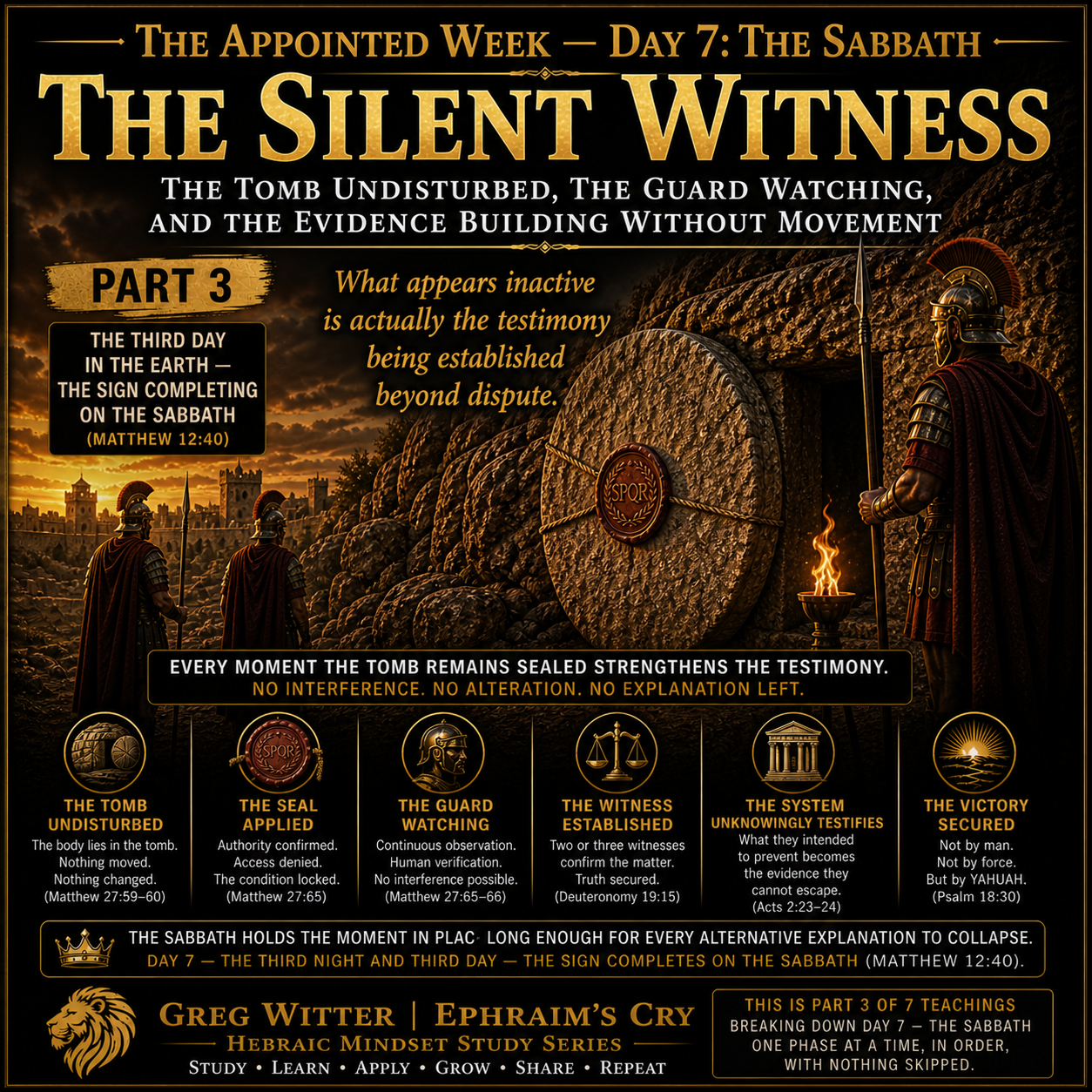
The Appointed Week — Day 7: The Sabbath — Part 3: The Silent Witness
The Tomb Undisturbed, the Guard Watching, and the Evidence Building Without Movement
Greg Witter | Ephraim’s Cry
Hebraic Mindset Study Series
Study Learn Apply Grow Share Repeat
Most people expect movement to prove that something is real. They look for action, for visible change, for something measurable that confirms progress is being made. If something is truly happening, in their mind, it must be observable, active, unfolding in a way that can be seen and tracked. And if it is not, the natural conclusion is simple—nothing is happening.
That assumption is where everything breaks.
Because covenant does not operate according to human expectation. Covenant does not rush to prove itself through visible activity. Covenant establishes, and then it holds. It does not require constant outward motion to validate what has already been set in place by Yahuah (Genesis 2:2–3). When Yahuah completed His work in creation, He did not continue working to prove it. He rested. That rest was not inactivity—it was confirmation that the work was complete.
Now that same pattern stands in the tomb.
The body of 𐤉𐤄𐤅𐤔𐤏 (Yahusha) has been taken down, wrapped in linen, and placed inside a new tomb (Matthew 27:59–60; John 19:41–42). The stone has been rolled into place. The entrance has been closed. The condition of burial has been fully established. From the outside, it is absolute stillness. No movement. No change. No visible activity.
And yet, everything is advancing exactly as spoken.
This is Day 7. The Sabbath. The third night and third day within the count that Yahusha defined—“three days and three nights in the heart of the earth” (Matthew 12:40). The sign is not waiting to be completed. It is completing. The timeline is not paused. It is moving forward with precision, even though nothing can be seen.
This is where the natural mind loses the pattern, because silence is interpreted as inactivity. But silence is not inactivity. Silence is containment. Silence is controlled environment. Silence is the deliberate removal of every competing explanation before truth is revealed.
Now the text must be allowed to speak with full weight.
Matthew records that after the burial, the chief priests and Pharisees go to Pilate, remembering the words of Yahusha: “After three days I will rise again” (Matthew 27:63). They do not believe the promise, but they fear its implication. They act—not out of faith, but out of concern that the narrative might escape their control.
So they move to secure the tomb.
They ask for authority.
They apply a seal.
They set a guard (Matthew 27:65–66).
This is not passive observation. This is full-system enforcement. Roman authority is now involved. The stone is officially sealed. The tomb is under watch. The condition is no longer simply burial—it is secured burial under authority.
And in doing this, they step into something they do not understand.
They believe they are preventing deception. They believe they are securing control. They believe they are protecting their version of events. But what they are actually doing is eliminating every alternative explanation.
Because once the tomb is sealed and guarded, the situation changes completely. No one can enter. No one can remove the body. No one can tamper with the condition. No one can interfere with what has been established.
The environment is now locked.
And that is exactly what is required.
Because resurrection cannot be argued into acceptance. It must be established beyond dispute.
Now follow the progression carefully. Every moment the tomb remains sealed strengthens the testimony. Every hour that passes removes another possible explanation. Every watch of the guard confirms the same reality again and again—nothing has happened, nothing has changed, nothing has been touched.
This is not empty time.
This is evidence being built.
Not by action—but by restriction.
Now bring in the covenant legal structure. Yahuah established that “a matter shall be confirmed by the mouth of two or three witnesses” (Deuteronomy 19:15). That principle is not abstract—it is operational. It governs how truth is established. And here, on Day 7, the witnesses are undeniable.
The tomb itself stands as a witness—its condition unchanged, its contents undisturbed.
The seal stands as a witness—authority applied, interference prohibited.
The guard stands as a witness—continuous observation, human verification.
And beyond that, the system itself stands as a witness—enforcing the very conditions that validate what is coming.
They do not agree with the truth.
But they are establishing it.
That is the weight of what is happening.
This is not Yahuah trying to prove something through spectacle. This is Yahuah allowing the system to secure itself into a position where it cannot escape the truth when it is revealed. They believe they are securing death—but they are securing the testimony of resurrection.
Now the timeline must remain clear and anchored. This is Day 7. The Sabbath. The third day and third night within the count (Matthew 12:40). The count has already begun at burial. Evening to morning, night to day, the cycle is advancing exactly as established in creation (Genesis 1:5). Fulfillment is unfolding, even though nothing appears to be moving.
Time is progressing.
The word is holding.
The sign is completing.
Silence has not stopped anything.
Now bring in the alignment across the full witness of Scripture. Creation establishes the pattern—work completed, then rest (Genesis 2:2–3). Torah commands the same structure—cease from labor, recognize Yahuah’s authority (Exodus 20:8–11). Messiah declares the same reality—“It is finished” (John 19:30), and then He enters rest in the tomb.
This is not symbolic layering.
This is structural consistency.
Everything converges here.
Now return to the human perspective, because this is where the tension becomes personal. The disciples are scattered. Confused. Disoriented. Their expectations have collapsed (Luke 24:21). Everything they thought would happen did not happen the way they expected. The promise appears buried. The movement appears over. The outcome is not visible.
And yet—
the command still stands.
Luke records it without apology: “They rested on the Sabbath according to the command” (Luke 23:56). That line carries more weight than most realize. This is obedience without clarity. This is alignment without understanding. This is covenant faith when nothing makes sense.
Now the confrontation must come forward.
Most people cannot endure this phase.
They need movement. They need confirmation. They need visible progress. They need something to reassure them that what they believe is still unfolding.
But Day 7 removes all of it.
No movement.
No visible proof.
No outward activity.
Only:
The command (Exodus 20:8–11).
The structure (Genesis 1:5).
The word spoken (Matthew 12:40).
This is where faith is proven—not when things are happening, not when miracles are visible, but when everything appears still.
Do you remain aligned when nothing is moving?
Do you remain obedient when the outcome is not visible?
Do you hold to the command when everything looks finished?
Because that is the proving ground.
Now bring in what most overlook entirely. The tomb represents what appears to be finality. It represents closure. It represents the end of expectation. Everything looks concluded. But covenant does not end at what appears final—it fulfills beyond it.
That is the tension of Day 7.
Everything appears finished—
but fulfillment is still unfolding.
Now extend this forward, because this is not only historical—it is prophetic. There will be moments when everything appears sealed again. When authority structures appear absolute. When the system controls narrative, movement, and outcome. When silence dominates and nothing appears to be happening.
And in that moment, the same question will stand:
Will you remain aligned when you cannot see what Yahuah is doing?
Because the pattern does not change.
Day 7 is not empty.
It is not passive.
It is not inactive.
It is the moment where testimony is established, evidence is secured, and truth is locked into place beyond dispute. Most people miss it because they are waiting for movement. But covenant does not require movement to establish truth.
It establishes—
and then it stands.
Full teaching series available at:
https://ephraimscry.com/blog
This is Part 3 of the Day 7 Sabbath teachings
in The Appointed Week series.
Inspection is uncomfortable.
But covenant demands it.
#GregWitter #EphraimsCry #HebraicMindset #TheAppointedWeek #Day7 #Part3 #TheSilentWitness #Sabbath #TombSealed #GuardWatching #CovenantWitness #TruthEstablished #HiddenWork #Yahusha #Yahuah #Remnant
