
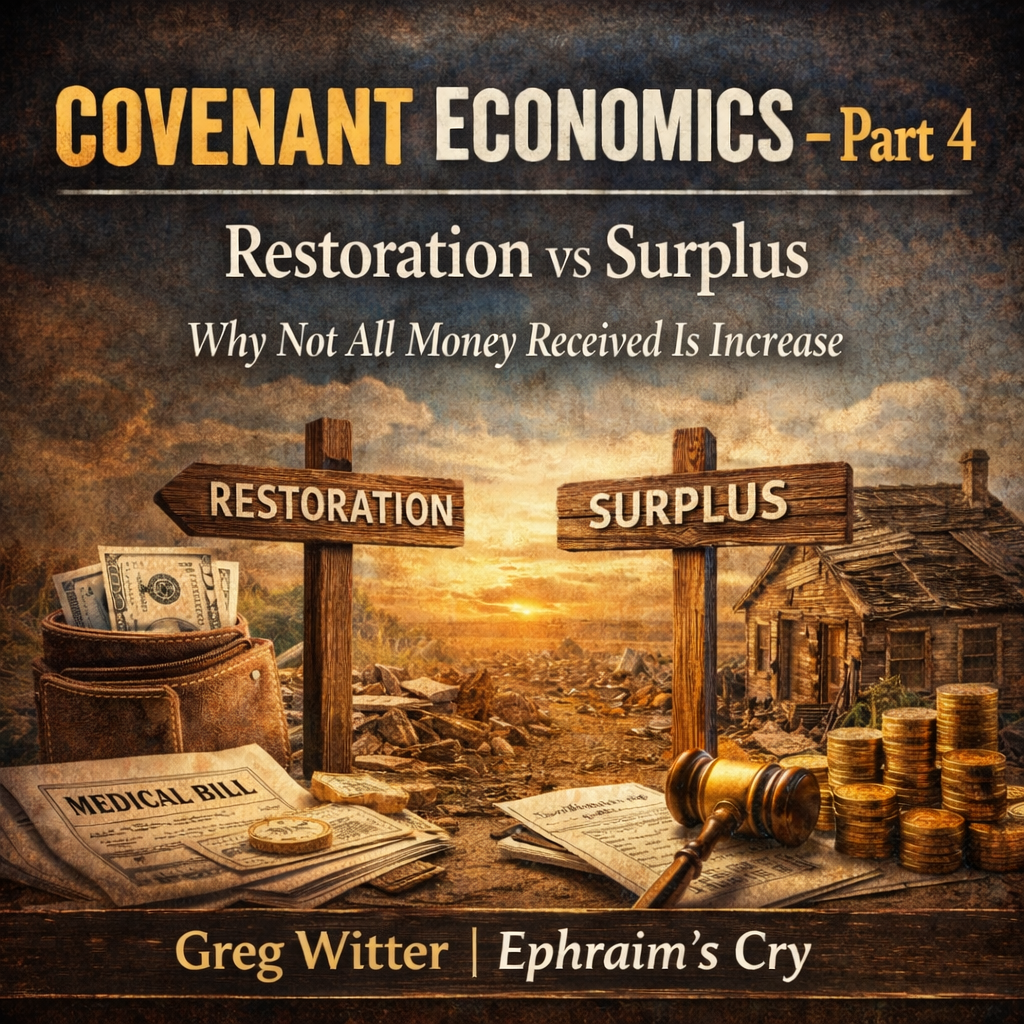
COVENANT ECONOMICS – Part 4
Restoration vs Surplus
Why Not All Money Received Is Increase
Greg Witter | Ephraim’s Cry
Hebraic Mindset Study Series
Study • Learn • Apply • Grow • Share • Repeat
INTRODUCTION: A CRITICAL DISTINCTION THAT IS OFTEN IGNORED
One of the most damaging errors in modern religious teaching is the failure to distinguish between restoration and increase.
Many people have been told that any money received—no matter the reason, circumstance, or purpose—automatically qualifies as titheable income. Scripture never teaches this. In fact, Torah consistently distinguishes between what restores loss and what produces surplus.
When this distinction is ignored, giving becomes exploitative rather than covenantal. Yahuah does not demand obedience that multiplies loss or prolongs hardship. He is a restorer before He is a multiplier.
Understanding restoration is essential to understanding covenantal tithing.
WHAT RESTORATION IS IN SCRIPTURE
Restoration is the return of what was lost, damaged, taken, or withheld. It is not new gain. It is not profit. It is not surplus.
Torah repeatedly commands restoration as an act of justice, not generosity.
“If a man steals… he shall surely make restitution.”
(Exodus 22:1–4)
Restoration returns a person to their prior state. It does not advance them beyond it.
Because of this, restoration is not increase.
TAX RETURNS AND OVERPAYMENTS
A tax return is not income. It is the return of money that was already earned but temporarily withheld.
Scripture recognizes lawful obligations to governing authorities but does not redefine returned funds as gain.
Money returned after overpayment does not create surplus. It corrects imbalance.
Therefore, tax returns do not qualify as increase and are not subject to tithing.
INSURANCE PAYOUTS AND DISASTER RELIEF
Insurance payouts exist to restore loss caused by theft, damage, accident, or disaster. They are not profit-generating mechanisms.
Whether the loss involves a home, vehicle, business, or personal property, insurance funds are intended to bring a person back to where they were before the loss occurred.
Torah does not tithe loss being repaired.
Only after full restoration is complete—and only if surplus remains—can increase even be evaluated.
LEGAL SETTLEMENTS AND JUDGMENTS
Legal settlements and court judgments are forms of restitution. They exist to compensate for harm, injury, withheld wages, damages, or injustice.
Scripture recognizes restitution as corrective justice, not gain.
Restoration may cover:
medical expenses
legal fees
lost income
damages
emotional or physical harm
Until restoration is complete, there is no increase. Only surplus beyond full restoration can ever qualify.
GIFTS GIVEN FOR RELIEF AND SUPPORT
Scripture commands generosity toward those in need. Gifts given to relieve hardship, support survival, or meet urgent needs are acts of mercy.
A gift does not automatically equal increase.
If a gift:
covers rent
buys food
pays utilities
offsets loss
supports survival
It is provision or restoration, not surplus.
Torah never commands the needy to tithe mercy.
INHERITANCE AND INSURANCE BENEFITS
Inheritance and insurance benefits often follow death, loss, or major life disruption. Scripture treats inheritance as provision and continuity, not automatic increase.
An inheritance may be required to:
settle debts
stabilize housing
replace lost income
restore family security
Only after those needs are met, and only if surplus remains, does increase exist.
Scripture does not tithe grief.
WHEN RESTORATION BECOMES SURPLUS
Restoration ends when balance is restored.
If, after restoration:
debts are cleared
losses are repaired
stability is reestablished
provision is secure
And surplus remains, that surplus may then qualify as increase.
Until that point, no tithe obligation exists.
COVENANTAL CLARITY VS RELIGIOUS PRESSURE
Covenantal understanding:
restoration precedes increase
justice precedes generosity
mercy precedes obligation
surplus defines titheability
Religious distortion:
all money is titheable
loss is ignored
hardship is spiritualized
guilt replaces discernment
One reflects the heart of Yahuah.
The other reflects exploitation.
WHY THIS DISTINCTION MATTERS
Many people have been pressured to tithe from moments of grief, crisis, and loss. Scripture never endorses this. Yahuah is described as compassionate, just, and near to the brokenhearted.
“He executes justice for the oppressed and gives food to the hungry.”
(Psalm 146:7)
Correctly distinguishing restoration from increase protects the vulnerable and preserves the integrity of covenant obedience.
CLOSING ORIENTATION
Before anyone is asked to give, one truth must be honored:
Restoration is not increase.
Yahuah restores first. Only then does He multiply.
The next installment will turn to a related but distinct topic that has also been misunderstood:
Offerings vs Tithes — What Is Required and What Is Voluntary.
That will be examined in COVENANT ECONOMICS – Part 5
Tithes and Offerings: Obligation vs Freewill Giving.
HASHTAGS
#EphraimsCry #GregWitter #HebraicMindset #CovenantEconomics #CovenantalTithing #RestorationNotIncrease
#BiblicalStewardship #TorahTruth #ScriptureOverTradition #KingdomOrder #MercyBeforeObligation #BlessingNotBurden
