
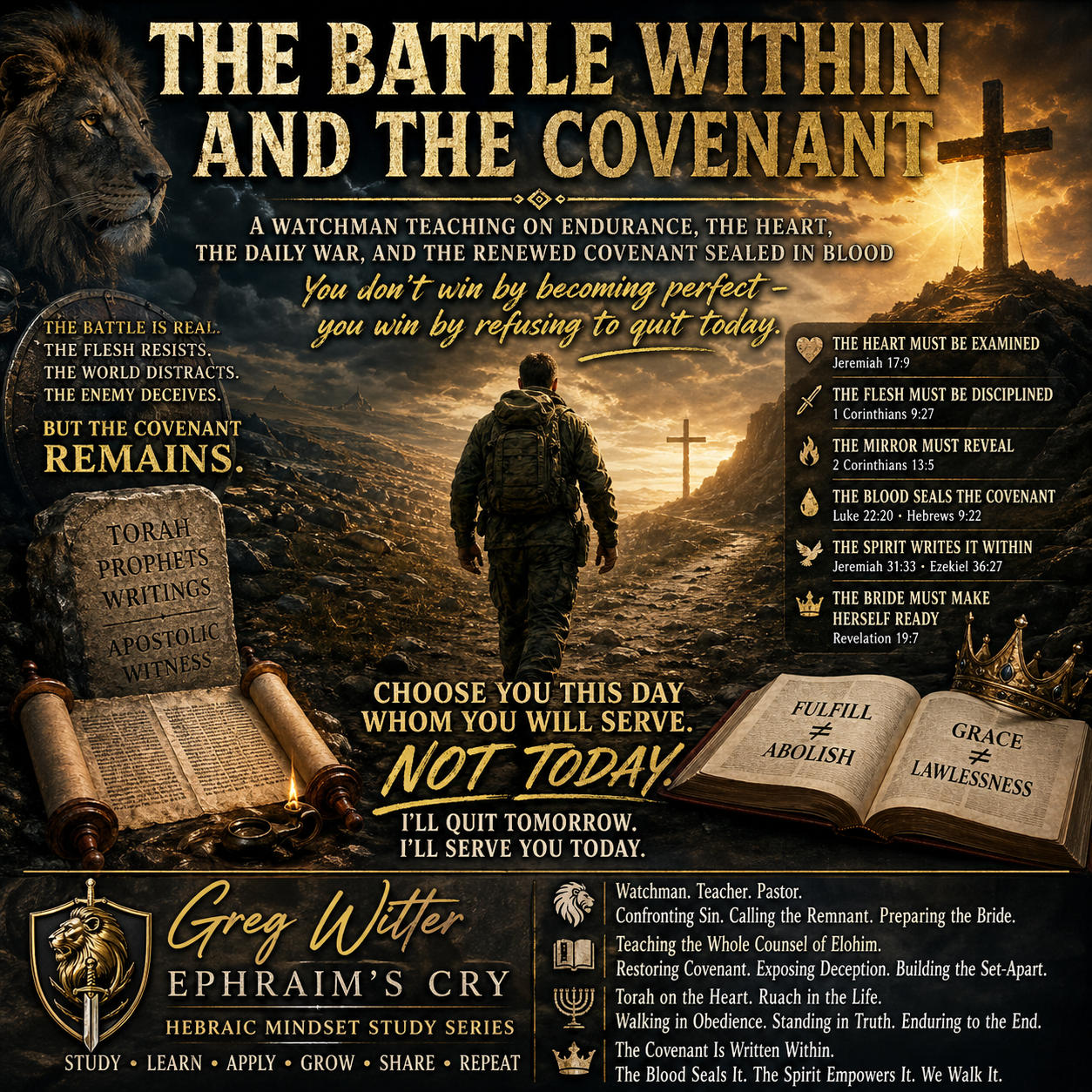
The Battle Within and the Covenant
A Watchman Teaching on Endurance, the Heart, the Daily War, and the Renewed Covenant Sealed in Blood
You don’t win by becoming perfect—you win by refusing to quit today.
Greg Witter | Ephraim’s Cry
Hebraic Mindset Study Series
Study Learn Apply Grow Share Repeat
This is not theory. This is not a polished religious thought arranged for comfort. This is not an inspirational slogan designed to make weak men feel strong while they continue surrendering to the flesh. This is covenant reality. This is the daily war. This is the battle within and the covenant. It is the place where the truth of what a man teaches is tested against the truth of how he walks. It is the place where the words of the mouth, the desires of the heart, the habits of the body, the hidden motivations of the mind, and the obedience of the life are all brought before the mirror of the Word and examined in the sight of Yahuah.
This teaching begins with a hard truth: a man can be broken and still be used. Those two truths do not cancel each other. They define the walk. A broken vessel is not automatically disqualified. A proud vessel is. A corrected vessel is not cast away because he is being refined. A rebellious vessel is. The difference is not whether weakness exists. The difference is what a man does when weakness is exposed. The difference is whether he hides it, excuses it, defends it, and builds doctrine around it—or whether he brings it into the light, confesses it, corrects it, and continues walking.
Scripture does not flatter the heart. It exposes it. “The heart is deceitful above all things, and desperately wicked: who can know it?” (Jeremiah 17:9). That verse is not written so a man can condemn himself into despair. It is written so he stops trusting his flesh. It is written so he understands that the heart cannot be left unexamined, ungoverned, uncorrected, and unsubmitted. The heart must be brought under covenant. The heart must be brought under the Word. The heart must be brought under the discipline of the Ruach HaKodesh. The heart must be examined daily because what is hidden in the heart eventually becomes visible in the walk.
The covenant walk is not the absence of struggle. It is the presence of war. Paul did not speak as a man who had escaped the battle. He spoke as a man who understood that the body must be disciplined, the flesh must be resisted, and the life must be brought under obedience. “But I keep under my body, and bring it into subjection: lest by any means, when I have preached to others, I myself should be disqualified” (1 Corinthians 9:27). That is not religious poetry. That is warfare. That is not the language of a man who assumes that because he teaches truth, he is beyond danger. That is the language of a man who knows that preaching to others does not remove the need to examine himself.
That matters. A teacher is not exempt. A watchman is not exempt. A man who warns others is not exempt. A man who sees deception clearly is not exempt. A man who understands covenant, Torah, prophecy, restoration, blood, and priesthood is not exempt. If anything, the weight is greater because knowledge increases accountability. “My brethren, be not many teachers, knowing that we shall receive the greater condemnation” (James 3:1). The man who teaches must examine more, not less. He must tremble more, not less. He must guard his words more, not less. He must fear misleading others more, not less. Teaching truth does not cancel the need for refinement. It intensifies it.
So the standard is not that you never struggle. The standard is not that you never feel temptation. The standard is not that your flesh never speaks. The standard is not that you never become weary, discouraged, wounded, angry, exposed, corrected, or pressed. The standard is this: you do not surrender. You do not make peace with sin. You do not redefine disobedience. You do not build excuses around weakness. You do not quit today.
There was a time when this principle was forged physically. It was not learned in comfort. It was learned under pressure. Three days without sleep. Three days moving, walking, carrying over a hundred pounds of weight. The body hurt. The body ached. The body was tired. The body was sore. Thebody was injured. There comes a point where strength is gone, where the mind is worn down, where every step becomes its own decision, where the thought is no longer simply, “This is hard,” but, “I do not know if I can take another step.” And deeper still, “I just want to lay down and die.” And that was only training.
In Special Forces training, every day there was an opportunity to quit. No questions asked. No debate. No complicated explanation required. Just quit. Walk away. End the pain. Stop the pressure. Lay the burden down. Every day the door was open, and every day the question had to be faced. Will I quit today?
And every day the answer became a strategy: “I will quit tomorrow.”
Not today. Tomorrow.
That was not weakness. That was endurance. That was not surrender. That was strategy. The flesh wanted relief today, but the will answered, “Not today.” And when tomorrow came, it was no longer tomorrow. It was today again. So the same decision had to be made again: “I will quit tomorrow.” That is how endurance is built. Not by conquering the entire future at once. Not by pretending pain is not real. Not by acting as though the body is not exhausted, the heart is not wounded, or the soul is not under pressure. Endurance is built by refusing to surrender today.
“He that shall endure unto the end, the same shall be saved” (Matthew 24:13). The text does not say, “He who never feels the battle.” It says, “He who endures.” Endurance assumes resistance. Endurance assumes pressure. Endurance assumes something is pushing against you hard enough that quitting becomes a real possibility. If there were no pressure, endurance would not be required. If there were no war, steadfastness would not be tested. If there were no flesh, obedience would not need to be chosen.
But the battlefield is not always physical. Sometimes the battle is in the body, but sometimes it is in the mind. Sometimes it is in the emotions. Sometimes it is personal. Sometimes it is spiritual. Sometimes something gets revealed in you that you did not want to see. Sometimes correction comes and it hurts. Sometimes truth exposes something hidden in the corner of the heart, and the first reaction is not humility but defense. Sometimes an event in life cuts open something you thought was healed. Sometimes a word, a memory, a failure, a correction, a disappointment, or a confrontation brings pain to the surface, and emotions rise quickly.
That is also the battlefield. The flesh reacts. The mind argues. Pride defends. Hurt wants to lash out. Fear wants to withdraw. Shame wants to hide. Anger wants to answer. The desire for relief says, “Quit. Shut down. Walk away. React. Defend yourself. Make it stop.” And in that moment, the same word must be spoken: not today.
Not today will I let emotion rule me. Not today will I let pain define me. Not today will I let exposure destroy me. Not today will I let correction harden me. Not today will I let the flesh take control. Not today will I quit covenant. Not today will I stop examining. Not today will I excuse what Yahuah is revealing. Whether the battle is in the body, the mind, the heart, the home, the work, the ministry, the relationships, the correction, or the hidden places of the soul, the answer does not change: not today.
This is why the battle must be anchored in covenant, because without covenant this becomes self-effort. Without covenant, discipline becomes pride. Without covenant, endurance becomes human willpower. Without covenant, correction becomes condemnation. Without covenant, failure becomes despair. Covenant gives the battle its meaning because covenant defines who we serve, what standard governs us, what blood seals us, what Spirit leads us, and what end we are pressing toward.
Sin must be defined clearly. Scripture defines sin: “Whosoever committeth sin transgresseth also the law: for sin is the transgression of the law” (1 John 3:4). If sin is transgression of the law, then Torah still defines sin. If Torah is written on the heart, then Torah has not been abolished. If sin is undefined, repentance becomes meaningless. If the standard is removed, obedience becomes subjective. If obedience becomes subjective, every man does what is right in his own eyes. That is not covenant. That is lawlessness.
This is where many have been deceived. They were taught that the covenant was replaced. They were taught that “new” means different, foreign, unrelated, and disconnected from what Yahuah already established. They were taught that grace removes obedience, that fulfillment means cancellation, that Messiah came to free men from the very standard He embodied. But Yahusha said, “Think not that I am come to destroy the law, or the prophets: I am not come to destroy, but to fulfil” (Matthew 5:17). He did not say He came to abolish. He explicitly said not to think that. He continued, “For verily I say unto you, Till heaven and earth pass, one jot or one tittle shall in no wise pass from the law” (Matthew 5:18). Then He warned that whoever relaxes even the least of the commandments and teaches men so will be called least in the Kingdom, but whoever does and teaches them will be called great (Matthew 5:19).
Fulfill does not mean abolish. Fulfill means to bring to fullness, to fill up, to bring to complete expression, to embody what was written, to reveal its intended meaning, to walk it without defect, and to establish its true weight. Yahusha did not come to destroy the Torah. He came as the living Word, walking in perfect obedience, exposing corrupt handling of the Word, correcting man-made traditions, and sealing the covenant by His blood.
Hebrews 7–10 must be handled correctly. It is not teaching the abolition of the covenant. It is teaching a change in priesthood, mediation, sacrifice, and administration. Hebrews 7 deals with priesthood. Hebrews 8 continues the argument and quotes Jeremiah 31. Hebrews 9–10 deals with sacrifice, blood, access, and the once-for-all offering. The covenant itself is not replaced. The administration changes. The priesthood changes. The mediator changes. The sacrificial system is fulfilled. Access is transformed. But Yahuah’s righteous standard is not erased.
Jeremiah 31 defines the covenant clearly: “I will put My Torah within them, and write it in their hearts” (Jeremiah 31:33). That is not Torah removed. That is Torah internalized. That is not a lawless covenant. That is covenant restoration. Ezekiel gives the same witness: “And I will put My Spirit within you, and cause you to walk in My statutes, and ye shall keep My judgments, and do them” (Ezekiel 36:27). The Spirit does not lead men away from Yahuah’s statutes. The Spirit causes covenant obedience from within. Paul confirms the same alignment when he says, “Do we then make void the law through faith? Elohim forbid: yea, we establish the law” (Romans 3:31). Faith does not void Torah. Faith establishes it.
This covenant is sealed in blood. When Yahusha took the cup and said, “This cup is the covenant in My blood” (Luke 22:20), He was not creating a lawless religion. He was sealing the renewed covenant. The wine represents the blood of the covenant. His body given and His blood poured out are not symbols of abolition; they are the covenant ratification. “Without shedding of blood is no remission” (Hebrews 9:22). Blood is required for remission. Blood seals covenant. Blood answers the legal reality of sin. Blood establishes what flesh could not secure. His resurrection then establishes the covenant as living, enduring, and eternal, because the mediator is not dead and temporary, but alive forever.
That is why the renewed covenant is not a lesser covenant. It is not a softer covenant. It is not a lawless covenant. It is a deeper covenant. The standard moves from external tablets to the internal heart. The administration is now through Yahusha as mediator and the Ruach HaKodeshdwelling within, causing obedience from the inside. The covenant is not merely commanded from outside; it is written within. The question is no longer whether the instruction exists. The question is whether the heart is yielding to what has been written.
This is where the false system must be exposed. There is a system that teaches “new covenant” means new rules, new laws, new morality, new religion, and new permission to disregard what Yahuah commanded. There is a system that teaches grace means permission. There is a system that teaches fulfilled means abolished. There is a system that teaches love without obedience, faith without covenant, Messiah without Torah, and redemption without transformation. That system is not covenant restoration. It is lawlessness dressed as redemption.
The deception is subtle. It is not always large. It is often small. A word supplied where it can shift the reader’s hearing. A meaning assumed that the text itself did not say. A phrase interpreted through replacement theology. A doctrine built on convenience instead of covenant. A calendar simplified by adding to and taking from the instructions. A command softened because obedience is inconvenient. A tradition accepted because it is easier than testing. This is how deception works. Yahusha warned that false christs and false prophets would arise and deceive many, and if possible, even the elect (Matthew 24:24). That means deception can be small enough to appear harmless and strong enough to redirect entire lives.
This is why the mirror matters. This is why examination matters. This is why a man must test himself daily, not merely test others. “Examine yourselves, whether ye be in the faith; prove your own selves” (2 Corinthians 13:5). Examination is not occasional. It is not reserved for crisis. It is not something done only when someone else catches you. It is covenant discipline. A man must stand before the mirror of the Word and ask: What was revealed today? Where did I fail? Where did I resist? Where did I speak from flesh? Where did I hear the Ruach and not obey? Where did pride dress itself as confidence? Where did desire dress itself as need? Where did anger dress itself as righteousness?
The flesh is real. The lust of the flesh, the lust of the eyes, and the pride of life are real. “For all that is in the world—the lust of the flesh, and the lust of the eyes, and the pride of life—is not of the Father, but is of the world” (1 John 2:16). This does not always appear in dramatic form. Sometimes it is simple. “I want it. I see it. I know I should not have it. I take it anyway.” Something as small as ice cream can expose the principle. You know it is not good for you. You know you should not. You know it is not wise. But you want it, and the flesh argues for it. Then there are deeper things—the lusts that do not need to be named because every honest man knows the battlefield. The eyes see. The flesh wants. The heart justifies. The will chooses.
Then comes pride. Pride says, “I have done this. I know this. I have walked this path for years. I have studied. I understand. I can.” Pride speaks in the first person and forgets submission. Pride forgets to say, “If it be Your will.” Pride forgets dependence. Pride forgets that wisdom comes from above. Pride forgets that knowledge without humility becomes dangerous. Pride can even take truth and wield it wrongly. That is why truth must be carried with fear, trembling, mercy, and submission.
There is a difference between struggle and lawlessness. This difference must be made plain. The man who struggles hates sin. The lawless man defends it. The man who struggles falls and rises. The lawless man falls and stays. The man who struggles confesses and corrects. The lawless man excuses and redefines. The man who struggles grieves when he violates the standard. The lawless man attacks the standard so he does not have to repent. The man who struggles says, “I failed; Father, correct me.” The lawless man says, “It does not matter; grace covers it.” Those are not the same spirit.
Yahusha asked, “Why call ye Me, Master, Master, and do not the things which I say?” (Luke 6:46). That question cuts through every claim. A man can say he loves Yahusha, but Yahusha said, “If ye love Me, keep My commandments” (John 14:15). John wrote, “And hereby we do know that we know Him, if we keep His commandments. He that saith, I know Him, and keepeth not His commandments, is a liar, and the truth is not in him” (1 John 2:3–4). That is not opinion. That is the apostolic witness. The evidence is not a claim. The evidence is alignment.
The evidence of the Ruach is not merely that a man says, “I have the Spirit.” The evidence is that the Spirit causes him to walk in Yahuah’s statutes (Ezekiel 36:27). The evidence is that there is an inward pull toward obedience even while the flesh resists. The evidence is that sin bothers him. The evidence is that he cannot comfortably remain in rebellion. The evidence is that when he fails, he is drawn to confess, correct, and return. The evidence is that the Word cuts him first before he uses it to cut others.
That is why the daily rhythm matters. In the morning, the day must be given to the Father. Before the work begins, before the mouth speaks, before the hands move, before the reactions come, the day must be surrendered. “Father, this day is Yours. Today I choose to serve You. Guide my path. Guide my work. Guide my words. Fill me with Your presence, Your knowledge, Your wisdom, and Your guidance. Let what I do today honor and glorify You.” This is not ritual. This is alignment. This is choosing whom you will serve before the day tests that choice.
Joshua said, “Choose you this day whom ye will serve” (Joshua 24:15). That choice is not made once and then forgotten. It is made daily. It is made in the morning before the battle unfolds. It is made again when the flesh rises. It is made again when the eyes want what they should not have. It is made again when pride wants to answer. It is made again when the Ruach prompts quietly and obedience requires action. It is made again when correction comes. It is made again when you want to quit. Choose this day. Not merely someday. Not theoretically. Today.
The evening then becomes the place of accounting. At the end of the day, a man must stand before the Father and examine what happened. “I got angry. That made me mad. I wanted to quit. I failed. I misspoke. I lied. I heard the prompting and did not obey. I saw what was right and chose what was easy.” Sometimes a misspeaking is not merely a mistake. Sometimes it becomes a lie because the heart knew and still shaped the words wrongly. Sometimes it happens fast. Sometimes the intent is subtle. Sometimes the realization comes later, and when it comes, the man must not hide from it.
There are failures that must be confessed before Yahuah alone, and there are failures that require going back to another person. That is where humility becomes real. It is one thing to say privately, “Father, forgive me.” It is another thing to go to someone and say, “I lied. I was wrong. I am not making excuses.” That is getting back up. That is not wallowing in the mud. That is not covering sin. That is not pretending. That is repentance with action. “Confess your faults one to another, and pray one for another, that ye may be healed” (James 5:16). Confession is not weakness. It is covenant repair.
Getting back up is not a feeling. It is a decision. First, you must see the failure. Then you must admit the failure. Then you must confess the failure. Then you must correct the failure. Then you must continue. You do not get back up by pretending you never fell. You get back up by telling the truth about the fall and refusing to stay there. “For a just man falleth seven times, and riseth up again” (Proverbs 24:16). The difference is not that the righteous man never falls. The difference is that he rises.
This is where many deceive themselves. They think because they fell, they are finished. That is despair. Others think because grace exists, they can stay down and rename the mud freedom. That is lawlessness. Covenant does neither. Covenant says: see it, confess it, correct it, stand again. Not because failure is acceptable, but because repentance is required. Not because sin is small, but because blood has been shed, and that blood is not permission to continue in rebellion. It is the covenant provision for remission, restoration, and continued obedience.
Paul asks, “Shall we continue in sin, that grace may abound? Elohim forbid” (Romans 6:1–2). Grace is not permission to remain in sin. Grace trains. Grace disciplines. Grace restores. Grace does not erase the standard; grace empowers the walk. If grace is preached as permission, it has been twisted. If grace is preached as covenant power to return, obey, endure, and be transformed, it is being handled correctly.
This is why love must be understood correctly. Many will accuse a watchman of being harsh, unloving, too direct, too strong, too forceful, or too opinionated. But when the Word is being handled rightly, the issue is not personality. The issue is truth. Torah, Prophets, Writings, and Apostolic witness must align. If they do not align, the teaching is false. If they do align, then the accusation of “opinion” becomes a shield used to avoid correction.
Love without guidance is not love. Love without correction is not love. Psalm 23 says, “Thy rod and Thy staff they comfort me” (Psalm 23:4). The rod corrects and protects. The staff guides and draws near. Both comfort. The rod without the staff can become harsh. The staff without the rod can become compromise. But rod and staff together reveal covenant care. Correction is not the absence of love. Correction can be the expression of it. “Faithful are the wounds of a friend; but the kisses of an enemy are deceitful” (Proverbs 27:6). A wound from truth can heal. A kiss from deception can destroy.
Yet truth must be carried with mercy. This is the lesson that must be learned continually. When confronting sin, there is often little room for softness because sin deceives, hardens, and destroys. But the one correcting must remember that he is also being corrected. The one warning must remember he is also under examination. The one exposing must remember his own heart is deceitful and must be watched. Mercy must sit on top of correction. Not to weaken truth, but to keep the vessel from becoming proud while delivering it.
This is all process. Sanctification is process. Endurance is process. Refinement is process. Purification is process. Cleansing is process. “Work out your own salvation with fear and trembling” (Philippians 2:12). That does not mean earn salvation by flesh. It means the covenant life must be walked out with reverence, seriousness, trembling, examination, and obedience. It means what is inside must be brought into the walk. It means the heart must be cleansed as the Word exposes it. It means the flesh must be resisted as it rises. It means the corners of the heart must not be left dark when the mirror reveals them.
Malachi says, “But who may abide the day of His coming? and who shall stand when He appeareth? for He is like a refiner’s fire, and like fullers’ soap” (Malachi 3:2). Fire burns. Soap scrubs. Refinement is not comfortable. Purification does not flatter the vessel. It removes impurity. It exposes mixture. It reveals what does not belong. That is why the process hurts. Not because Yahuah is cruel, but because impurity resists removal. Flesh does not volunteer to die. Pride does not volunteer to bow. Lust does not volunteer to be restrained. The heart must be confronted.
The bride must make herself ready. Revelation says, “The marriage of the Lamb is come, and His wife hath made herself ready” (Revelation 19:7). That is not passive. That is not careless. That is not automatic. The bride prepares. The bride cleanses. The bride responds. The bride does not treat covenant as a slogan. The bride does not say, “I believe,” while refusing to be washed. The bride does not hide stains and call them freedom. The bride makes herself ready.
So the question must be asked directly: Are you making yourself ready? Are you allowing the Word to expose the corners of your heart? Are you walking through the furnace of refinement, or are you avoiding the fire? Are you confessing what is revealed, or are you defending it? Are you cleansing what Yahuah exposes, or are you covering it with religious language? Are you choosing today whom you will serve, or are you drifting while calling it faith?
The remnant identity is not vague. “Here is the patience of the set-apart ones: here are they that keep the commandments of Elohim, and the faith of Yahusha” (Revelation 14:12). Both. Always both. Commandments of Elohim and faith of Yahusha. Not commandments without Messiah. Not Messiah without commandments. Not Torah without testimony. Not testimony without Torah. The remnant is identified by the alignment of obedience and faith.
This is why the battle within matters. The public confession must match the private war. A man cannot teach covenant while refusing examination. A man cannot expose deception while hiding from the mirror. A man cannot call others to obedience while excusing his own disobedience. A man cannot warn the bride to make herself ready while refusing refinement in his own life. Judgment begins at the house (1 Peter 4:17), and every man must give account. “For we must all appear before the judgment seat” (2 Corinthians 5:10). That reality should produce sobriety, not fear-driven collapse. It should produce daily examination, not despair.
The fear of Yahuah is clean. It anchors the soul. It keeps a man from treating grace cheaply. It keeps him from thinking his calling exempts him from correction. It keeps him from imagining that knowledge equals obedience. “Let us hear the conclusion of the whole matter: Fear Elohim, and keep His commandments: for this is the whole duty of man” (Ecclesiastes 12:13). That is not old and obsolete. That is the conclusion of the matter. Fear Elohim. Keep His commandments. Walk covenant.
And when you fail, do not quit. When you are exposed, do not run. When correction hurts, do not harden. When the flesh rises, do not obey it. When the eyes desire, do not surrender to them. When pride speaks, silence it. When the Ruach prompts, obey. When you miss it, return. When you fall, rise. When you lie, confess. When you wound, repair. When you are wrong, say so. When you are weary, say, “I will quit tomorrow.” But today, serve.
Morning: give the day to the Father. “Today I choose to serve You.” Midday: walk the battle. Listen. Obey. Resist. Evening: examine the day. Confess. Correct. Learn. Then rise again. This is the daily covenant rhythm. This is the operating system of endurance. This is how a broken vessel remains usable. Not because he is flawless, but because he remains submitted. Not because he never fails, but because he refuses to make failure his home.
This is the choice. “Choose you this day whom ye will serve” (Joshua 24:15). The choice is daily. The choice is practical. The choice is visible. The choice is tested in the appetite, in the eyes, in the tongue, in the anger, in the private thought, in the correction, in the apology, in the hidden prompting, in the moment no one sees but Yahuah. Who will you serve today?
Are you making yourself ready, or are you falling away? Are you walking through refinement, or are you fleeing the fire? Are you letting the covenant be written within, or are you resisting the very work you claim to believe? Are you teaching obedience while refusing it, or are you allowing the Word to cut you first?
Tomorrow is not the day you quit. Tomorrow is the day you stand before Yahuah. So today, remain. Today, serve. Today, obey. Today, examine. Today, confess. Today, correct. Today, endure. Today, say to the flesh, to fear, to pain, to pride, to despair, to deception, and to every pressure that tells you to stop: not today.
The covenant is not replaced. It is renewed, restored, and written on the heart. It is sealed in the blood of Yahusha. Without the shedding of blood there is no remission. His sacrifice ratifies the covenant, and His resurrection establishes it as living and enduring. The priesthood changed. The mediation changed. The sacrifice changed. The administration changed. The standard did not. The administration of the covenant is now carried by Yahusha as mediator and worked within us by the Ruach HaKodesh, who writes the covenant internally and causes us to walk in Yahuah’s statutes. The covenant is not merely over us; it is written within us.
You do not win by becoming flawless. You win by refusing to quit today.
You do not endure by pretending the flesh is weak. You endure by admitting the flesh is strong and choosing covenant anyway.
You do not overcome by hiding from the mirror. You overcome by looking into it, confessing what is revealed, correcting what must be corrected, and standing again.
You do not prepare as the bride by claiming readiness. You prepare by being refined.
So choose today.
Serve today.
Endure today.
Quit tomorrow.
This is “The Battle Within and the Covenant”
Welcome to the battlefield.
#GregWitter, #EphraimsCry, #HebraicMindset, #CovenantRestored, #TorahOnTheHeart, #FaithAndObedience, #EndureToTheEnd, #NotToday, #SpiritualBattle, #RuachHaKodesh, #WalkInTruth, #SetApartLiving, #CovenantLife, #RefinedByFire, #DailyObedience, #KingdomWalk, #NoCompromise, #TruthAndMercy, #PrepareTheBride,
