
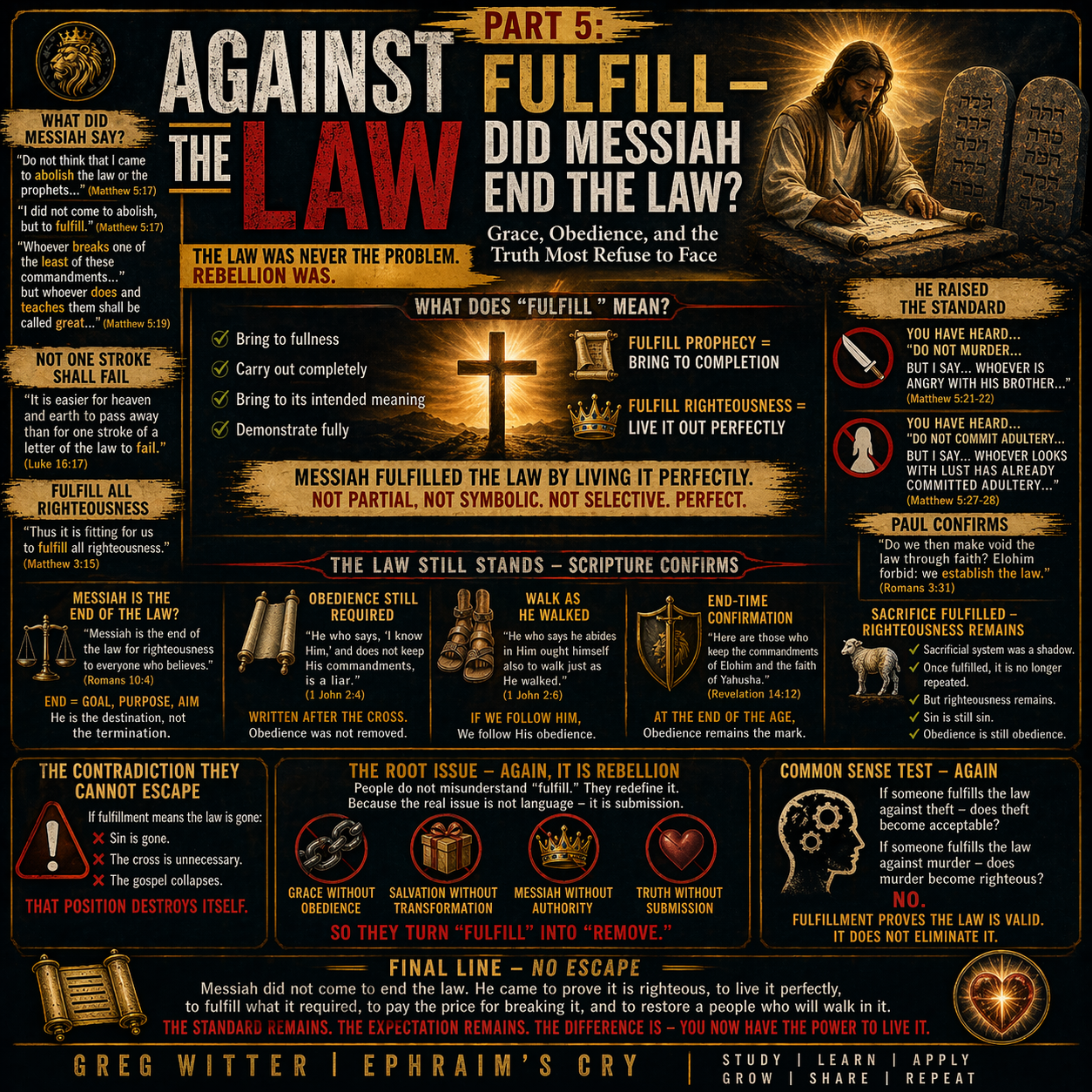
AGAINST THE LAW — PART 5: FULFILL — DID MESSIAH END THE LAW?
Grace, Obedience, and the Truth Most Refuse to Face
The law was never the problem. Rebellion was.
Greg Witter | Ephraim’s Cry
Hebraic Mindset Study Series
Study Learn Apply Grow Share Repeat
Now we come to one of the most quoted—and most distorted—claims used to argue that the law is finished:
“Messiah fulfilled the law.”
From that, the conclusion is forced:
“If He fulfilled it, we don’t have to.”
That sounds simple.
It is also completely false.
So we are not going to assume what “fulfill” means.
We are going to let Scripture define it—consistently, completely, and without contradiction.
WHAT DID MESSIAH ACTUALLY SAY?
“Do not think that I came to abolish the law or the prophets…” (Matthew 5:17)
Stop.
Before anything else—He shuts down the assumption.
Do not even think that.
Then He defines His mission:
“I did not come to abolish, but to fulfill.”
So whatever “fulfill” means—
It cannot mean abolish, remove, cancel, or end.
Because He explicitly separates the two.
SECOND WITNESS — NOTHING PASSES AWAY
“It is easier for heaven and earth to pass away than for one stroke of a letter of the law to fail.” (Luke 16:17)
Now the argument collapses further.
He did not say:
“Until I come.”
He did not say:
“Until the cross.”
He tied it to heaven and earth passing away.
So if someone claims the law failed at the cross—
They are claiming something Messiah said would not happen.
DEFINE “FULFILL” CORRECTLY — OR YOU WILL MISUNDERSTAND EVERYTHING
“Fulfill” does not mean:
End
Cancel
Make obsolete
“Fulfill” means:
Bring to fullness
Carry out completely
Bring to its intended meaning
Demonstrate fully
There are two critical dimensions of fulfillment:
1. Fulfill prophecy → bring it to completion
2. Fulfill righteousness → live it out perfectly
Messiah fulfilled prophecy so it would be completed.
Messiah fulfilled righteousness so it would be demonstrated.
He did not fulfill righteousness so it could be discarded.
“FULFILL ALL RIGHTEOUSNESS” — THIS DEFINES THE TERM
“Thus it is fitting for us to fulfill all righteousness.” (Matthew 3:15)
Now apply the same logic people try to use:
If “fulfill” means “end”—
Then Messiah ended righteousness at His baptism.
That is absurd.
So the word itself cannot mean termination.
It means to carry out fully.
HE DID NOT REMOVE THE LAW — HE LIVED IT PERFECTLY
Messiah did what no one else could do:
He walked in complete obedience.
Not partial.
Not symbolic.
Not selective.
Perfect.
That is fulfillment.
Not removal.
HE IMMEDIATELY CONFIRMS THE LAW REMAINS
Right after saying “fulfill,” He says:
“Whoever breaks one of the least of these commandments and teaches others to do so shall be called least… but whoever does and teaches them shall be called great…” (Matthew 5:19)
If fulfillment meant “end”—
This statement becomes meaningless.
Why warn against breaking something that no longer exists?
Why commend teaching something that has been removed?
You can’t have both.
HE RAISES THE STANDARD — HE DOES NOT LOWER IT
“You have heard… do not murder…
But I say… whoever is angry…”
“You have heard… do not commit adultery…
But I say… whoever looks with lust…”
This is not reduction.
This is expansion.
This is exposure of the deeper requirement.
Fulfillment does not reduce the law—
It reveals its full depth.
PAUL DOES NOT CONTRADICT THIS — HE CONFIRMS IT
“Do we then make void the law through faith? Elohim forbid: we establish the law.” (Romans 3:31)
So if you interpret “fulfill” as “end”—
You now have Messiah and Paul contradicting each other.
That is not a problem with Scripture.
That is a problem with interpretation.
“MESSIAH IS THE END OF THE LAW” — DEFINE IT CORRECTLY
“For Messiah is the end of the law for righteousness…” (Romans 10:4)
This is another misused verse.
“End” does not mean termination.
It means:
Goal
Purpose
Aim
He is the destination the law points to.
Not the cancellation of it.
If the law points to Him—
Then removing the law removes the witness to Him.
OBEDIENCE STILL REQUIRED AFTER THE CROSS
“He who says, ‘I know Him,’ and does not keep His commandments, is a liar.” (1 John 2:4)
This is written after the cross.
After the resurrection.
After the establishment of the renewed covenant.
So obedience was not removed.
WALK AS HE WALKED
“He who says he abides in Him ought himself also to walk just as He walked.” (1 John 2:6)
Now follow the chain:
He fulfilled the law by walking in obedience.
You are commanded to walk as He walked.
So fulfillment cannot mean abandonment.
It means demonstration and pattern.
END-TIME CONFIRMATION — THE STANDARD REMAINS
“Here are those who keep the commandments of Elohim and the faith of Yahusha.” (Revelation 14:12)
At the end of the age—
The defining mark is still:
Faith + obedience
Not faith alone divorced from conduct.
SACRIFICE FULFILLED — RIGHTEOUSNESS REMAINS
The sacrificial system pointed forward.
It was a shadow.
Once fulfilled, it is no longer repeated.
But righteousness?
Still required.
Sin?
Still sin.
Obedience?
Still obedience.
These are not the same category.
THE CONTRADICTION THEY CANNOT ESCAPE
If fulfillment means the law is gone:
Then sin is gone.
Then the cross is unnecessary.
Then the gospel collapses.
That is where the argument leads.
COMMON SENSE TEST — AGAIN
If someone fulfills the law against theft—
Does theft become acceptable?
If someone fulfills the law against murder—
Does murder become righteous?
No.
Fulfillment proves the law is valid.
It does not eliminate it.
THE ROOT ISSUE — AGAIN, IT IS REBELLION
People do not misunderstand “fulfill.”
They redefine it.
Because the real issue is not language.
It is submission.
They want:
Grace without obedience
Salvation without transformation
Messiah without authority
So they turn “fulfill” into “remove.”
FINAL STRUCTURE — LOCK THIS IN
Law defined
Messiah fulfills
Righteousness demonstrated
Sin exposed
Penalty paid
Spirit given
Obedience restored
FINAL LINE — NO ESCAPE
Messiah did not come to end the law.
He came to prove it is righteous, to live it perfectly, to fulfill what it required, to pay the price for breaking it, and to restore a people who will walk in it.
If you say “fulfilled means ended,” you are not following His words—
You are contradicting them.
The standard remains.
The expectation remains.
The difference is—you now have the power to live it.
You don’t remove sin by removing the standard—you expose it and deal with it.
#GregWitter #EphraimsCry #HebraicMindset #AgainstTheLaw #WatchmanWarning #BiblicalTruth
#TorahIsTruth #CovenantFaithfulness #EndTimesDiscernment #StayAwake #SoundDoctrine
#TruthOverTradition #ScriptureFirst #LawAndGrace #FaithAndObedience #FulfillTheLaw
#SpiritualDiscernment #WatchmanOnTheWall #TestEverything
