
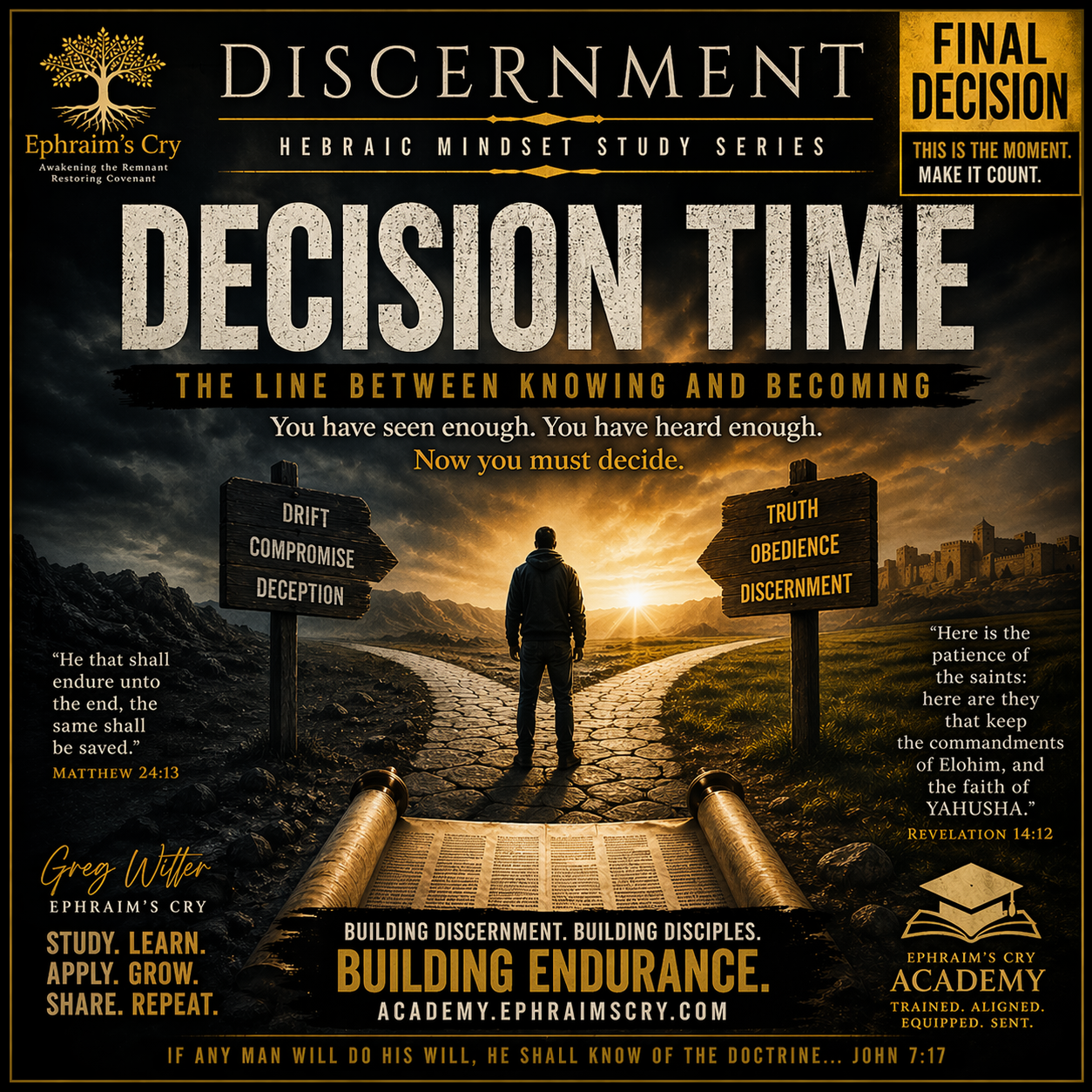
Discernment: Decision Time — The Line Between Knowing and Becoming
Greg Witter | Ephraim’s Cry
Hebraic Mindset Study Series
Study Learn Apply Grow Share Repeat
There comes a point where learning is no longer the issue. There comes a point where exposure is no longer the issue. There comes a point where understanding is no longer the issue. And when that point is reached, everything shifts—because what once could be delayed can no longer be ignored. What once could be considered can no longer be postponed. What once could be heard can no longer remain unanswered. That point is where knowledge gives way to responsibility, and understanding gives way to decision.
This is that point.
Because everything that has been laid out across this series has not been casual information. It has not been theoretical. It has not been optional insight. It has been a structured, covenant-rooted exposure to what discernment actually is, how it is built, how it is trained, how it is tested, how it is maintained, how it is applied, and ultimately—what it demands. And once something has been revealed at that level, you do not return to neutrality. You do not return to passivity. You do not return to where you were before.
You move forward—or you drift backward.
There is no middle ground.
And that is where this becomes real.
Because discernment is not something that forms itself over time by accident. It is not something that settles in naturally through occasional exposure. It is not something sustained by preference, personality, or even sincerity. It is formed. It is built. It is trained. It is aligned. It is tested. It is refined. And if it is not formed intentionally, it will be shaped unintentionally by everything around you that is already competing for your attention, your agreement, and your direction.
You are not standing still.
You are being formed.
Every day.
By what you allow.
By what you accept.
By what you tolerate.
By what you follow.
And over time, what you repeatedly align with becomes what governs you—whether you intended it to or not.
This is why discernment cannot remain theoretical. It cannot remain something you “understand.” It must become something you build, something you walk in, something you submit to, and ultimately—something you become. Because if it does not become identity, it will never remain stable. And if it does not remainstable, it will not endure when pressure comes.
And pressure is coming.
Not in abstraction—but in reality.
In voices that sound right but are not aligned.
In teachings that feel familiar but are not anchored.
In pressures that demand compromise while appearing reasonable.
This is why the foundation matters.
Because discernment that is not built on the right foundation will not hold when tested. It will bend. It will adjust. It will justify. And eventually, it will align itself with what it once would have rejected.
“If the foundations are destroyed, what can the righteous do?” (Psalm 11:3).
This is why the work must begin where it was always meant to begin.
Not in fragments.
Not in isolated passages.
Not in inherited frameworks.
But in the whole counsel of Elohim.
Torah establishes the foundation.
The Prophets call back to it.
The Writings demonstrate it.
The Apostolic witness confirms it.
This is not separate.
This is one continuous, covenant-aligned revelation.
“And I have not shunned to declare unto you all the counsel of Elohim” (Acts 20:27).
This is the standard.
This is the structure.
This is the alignment.
And without it, discernment cannot be trusted—because it is not anchored.
This is why a Hebraic, covenant-centered understanding is not optional. Because the Word was never meant to be interpreted outside of the framework it was given in. It is not abstract. It is not detached. It is not philosophical. It is lived. It is walked. It is obeyed.
“You shall therefore keep my statutes and my judgments: which if a man do, he shall live in them…” (Leviticus 18:5).
Discernment is formed in that process.
Not in discussion.
But in obedience.
Not in agreement.
But in submission.
“If any man will do His will, he shall know of the doctrine…” (John 7:17).
Doing comes first.
Clarity follows.
This is the order.
And this is exactly why Ephraim’s Cry Academy exists.
Not to give more information—but to build formation.
Not to offer more content—but to establish alignment.
Not to inspire—but to train.
Because discernment that is not trained will not hold. It will fluctuate. It will respond inconsistently. It will adjust under pressure. It will weaken over time. And what weakens becomes vulnerable—and what is vulnerable will eventually be influenced.
This is why structure matters.
This is why accountability matters.
This is why consistency matters.
Because without them, everything remains unstable.
And instability cannot endure.
“He that shall endure unto the end, the same shall be saved” (Matthew 24:13).
Endurance is not passive.
It is sustained alignment.
It is continued obedience.
It is remaining under the authority of the Word when everything around you is shifting.
This is the call.
Not just to learn.
Not just to understand.
But to stand.
To stand when it costs something.
To stand when it isolates you.
To stand when it requires separation.
To stand when compromise would be easier.
This is where discernment becomes visible.
Not in comfort.
But in conviction.
Not in agreement.
But in alignment.
And this is where the decision must be made.
Because at this point—you know enough.
You have seen enough.
You have been shown enough.
The question is no longer:
“Do you understand?”
The question is:
Will you commit?
Will you step into the process?
Will you allow yourself to be formed?
Or will you remain where you are?
Because remaining where you are is not neutral.
It is drift.
It is exposure.
It is vulnerability.
And eventually—it becomes compromise.
This is the line.
This is the moment.
This is decision time.
If you are serious about building discernment that will not collapse under pressure…
If you are serious about not being led astray by voices that sound right…
If you are serious about standing in this time and season…
If you are serious about walking in covenant obedience and holding fast to the testimony of 𐤉𐤄𐤅𐤔𐤏 (Yahusha)…
Then you cannot remain casual.
You must commit.
This is why Ephraim’s Cry Academy exists.
To build what must be built.
To train what must be trained.
To align what must be aligned.
To form what must be formed.
Not casually.
Not passively.
But deliberately.
The cost is not high.
But the commitment must be real.
If you are ready to move from exposure to formation…
From understanding to alignment…
From learning to becoming…
Then take the next step:
Because discernment is not something you wait to have.
It is something you choose to build.
And the time to decide—
is now.

#GregWitter, #EphraimsCry, #HebraicMindset, #Discernment, #DecisionTime, #TruthVsError, #SoundDoctrine,
#Hebrews514, #Matthew2413, #Acts2027, #CovenantFaithfulness, #WalkInTruth
