
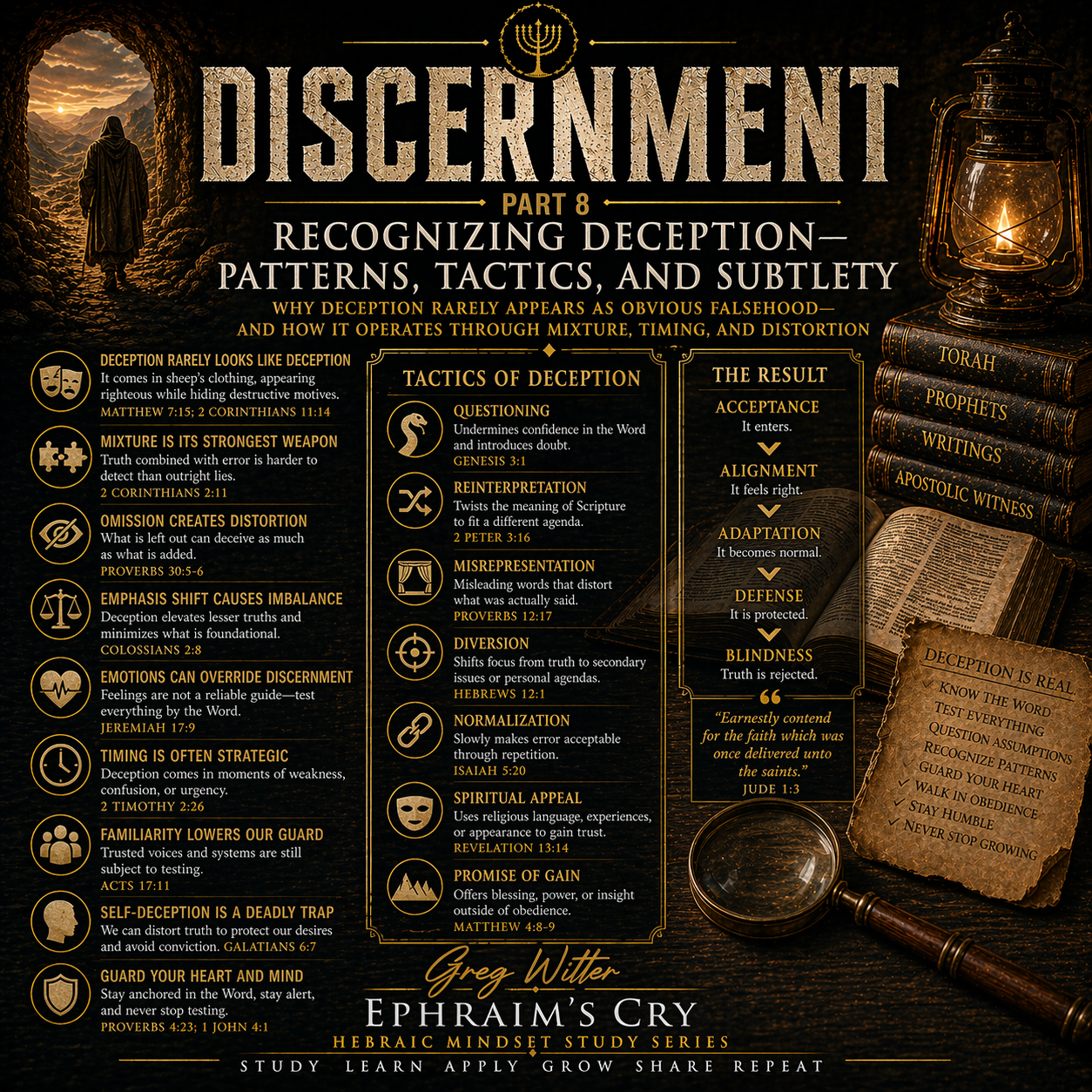
Discernment Part 8: Recognizing Deception — Patterns, Tactics, and Subtlety
Why deception rarely appears as obvious falsehood—and how it operates through mixture, timing, and distortion
Greg Witter | Ephraim’s Cry
Hebraic Mindset Study Series
Study Learn Apply Grow Share Repeat
Discernment reaches another level when it moves beyond testing what is being taught and begins to recognize how deception actually operates. If Part 7 established that teachers, teachings, and voices must be tested, then Part 8 must expose the deeper layer: deception is not always found in what is openly false—it is often found in what is subtly altered, slightly shifted, strategically omitted, and carefully blended with truth. The issue is not always what is being said. The issue is how truth is being handled.
This is where discernment becomes sharp—or fails completely.
Because deception is rarely obvious.
If deception appeared clearly false, it would not succeed.
Its strength is in resemblance.
Its power is in mixture.
Its effectiveness is in subtlety.
This is why Scripture does not describe deception as something crude or easily identified, but something convincing, persuasive, and even appealing. “And no marvel; for Satan himself is transformed into an angel of light” (2 Corinthians 11:14). The warning is not that darkness presents itself as darkness—the warning is that darkness presents itself as light.
This is the danger.
Because when something appears aligned, the natural response is trust.
And once trust is established, testing is often reduced.
And when testing is reduced, deception gains access.
This is why discernment must go deeper than surface evaluation.
It must recognize patterns.
It must identify tactics.
It must expose subtlety.
Because deception does not need to remove truth to succeed.
It only needs to alter it.
This is the pattern established from the beginning.
In the garden, the Word was not denied—it was adjusted. “Has Elohim said…?” (Genesis 3:1). That question did not remove truth—it introduced doubt. It shifted focus. It weakened certainty. It created space for reinterpretation. And then came the distortion.
This is how deception operates.
Not through immediate contradiction.
But through progressive alteration.
This must be understood clearly:
Deception does not begin with rejection.
It begins with adjustment.
It begins with questioning.
It begins with softening.
It begins with introducing alternatives.
And once that process begins, it progresses.
This is the progression:
- exposure to slight distortion
- acceptance of adjusted framing
- normalization of misalignment
- defense of the altered position
- resistance to correction
- eventual blindness
This is how deception matures.
Not instantly.
But progressively.
And once it reaches maturity, it becomes difficult to reverse.
This is why early recognition is critical.
Because once deception is normalized, it no longer feels wrong.
It feels right.
And when something feels right, it is rarely tested.
This is why deception is sustained—not because it is hidden, but because it is accepted.
This leads to the next reality.
Deception is not only encountered.
It is often chosen.
“For the time will come when they will not endure sound doctrine…” (2 Timothy 4:3). This is not passive. This is active. People do not just fall into deception—they align with it. They gather voices that support it. They remain under teaching that confirms it. They protect it once it is established.
This means deception is not only external.
It is internal.
Because desire influences acceptance.
Preference shapes perception.
What a person wants will affect what they allow.
This is why discernment must confront the heart.
Not just the teaching.
What do you want to be true?
What are you protecting?
What are you unwilling to release?
Because whatever you are protecting will influence what you accept.
And whatever you accept repeatedly will begin to shape your perception.
This is where deception becomes personal.
Because it is no longer about what is being presented.
It is about what is being permitted.
This is why Scripture warns repeatedly against self-deception. “Be not deceived…” (Galatians 6:7). This is not only a warning against others—it is a warning against the internal capacity to distort truth to protect self.
This is where deception becomes dangerous.
Because once a person begins to deceive themselves, external correction becomes ineffective.
Truth is resisted.
Correction is rejected.
Alignment is avoided.
And over time, perception becomes fixed in distortion.
This is where blindness forms.
Not because truth disappeared.
But because it was consistently resisted.
This is why deception must be recognized early.
Before it becomes established.
Before it becomes defended.
Before it becomes identity.
This is also why mixture is so dangerous.
Deception rarely comes as full falsehood.
It comes as partial truth.
And partial truth builds trust.
But that trust becomes the vehicle for distortion.
This is why discernment must evaluate completely.
Not based on what is correct.
But based on whether the whole aligns.
Because something can be partially right—and still be functionally wrong.
This is where many fail.
They accept the whole because part of it is correct.
Instead of testing the whole against the standard.
This is how deception hides.
In what appears accurate.
While subtly redirecting what matters.
This is also why omission must be recognized.
Not what is said.
But what is not said.
Because leaving out necessary truth can distort understanding as effectively as adding falsehood.
A statement can be technically correct.
But functionally misleading.
If it is disconnected from its covenant context.
This is how Scripture is often misused.
Verses are quoted accurately.
But applied incorrectly.
Because they are removed from their framework.
This produces distortion without obvious contradiction.
This is why discernment must ask:
What is missing?
What is avoided?
What is not being addressed?
Because deception often hides in silence.
This is also where emphasis must be examined.
Deception does not always deny truth—it rearranges it.
It elevates what should be secondary.
It minimizes what should be central.
It shifts focus away from obedience.
It magnifies what is appealing.
This creates imbalance.
And imbalance leads to misalignment.
This is why discernment must evaluate priority—not just content.
What is being emphasized?
What is being minimized?
Does the emphasis align with the whole counsel of the Word?
Because misplaced emphasis leads to misplaced understanding.
This is also where emotional manipulation operates.
Deception often engages feeling before testing.
It creates urgency.
It produces excitement.
It triggers fear.
It appeals to desire.
And in doing so, it moves a person to respond before evaluating.
This is why discernment must remain anchored.
Because emotional intensity is not proof of truth.
Truth is measured by alignment with the Word—not by how strongly it is felt.
This is where many are led into error.
Because something feels powerful.
But feeling is not a standard.
It is a response.
And responses must be tested.
Another layer is familiarity.
Deception often comes through what is known.
Trusted voices.
Respected systems.
Long-held beliefs.
And because of familiarity, testing is reduced.
Guard is lowered.
Evaluation is softened.
This creates blind spots.
Because familiarity produces assumption.
And assumption weakens discernment.
This is why everything must be tested.
Not only what is unfamiliar.
But what is already accepted.
Because deception does not always enter from outside.
It can already be present.
Unexamined.
Unchallenged.
Uncorrected.
This is also where covenant consequence must be understood.
Deception is not neutral.
It does not simply exist without effect.
When deception is accepted, it leads to misalignment.
Misalignment leads to disobedience.
Disobedience leads to separation.
Not emotional separation—but functional separation from truth.
And over time, this leads to hardened perception.
This is why deception must be taken seriously.
Not as an intellectual issue.
But as a covenant issue.
Because it affects alignment with 𐤉𐤄𐤅𐤄 (Yahuah).
This is where the weight must land.
If deception is present in your life, it is not accidental.
It is being allowed.
Whether through neglect.
Through preference.
Through avoidance.
Or through lack of testing.
This is the responsibility.
Discernment is not only about identifying deception.
It is about refusing to allow it.
And that requires vigilance.
Consistency.
Alignment.
And continual return to the standard.
Because deception does not stop.
It adapts.
It refines itself.
It finds new entry points.
And discernment must remain active.
It must remain engaged.
It must remain anchored.
Because the moment it relaxes, distortion begins.
This is the reality.
Discernment is not maintained automatically.
It must be guarded.
It must be exercised.
It must be applied.
And when it is, something changes.
A person begins to recognize patterns.
They begin to see what others miss.
They begin to identify distortion early.
They begin to resist what once would have influenced them.
Not because deception disappeared.
But because it is now understood.
And once it is understood, it loses its power.
This is the function.
This is the progression.
This is the sharpening of discernment.
And this is what prepares the next step.
Because once deception is recognized, it must be responded to.
Not just seen.
But addressed.
Not just identified.
But handled correctly.
That is where we move next.
Discernment at this level is no longer just about identifying what is right—it is about recognizing how deception actually operates and where it is being allowed to remain. What has been established here makes it clear that deception is rarely obvious; it works through mixture, subtlety, omission, and gradual distortion. And more than that, it is not only encountered—it is often permitted, protected, and sustained by what a person is willing to accept. This is where discernment becomes personal, because once you begin to see how deception functions, you are responsible not to allow it to remain. Many stop here—not because they cannot recognize it, but because confronting it requires change, separation, and realignment. This is exactly why Ephraim’s Cry Academy exists: to train you to recognize deception early, expose it accurately, and remove it completely so that your perception remains clear and aligned with the Word. If you are serious about not being subtly led astray, not allowing distortion to take root, and not becoming desensitized over time, then you must commit to a process that strengthens discernment at its deepest level and keeps it sharp through continual alignment.
https://EphraimsCry.com/academy
Discernment — Part 9: Responding to Error — Correction, Separation, and Responsibility

#GregWitter, #EphraimsCry, #HebraicMindset, #Discernment, #BiblicalDiscernment, #TruthVsError, #SoundDoctrine,
#RecognizeDeception, #2Corinthians1114, #Genesis31, #Galatians67, #2Timothy43, #TestAllThings,
#WholeCounselOfElohim, #ScriptureAlignment, #TruthOverTradition
