
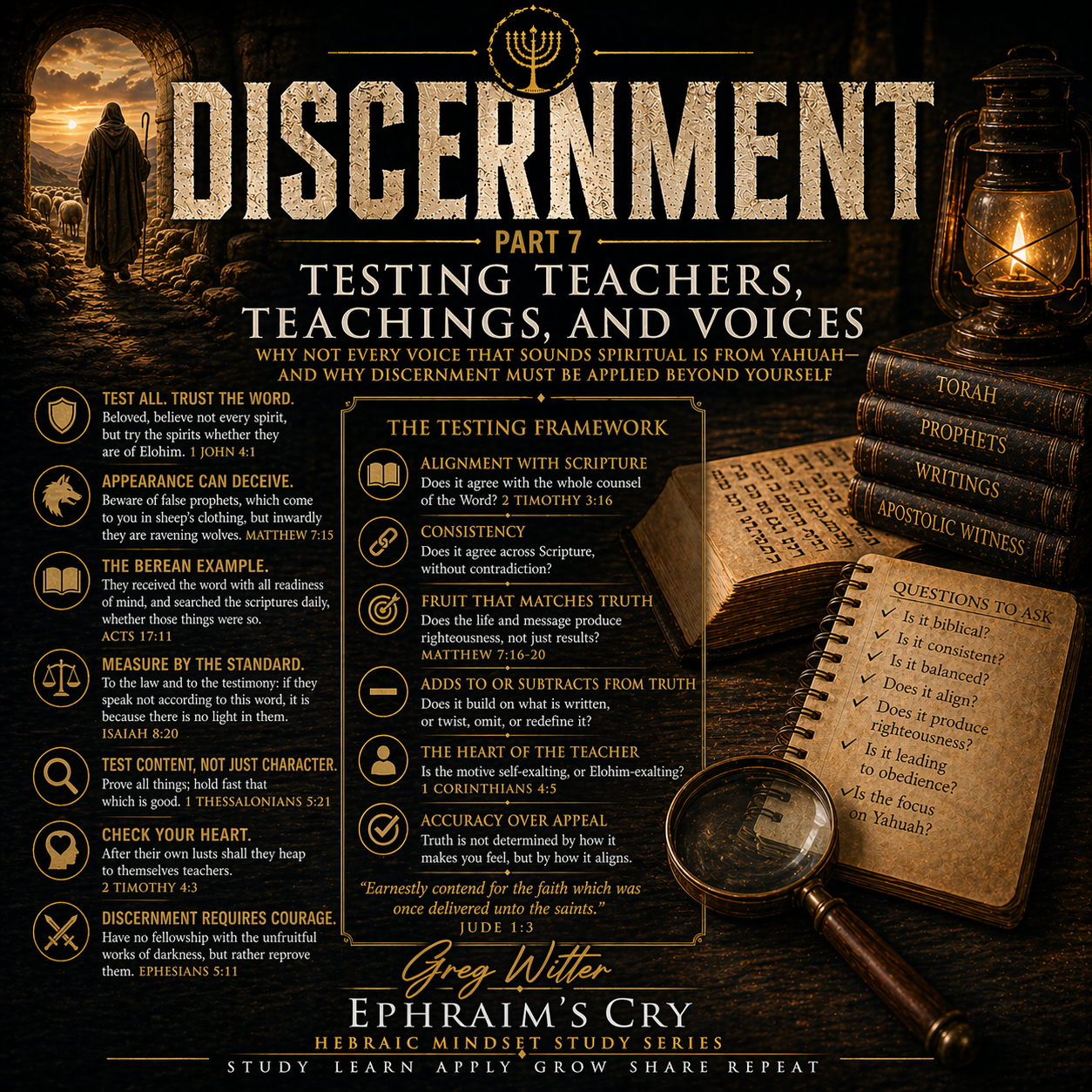
Discernment. Part 7: Testing Teachers, Teachings, and Voices
Why not every voice that sounds spiritual is from 𐤉𐤄𐤅𐤄—and why discernment must be applied beyond yourself
Greg Witter | Ephraim’s Cry
Hebraic Mindset Study Series
Study Learn Apply Grow Share Repeat
Discernment does not remain internal. It does not exist only for personal correction, private understanding, or internal alignment. If Part 6 established that discernment must be built through structured, systematic study, then Part 7 brings the next unavoidable step: discernment must be applied externally. It must be used to evaluate what is being taught, who is teaching it, and what voices are shaping belief, direction, and action.
This is where discernment becomes costly.
Because it requires testing what many would rather trust.
It requires examining what many assume is safe.
It requires measuring what is widely accepted, widely followed, and widely defended.
And this is where many hesitate—not because they lack the ability to test, but because they are unwilling to confront the possibility that what they have trusted may not fully align with the standard.
But Scripture does not permit passive acceptance of teaching.
It commands testing.
“Beloved, believe not every spirit, but try the spirits whether they are of Elohim…” (1 John 4:1). This is not optional. It is not reserved for a few. It is a direct command to the covenant people. Not every voice that uses Scripture is aligned with Scripture. Not every teacher who sounds confident is accurate. Not every message that feels encouraging is true.
Discernment must be applied.
And it must be applied consistently.
This is why Scripture warns repeatedly about false teachers, false prophets, and deceptive voices. “Beware of false prophets, which come to you in sheep’s clothing, but inwardly they are ravening wolves” (Matthew 7:15). The danger is not in what is obviously false. The danger is in what appears right while being subtly misaligned. The deception is not always in blatant contradiction—it is often in slight alteration.
This is why discernment cannot rely on appearance.
It must rely on measurement.
And that measurement must be the Word.
Because without a fixed standard, testing becomes subjective.
And subjective testing is no testing at all.
This is where many fail.
They evaluate teaching based on response rather than standard:
- how it feels
- how it sounds
- how persuasive it is
- how popular it is
- how much it agrees with them
But none of these are valid measures.
They are reactions—not judgments.
And reactions can be manipulated.
Feelings can be stirred.
Confidence can be performed.
Popularity can be engineered.
Agreement can be self-serving.
But the Word does not change.
This is why testing must be anchored in the standard established in Part 2.
Everything must be brought under the Word.
Not alongside it.
Not equal to it.
Under it.
This requires discipline.
Because testing takes effort.
It takes time.
It takes slowing down when everything around you is moving quickly.
And this is where many bypass the process.
They hear something and immediately respond.
They accept quickly or reject quickly.
But discernment does not react—it examines.
It tests.
It compares.
It measures.
This is why the Bereans are given as an example. “They received the word with all readiness of mind, and searched the scriptures daily, whether those things were so” (Acts 17:11). They were not cynical—but they were not careless. They were open—but not unguarded. They received—but they verified.
This is the model.
Receive—but test.
Listen—but measure.
Consider—but confirm.
This must be done consistently.
Not only when something feels questionable.
But with everything.
Because one of the most dangerous patterns is selective testing.
People test what they disagree with.
But accept without testing what they already agree with.
This creates bias.
And bias corrupts discernment.
Because agreement is not proof of truth.
Alignment with the Word is.
This is why testing must be consistent.
Across everything.
Even what confirms your current beliefs.
Even what comes from voices you trust.
Even what you have believed for years.
Because discernment does not protect what is familiar—it exposes what is misaligned.
This also exposes a deeper issue.
People do not just encounter false teaching.
They choose it.
“For the time will come when they will not endure sound doctrine; but after their own lusts shall they heap to themselves teachers…” (2 Timothy 4:3).
This is not passive deception.
This is active selection.
People gather teachers that match their desires.
They align with voices that support what they want to believe.
They remain under teaching that does not confront them.
This means testing must include self-examination.
Because desire influences discernment.
If a person wants something to be true, they will be more likely to accept it without testing.
If they resist something, they may reject it without testing.
Both are failures.
Because both are driven by desire—not by truth.
This is why discernment must confront not only the teaching—but the heart receiving it.
What do you want to be true?
What are you protecting?
What are you unwilling to let go of?
Because whatever you are protecting will influence what you accept.
This is where many are led into error—not because they lacked access to truth, but because they preferred something else.
This also reveals another layer.
False teachers are not always obvious.
They are often precise.
They use Scripture.
They sound aligned.
They speak with confidence.
They may even teach truth in some areas.
But they introduce distortion in others.
This is what makes them dangerous.
Because mixture is harder to detect than outright falsehood.
This is why discernment must go beyond surface evaluation.
It must examine:
- consistency with the whole Word
- alignment with covenant continuity
- whether it adds to or subtracts from what is written
- whether it shifts emphasis away from obedience
- whether it isolates parts of Scripture to support a position
Because distortion often lives in what is omitted—not just what is stated.
This is also why fruit alone is not enough.
People often say, “look at the fruit.”
But fruit must be defined by the Word—not by appearance.
Because influence is not fruit.
Growth is not fruit.
Impact is not fruit.
Fruit is alignment with righteousness.
Fruit is obedience.
Fruit is consistency with the standard.
Without that, what appears fruitful may still be misaligned.
This is why both doctrine and life must be tested.
Not one or the other.
Both.
This also raises the level of accountability.
Because once you begin to see, you are responsible.
You cannot continue to follow what you know is misaligned.
You cannot continue to support what you know is distorted.
You cannot continue to sit under teaching that does not align with the Word.
This is where the cost becomes real.
Because testing may lead to separation.
From teachers.
From systems.
From communities.
From long-held beliefs.
But discernment requires alignment over attachment.
Truth over comfort.
Standard over familiarity.
This is where many stop.
Because they do not want to lose what they are connected to.
But discernment will always demand separation where there is misalignment.
This is the function.
This is the responsibility.
This is the cost.
Discernment is not proven in what you agree with.
It is proven in what you are willing to test.
And what you are willing to reject when it does not align.
This is where the line becomes clear.
If a teaching aligns with the Word, it stands.
If it does not, it falls.
There is no middle ground.
No adjustment to make it fit.
No reinterpretation to preserve it.
Because the standard does not move.
And once that is established, discernment begins to function with clarity.
Not because everything is simple.
But because everything is measured.
This is the next level of discernment.
Not just knowing truth.
But applying it.
Not just understanding the standard.
But using it.
Not just correcting yourself.
But evaluating what influences you.
Because whatever you allow to shape you will ultimately direct you.
And if it is not tested, it will not be trusted correctly.
That is the weight of this part.
That is the responsibility.
That is the function of discernment applied externally.
And once this is established, the next step becomes necessary.
Because discernment must now go deeper.
Not just identifying false teaching—but recognizing how deception operates.
How it enters.
How it spreads.
How it hides.
And how it sustains itself.
That is where we move next.
Discernment does not remain internal—it must be applied to what you hear, who you follow, and what you allow to shape your understanding. What has been established here makes it clear that not every voice that sounds aligned is aligned, and not every teaching that uses Scripture is anchored in truth. This is where discernment becomes costly, because it requires testing what you have trusted, examining what you have assumed, and being willing to confront the possibility that what has shaped you may not fully align with the standard. Many stop here—not because they cannot discern, but because they are unwilling to face what that discernment may require them to change. But once you see, you are responsible. This is exactly why Ephraim’s Cry Academy exists: to train you to test consistently, measure accurately, and develop discernment that is not influenced by personality, familiarity, or preference, but anchored in the Word alone. If you are serious about not being carried by voices, not being shaped by influence, and not remaining dependent on what others say, then you must commit to a process that builds discernment strong enough to stand under pressure and remain aligned when it matters most.
https://EphraimsCry.com/academy
Discernment — Part 8: Recognizing Deception — Patterns, Tactics, and Subtlety

#GregWitter, #EphraimsCry, #HebraicMindset, #Discernment, #BiblicalDiscernment, #TruthVsError, #SoundDoctrine
#TestAllThings, #1John41, #Acts1711, #Matthew715, #2Timothy43, #StudyTheWord, #TorahFoundation,
#WholeCounselOfElohim, #ScriptureAlignment, #SpiritualGrowth, #TruthOverTradition
