
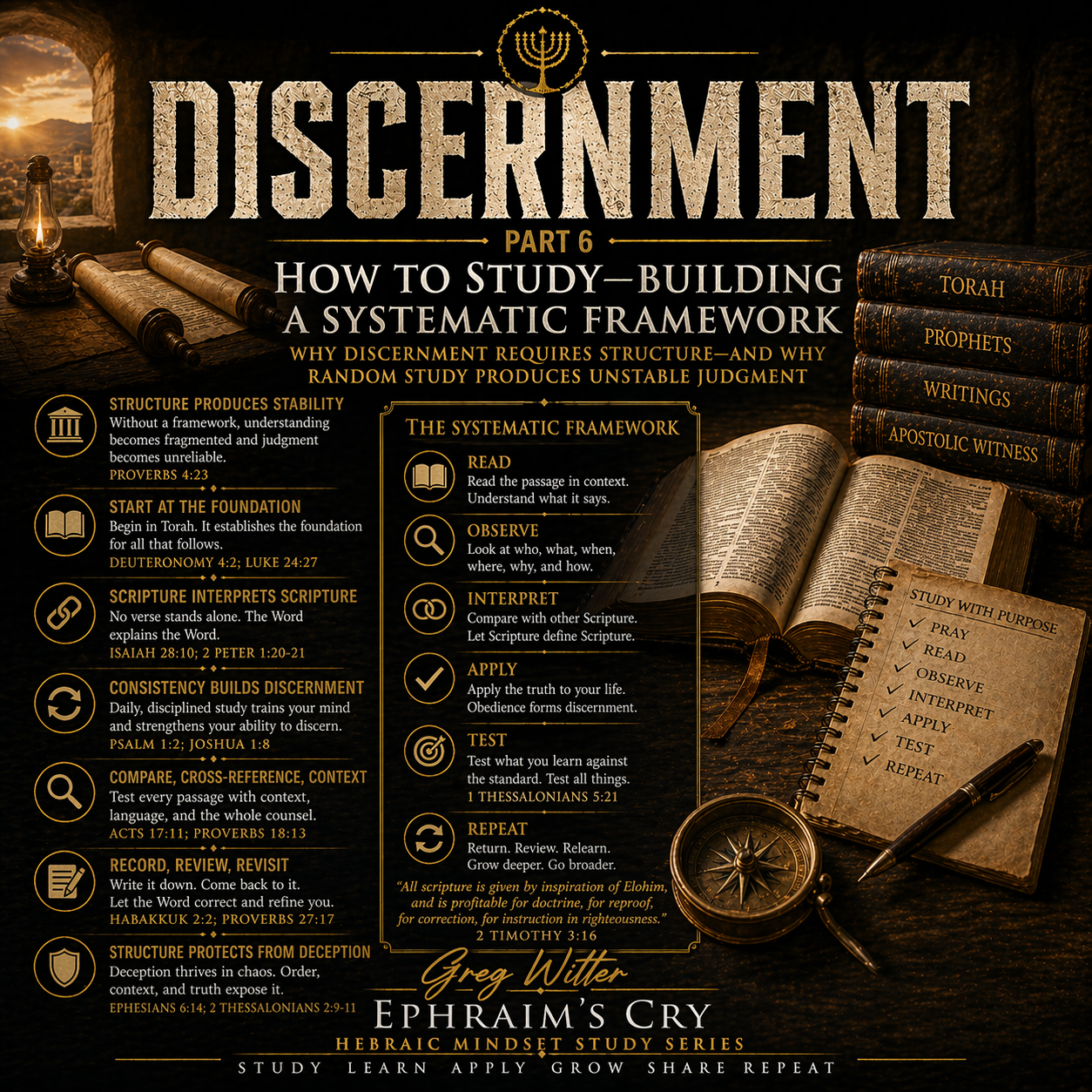
Discernment Part 6: How to Study — Building a Systematic Framework
Why discernment requires structure—and why random study produces unstable judgment
Greg Witter | Ephraim’s Cry
Hebraic Mindset Study Series
Study Learn Apply Grow Share Repeat
Discernment cannot be sustained without structure. It cannot be maintained through randomness, and it cannot be developed through scattered, inconsistent exposure to Scripture. If Part 5 established that discernment is trained through repetition, testing, correction, and time, then Part 6 must bring order to that process. Because without a structured, systematic framework for study, the training of discernment becomes inconsistent, fragmented, and ultimately unreliable. The issue is not whether a person is engaging the Word. The issue is whether that engagement is ordered, disciplined, and aligned with the way the Word was given.
This is where many fail without realizing it.
They are sincere.
They are engaged.
They are exposed to Scripture.
But they are not structured.
And without structure, training breaks down.
Because discernment is not built through occasional contact with truth. It is built through consistent, ordered, covenant-aligned engagement with the Word. There is a difference between reading Scripture and being formed by Scripture. Reading exposes a person to truth. Systematic study shapes how that truth is understood, connected, and applied. Without structure, a person gathers fragments. With structure, a person builds a framework. And only a framework can sustain discernment.
This is the difference between reading and studying.
Reading introduces.
Studying establishes.
Reading gathers.
Studying builds.
Reading can be passive.
Studying must be intentional.
Many read Scripture.
Few study it systematically.
And because of that, their discernment remains uneven. They may recognize certain truths clearly while remaining blind in others. They may be strong in one area but unstable in another. They may be confident in what they know but unaware of what they are missing. This is not because the Word is incomplete—but because their engagement with it is fragmented.
Fragmentation always leads to distortion.
This is why structure is not optional—it is protective.
Because without structure, people naturally drift into what can only be described as selective engagement, or what many practice without realizing it—buffet-style reading. They take what resonates. They skip what confronts. They revisit what comforts. They avoid what challenges. They build belief systems out of preferred passages while leaving foundational sections unexplored.
This produces a dangerous condition:
Confidence without completeness.
And confidence without completeness is one of the fastest paths to deception.
Because fragments can be rearranged.
Fragments can be isolated.
Fragments can be used to justify almost anything.
But a complete, covenantal framework resists distortion.
Because it reinforces itself.
Scripture was not given as isolated ideas—it was given as a unified testimony. Torah establishes the foundation. The Prophets call back to that foundation. The Writings demonstrate wisdom and application. The Apostolic witness confirms and continues in alignment. There is no division within the Word—only division in how people approach it.
This is why starting point matters.
And this must be stated without compromise:
If you do not start at the foundation, you will misinterpret what follows.
If you begin in the middle, you will build backwards.
If you build backwards, your conclusions will be unstable.
This is why beginning in Torah is not optional—it is essential. It establishes the nature of 𐤉𐤄𐤅𐤄 (Yahuah), the structure of covenant, the definition of righteousness, the boundaries of obedience, and the pattern of relationship. Without that, later Scripture is not clarified—it is distorted.
This is where many go wrong.
They begin in later writings and interpret backward.
Instead of beginning at the foundation and reading forward.
This reverses the framework.
And when the framework is reversed, discernment becomes unreliable.
Because conclusions are no longer anchored in what was established—they are shaped by what is preferred.
This is why study must be sequential.
Not random.
Not preference-driven.
Not convenience-based.
Sequential study builds continuity.
Continuity builds understanding.
Understanding builds discernment.
This is the process.
And this process requires discipline.
Not occasional discipline.
Not seasonal discipline.
But consistent, daily engagement with the Word.
Because study is not preference—it is stewardship.
You are responsible for how you handle the Word.
You are accountable for how you engage it.
You are measured by what you do with what you have been given.
“All scripture is given by inspiration of Elohim, and is profitable…” (2 Timothy 3:16). If all Scripture is profitable, then selective engagement is already misalignment.
This is where the cost must be faced.
Systematic study requires:
- time when you would rather rest
- consistency when you would rather drift
- focus when you would rather be distracted
- submission when you would rather remain unchanged
It requires choosing formation over convenience.
And many avoid this.
Not because they cannot do it.
But because they do not want the cost that comes with it.
Because structured study does not just increase knowledge.
It increases accountability.
It exposes inconsistency.
It removes the ability to hide behind fragments.
It forces alignment.
And that is why many resist it.
This is also why systematic study is protection.
Not from lack of knowledge—but from deception.
Because deception thrives in fragmentation.
It thrives where context is missing.
It thrives where people know parts—but not the whole.
But a structured, covenantal framework resists deception.
Because it forces everything to align with everything else.
This is why Scripture must interpret Scripture.
Not emotion.
Not tradition.
Not external systems.
But the Word itself.
“Line upon line, precept upon precept…” (Isaiah 28:10).
This is how structure is built.
Layer by layer.
Connection by connection.
Alignment by alignment.
This is also why repetition is necessary.
Truth is not exhausted in one reading.
It must be revisited.
Re-examined.
Re-applied.
Not because it changes.
But because you do.
And as alignment increases, clarity increases.
This is how depth is formed.
This is how discernment stabilizes.
This is how judgment becomes reliable.
This also exposes another critical issue.
Many rely on secondary sources more than primary engagement.
They listen.
They follow.
They consume teachings.
But they do not consistently engage the Word themselves.
This creates dependency.
And dependency weakens discernment.
Because discernment must be trained through direct interaction with the standard—not through secondhand interpretation.
Teachers have a place.
But they are not the standard.
They must be tested.
Measured.
Examined.
And that can only happen if the individual is anchored in the Word.
Otherwise, discernment becomes outsourced.
And outsourced discernment is not discernment at all.
It is dependence.
This is why personal study is non-negotiable.
It builds stability.
It builds independence under the authority of the Word.
And it ensures that discernment is not limited by whoever a person happens to follow.
This leads to the unavoidable conclusion.
If your study is random, your discernment will be unstable.
If your study is selective, your discernment will be biased.
If your study is inconsistent, your discernment will be weak.
But if your study is structured, systematic, and aligned with the full counsel of the Word, your discernment will become stable, consistent, and reliable.
This is the dividing line.
Discernment is not just about what you know.
It is about how you engage what you know.
And that engagement must be ordered.
Because without order, training fails.
And without training, discernment cannot develop.
So the question becomes unavoidable:
How are you studying?
Not how much you know.
Not how long you’ve been reading.
But how you are engaging the Word.
Because if your engagement is inconsistent, your discernment will never stabilize.
And until that changes, everything else will remain incomplete.
But once it does, something shifts.
Study becomes formation.
Understanding becomes cumulative.
Discernment becomes stable.
And judgment becomes accurate.
That is the function of structure.
That is the necessity of systematic study.
And that is the foundation for what comes next.
Discernment cannot be sustained without structure. What has been established here makes it clear that random, inconsistent engagement with the Word will never produce stable judgment. Without a systematic, disciplined approach, truth is encountered in fragments, and fragments cannot support accurate discernment. They produce confidence without completeness, clarity in some areas while leaving blind spots in others. This is why structure is not optional—it is protective. It ensures that the full counsel of the Word is engaged, connected, and understood within its covenant framework. Without this, discernment remains uneven and vulnerable to distortion. This is exactly why Ephraim’s Cry Academy exists: to provide a structured pathway of study where the Word is approached in order, connected correctly, and built into a complete framework that can sustain discernment over time. If you are serious about developing judgment that is not fragmented, not selective, and not easily influenced, then you must commit to a disciplined process where your engagement with the Word is ordered, consistent, and comprehensive.
https://EphraimsCry.com/academy
Discernment — Part 7: Testing Teachers, Teachings, and Voices

#GregWitter, #EphraimsCry, #HebraicMindset, #Discernment, #BiblicalDiscernment, #TruthVsError, #SoundDoctrine,
#StudyTheWord, #TorahFoundation, #WholeCounselOfElohim, #ScriptureAlignment, #CovenantTruth, #SpiritualGrowth,
#SystematicStudy, #ConsistencyIsKey, #TestAllThings, #Isaiah2810, #2Timothy316, #TruthOverTradition
