
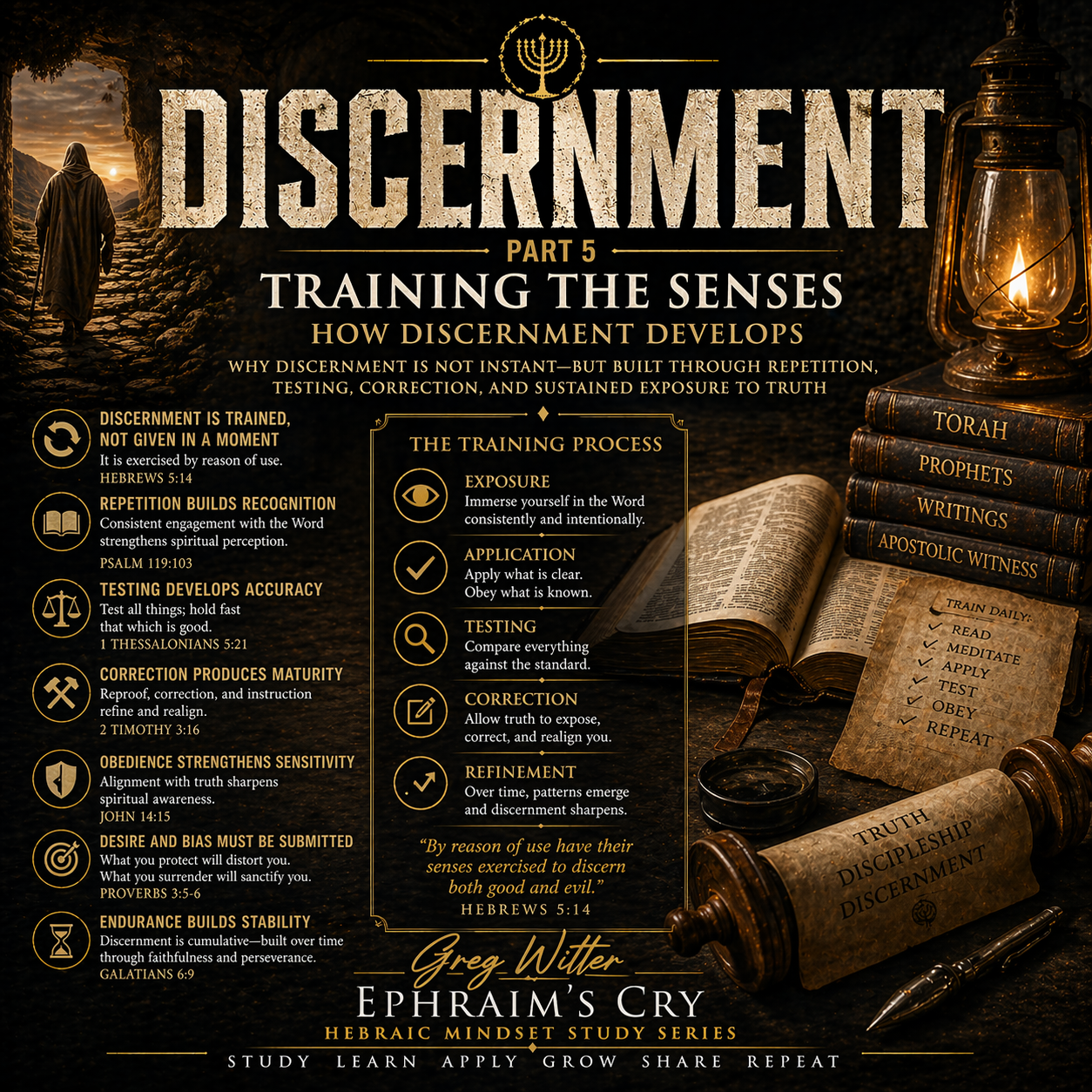
Discernment
Part 5: Training the Senses — How Discernment Develops
Why discernment is not instant—but built through repetition, testing, correction, and sustained exposure to truth
Greg Witter | Ephraim’s Cry
Hebraic Mindset Study Series
Study Learn Apply Grow Share Repeat

Discernment is not given in a moment. It is not activated by a single realization, nor is it unlocked by one teaching, one experience, or one encounter. If Part 4 established that obedience forms discernment, then Part 5 must press further: discernment is not only formed through obedience—it is trained through repeated, disciplined, covenant-aligned use. It is developed over time, through exposure, testing, correction, refinement, and endurance. It is not accidental. It is not automatic. It is the result of a process that cannot be bypassed.
This is where many misunderstand the nature of discernment.
They assume that once they understand truth, they will consistently recognize error.
But understanding is not the same as trained perception.
And untrained perception is unstable, inconsistent, and easily influenced.
This is why Scripture does not describe discernment as something simply received—but something exercised. “Strong meat belongs to them that are of full age, even those who by reason of use have their senses exercised to discern both good and evil” (Hebrews 5:14). The language is precise and deliberate. “Reason of use” means repetition, continued application, ongoing engagement. “Exercised” means trained, conditioned, developed under pressure, corrected through use, and refined over time.
Discernment is not static.
It is either being sharpened or dulled.
It is either increasing or decreasing.
There is no neutral state.
This must be understood at the beginning.
If a person is not actively training their discernment, it is not remaining the same—it is weakening. Because discernment depends on consistent engagement with truth. Remove that engagement, and sensitivity declines. Ignore the standard, and the ability to measure accurately begins to deteriorate.
This is no different than the body.
Muscles that are not used weaken.
Senses that are not engaged dull.
Judgment that is not exercised becomes unreliable.
The same is true spiritually.
Discernment must be exercised, or it will deteriorate.
This is why repetition is not optional—it is essential.
Not occasional exposure.
Not random study.
Not intermittent attention.
But repeated, structured, intentional engagement with the Word.
This is where training begins.
Every time a person encounters truth, they are presented with an opportunity to train their discernment.
They can align with it.
They can resist it.
They can ignore it.
Each response produces a different outcome.
Alignment sharpens discernment.
Resistance distorts it.
Neglect weakens it.
This means discernment is being shaped continuously—whether a person realizes it or not.
There is no pause in this process.
Every interaction with truth is training something.
Either accuracy—or distortion.
This is why casual engagement with Scripture does not produce mature discernment.
A person may read occasionally, listen periodically, and still remain untrained.
Because training requires consistency.
It requires structure.
It requires discipline.
And it requires correction.
This is another place where many resist.
They are willing to be exposed to truth.
But they are not willing to be corrected by it.
Yet correction is essential to training.
No discipline advances without correction.
No perception sharpens without refinement.
No judgment becomes accurate without being adjusted when it is wrong.
Scripture is not only given for doctrine—it is given “for reproof, for correction, for instruction in righteousness” (2 Timothy 3:16).
Reproof exposes error.
Correction realigns what is off.
Instruction establishes what is right.
All three must function together.
And without correction, discernment remains immature.
Because a person who is never corrected will assume they are always right.
And that assumption destroys discernment at its root.
This is why humility is required.
Not passive humility.
Active humility.
The willingness to be shown where you are wrong.
The willingness to abandon conclusions.
The willingness to be reshaped.
Without that, training stops.
Because training requires change.
This is also why discernment develops through testing.
Truth must be applied.
It must be compared.
It must be used to evaluate.
Not occasionally—but consistently.
“Test all things; hold fast that which is good” (1 Thessalonians 5:21).
Testing is not optional.
It is part of the training process.
Every teaching must be tested.
Every voice must be measured.
Every claim must be examined.
Not emotionally.
Not reactively.
But against the standard of the Word.
And this must be done repeatedly.
Because one correct judgment does not produce trained discernment.
Repeated correct judgments do.
This is how perception is rewired.
This is how instinct is retrained.
This is how reaction becomes governed by truth instead of impulse.
Over time, the mind begins to recognize patterns.
Through repeated exposure to truth, consistency becomes visible.
Through repeated testing, deviation becomes obvious.
Through repeated correction, error becomes easier to reject.
This is how discernment becomes precise.
Not through one moment.
But through many.
This is also where desire must be exposed again.
Because training does not occur in a neutral environment.
Desire is always present.
Bias is always present.
Preference is always present.
And during training, these either get corrected—or they take control.
If a person trains while protecting their desires, their discernment will be shaped around those desires.
If they train while submitting their desires, their discernment will be aligned with truth.
This is why two people can go through the same exposure and come out with different levels of discernment.
Because one allowed correction.
The other protected preference.
Training does not automatically produce accuracy.
It produces what is submitted to.
This is why the process must be honest.
Because if desire is hidden, discernment will be distorted.
This also brings in the element of endurance.
Discernment is not developed quickly.
It requires time.
Not passive time.
But engaged time.
Time under the Word.
Time in obedience.
Time in testing.
Time in correction.
Time in refinement.
This is why those who seek immediate clarity without long-term discipline remain unstable.
They want results without process.
They want precision without repetition.
They want maturity without endurance.
But discernment does not develop that way.
It is built over time.
Layer upon layer.
Decision upon decision.
Alignment upon alignment.
And this leads to a critical understanding:
Discernment is cumulative.
Every act of alignment adds to it.
Every correction refines it.
Every test sharpens it.
Every compromise weakens it.
Over time, it builds—or it deteriorates.
This is why mature discernment feels different.
It is not reactive.
It is not easily shaken.
It is not driven by impulse.
It is not dependent on external validation.
Because it has been built through repeated exposure, testing, correction, and obedience.
It has weight.
It has stability.
It has consistency.
This also exposes the danger of untrained discernment.
Untrained discernment is confident—but inaccurate.
It reacts quickly—but without depth.
It speaks boldly—but without alignment.
It feels certain—but has not been tested.
This is why many are easily influenced.
They have not trained their discernment through repeated testing.
So when something sounds convincing, they accept it.
When something feels right, they follow it.
When something is presented confidently, they trust it.
But trained discernment does not respond that way.
It slows down.
It tests.
It compares.
It evaluates.
It measures.
Because it has been trained to do so.
This is the difference between exposure and development.
Exposure introduces truth.
Development trains perception.
And without development, exposure alone produces instability.
This is also why discipline becomes non-negotiable.
Training requires commitment.
It requires returning to the Word consistently.
It requires applying what is learned.
It requires rejecting what does not align.
And it requires continuing—even when it is difficult.
Because discernment is not built in moments of convenience.
It is built in sustained pursuit.
This also leads to an unavoidable conclusion.
Training never stops.
There is no point where a person becomes beyond testing.
There is no level where correction is no longer needed.
There is no stage where discernment is fully complete.
It must continue.
Because the moment training stops, decline begins.
This is the reality.
Discernment is either increasing—or it is decreasing.
And that movement is determined daily.
This is where the weight must land.
Because discernment is no longer theoretical.
It is measurable.
It is observable.
It is revealed through consistency, testing, correction, endurance, and alignment.
And this leads to the next step.
Because once discernment is being trained, it must be structured.
It must be intentional.
It must be systematized.
So that training is not random—but directed.
That is where we move next.
Discernment is not instant—it is trained. What has been established here makes it clear that discernment develops through repeated exposure to truth, consistent testing, correction, and sustained alignment over time. It is not something you arrive at—it is something that is built through disciplined use. Without this process, perception remains untrained, inconsistent, and easily influenced. Many assume that understanding truth once will produce lasting clarity, but without repetition and correction, discernment does not stabilize—it fluctuates. This is why training is not optional. It is required if discernment is to become reliable. This is exactly why Ephraim’s Cry Academy exists: to provide a structured environment where discernment is not left to chance, but developed intentionally through repetition, testing, and correction within a covenant framework. If you are serious about moving beyond unstable perception and into discernment that is consistent, sharpened, and dependable, then you must commit to a process where your senses are trained over time—not just exposed to truth, but formed by it.
https://EphraimsCry.com/academy
Discernment — Part 6: How to Study — Building a Systematic Framework

#GregWitter, #EphraimsCry, #HebraicMindset, #Discernment, #BiblicalDiscernment, #TruthVsError, #SoundDoctrine,
#StudyTheWord, #TorahFoundation, #WholeCounselOfElohim, #ScriptureAlignment, #CovenantTruth, #SpiritualGrowth,
#Hebrews514, #TestAllThings, #1Thessalonians521, #2Timothy316, #SpiritualGrowth, #DisciplineMatters, #ConsistencyIsKey
