
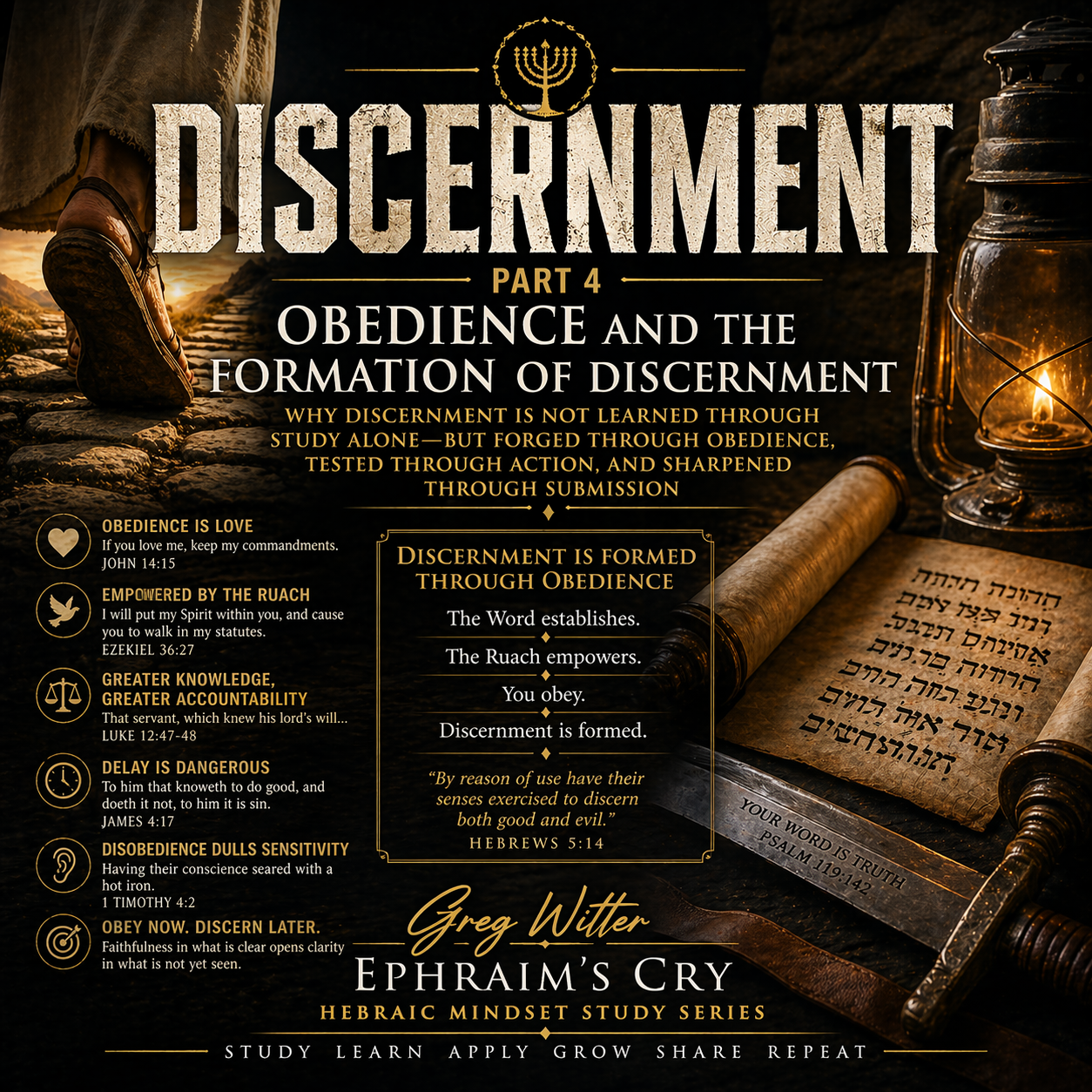
Discernment
Part 4: Obedience and the Formation of Discernment
Why discernment is not learned through study alone—but forged through obedience, tested through action, and sharpened through submission
Greg Witter | Ephraim’s Cry
Hebraic Mindset Study Series
Study Learn Apply Grow Share Repeat
Discernment is not formed in theory. It is not produced by exposure alone, nor is it developed through study detached from action. If Part 1 established what discernment is, Part 2 established the standard, and Part 3 corrected the mindset, then Part 4 must confront the reality that discernment is actually formedthrough obedience. Without obedience, everything that has been established up to this point remains incomplete, unstable, and ultimately ineffective. The standard may be correct, and the mindset may be shifting, but until the life aligns, discernment does not mature—it stalls, distorts, and eventually begins to decay.
This is where many stop progressing.
They define discernment correctly.
They acknowledge the Word as the standard.
They begin to adjust their thinking.
But they do not obey.
And without obedience, discernment does not develop—it hardens into assumption.
Because discernment is not something you arrive at through information.
It is something that is forged through alignment.
This is why Scripture consistently ties understanding, clarity, and discernment to obedience—not merely to knowledge. “If any man will do his will, he shall know of the doctrine…” (John 7:17). That order is not accidental. Knowing follows doing. Clarity follows submission. Discernment follows alignment. A person who refuses to act on what is already clear will not be given greater clarity in what is not yet fully understood. The pathway to discernment is not intellectual expansion—it is obedient response.
But this obedience must be understood correctly. It is not mechanical compliance. It is covenant loyalty. “If you love me, keep my commandments” (John 14:15). Obedience is the outward expression of inward allegiance to 𐤉𐤄𐤅𐤄 (Yahuah). It is not performance for approval; it is alignment with authority. It is not selective; it is comprehensive. It is not driven by convenience; it is driven by submission. Without this covenantal dimension, obedience becomes external behavior, and external behavior without submission does not produce discernment—it produces religious routine.
The modern approach reverses this structure.
It teaches:
- Understand fully before you obey
- Resolve every question before you act
- Agree intellectually before you align
But Scripture demands response before full comprehension. “You shall therefore keep my commandments, and do them… that you may understand” (Deuteronomy 4:1). Again, “A good understanding have all they that do his commandments” (Psalm 111:10). Not those who discuss them. Not those who debate them. Not those who build systems around them. Those who do them.
This establishes a non-negotiable principle:
Discernment is formed through obedience.
Because obedience places a person under the authority of the standard, and it is only under that authority that judgment becomes accurate. A person cannot correctly measure truth while resisting the truth they already see. Refusal in one area produces distortion in another. Resistance in one command weakens clarity in another. Over time, disobedience trains the mind to reinterpret what it refuses to follow.
This is how discernment is corrupted.
Not first through ignorance.
But through resistance.
When a person chooses not to obey what is already clear, they begin to adjust their interpretation to justify their decision. They soften what was direct. They redefine what was established. They isolate passages from their covenant context. They elevate alternate voices that agree with their position. They search for agreement rather than truth. In doing so, they begin to reshape the standard itself to match their behavior.
At that point, discernment is no longer functioning.
It has been replaced by self-preservation.
This is why obedience is not simply about behavior—it is about perception. It governs how clearly a person sees. It determines whether the Word remains the authority or becomes something to be negotiated. When obedience is present, the Word remains fixed and the individual adjusts. When obedience is absent, the individual remains fixed and the Word is adjusted. Only one of those produces discernment.
This also reveals why greater knowledge without obedience increases accountability rather than maturity. “That servant, which knew his lord’s will, and prepared not himself… shall be beaten with many stripes” (Luke 12:47). Knowledge does not excuse disobedience—it intensifies responsibility. The more a person knows and refuses to obey, the more their discernment is affected. Truth rejected does not remain neutral—it becomes the basis for distortion.
This is why obedience must be immediate where truth is clear.
Delayed obedience is often disguised rebellion.
Selective obedience is controlled obedience.
Partial obedience is compromised obedience.
All of these weaken discernment because they introduce inconsistency into the relationship between the individual and the standard. Discernment requires continuity of alignment. The moment obedience becomes conditional, discernment becomes unstable.
This is also where the role of the Ruach must be understood correctly. Discernment is not formed by human effort alone. “I will put my Spirit within you, and cause you to walk in my statutes” (Ezekiel 36:27). The Ruach does not replace obedience—He empowers it. The Word establishes the command. The Ruachenables the walk. The individual submits to both. This is the structure.
The Word establishes.
The Ruach empowers.
The individual obeys.
And discernment is formed.
Without submission to the Ruach, obedience becomes inconsistent and strained. Without obedience to the Word, spiritual claims become disconnected from truth. Both must operate together. The Ruach does not lead outside of the Word, and the Word is not lived apart from the Ruach. When both are aligned, discernment sharpens with precision.
This is why discernment is described as something that is trained. “Strong meat belongs to them that are of full age, even those who by reason of use have their senses exercised to discern both good and evil” (Hebrews 5:14). “Reason of use” implies repeated application. “Exercised” implies disciplined training. Discernment is not theoretical—it is developed through practice.
Every act of obedience sharpens clarity.
Every act of disobedience dulls it.
This dulling is not theoretical—it is experiential. Repeated disobedience numbs response to truth. Over time, sensitivity decreases. Conviction weakens. Distinction fades. This is how a conscience becomes seared (1 Timothy 4:2). What once would have been immediately rejected becomes tolerated, then normalized, then defended. This is not growth—it is desensitization.
And discernment cannot survive desensitization.
This is why even small acts of obedience matter. What you obey now prepares you to discern later. Faithfulness in what is clear opens clarity in what is not yet fully seen. If a person ignores what is obvious, they will not be given precision in what is complex. The training ground for discernment is not in advanced mysteries—it is in simple obedience.
This exposes why many remain in cycles of learning without growth.
They hear truth.
They agree with it.
They may even teach it.
But they do not consistently walk in it.
And because of that, their discernment remains limited.
They can identify obvious error.
But they fail to detect subtle distortion.
They can correct others.
But remain blind in themselves.
Because discernment is not sharpened by what you say.
It is sharpened by what you obey.
This also increases sensitivity. When a person walks in obedience, their awareness of misalignment increases. What once seemed acceptable begins to stand out. What once blended in becomes visible. What once passed unnoticed becomes clear. This is not because new information has been introduced—but because the individual has been brought into greater alignment with the standard.
Alignment produces clarity.
Misalignment produces distortion.
This is why even small compromises matter. One justified exception becomes a gateway for reinterpretation. One area of resistance opens the door for broader distortion. Over time, the line between what is clean and unclean begins to blur—not because the line moved, but because the individual stepped away from it.
This is where discernment begins to deteriorate.
And it happens gradually.
Quietly.
Through repeated decisions not to align.
This is why Scripture warns about the hardening of the heart. Because a hardened heart does not merely resist truth—it loses the ability to recognize it accurately. What was once clear becomes negotiable. What was once firm becomes flexible. What was once rejected becomes accepted.
This is not growth.
It is drift.
And discernment cannot survive drift.
It requires consistency, submission, and obedience in both visible and hidden areas.
This brings a necessary confrontation.
Many claim to want discernment, but they resist obedience.
They want clarity without submission.
They want to see truth without yielding to it.
They want to identify deception without allowing truth to correct them.
But this cannot happen.
Discernment is not given to the curious.
It is formed in the committed.
And commitment is revealed through obedience.
Not occasional obedience.
Not convenient obedience.
But consistent alignment with what has been established.
This is also where discernment becomes costly.
Because obedience will require a person to act against:
- personal preference
- established habit
- surrounding culture
- relational pressure
- inherited tradition
It will require choosing what is right over what is easy, what is established over what is familiar, what is true over what is accepted. And every time that choice is made, discernment is strengthened. Every time it is avoided, discernment is weakened.
This is the reality.
Discernment is not a switch.
It is a result.
It is formed over time through repeated submission to truth.
So the question becomes unavoidable.
What are you doing with what you already understand?
Because whatever you are not obeying is already affecting your discernment.
And whatever you are aligning with is sharpening it.
This is where the weight must land.
If you are not growing in discernment, the issue is not lack of teaching.
It is lack of obedience.
Discernment is not withheld.
It is formed.
And it is formed through alignment.
That alignment is revealed through obedience.
And that obedience determines what you will be able to see next.
Because obedience unlocks further clarity.
And disobedience limits it.
This is the process.
This is the formation.
This is the dividing line.
And until this is embraced, everything else remains incomplete.
But once it is embraced, discernment begins to move from concept to reality.
From idea to function.
From knowledge to precision.
That is where we move next.
Discernment is not formed by knowing—it is formed by obeying. What has been established here makes it clear that without alignment in action, everything else remains incomplete. You can define discernment correctly, you can acknowledge the standard, and you can begin to adjust your mindset—but if you do not obey what is already clear, discernment will not develop. It will stall, distort, and eventually begin to weaken. This is where many stop, not because they lack access to truth, but because they resist the cost of aligning with it. Obedience is not optional at this level—it is the pathway through which clarity increases and perception sharpens. This is exactly why Ephraim’s Cry Academy exists: to move beyond information into disciplined, consistent alignment with the Word, where discernment is not assumed but forged through obedience over time. If you are serious about developing discernment that is stable, accurate, and not easily shaken, then you must commit to a process where what you know is brought into full alignment with how you live.
https://EphraimsCry.com/academy
Discernment — Part 5: Training the Senses — How Discernment Develops

#GregWitter, #EphraimsCry, #HebraicMindset, #Discernment, #BiblicalDiscernment, #TruthVsError, #SoundDoctrine,
#StudyTheWord, #TorahFoundation, #WholeCounselOfElohim, #ScriptureAlignment, #CovenantTruth,
#SpiritualGrowth, #Hebrews514, #John717, #Psalm11110, #Luke1247, #Ezekiel3627, #1Timothy42
#ObedienceMatters, #TruthOverTradition
