
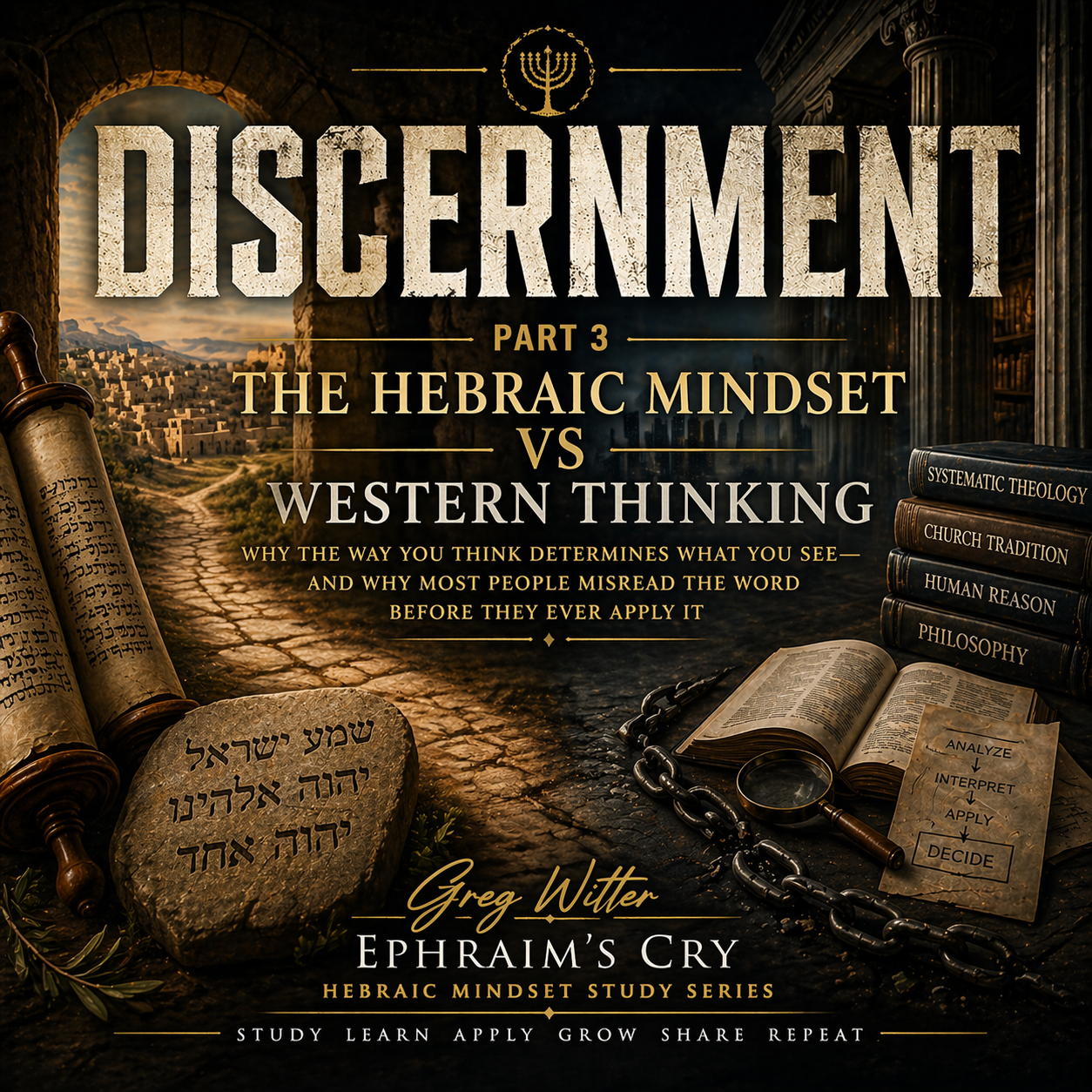
Discernment
Part 3: The Hebraic Mindset vs Western Thinking
Why the way you think determines what you see—and why most people misread the Word before they ever apply it
Greg Witter | Ephraim’s Cry
Hebraic Mindset Study Series
Study Learn Apply Grow Share Repeat

Discernment does not begin with information. It begins with how that information is received, processed, and submitted to. If Part 2 established that the Word is the standard, then Part 3 must confront the unavoidable reality that even with the correct standard in hand, a person can still misread, misapply, distort, and misjudge if their mindset is not aligned with how the Word was given. The failure is not always in the text. The failure is in the lens.
This is where the breakdown becomes severe.
Most people approach Scripture through a Western, Greek-influenced mindset that prioritizes abstraction, detachment, categorization, philosophical reasoning, and intellectual autonomy over covenantal alignment, obedience, continuity, and lived submission. They treat the Word as a text to be studied rather than a covenant to be entered, guarded, and lived. They separate belief from behavior. They prioritize interpretation over obedience. They dissect rather than align. They analyze rather than submit.
And then they wonder why their discernment fails.
Because discernment is not formed in a detached mindset. It is formed in a covenantal one.
The Hebraic mindset, which is the framework in which the Word was given, is not abstract, theoretical, or detached from life. It is concrete, action-oriented, relational, covenant-bound, and submission-driven. It does not ask first, “What does this mean to me?” It asks, “What has 𐤉𐤄𐤅𐤄 (Yahuah) established, and how do I walk in it?” It does not separate knowing from doing. It binds them together as one reality. To know is to do. To hear is to obey. To understand is to align.
This is why Scripture repeatedly ties understanding to obedience, not to intellectual agreement. “You shall therefore keep my commandments, and do them… that you may understand” (Deuteronomy 4:1). Again, “The fear of 𐤉𐤄𐤅𐤄 is the beginning of wisdom: a good understanding have all they that do his commandments” (Psalm 111:10). Understanding is not granted to the one who merely reads, studies, or debates. It is given to the one who aligns.
The Western mindset reverses this order.
It says:
- Understand first, then decide whether to obey
- Analyze first, then determine application
- Interpret first, then consider submission
- Agree intellectually, then choose behavior
But Scripture establishes the opposite pattern:
- Submit first, then understanding follows
- Obey what is clear, then clarity increases
- Align with what is established, then discernment develops
“If any man will do his will, he shall know of the doctrine…” (John 7:17).
The condition is not intellectual comprehension.
The condition is willingness to obey.
This is where discernment begins to sharpen or collapse.
Because if your mindset separates knowledge from obedience, you will accumulate information without gaining clarity. You will know more, but see less. You will quote more, but understand less. You will analyze more, but discern less. You will develop confidence without accuracy. You will build systems without alignment.
And this is exactly what has happened across much of modern teaching.
Scripture has been turned into a subject of study rather than a governing authority of life.
This produces a specific and dangerous kind of blindness.
A person may know passages, frameworks, doctrines, languages, historical contexts, and theological systems, yet still fail to discern because they are operating within the wrong framework. They are asking the wrong questions. They are prioritizing the wrong processes. They are filtering everything through a mindset that was never designed to carry the weight of covenant truth.
The Hebraic mindset does not approach Scripture as disconnected categories or independent concepts. It sees continuity, pattern, covenant flow, and structural unity. It recognizes that what is established in the beginning governs what follows. It does not isolate the Apostolic writings from Torah. It does not create divisions between what 𐤉𐤄𐤅𐤄 (Yahuah) has already unified. It does not treat later revelation as contradiction—it treats it as confirmation and fulfillment within the same covenant framework.
This is why starting point matters more than most people realize.
If you begin in the middle of the text, you will misinterpret the beginning.
If you begin with inherited doctrine, you will force the text to conform to it.
If you begin with Western categories, you will read the Word through lenses that distort its meaning.
This is why so many read Scripture and arrive at conclusions that contradict other parts of Scripture.
The issue is not the Word.
The issue is the lens.
A Western mindset often seeks abstract definitions, philosophical categories, and conceptual frameworks. It wants to define truth as an idea. The Hebraic mindset defines truth as something lived, embodied, and demonstrated. “Your righteousness is an everlasting righteousness, and your law is the truth” (Psalm 119:142).
Truth is not merely something to be believed.
It is something to be walked.
This is why discernment cannot develop properly in a mindset that divorces belief from behavior. If you think rightly but live wrongly, your perception will eventually follow your behavior. Disobedience reshapes thinking. Compromise alters judgment. Repeated misalignment trains the mind to normalize what should have been rejected. Over time, what once appeared clear becomes blurred—not because the truth changed, but because the lens became corrupted.
This is why the Hebraic mindset guards against separation between hearing and doing. “Be doers of the word, and not hearers only, deceiving your own selves” (James 1:22). The deception is internal before it is external. A person hears truth, agrees with it intellectually, but does not align with it in practice. Over time, that gap produces distortion. They begin to reinterpret the Word to match their behavior rather than adjusting their behavior to match the Word.
This is how discernment is lost.
Not suddenly.
But progressively.
Through repeated misalignment.
Through selective obedience.
Through allowing mindset to override standard.
The Western approach often seeks to master the text.
The Hebraic approach submits to it.
This difference determines everything.
Because if you approach Scripture as something to master, you will position yourself above it.
If you approach it as something to submit to, you will position yourself under it.
And only one of those positions produces discernment.
This also affects how patterns are recognized.
The Hebraic mindset sees repetition, cycles, covenant patterns, and structural consistency throughout Scripture. It understands that what happened before reveals what will happen again. It sees the pattern: command, warning, rebellion, judgment, mercy, restoration. It sees types and shadows. It sees that Elohim does not change His method to accommodate man’s preference.
The Western mindset isolates events and treats them as independent.
It disconnects what should be connected.
And when patterns are not recognized, discernment weakens.
Because discernment is not only about identifying what is right and wrong—it is about recognizing what is consistent and what is out of pattern.
This becomes critical when testing teachings, movements, and claims.
If you do not recognize covenant patterns, you will be vulnerable to anything that sounds new, refined, progressive, or appealing—even if it contradicts what has already been established.
Because you are not comparing it to the pattern.
You are evaluating it in isolation.
And isolation is where deception thrives.
So the issue is not just whether you have the Word.
It is whether you are thinking in alignment with how the Word was given.
Because if your mindset is misaligned, your discernment will be misaligned—even if you are holding the correct standard.
This leads to a necessary and unavoidable confrontation.
Many believe they are discerning when they are actually filtering everything through a Western framework that prioritizes personal interpretation, intellectual autonomy, emotional validation, and system-driven theology over covenant alignment.
They believe they are evaluating truth.
But in reality, they are filtering truth through a lens that reshapes it.
And once the lens reshapes the standard, discernment collapses.
Because you cannot produce correct judgment from a corrupted framework.
This is why transformation of thinking is not optional—it is required.
“Be not conformed to this world: but be transformed by the renewing of your mind…” (Romans 12:2).
This is not about gaining more information.
It is about restructuring how you process truth.
It is about tearing down the existing framework and replacing it with one that aligns with how 𐤉𐤄𐤅𐤄 (Yahuah) has revealed Himself.
It is about shifting from:
- detached analysis → covenant alignment
- intellectual priority → obedience priority
- fragmented reading → unified continuity
- self-centered interpretation → Word-governed submission
Until that shift happens, discernment will remain partial, unstable, and easily manipulated.
Because the lens will continue to distort what the standard is trying to reveal.
This is the dividing line.
If the Word is the standard (Part 2), then the mindset must align with how that standard is understood and applied.
Otherwise, the standard will be misused.
And misused truth becomes one of the most powerful tools of deception.
This is why many can quote Scripture and still be wrong.
Not because the Word failed.
But because the mindset interpreting it is misaligned.
So the question becomes direct.
Are you approaching the Word to understand it?
Or to submit to it?
Are you reading to confirm what you already believe?
Or to be corrected?
Are you analyzing the text?
Or allowing the text to govern you?
Because discernment is not formed in the one who studies alone.
It is formed in the one who aligns.
And that alignment begins in the mind—but it does not end there. It moves into action, into obedience, into correction, into consistency, into covenant living.
Until that transformation occurs, discernment will always be limited.
But once it begins, everything changes.
Because now the standard is clear.
And the lens is being corrected.
And when those two come together, discernment begins to function with precision.
That is where we move next.
Discernment cannot function correctly if the mindset itself is misaligned. If the way you think has been shaped by tradition, assumption, or incomplete understanding, then even with the right standard in front of you, your interpretation will continue to be distorted. This is why discernment is not just about what you read—it is about how you process what you read. A Hebraic, covenant-centered mindset is not optional at this level; it is required for the Word to be understood in its proper order and authority. What has been exposed here is not simply information—it is a call to realignment. And realignment does not happen passively. It requires structured learning, correction, and consistent retraining of thought. This is exactly why Ephraim’s Cry Academy exists: to walk through this transformation deliberately, so that your thinking is rebuilt on a foundation that can actually support discernment. If you are serious about seeing clearly and no longer interpreting Scripture through inherited frameworks, then you must commit to a process that reshapes how you think at its core.
https://EphraimsCry.com/academy
Discernment — Part 4: Obedience and the Formation of Discernment
#GregWitter, #EphraimsCry, #HebraicMindset, #Discernment, #BiblicalDiscernment, #TruthVsError,
#SoundDoctrine, #StudyTheWord, #TorahFoundation, #WholeCounselOfElohim, #ScriptureAlignment,
#CovenantTruth, #SpiritualGrowth, #RenewYourMind, #Romans122, #Psalm11110, #John717, #James122,
#ObedienceMatters, #TruthOverTradition
